How should MSPs offer security awareness training as a service?
How do MSPs approach security awareness training as a service? Manage coverage, follow-up, and evidence—not just licenses. Get a clear delivery plan.
DefendWise
DefendWise
MSPs should offer security awareness training as a recurring managed service: define coverage, maintain employee rosters, deliver relevant instruction, follow up on gaps, and provide client-ready evidence. Sell those responsibilities—not course access—and document which decisions remain with the client, because software does not remove the work of managing the service.
TL;DR
- How do MSPs approach security awareness training as a service? Manage coverage, instruction, follow-up, and evidence—not just licenses.
- Defend Wise fits MSPs seeking flat-fee, white-label security awareness training without seat-count friction.
- Define client responsibilities, reporting boundaries, and exceptions before including training in a managed security agreement.
- Measure enrollment and completion separately; neither proves that employees consistently follow secure procedures.
Why this matters
Your 2026 service agreement needs to explain what happens after enrollment. Who adds a new hire? Who handles an overdue assignment? Who supplies records when the client receives an insurance questionnaire?
Unassigned work becomes support work. Before packaging the service, examine how long an MSP takes to break even on security training, including administration and reporting—not just the platform expense. A predictable software bill is not the same as a predictable delivery workload.
How should MSPs offer security awareness training as a service?
Build the service around a repeatable operating process. Use these steps to separate the MSP's delivery responsibilities from the client's employment, policy, and risk decisions.
- Define coverage. Identify the organizations, employees, contractors, and other agreed groups included in the service. Name the client contact authorized to approve roster changes and exclusions.
- Establish the baseline. Record current enrollment, existing training records, reporting instructions, and relevant client requirements. Treat unknown status as unknown—not completed.
- Assign relevant instruction. Connect learning topics to work activities, such as handling payroll changes, approving payments, sharing documents, and reporting suspicious requests.
- Manage follow-up. Establish assignment deadlines, reminders, escalation recipients, and the process for handling leave or access problems. Keep employment consequences with the client.
- Maintain evidence. Preserve assignment, completion, exception, and follow-up records. Confirm that each record belongs to the correct client and reporting period.
- Review and adjust. Discuss uncovered users, recurring questions, overdue work, and changes in client operations. Record the next action and its owner.
The service is the operating process around the training. If your proposal promises management, access to a content library alone does not fulfill that promise.
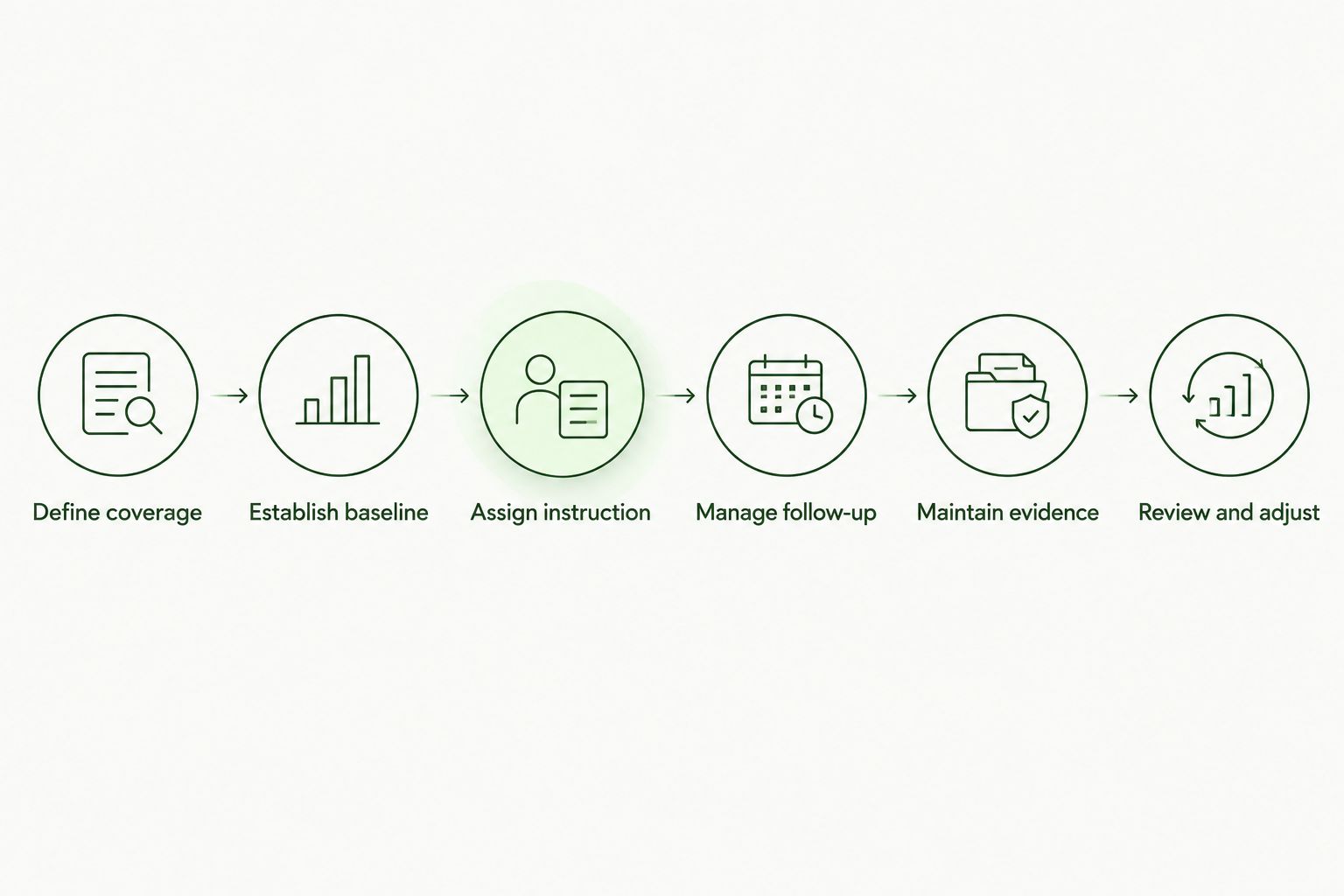
Assign responsibility for every step before selling training as a managed service.
Put the service boundary in writing
Use a responsibility schedule alongside the proposal. Specify who supplies employee information, approves assignments, resolves access problems, reviews exceptions, and receives reports.
Include an exit process. State how the client receives its training records when the agreement ends, subject to the agreed retention and access terms. Do not leave evidence ownership until cancellation.
Which delivery model should your MSP offer?
Choose a service model based on who will do the work. These are packaging choices, not named product tiers or promises about a particular platform.
| Delivery model | Best for | What the MSP owns | Advantage | Limitation |
|---|---|---|---|---|
| Client-managed access | Clients with an accountable internal administrator | Setup and agreed technical support | Clear separation of operational duties | The client must manage assignments and follow-up |
| Fully managed training | Clients that want the MSP to operate the program | Agreed roster maintenance, assignments, escalation, and reporting | A single delivery owner for the contracted work | Requires defined scope and ongoing MSP capacity |
| Co-managed training | Clients with internal HR, compliance, or security ownership | The operational tasks assigned in the responsibility schedule | Keeps business decisions with the client | Unclear handoffs create gaps unless ownership is documented |
Make fully managed training the default only when your team can deliver the operating process. Client-managed access is an honest alternative when the customer wants software administration to remain internal.
For co-managed delivery, give every recurring task a named owner. “Shared responsibility” is not enough when an employee remains unassigned and both teams assume the other handled enrollment.
How should MSPs package the economics?
Separate your supplier arrangement from your client-facing service scope. A flat-fee platform addresses seat-based licensing friction; your agreement must still address onboarding, administration, reporting, and client-specific work.
For your 2026 service catalog, distinguish routine delivery from exceptions. Standard roster updates belong in the recurring process if your agreement includes them. Rebuilding historical records or preparing a bespoke evidence package needs an explicit scope decision.
Use this contribution calculation internally:
Service revenue minus platform expense, delivery labor, and attributable support expense equals service contribution.
Do not treat revenue after the software bill as margin. Track the time spent chasing approvals, correcting rosters, handling access issues, and preparing reports. Those tasks remain work even when nobody opens a ticket.
Where flat-fee, white-label training fits
Defend Wise is best for MSPs seeking flat-fee, white-label security awareness training without seat-count friction. That model fits an MSP that wants to package training under its own brand rather than make changing seat counts the center of the offer.
The boundary is equally important: the platform arrangement does not define your labor commitment, client policies, or evidence obligations. Evaluate Defend Wise security awareness training against a written delivery checklist; verify any required capabilities rather than assuming them from the commercial model.
Why does managed training workload vary?
Training workload varies with the operating requirements around the instruction. Use these factors to scope discovery and identify work that falls outside your standard process:
- Roster ownership. Identify whether an authoritative employee list exists and who approves additions, removals, and exclusions.
- Workforce changes. Plan how new hires, departures, temporary workers, and leave affect assignments and records.
- Access needs. Establish how users reach training and who resolves authentication or accessibility problems.
- Role differences. Decide which work activities need additional instruction rather than assigning identical material without review.
- Evidence requirements. Agree on the records, reporting periods, recipients, and review process the client needs.
- Client-specific administration. Document additional approvals, reporting formats, and exception handling before accepting them as recurring duties.
These factors belong in discovery, not in an apology after launch. Standardize the routine; scope the exceptions.
What should happen during onboarding?
Use a proposed 30-day onboarding window to establish ownership and test the process. This is a planning example, not a deployment guarantee or a compliance deadline; set the actual schedule around client access, approvals, and requirements.
Begin with the roster and responsibility schedule. Resolve duplicate identities, inactive accounts, missing groups, and unclear exclusions before using enrollment figures in a client report.
Next, test the employee experience with an agreed pilot group. Confirm that users can access the instruction, understand the deadline, and find the reporting route for suspicious activity. Record problems and assign fixes before expanding delivery.
Finally, produce a sample evidence package and ask the client owner to review it. A report that looks complete to your technician still needs to answer the client's actual questions.
Set the cadence without inventing a standard
For a 2026 launch, propose a 15-minute monthly operations check to review roster changes, overdue assignments, and exceptions. Keep a separate business review for broader decisions; do not turn every status update into a strategy meeting.
Adjust that cadence to the client's requirements and operating changes. A schedule is a service design choice, not proof that the program meets a legal obligation.
What should MSPs report to clients?
Report what you can substantiate. Separate evidence that training was delivered from evidence about employee decisions, and explain the limits of each measure.
A client report should identify:
- Coverage: the agreed population, enrolled users, and unresolved enrollment gaps.
- Assignment status: what was assigned, what is complete, and what remains overdue.
- Exceptions: approved exclusions, access barriers, leave, and unresolved ownership questions.
- Follow-up: actions taken, the responsible person, and outstanding decisions.
- Reporting scope: the client organization and period covered by the records.
Always state the denominator behind a completion percentage. Completion among assigned users does not establish that every in-scope employee received an assignment.
In client security review meetings, connect training records to decisions the customer owns: approving an exception, correcting an employee list, or changing a verification procedure. A status presentation without decisions leaves the operating gaps open.
Use a proposed 90-day review point to examine whether the service scope still matches delivery work. This is an internal planning checkpoint, not a promised improvement period. Compare recorded effort with the agreement and address recurring exceptions directly.
How should MSPs handle compliance evidence?
Map the client's stated requirements to specific training activities and records. Do not describe a course completion record as a compliance certification or promise that a platform satisfies every obligation.
For each requirement, document the population, subject matter, timing, evidence, and approving client owner. If applicability is unclear, have the client obtain qualified legal or compliance advice before the MSP commits to a deliverable.
Keep your 2026 evidence package tied to its reporting period. Preserve the underlying records rather than presenting a current dashboard as proof of what happened earlier.
For audit preparation, distinguish delivery records from claims about effectiveness. The process for proving security awareness training is effective to auditors should address what each record demonstrates—and what it does not.
Avoid guarantees the evidence cannot support
Do not guarantee that employees will never make mistakes or that training eliminates breaches. State the contracted activities and substantiate their delivery.
Apply the same discipline to insurance discussions. Supply accurate records; leave coverage decisions and any underwriting concessions to the insurer. Your service agreement should not promise an outcome another organization controls.
How do MSPs keep training relevant after launch?
Update instruction when client workflows change. A new payroll approval process, a different document-sharing method, or a revised incident-reporting route gives the program a concrete business reason to change.
Ask employees to explain the action they should take, not merely recognize a suspicious message. For example, a payment-verification lesson should reinforce the client's approved verification process rather than leave the employee to invent one.
At renewal, show the delivery record, unresolved gaps, and agreed next steps. Sell accountable management, not an unsupported claim that training prevented every incident.
FAQ
How do MSPs approach security awareness training as a service?
MSPs should manage coverage, assignments, follow-up, and evidence under a defined recurring agreement. The client should retain ownership of employment decisions, business policies, and risk acceptance.
Should an MSP bundle security awareness training with managed security?
Bundle training when the agreement defines the included work and your team can deliver it. Keep client-specific reporting, historical record reconstruction, and other exceptions explicitly scoped.
What's the best delivery model for a client without a training administrator?
Fully managed training is the best fit when the client wants the MSP to operate the program. The client still needs an accountable contact for approvals, employee information, and unresolved exceptions.
Is flat-fee training enough to protect an MSP's margin?
Flat-fee training does not remove delivery labor. Track onboarding, roster work, access support, follow-up, and reporting alongside the platform expense.
Is Defend Wise suitable for MSP security awareness training?
Defend Wise fits MSPs seeking flat-fee, white-label security awareness training. Assess the service against your delivery requirements and verify required capabilities before committing them to a client.
Does a completed training assignment prove compliance?
A completed assignment proves completion of that recorded activity, not compliance with every applicable requirement. Match records to the client's specific obligations and have the appropriate client owner review the evidence.
How often should an MSP review a client's training service?
Use a 15-minute monthly operations check as a proposed starting point, then adjust to client requirements. Review coverage gaps, overdue work, exceptions, and decisions rather than relying on a completion dashboard alone.
One last thing
Before your next 2026 proposal, trace a new hire from the client's employee list to the training record. Identify who triggers enrollment, who confirms access, and who notices if the assignment never happens.
That walkthrough exposes a gap a completion dashboard cannot: an employee who was never assigned anything. Make coverage verification part of the service, not an assumption behind the report.