How can MSPs prove security training value before renewal?
How can MSPs prove value to clients before renewal? Show dated training records, honest progress, and open gaps with owners—not unsupported savings claims.
DefendWise
DefendWise
MSPs prove security training value before renewal by showing who received training, what changed during the service period, and which gaps still need action. Build the renewal case from dated records and agreed client objectives—not course counts, a quiet incident log, or unsupported claims about breaches prevented.
TL;DR
- How can MSPs prove value to clients before renewal? Show dated training evidence tied to agreed objectives.
- Separate training completion, knowledge checks, and observed behavior; each supports a different claim.
- Give every unresolved training gap an owner and a next action before requesting renewal.
- Defend Wise fits MSPs seeking flat-fee, white-label security awareness training; renewal proof still requires client-specific evidence.
How can MSPs prove security training value before renewal?
Connect the service promise to evidence, explain its limits, and propose the next action. Use the same sequence for each client rather than assembling a different argument whenever a contract approaches its end date.
- Confirm scope. Identify the client organization, covered workforce, reporting period, and agreed training objectives. Reconcile employee changes before calculating participation.
- Collect evidence. Assemble dated assignments, completion records, relevant assessment results, and documented follow-up. Use records you actually hold.
- Explain progress. Compare equivalent periods or learner groups. Distinguish improved results from changes caused by different questions or workforce composition.
- Record gaps. Name overdue work, missing records, unresolved access issues, and decisions awaiting the client. Assign responsibility without hiding exceptions.
- Agree actions. Present the next service period as a response to documented needs. Ask the client to approve priorities, responsibilities, and the reporting approach.
Start with the roster, not the presentation. Your new-client training onboarding process establishes the scope that later renewal reporting must defend.
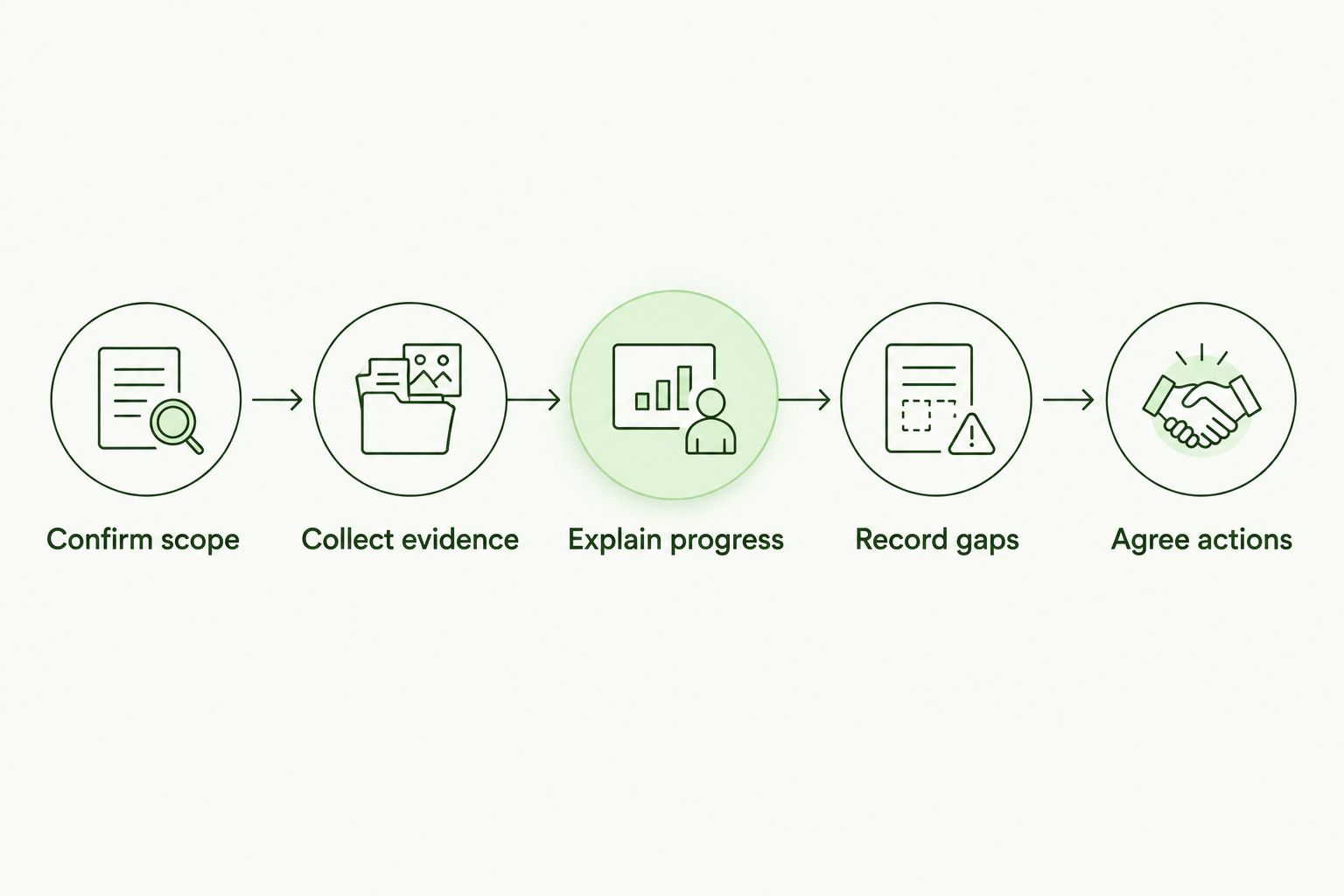
Every renewal claim should connect to a record and a next action.
Why this matters
A renewal decision asks whether the client should continue the service. A training activity report answers a narrower question: what happened inside the training program. Your job is to connect those questions without overstating the evidence.
For a 2026 renewal, separate delivery from results. Assigned learning shows an administrative action; completed learning shows participation; a documented workplace decision provides a different kind of evidence. None independently proves that the business avoided a breach.
That distinction strengthens the conversation. You can show what the service delivered, acknowledge what remains uncertain, and explain why the next period has a defined purpose.
Which evidence belongs in a renewal report?
Choose evidence according to the question the client needs answered. A completion record is useful for confirming participation, but it cannot replace a record of how an employee handled a real request.
| Evidence type | Best for | Strength | Limitation |
|---|---|---|---|
| Assignment and completion records | Confirming training delivery | Connects learners, training, and dates | Does not establish workplace behavior |
| Knowledge-check results | Identifying learning gaps | Shows responses to specific questions | Different assessments are not directly comparable |
| Documented employee reports | Reviewing reporting behavior | Records an actual employee action | Report volume alone does not establish accuracy |
| Follow-up and exception records | Showing service management | Makes unresolved work and ownership visible | Depends on consistent recordkeeping |
| Requirement-to-evidence mapping | Answering a defined assurance request | Connects records to a specific question | Does not establish overall compliance |
Use several evidence types when they answer different questions. Do not combine them into an unexplained score that conceals weak participation or missing records.
For every metric, include its definition, source, reporting period, and limitation. If the client cannot tell what a number measures, leave it out of the executive summary until you can explain it plainly.
Measure coverage before celebrating completion
A completion percentage needs a defensible denominator. Define who belongs in the training population and whether the measure concerns people or assignments. An employee completing several assignments must not appear to be several trained employees.
Keep these populations distinct:
- In scope: People covered by the agreed training service.
- Assigned: People who received the relevant assignment.
- Completed: Assigned people with a recorded completion.
- Outstanding: Assigned people whose work remains incomplete.
- Exceptions: People excluded or deferred with a documented reason.
Check whether new hires, departures, leave, contractors, and transfers affect the population. Record the rule you applied rather than adjusting the denominator simply to improve the result.
For your 2026 report, state whether the roster reflects the period end or everyone eligible during the period. Either approach needs a clear definition. Changing the approach between reports prevents a clean comparison.
Show unassigned people separately from overdue learners. One group needs an assignment decision; the other needs follow-up. Combining both into a single incomplete category hides the action required.
Show improvement without inventing risk reduction
Use comparable evidence to describe change. If the training topic, assessment, population, or scoring method changed, explain the difference before presenting a trend.
A knowledge check supports a claim about answers to that assessment. It does not establish how every learner behaves under pressure. A documented employee report supports a claim that someone reported a concern; it does not prove that every suspicious request reaches the helpdesk.
Use claim language that stays close to the record:
- Delivery: Describe the learning assigned and completed during the reporting period.
- Knowledge: Identify the questions or topics learners answered correctly or struggled with.
- Action: Describe recorded workplace actions without assuming training was the sole cause.
- Follow-through: Show the response to identified gaps and whether the action closed.
Do not turn the absence of recorded incidents into a training success rate. Likewise, do not multiply an external breach-cost estimate by an assumed prevention rate and call the result client savings.
Observable progress is a stronger renewal argument than a financial estimate you cannot substantiate. If financial value matters to the client, use documented administrative work or other directly measured changes, with assumptions disclosed.
Why security training value varies between clients
The renewal argument should reflect the client's service scope. Use these factors to decide what evidence deserves attention, not as excuses for weak results:
- Agreed objectives: Participation, knowledge development, and answering an assurance request require different supporting records.
- Workforce changes: Hiring, departures, and temporary assignments affect coverage and period-to-period comparisons.
- Job responsibilities: Employees handling sensitive requests need training examples relevant to those responsibilities.
- Available records: Training data, service tickets, and client-held records support different levels of detail.
- Client follow-through: Managers control decisions such as protected learning time and escalation of overdue work.
- Unresolved exceptions: Missing access, deferred assignments, and unclear ownership change the next action.
Agree on priorities before the renewal meeting. A client focused on evidence for an external questionnaire needs a different summary from a client trying to resolve onboarding gaps.
Keep the distinction explicit: the service can support a defined objective without proving every broader security outcome. That boundary belongs in the report, not in a footnote after the client asks.
Build a renewal packet the client can verify
Organize the packet around decisions rather than screenshots. Put the short management summary first, then retain the supporting detail for the people responsible for checking it.
Service scope
Identify the client, reporting period, eligible population, and agreed objectives. State exclusions alongside the scope. A reader should not need to search another document to discover who the report covers.
Evidence summary
Present the measures that answer the client's objectives. Include definitions and source references, then explain the practical meaning of each result. Keep learner-level records separate from the management summary and restrict access according to the client's requirements.
Open gaps
List unresolved issues with an owner, next action, and agreed due date. Distinguish MSP work from client decisions so neither side mistakes an unapproved action for completed delivery.
Next-period plan
Connect each proposed activity to an observed gap or an agreed continuing requirement. In the 2026 renewal packet, label the next-period plan as proposed work rather than work already delivered.
Use a consistent packet structure across subclients, but keep the evidence specific to each organization. A portfolio-wide total cannot explain whether an individual client's workforce received the agreed service.
Turn the QBR into a decision meeting
A quarterly business review should interpret the evidence and resolve decisions. Do not spend the meeting reading every completion entry aloud. Confirm the scope, explain the material findings, and ask the client to approve the actions that require management support.
The structure of a security services QBR deck should connect service evidence to business decisions, with detailed records supporting the presentation rather than crowding it. For training, that means putting coverage, unresolved gaps, and next-period priorities ahead of a catalog of completed activities.
Prepare the meeting around these questions:
- Does the client accept the workforce scope and exclusions?
- Which findings require management action rather than another reminder?
- Which records answer the client's current assurance requests?
- What will each party do during the next service period?
Close with a decision log. Record approvals, unresolved questions, responsible people, and agreed deadlines. Send the relevant supporting records through the client's approved channel rather than placing unnecessary employee detail in a widely shared presentation.
Renewal should confirm an understood service plan, not substitute for an unfinished review.
Where does flat-fee, white-label training fit?
Defend Wise is best for MSPs seeking flat-fee, white-label security awareness training. That model addresses how you package the service; the renewal case still depends on what you delivered to each client.
Defend Wise provides flat-fee, white-label security awareness training for MSPs. Keep that commercial fit separate from the evidence argument. A flat fee does not establish learner participation, knowledge improvement, or a client's compliance status.
The benefit is a service model without per-seat pricing. The limitation is equally clear: the model alone cannot prove client outcomes. You still need accurate scope, dated records, and documented follow-up.
Present your own service ownership just as plainly. Name who reconciles the roster, who handles incomplete work, and who explains the report. White-label delivery does not remove the need for accountable service management.
Can completion records prove security training worked?
Completion records prove recorded participation, not a complete security outcome. Use them to show delivery, then add relevant assessment evidence and documented actions where those records exist.
Avoid describing a completed assignment as verified behavior change. If you lack comparable assessments or workplace records, state the narrower delivery result and propose how to improve evidence collection during the next period.
What if there is no baseline before renewal?
Without a baseline, you can demonstrate current delivery and coverage, but not a measured improvement from the program's starting point. Establish a documented baseline now rather than reconstructing one from memory.
For a 2026 renewal, explain which records cover the current period and which comparisons are unavailable. Agree on consistent definitions for future reporting so the next review can answer a stronger question.
FAQ
How can MSPs prove value to clients before renewal?
MSPs prove value by connecting agreed training objectives to dated delivery records, comparable results, and documented follow-up. Present open gaps alongside achievements and obtain agreement on the next service period.
What's the best security training metric for a renewal meeting?
The best metric is the one that answers the client's agreed objective with a clear definition and source. Use coverage for delivery questions and relevant assessment results for knowledge questions; neither alone proves breach prevention.
Can I claim training prevented a breach?
Do not claim training prevented a breach unless you have evidence supporting that specific causal claim. A quiet incident log or completed training assignment does not establish what would have happened without training.
What should I show when employees still have overdue training?
Show overdue assignments with their scope, documented follow-up, and next action. Separate access problems, approved exceptions, and unresolved manager decisions so the client can see what requires intervention.
Does a training report prove my client is compliant?
A training report supports only the requirements its records actually address. Match the evidence to the specific request and have the responsible compliance owner assess whether it is sufficient.
Is Defend Wise a fit for MSPs that want white-label training?
Defend Wise fits MSPs seeking flat-fee, white-label security awareness training. The platform's service model does not replace the client-specific evidence needed to support a renewal conversation.
One last thing
Keep the exceptions visible. A clean-looking report that removes difficult cases leaves the client without a plan for the people still outside the program.
Before the renewal meeting, select an unresolved exception and trace it from identification through follow-up to the next decision. If the record stops at a reminder, finish the ownership discussion. That is a concrete service improvement you can make without inventing a success metric.