How long until an MSP breaks even on security training?
MSP breakeven security awareness training service: recover setup and delivery costs, not just software fees. Calculate payback from revenue and cash flow.
DefendWise
DefendWise
An MSP breaks even on security awareness training when collected service revenue covers the platform, onboarding, ongoing delivery, and overhead assigned to the service. There is no universal payback period: your timing depends on your setup investment and the contribution left after recurring costs. For a 2026 launch, calculate monthly operating breakeven separately from recovering the money spent getting the service live.
TL;DR
- MSP breakeven security awareness training service planning needs separate calculations for recurring coverage and startup payback.
- Defend Wise offers flat-fee, white-label security awareness training; unlimited seats remove seat-based platform charges, not delivery costs.
- Count collected revenue, onboarding labor, recurring administration, and reporting before calling the service profitable.
- Positive monthly contribution funds payback; unpaid invoices do not fund cash recovery.
How long until an MSP breaks even on security training?
You break even when cumulative service contribution recovers your startup investment. First establish that recurring service revenue exceeds recurring service costs. Then calculate how much contribution remains each month to repay setup work.
Use these relationships:
- Monthly service contribution: recognized service revenue minus recurring platform, delivery, and assigned overhead costs.
- Startup payback period: unrecovered startup investment divided by positive monthly service contribution, when that contribution stays constant.
- Cash recovery: cumulative collections minus cumulative cash outflows reaches a nonnegative balance.
Defend Wise is best for MSPs seeking flat-fee, white-label security awareness training with unlimited seats. Defend Wise removes seat-based platform billing, but you still need to budget for onboarding, administration, reporting, and customer support.
The division formula works only for a steady monthly contribution. If you add clients gradually, discount early contracts, or collect invoices late, use a month-by-month schedule instead. Your actual recovery date is the point where the cumulative balance clears the startup investment.
Why this matters
Covering the software bill is not the same as recovering the service investment. A training offer can cover its platform cost while leaving onboarding time and delivery labor unpaid.
For your 2026 service plan, keep operating performance and cash performance separate. Recognized revenue shows whether the service earns enough for the work delivered; collections show whether that money has reached your bank account. Both matter, but they answer different questions.
A bundled service needs extra discipline. Adding training to an existing agreement without increasing revenue creates a new delivery obligation, not a new revenue stream. Decide whether that obligation belongs inside the existing package margin or needs a separately priced service component.
Build the calculation around the service you sell
Start with a defined scope, not a vendor invoice. Write down who receives training, who handles enrollment, what reporting the client receives, and what happens when users ignore assignments.
Then connect each commitment to a cost owner. If your account manager follows up on overdue training, that work belongs in the service model even when it never creates a separate supplier bill.
Separate startup work from ongoing delivery
Startup investment includes work needed to launch the offer: selecting the platform, creating the service package, preparing client communications, configuring your delivery process, and training your team. Include work already completed if you are measuring full investment recovery.
Ongoing costs include the platform subscription, recurring administration, client support, report preparation, and service reviews. Classify client-specific onboarding consistently. You can treat it as a launch cost for that client or as delivery cost in the onboarding month, but never count it twice.
Your 2026 model should also distinguish cash spending from internal labor allocation. Staff time consumes delivery capacity even when payroll would remain unchanged without the new service. A service that covers cash outlays can still fail your margin target once that time is included.
Define revenue without counting it twice
For a standalone service, use the revenue attributable to the training agreement. For a bundle, document a consistent allocation instead of assigning the entire managed-services contract to security training.
If you charge for onboarding, record that revenue against the onboarding work it covers. Do not use the same payment to claim both that setup was fully recovered and that recurring delivery produced extra contribution.
Keep potential benefits outside the base calculation until you can measure them. Expected renewals, possible upsells, and hoped-for support savings are not collected training revenue.
Compare flat-fee and per-seat platform economics
Flat-fee and per-seat models change how platform expense responds to enrollment. Neither model eliminates the cost of delivering the service. Compare them using your actual contract terms and the same delivery scope.
| Platform model | Best for | Economic advantage | Limitation to include |
|---|---|---|---|
| Flat-fee platform | MSPs seeking a platform expense that does not increase with covered seats | Additional covered users do not create seat-based platform charges under the agreed terms | You carry the agreed platform expense while building the client base; delivery work still costs money |
| Per-seat platform | MSPs wanting platform expense tied to billed seat quantities | Platform expense follows the contracted seat calculation | Adding covered seats adds platform expense; minimum commitments and reconciliation depend on the contract |
Choose the model using contribution after delivery costs, not the billing label. Unlimited seats change one cost driver. They do not make client-specific work unlimited at no cost.
Before comparing proposals, check what each agreement includes and excludes. Use the actual terms for billing quantities, commitments, onboarding, and additional services. Do not assume every flat-fee agreement or every per-seat agreement behaves identically.
Calculate your payback in a repeatable sequence
A useful breakeven model connects the service promise to cash recovery. Build it so another person on your team can update it without changing the meaning of the figures.
- Define scope. List the training, administration, follow-up, and evidence preparation you promise. Separate standard delivery from work that requires an additional agreement.
- Record setup. Capture launch spending and the internal time assigned to preparing the service. Keep a separate record of client onboarding so its treatment remains consistent.
- Model delivery. Enter the platform expense and recurring work required at each planned enrollment level. Keep shared platform costs separate from client-specific costs.
- Track collections. Put expected receipts in the period you expect payment, not merely the period you issue an invoice. Update the schedule with actual collections.
- Review recovery. Compare cumulative contribution with the startup investment, and compare cumulative receipts with cash outflows. Investigate any gap between the two results.
The result is a recovery schedule, not just a client-count target. Keep the assumptions visible alongside the calculation so a change in service scope does not disappear inside a revised spreadsheet total.
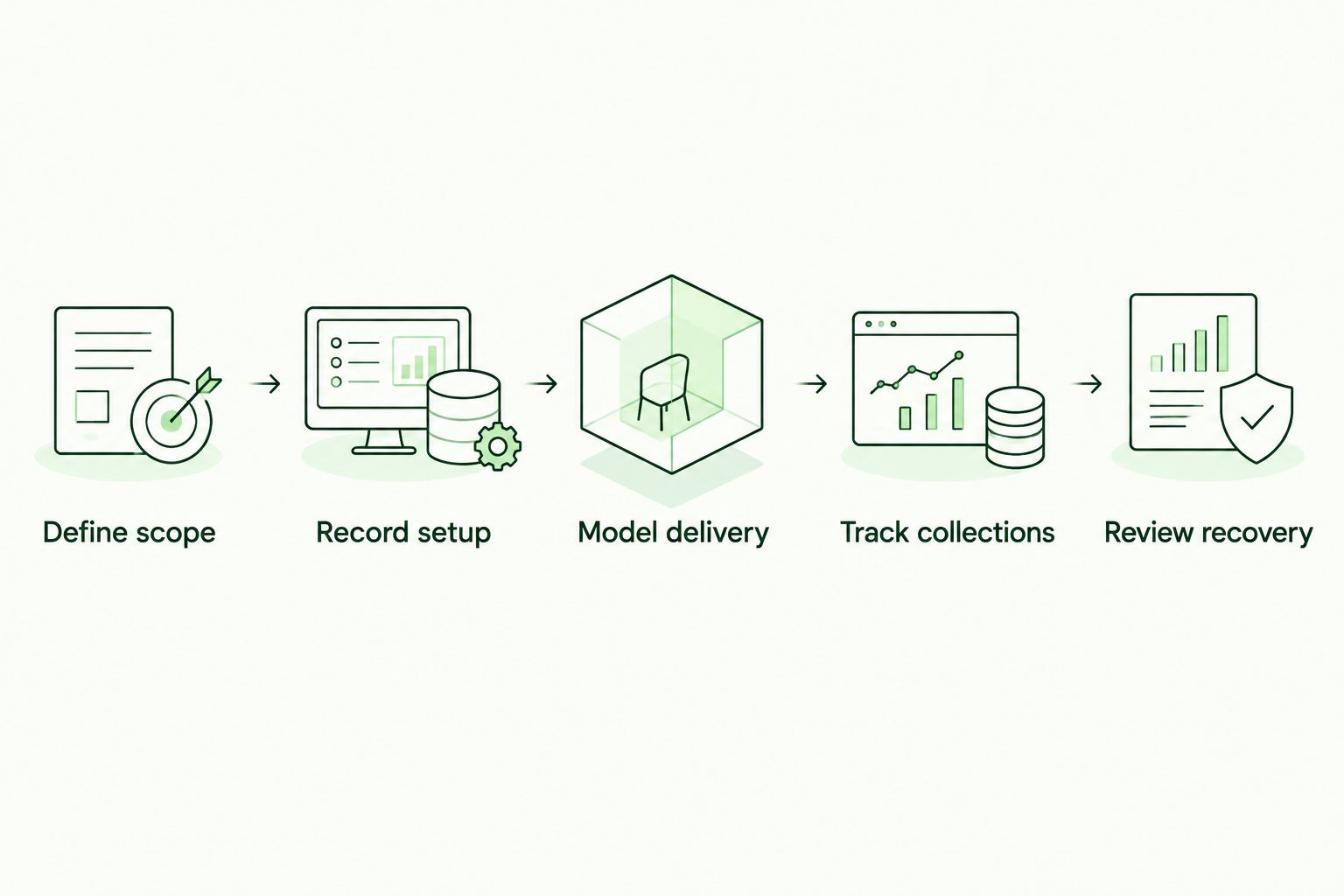
Measure service contribution and cash recovery separately.
Use a monthly schedule when the client base changes
A simple payback division assumes a constant contribution. That assumption does not describe a launch where clients start at different times and onboarding work arrives before recurring collections.
Create a schedule with opening unrecovered investment, service revenue, recurring costs, contribution, and closing unrecovered investment. Maintain a separate cash view with receipts and payments. Carry each closing balance into the next period.
If contribution turns negative during a period, the unrecovered investment increases. Do not stop the schedule at the first month that covers the platform subscription; continue until the full investment is recovered.
Why MSP security training breakeven varies
The inputs below determine your result. Use actual contract terms and delivery records wherever you have them; label planning assumptions separately from observed performance.
- Client acquisition timing. A signed pipeline is not active service revenue. Put each client into the model when its paid service begins.
- Revenue structure. Standalone billing and bundled billing require different attribution. Use a consistent revenue allocation for bundled training.
- Platform billing. Flat-fee and per-seat agreements respond differently to enrollment. Model the agreement you actually sign.
- Onboarding effort. Client setup, enrollment preparation, and launch communications consume capacity before routine delivery settles into place.
- Recurring service scope. Follow-up, reporting, evidence requests, and account reviews belong in the cost calculation when your agreement includes them.
- Payment timing. Invoice dates and collection dates are different inputs. Cash recovery follows collections and payments, not booked revenue alone.
Change the assumption that drives the result before changing the sales target. If recurring administration consumes the contribution, adding clients without changing delivery also adds that work. If onboarding delays recovery, review how you scope, schedule, and charge for onboarding.
How many clients do you need to cover recurring costs?
The required client count equals shared recurring service costs divided by average client contribution before shared costs, rounded up to a whole client. Average client contribution means attributable client revenue minus client-specific delivery costs.
Use that shortcut only when your clients have comparable economics. If account sizes or service commitments differ materially, calculate each client's contribution separately and add the results until they cover shared recurring costs.
Be precise about the boundary. Covering shared recurring costs establishes operating breakeven under your model; it does not prove that startup investment has been recovered. The remaining contribution must still repay that investment.
Does bundling training make breakeven faster?
Bundling does not create incremental revenue unless the agreement includes an increase or you assign a defensible share of existing revenue to the service. It changes packaging, not the underlying delivery obligation.
For 2026 renewals, decide what the bundle promises before agreeing to the contract. State who owns enrollment, reminders, reporting, and client evidence requests. An undefined training inclusion leaves the cost boundary undefined too.
Keep the evaluation honest. You can assess whether the whole managed-services package remains profitable, but that is different from proving that training generates a separate return. Use the measure that matches the commercial decision.
What happens if monthly contribution is negative?
Negative monthly contribution means the service is not funding startup recovery. Each period adds to the unrecovered balance until revenue rises or recurring costs fall.
Identify whether the shortfall comes from the platform commitment, client-specific work, or insufficient service revenue. Those causes require different responses: revisiting the commitment, narrowing delivery scope, improving the process, or changing contract economics.
Do not assume volume fixes the problem. More clients help only when their incremental revenue exceeds the incremental cost of serving them. A larger client base with negative incremental contribution makes the underlying problem larger.
Check the service promise before you launch
Your breakeven calculation is only as reliable as the work it includes. Review the offer with the people who will deliver it, not just the person who chose the platform.
Ask your service desk who handles enrollment errors and access questions. Ask the account owner who answers requests for completion evidence. Ask finance how bundled revenue and onboarding payments will be attributed. Resolve ownership before treating a cost category as negligible.
Use the same review for a pilot and a full launch. A pilot can reveal missing tasks, but its workload does not automatically describe a larger service. Update the model with observed delivery work rather than preserving the original estimate because it supported the sales plan.
For your 2026 launch decision, approve the service scope, accounting treatment, and cash schedule together. That gives sales a defined offer and gives delivery a boundary it can enforce.
FAQ
How long does it take an MSP to break even on security awareness training?
An MSP breaks even when cumulative service contribution recovers its startup investment. Calculate the date from actual revenue, platform expense, delivery costs, and onboarding work rather than using a generic industry timeline.
What should an MSP breakeven security awareness training service calculation include?
The calculation should include attributable service revenue, platform expense, onboarding, recurring delivery, and assigned overhead. Track collections separately when measuring cash recovery.
Does unlimited-seat training mean every added client is pure profit?
Unlimited seats do not make every added client pure profit. Defend Wise offers flat-fee, white-label security awareness training with unlimited seats, but client onboarding, support, and reporting still need a delivery budget.
Should I count internal staff time in training service costs?
Count internal staff time when measuring the service's economic contribution. Track it separately from cash outlays so you can distinguish capacity consumption from additional payments.
Can I count annual prepayments as immediate profit?
An annual prepayment is a cash receipt, not proof that all future service work has been earned or funded. Keep a cash schedule separate from the revenue and costs associated with delivery.
Does covering the platform subscription mean I have broken even?
Covering the platform subscription does not establish full service breakeven. You must also cover delivery costs and distinguish recurring operating coverage from startup investment recovery.
What is the fastest way to improve my training service payback?
Address the largest measured source of lost contribution first. Use your records to determine whether the issue is onboarding, recurring administration, platform expense, service scope, or insufficient attributable revenue.
One last thing
An annual prepayment can improve cash recovery without making the underlying service profitable. The cash arrives before the remaining delivery obligation is complete. Keep the work still owed visible alongside the bank balance.
Before signing your next training agreement, write down what counts as recovered investment and what counts as recurring profit. That distinction is the foundation of a useful 2026 breakeven target.