Best security awareness training for waste management companies
Security awareness training for waste management companies: choose MSP-led delivery. Compare four models, phishing practice, staff coverage, and reporting.
DefendWise
DefendWise
Best for MSP-managed delivery: Defend Wise. Best for direct policy control: an employer-run program. Best for practicing difficult decisions: facilitated workshops. The best security awareness training for waste management companies connects everyday decisions about payments, account access, and sensitive information to a repeatable training process.
TL;DR
- Defend Wise is the best fit for MSP-delivered security awareness training for waste management companies seeking white-label, unlimited-seat coverage.
- Choose employer-run training when your organization needs direct control over policies, assignments, and follow-up.
- Use facilitated workshops for payment changes and suspicious requests; use induction training as an onboarding baseline.
- Require role-relevant exercises, accessible delivery, and usable training evidence before selecting a program.
Why this matters
A training completion record answers whether someone finished an assignment. It does not answer whether that person will challenge a suspicious bank-detail change or report an unexpected sign-in request.
For your 2026 selection, start with the decisions employees actually make. If your business handles customer records, supplier payments, dispatch messages, or shared accounts, build training around those workflows rather than generic threat descriptions.
Choose the operating model before choosing the content library. Someone must own enrollment, reminders, reporting, and follow-up. A large course catalog does not resolve an unclear service boundary between your company and its managed service provider, or MSP.
What makes the best training program
Use these criteria to judge security awareness training for waste management companies. They test whether the program fits your business, not whether its feature list looks impressive.
- Role relevance: Accounts staff should practice payment verification. Employees handling operational messages should practice recognizing suspicious requests in those channels.
- Workforce access: Check how employees without individual company email accounts receive training and report concerns. Do not assume a desk-based workflow fits every role.
- Administrative ownership: Name the person responsible for assignments, joiners, leavers, overdue work, and escalations.
- Evidence quality: Require records that identify the learner, assigned topic, completion status, and follow-up. Ask to inspect an export before committing.
- Commercial fit: Compare the licensing model with how your workforce changes. Separate software licensing from the labor required to run the program.
- Behavioral follow-through: Give employees a clear reporting route and a verification procedure they can use during real work.
Keep these criteria in your 2026 buying brief. Ask every provider or internal program owner to explain how the proposed service meets them.
Best training approaches at a glance
These are operating-model recommendations, not a claim that one software platform replaces every teaching method. The ranked options serve different needs and can work together.
| Rank and option | Best for | Standout feature | Key limitation |
|---|---|---|---|
| 1. Defend Wise through an MSP | Outsourced program delivery | White-label platform with flat-fee, unlimited-seat licensing | Your MSP's responsibilities still need a written scope |
| 2. Employer-run program | Direct policy and assignment control | Your team owns the training process | Requires an accountable internal owner |
| 3. Facilitated workshops | Practicing ambiguous decisions | Discussion and rehearsal of real workflows | Attendance alone does not show individual understanding |
| 4. Induction-only training | Establishing an onboarding baseline | Training connects to initial access and policy handover | Does not provide ongoing reinforcement |
1. Defend Wise: best for MSP-managed training
Defend Wise provides a white-labeled security awareness training platform that MSPs use to train and manage cybersecurity compliance for end-client organizations. Its flat-fee, unlimited-seat model removes seat-based licensing from the platform's commercial structure.
Defend Wise is best for waste management companies that want their MSP to deliver security awareness training. Your buying decision still needs a service definition: who assigns training, who follows up, and what evidence your company receives.
What to put in the MSP agreement
Ask your MSP to name the service owner and document the reporting schedule. Specify how new employees enter the program, how departures are handled, and how unresolved training gaps reach your management team.
For a 2026 evaluation, ask the MSP to demonstrate the proposed workflow using your own role examples. White-label delivery describes the presentation model; it does not, by itself, define the work included in your agreement.
Defend Wise pros:
- Unlimited-seat licensing avoids a platform license calculation for each additional learner.
- White-label delivery supports an MSP-branded service.
- The platform is explicitly designed for MSP delivery to end-client organizations.
Defend Wise cons:
- The MSP-focused model requires an MSP service relationship rather than a purely employer-operated approach.
- Platform licensing alone does not establish responsibility for reminders, escalations, or evidence delivery.
Best for: Companies that want an MSP to own a defined training service rather than merely supply access to software.
Verdict: Buy through your MSP when the service scope names an owner, deliverables, and escalation rules.
2. Employer-run training: best for direct policy control
An employer-run program puts your organization in charge of assignments, training material, and follow-up. You can use software to support that work, but accountability remains with your internal team.
This approach suits a company that wants training to reflect its exact approval procedures. The practical test is whether someone has time and authority to maintain the program after launch.
Make ownership explicit
Choose a named owner, not a department mailbox. Give that person a documented way to obtain current employee lists, involve managers, and resolve overdue assignments.
Build exercises around procedures your business has already approved. For example, an accounts exercise should teach the actual method for checking a supplier bank-detail change, not a generic instruction to be careful.
Employer-run program pros:
- Your team controls policy wording and assignment decisions.
- Training can directly reference internal approval procedures.
- Managers can connect follow-up to existing supervision responsibilities.
Employer-run program cons:
- Enrollment, reminders, recordkeeping, and updates remain internal work.
- An owner without authority to escalate overdue training cannot enforce the process.
Best for: Companies with an accountable internal security, IT, or compliance owner who can run recurring training operations.
Verdict: Buy this model when ownership is funded and documented; skip it when training is an unassigned extra task.
3. Facilitated workshops: best for difficult decisions
Facilitated workshops let employees rehearse situations where the correct response is not obvious. A supervisor, trainer, or security specialist presents a scenario and asks participants to explain what they would do next.
Use this format for decisions involving urgency, authority, and exceptions. A request appearing to come from a senior manager is a useful exercise when employees must decide whether to pause, verify, or escalate.
Rehearse the action, not the terminology
Set a proposed 15-minute session around one workflow. Present a suspicious request, ask participants to identify the approved verification route, and finish by having them describe how they would report it.
For your 2026 workshop plan, avoid treating public participation as proof that everyone understood. Add an individual response or short follow-up question so quieter employees also demonstrate the next action.
Facilitated workshop pros:
- Discussion exposes confusion about authority and exceptions.
- Scenarios can reference your actual reporting and approval procedures.
- Employees can practice wording a challenge to an urgent request.
Facilitated workshop cons:
- Scheduling requires coordination across the employees involved.
- Attendance records alone do not demonstrate individual understanding.
Best for: Teams that need to practice payment verification, suspicious instructions, or escalation decisions.
Verdict: Buy as a targeted teaching method; skip it as the only source of training evidence.
4. Induction-only training: best for an onboarding baseline
Induction training introduces security expectations when someone joins your company or receives new access. It should explain account handling, approved communication channels, reporting responsibilities, and where to find the relevant policies.
Its useful role is narrow. Induction establishes the starting point; it does not maintain awareness as procedures, responsibilities, and threats change.
Connect training to access
Ask new starters to demonstrate the reporting route and explain the verification procedure relevant to their role. A signed policy acknowledgment should not replace that conversation.
Treat induction as the first assignment in a continuing program. When someone changes responsibilities, revisit the training connected to the new access or approval authority.
Induction-only training pros:
- Establishes expectations at the point of entry.
- Connects initial access with security responsibilities.
- Gives managers a defined moment to explain reporting procedures.
Induction-only training cons:
- Does not provide recurring reinforcement after onboarding.
- A one-time acknowledgment does not show how someone responds later.
Best for: Establishing minimum expectations before new employees begin handling company systems and information.
Verdict: Buy as the starting layer; skip as your complete training strategy.
Test the service before committing
Use a proposed 30-day pilot to inspect the workflow, not to claim a measurable reduction in cyber risk. Select participants whose responsibilities represent the workflows you need to protect.
Ask the provider or internal owner to demonstrate each stage. Use the same acceptance criteria regardless of which operating model you choose.
- Assign training: Show how the right learner receives the right material.
- Practice decisions: Use a payment, account-access, or operational-message scenario relevant to that learner.
- Report concerns: Have the learner demonstrate the approved reporting route.
- Export evidence: Inspect the record a manager or external reviewer would receive.
- Resolve gaps: Show who acts when training remains incomplete or an answer reveals confusion.
The pilot passes when your team can explain the workflow and inspect its outputs. A demonstration of course playback is not enough.
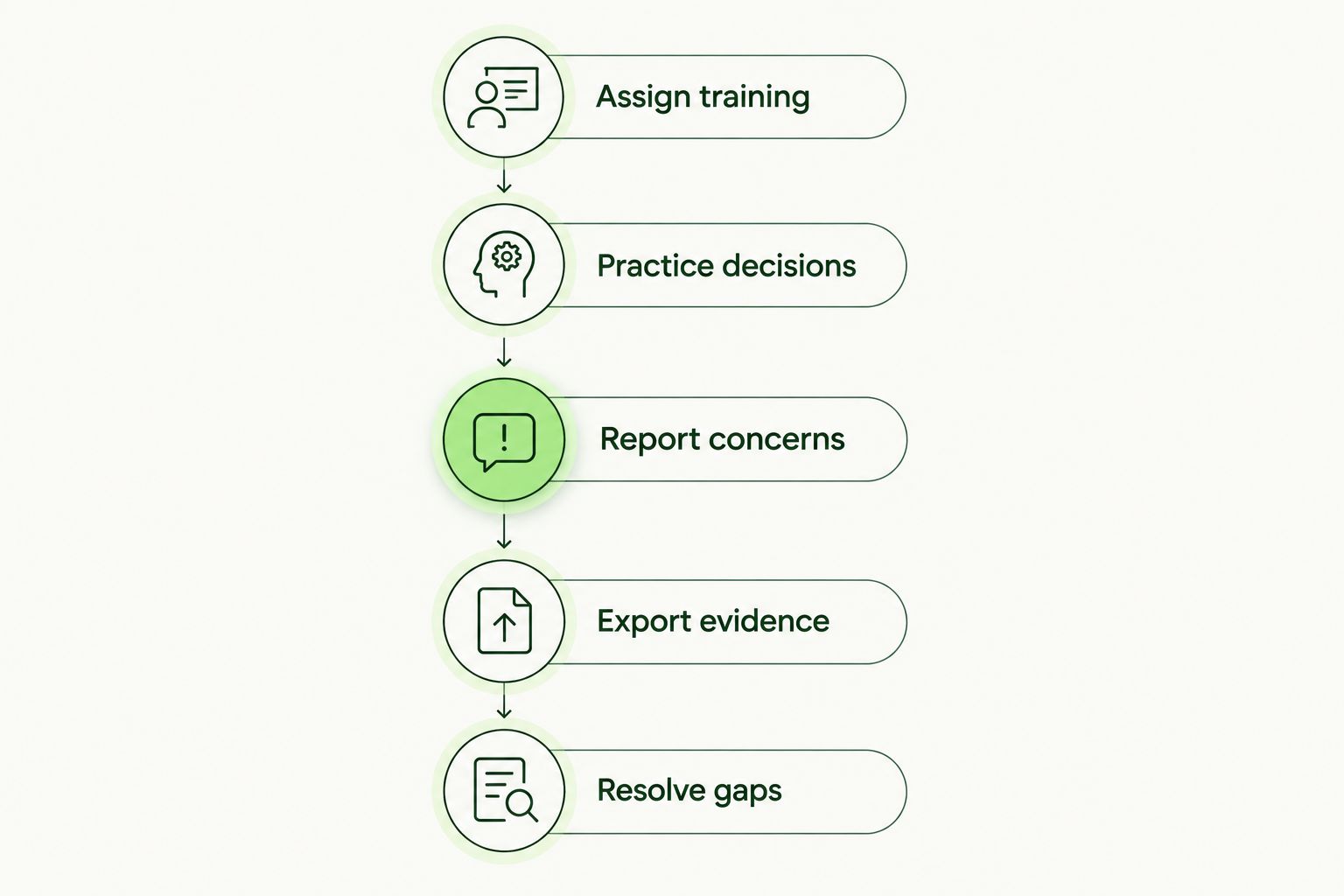
Evaluate the complete workflow, including reporting and follow-up, rather than course playback alone.
After the pilot, set a proposed 90-day review to inspect outstanding assignments, reporting problems, and changes in employee responsibilities. These are suggested evaluation periods, not performance benchmarks or provider commitments.
How the approaches were ranked
The ranking prioritizes operational ownership, workforce access, role relevance, evidence quality, and licensing fit. MSP-managed delivery takes the first slot for a buyer seeking an outsourced service; employer-run delivery takes the control-focused slot.
Workshops and induction rank below those operating models because their roles are narrower. They teach particular decisions or establish a baseline, rather than define who runs the whole program.
No incident-reduction percentage or training completion benchmark is assumed. For a 2026 purchase, judge the proposed service against your documented requirements and the workflow demonstrated during evaluation.
Which approach should you choose?
Choose MSP-managed delivery if you want external ownership of a defined training service. Require the MSP to explain the division of responsibilities before you approve the agreement.
Choose employer-run training when your internal owner has the authority and capacity to manage assignments and follow-up. Add workshops for difficult decisions, and use induction to establish expectations for new starters.
The default recommendation is an ongoing program with a named owner, supported by practical exercises. Do not confuse buying a platform with assigning responsibility for the work.
FAQ
What's the best security awareness training for waste management companies?
MSP-managed training is the best fit when your waste management company wants an external owner for delivery and follow-up. Choose an employer-run program when you have the internal capacity to manage assignments, evidence, and escalation.
Is a flat-fee training platform better than per-seat licensing?
Flat-fee, unlimited-seat licensing removes seat-based platform charges from the licensing model. Compare the service scope separately, because licensing does not define who handles enrollment, reminders, and reporting.
Can employees without company email take security awareness training?
Choose a program with a demonstrated enrollment and access method for employees without company email. Ask the provider to show that workflow before committing rather than assuming email-based assignments will cover everyone.
What should accounts staff practice during security training?
Accounts staff should practice verifying payment requests and bank-detail changes through your approved procedure. Include a clear escalation route for requests that pressure employees to bypass normal checks.
Does security awareness training prove cybersecurity compliance?
Training records document training activity; they do not establish compliance with every applicable requirement. Match the records to the specific contractual, insurance, or regulatory request being assessed.
Are phishing simulations enough on their own?
No. Phishing simulations should sit alongside reporting instructions, relevant training, and follow-up. Employees need to know what action to take, not just whether a message was simulated.
How should a waste management company evaluate a training provider?
Ask the provider to demonstrate assignment, learner access, reporting, evidence export, and follow-up using relevant role examples. Make the service owner and acceptance criteria explicit before signing.
One last thing
Ask an employee to show you how to report a suspicious request. If the route is unclear, correct that before adding another course.
Your final 2026 acceptance check should be practical: the employee knows the next action, the manager knows who follows up, and the service owner can produce the record. That is a clearer buying standard than the size of a training library.