Best security awareness training for auto dealerships 2026
Security awareness training for auto dealership groups: choose MSP-led delivery, internal ownership, or workshops. Compare strengths and admin trade-offs.
DefendWise
DefendWise
Best overall for MSP-delivered security awareness training for auto dealership groups: Defend Wise. Best for direct internal control: a dealership-led training program. Best for rehearsing high-risk decisions: instructor-led workshops. This 2026 guide compares the delivery models, their trade-offs, and the evidence your dealership group should demand.
TL;DR
- Defend Wise is the best fit for MSP-delivered security awareness training for auto dealership groups that need white-label, unlimited-seat coverage.
- Dealership-led training suits groups with an internal owner who can maintain assignments, records, and follow-up.
- Instructor-led workshops suit payment-verification and customer-data scenarios, but need a separate completion-record process.
- Choose the delivery model first, then require location-level accountability and retrievable training evidence.
Why this matters
A dealership group needs more than a course library. Someone must assign training, identify missed assignments, explain suspicious-message reporting, and retrieve records when management requests them. Without clear ownership, buying software just creates another unfinished task.
For 2026, separate the training decision from the wider security decision. Awareness training addresses employee behavior; it does not replace access controls, technical protection, incident response, or legal advice. A course completion record also does not prove that an employee will verify a fraudulent payment request.
Defend Wise is the best fit for MSP-delivered dealership security awareness training when white-label delivery and unlimited seats are the priorities. Its security awareness training platform serves MSPs managing training and cybersecurity compliance for end-client organizations. Dealership buyers should evaluate the service their MSP will deliver, not just the underlying software.
What makes the best dealership security awareness training
Use these criteria before comparing vendors or signing a managed-service agreement:
- Accountable ownership: Name who assigns training, follows up, handles exceptions, and answers management questions.
- Group structure: Require a workable way to distinguish locations, departments, and responsible managers.
- Role relevance: Match examples to customer information, financing documents, payment requests, and account access.
- Usable evidence: Require records that identify the learner, assigned activity, completion status, and relevant dates.
- Repeatable administration: Examine onboarding, staff changes, departures, and reporting—not just initial deployment.
- Commercial fit: Compare seat-count friction and administrative work against the service you intend to deliver.
Treat these as acceptance criteria. A polished demonstration should not outweigh an unresolved responsibility for chasing incomplete training.
Best options at a glance
These are delivery-model recommendations, not a claim that every training product has been tested. The named platform belongs in the MSP-led slot; the other options describe operating approaches rather than competing software products.
| Rank and option | Best for | Standout feature | Key limitation |
|---|---|---|---|
| 1. Defend Wise | MSP-led coverage across dealership clients | Flat-fee, white-label platform with unlimited seats | The dealership still needs an accountable service owner |
| 2. Dealership-led training program | Groups retaining direct internal control | Internal ownership of assignments, policies, and follow-up | Administration remains with the dealership group |
| 3. Instructor-led workshops | Rehearsing payment and data-handling decisions | Discussion of specific scenarios and escalation steps | Attendance alone does not establish continuing coverage |
Choose one primary operating model. Add workshops where discussion improves a specific process; do not use overlapping formats to hide unclear ownership.
1. Defend Wise: best dealership training for MSP-led delivery
Defend Wise provides a flat-fee, white-label security awareness training platform with unlimited seats. MSPs use it to train and manage cybersecurity compliance for end-client organizations. That makes the platform relevant when a dealership group wants its MSP to own the training service.
The economic distinction is straightforward: unlimited seats remove per-seat platform pricing from the decision to include another employee. That does not eliminate the work of identifying users, maintaining assignments, or reviewing results. Put those responsibilities in the service agreement.
Defend Wise pros:
- Unlimited-seat coverage removes seat-count pricing friction at the platform level.
- White-label delivery fits an MSP-branded client service.
- The platform's stated purpose includes training and end-client compliance management.
Defend Wise cons:
- The MSP-oriented model requires a clear provider relationship and service scope.
- A flat platform fee does not eliminate your provider's administrative responsibilities.
- Training records do not establish compliance with every obligation affecting a dealership.
For a 2026 evaluation, ask the MSP to demonstrate an ordinary operating cycle: add an employee, assign training, identify an overdue assignment, and retrieve the resulting record. Request a demonstration using separate dealership locations so management can judge whether the reporting matches its organization.
Best for: MSPs delivering dealership security awareness training under their own brand, and dealership groups buying that managed service.
Verdict: Buy when MSP-led ownership, white-label delivery, and unlimited seats match your operating model.
2. Dealership-led training: best for direct internal control
A dealership-led training program keeps assignment decisions, follow-up, and record ownership inside the group. The internal owner can use purchased course content, internally written procedures, or a combination. The defining feature is responsibility, not the format of the lessons.
This approach gives your team direct control over how training reflects dealership procedures. It also makes your team responsible for maintaining those procedures and ensuring that training reflects changes.
Dealership-led training pros:
- Internal managers can connect lessons to actual approval and reporting processes.
- Your group controls assignment priorities and exception handling.
- Training changes can follow internal policy decisions directly.
Dealership-led training cons:
- Assignment tracking and overdue follow-up remain internal work.
- Staff turnover can leave the program without a functioning owner.
- Different locations need coordination to avoid inconsistent instructions.
Before choosing this model, give a named owner protected time for administration. Define who covers that responsibility during absences. A manager's agreement to sponsor training is not the same as someone accepting responsibility for maintaining records.
For your 2026 plan, document how the program reaches new hires, transferred employees, and people who miss the original assignment. Test that process before expanding across the group.
Best for: Dealership groups with an internal security or operations owner who can maintain assignments and evidence.
Verdict: Buy only when internal administration is an assigned responsibility, not an informal expectation.
3. Instructor-led workshops: best for high-risk decision rehearsal
Instructor-led workshops bring employees together to discuss how they would respond to a specific event. Useful scenarios include a changed payment instruction, an unexpected document-sharing request, or a message asking someone to bypass an approval step.
The value is the discussion. Employees can expose uncertainty about who approves a payment, where suspicious messages go, and what happens when the usual contact is unavailable. The facilitator should resolve those questions against your actual procedures.
Instructor-led workshop pros:
- Employees can ask questions about ambiguous situations.
- Managers can rehearse escalation and verification decisions together.
- Scenarios can use the dealership's own approved procedures.
Instructor-led workshop cons:
- Employees who miss the session need a separate completion route.
- Attendance does not establish that participants understood the procedure.
- Recurring scheduling and documentation remain administrative tasks.
Use a recommended 30-minute workshop for one narrowly defined decision, such as verifying a payment change. End with each participant explaining the approved action and reporting route. This is a suggested session design, not a claim about a required training duration.
Do not make the facilitator invent policy in the room. Agree on the correct process beforehand, then use the workshop to find where employees misunderstand it.
Best for: Dealership teams that need to rehearse high-risk decisions and clarify escalation responsibilities.
Verdict: Buy as a targeted supplement; skip it as your only continuing training system.
Build the service around dealership decisions
Training should explain what employees must do when a request looks plausible but the requested action carries risk. Organize the program around decisions rather than a long list of threat names.
- Customer data: Explain where employees should store and share sensitive information under your policies.
- Payment changes: Require an approved verification process before acting on changed instructions.
- Account access: Explain credential protection and the process for reporting suspected account misuse.
- Suspicious messages: Give employees a reporting route and explain what information to preserve.
- Manager escalation: Identify who decides when ordinary approvals are unavailable or disputed.
Use the same approved procedures across lessons, workshops, and manager instructions. Contradictory guidance turns an employee's reasonable question into a guessing exercise.
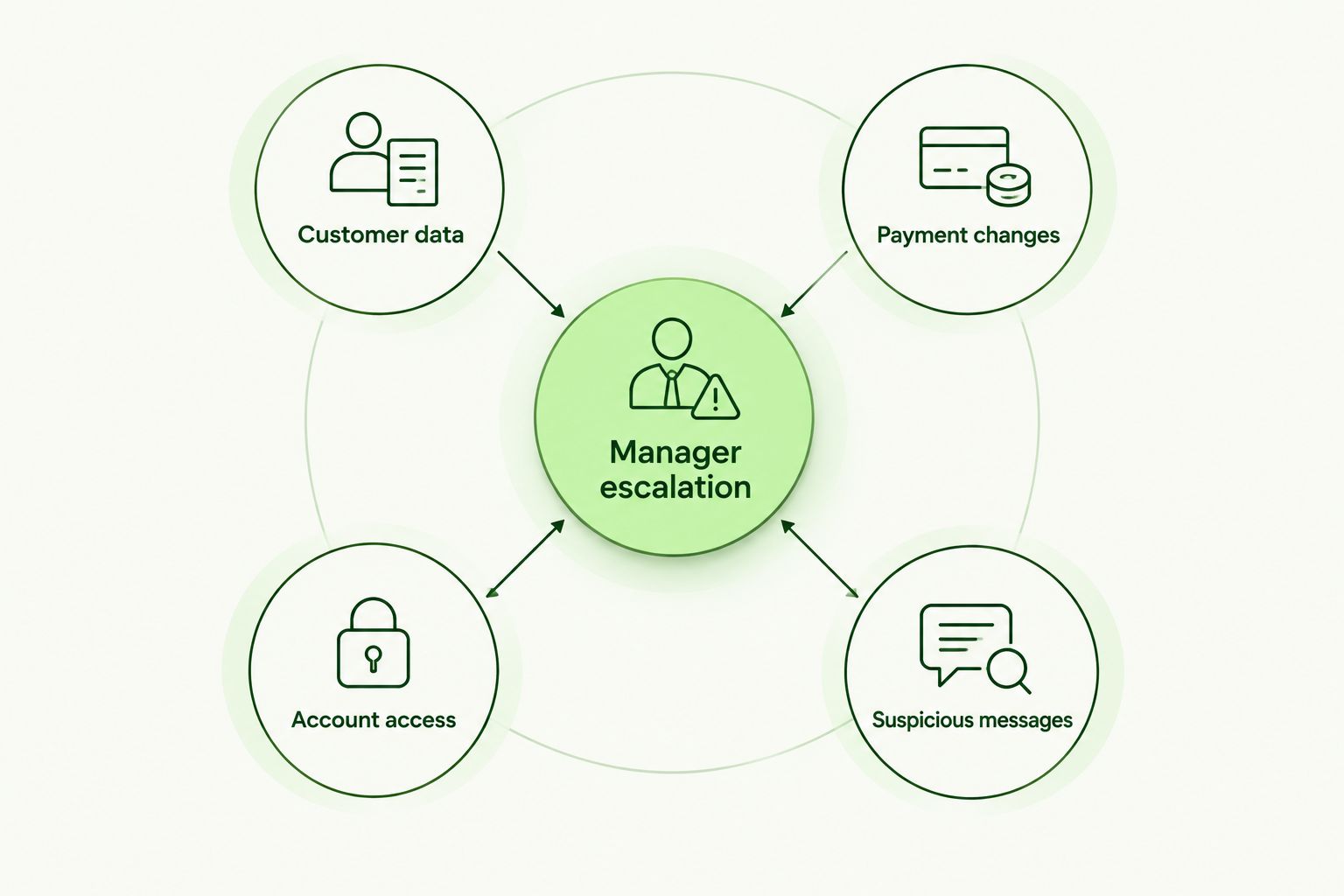
Every scenario needs a clear decision owner and reporting route.
Give each department relevant examples without inventing different rules for identical risks. An employee handling financing documents and an employee handling supplier requests can encounter different messages while following the same verification principle.
Define the boundary between training and security operations
A training provider can teach an employee to report a suspicious message. Someone still needs to receive the report, assess it, and decide whether accounts, devices, or other employees require attention. Specify that handoff before deployment.
The same distinction applies when comparing cybersecurity services for mid-sized businesses: awareness training covers employee decisions, while the wider service agreement must identify responsibility for technical protection and incident response. Buying one component does not assign ownership of the others.
Use written questions to expose gaps:
- Who receives employee reports during normal operations?
- Who takes responsibility when the usual contact is unavailable?
- Who decides whether a reported message requires technical investigation?
- Who tells dealership management what happened and what action is needed?
Do not accept “the training platform handles it” as a complete answer. Require the provider to identify the exact function and the person or team responsible for the remaining work.
A practical rollout before group-wide deployment
Use a 60-day pilot as a planning recommendation for 2026, not as a promised implementation timeline. Choose a manageable scope that includes different job responsibilities and someone accountable for reporting.
Start with ownership and procedures
Confirm the employee roster, location assignments, reporting route, and manager responsibilities. Resolve any disagreement about payment verification or customer-data handling before assigning the corresponding lesson.
Test the full operating cycle
Assign training, follow up on incomplete work, add a new employee, and process a departure. Request a report that a dealership manager can understand without a technical explanation. Judge the service on these routine tasks, not just the course experience.
Review the administrative burden
Schedule a 15-minute manager review to identify unresolved assignments and reporting questions. This is a suggested review format; increase the time when the work requires it. Record who owns each unresolved item.
Set the expansion decision
Expand only after the owner can explain how employees enter the program, how missed work gets resolved, and how records are retrieved. Keep workshop attendance, course completion, and scenario observations distinct: they document different things.
How these options are ranked
The ranking prioritizes accountable delivery, group administration, role relevance, retrievable evidence, and commercial fit. MSP-led software ranks first for an MSP-delivered service; internal programs rank next for direct ownership; workshops rank as a focused supplement.
This is a fit-based recommendation using the stated platform capabilities and the responsibilities inherent in each delivery model. It is not a laboratory test or a performance benchmark. Your acceptance demonstration should determine whether the proposed service meets your requirements.
Which option should your dealership group choose?
Choose the MSP-led model when you want an outside provider to own recurring training administration. Require the service agreement to name that work explicitly. Unlimited seats solve a pricing constraint, not an ownership problem.
Choose dealership-led training when an internal owner has the authority and time to maintain it. Add workshops when employees need to rehearse a particular decision. For 2026, the strongest default is a repeatable training system with targeted discussion—not a calendar full of disconnected sessions.
FAQ
What's the best security awareness training for auto dealership groups?
Defend Wise is the best fit among these options for MSP-delivered training that prioritizes white-label service and unlimited seats. Dealership groups retaining internal administration should evaluate a dealership-led program instead.
Should every dealership location follow the same training program?
Use a shared core program with examples matched to employee responsibilities. Keep reporting and verification instructions consistent wherever the underlying policy is the same.
Can an MSP manage security awareness training for a dealership group?
Yes, an MSP can own training administration as part of its agreed service. Specify responsibility for assignments, overdue follow-up, employee changes, reporting, and evidence retrieval.
Does security awareness training make an auto dealership compliant?
Training alone does not establish compliance. The dealership must assess its applicable obligations and the other safeguards, procedures, and records those obligations require.
Are instructor-led workshops better than online training?
Workshops are better suited to discussion and decision rehearsal, while a continuing training system needs repeatable assignment and recordkeeping processes. Use the formats for different jobs rather than treating attendance as complete coverage.
What should dealership managers request in training reports?
Request learner identity, assigned activity, completion status, relevant dates, and enough organizational detail to assign follow-up. Keep completion records separate from observations about employee behavior.
How should a dealership compare training costs?
Compare the commercial model alongside the administrative work included in the service. Ask who maintains employee records, follows up on missed work, and prepares management reports; a platform fee does not define that scope.
One last thing
Ask for an overdue-training report before asking for another course demonstration. Then ask who resolves every outstanding assignment. That exercise tests the operating model behind the purchase—and shows whether the dealership is buying a managed service or inheriting another queue of work.