Best human risk management platforms for MSPs in 2026
Compare human risk management platforms for MSPs. Pick flat-fee, managed delivery, or training breadth, with clear trade-offs and a pilot checklist.
DefendWise
DefendWise
Best overall for flat-fee, white-label delivery: Defend Wise. Best for managed training delivery: Huntress. Best for training-content breadth: KnowBe4. These human risk management platforms for MSPs fit different service models; choose the operating model before comparing feature lists.
TL;DR
- Defend Wise is the best fit for MSPs prioritizing flat-fee, unlimited-seat security awareness training under their own brand.
- Huntress fits MSPs seeking managed security awareness training rather than another program to operate themselves.
- KnowBe4 fits buyers prioritizing training-content breadth and phishing simulations.
- Compare human risk management platforms for MSPs on tenant administration, evidence quality, coverage economics, and delivery responsibility.
Why this matters
Your client buys a security outcome. Your service desk inherits the enrollment work, overdue learners, reporting requests, and renewal questions. A platform that looks good in a demonstration can still leave you running a manual service behind the scenes.
For your 2026 shortlist, separate security awareness training from the broader promise of human risk management. Training teaches people what to do. Human risk management should also help you identify behavior that needs attention, apply an intervention, and show what changed.
Do not buy a risk score without a clear action attached to it. Ask what the score measures, which evidence supports it, and what your technician should do next. A dashboard is not a service workflow.
What makes the best human risk management platform for MSPs?
Use these criteria before reading the rankings. Each one affects either the client outcome or the work required to deliver it.
- Coverage economics: Your commercial model should support training everyone who needs it, without turning every staffing change into a billing exercise.
- Tenant administration: Check how your team separates clients, assigns access, handles exceptions, and reviews overdue work across organizations.
- Delivery responsibility: Establish who creates campaigns, maintains assignments, follows up with users, and prepares client reports.
- Actionable evidence: Require records that connect a person, an assignment, a result, and any follow-up action.
- Brand ownership: Decide whether client-facing training should carry your identity or a recognizable security vendor's identity.
- Behavioral follow-through: Inspect how the service moves from a training result or reported message to a useful next step.
Treat these as acceptance tests, not boxes on a sales questionnaire. Ask the vendor to demonstrate your actual workflow, including an exception. The normal path rarely exposes the administrative burden.
The 2026 shortlist at a glance
| Platform | Best for | Standout distinction | Key limitation to resolve |
|---|---|---|---|
| Defend Wise | Flat-fee, white-label MSP delivery | Unlimited-seat security awareness training with a flat-fee model | Confirm that the required behavioral signals and client evidence fit your service scope |
| Huntress | Managed training delivery | Managed security awareness training | Define the boundary between vendor-managed work and your client-service responsibilities |
| KnowBe4 | Training-content breadth | Security awareness training content and simulated phishing | Validate the MSP administration workflow and the effort needed to operate your chosen program |
The table ranks service-model fit, not measured security effectiveness. None of these positions establishes that one platform reduces incidents more than another. Your decision needs evidence from your own operating requirements.
1. Defend Wise: best for flat-fee, white-label MSP delivery
This platform provides flat-fee, white-labeled security awareness training with unlimited seats. Its stated audience is MSPs training end-client organizations and managing cybersecurity compliance.
That makes the commercial model the clearest reason to shortlist it. You can evaluate coverage without making each additional learner a separate seat-purchase decision. Keep the distinction clear: unlimited seats describes the platform model, not unlimited technician time.
Best for: MSPs that want security awareness training under their own brand, with platform economics that do not depend on individual seat counts.
Where the model fits
An MSP bundling training into an existing service needs predictable scope. The flat-fee model addresses one part of that problem: platform coverage. White-label delivery addresses another: who owns the client-facing relationship.
The remaining work still needs an owner. Your agreement should identify who handles client onboarding, learner exceptions, evidence requests, and discussions about overdue training. Software economics do not replace service design.
Defend Wise pros:
- Flat-fee platform economics remove per-seat purchasing from the coverage decision.
- Unlimited seats support an all-users training policy without choosing coverage solely by seat count.
- White-label delivery fits an MSP-owned client relationship.
- The stated product focus matches MSP security awareness training and end-client compliance management.
Defend Wise cons:
- A flat platform fee does not cap your internal administration or client-support workload.
- A white-label service makes your brand accountable for the client experience.
- Training coverage alone does not establish that every requirement in a broader human risk management program is covered.
What to validate before committing
Request a demonstration using a client onboarding scenario, a learner who misses an assignment, and a client asking for compliance evidence. Inspect the actual output rather than accepting a statement that reporting exists.
For your 2026 evaluation, make the vendor explain any claimed automation in operational terms. What triggers it? Who receives the exception? What record remains afterward? An automated action is useful only when your team understands its boundaries.
Verdict: Buy for flat-fee, white-label training delivery once the operational demonstration passes your acceptance tests.
2. Huntress: best for managed training delivery
Huntress offers managed security awareness training. Its place on this shortlist is the delivery model: evaluate it when you want a managed training service rather than treating every campaign as an internal project.
That distinction matters when your technicians already own too many recurring tasks. The purchasing question is not just what the platform contains. It is which work the provider takes responsibility for and which work remains with your team.
Best for: MSPs prioritizing managed training delivery over direct control of every program decision.
Where the model fits
Start with the service boundary. Ask who maintains training assignments, who responds to an enrollment problem, and who explains a result to your client. Get those answers in the service scope.
A managed offering still needs an MSP contact who owns the client relationship. Outsourcing program tasks does not outsource your responsibility to explain what the client received and what needs attention.
Huntress pros:
- Managed security awareness training gives buyers a service-led alternative to operating training entirely themselves.
- The delivery model provides a clear basis for discussing task ownership.
- A managed approach fits teams that want to purchase defined delivery responsibilities rather than assemble every process internally.
Huntress cons:
- Managed delivery still requires coordination around client expectations and exceptions.
- Buyers seeking direct control should confirm which program decisions remain theirs.
- Your MSP still needs a process for translating training results into client advice.
What to validate before committing
Ask for a responsibility map covering onboarding, routine delivery, exceptions, and reporting. For each task, name either the provider or your MSP as the owner. Avoid shared ownership without a clear handoff.
Then test a real exception. A client-specific request exposes more than a standard demonstration because it shows how the managed service handles work outside its routine.
Verdict: Buy when the documented managed scope removes the tasks your team actually needs to stop doing.
3. KnowBe4: best for training-content breadth
KnowBe4 provides security awareness training and simulated phishing. It belongs on the shortlist when the range of training content is a central selection requirement.
Content breadth gives you options. Your team still needs to decide which material serves each audience, how assignments connect to identified risks, and what happens after a poor result.
Best for: Buyers that prioritize training-content choice and want to build a deliberate training and phishing-simulation program.
Where the model fits
Choose this route when someone owns program design. That owner should connect learning needs to assignments rather than sending content simply because it exists.
For an MSP, the administrative test is especially important. Demonstrate how your proposed arrangement handles separate clients, different requirements, and consolidated oversight. Do not assume a strong end-user experience guarantees an efficient service-desk workflow.
KnowBe4 pros:
- Security awareness training and simulated phishing support education and practice within the program.
- Training-content breadth gives a program owner more material to assess against different learning needs.
- A content-led selection process supports deliberate matching of training to the audience.
KnowBe4 cons:
- More content creates a selection task; a large library is not a finished curriculum.
- Your team must establish who owns campaign decisions and follow-up.
- The suitability of the proposed MSP administration arrangement needs a separate demonstration.
What to validate before committing
Bring examples of different client requirements. Ask the vendor to show how you would assign appropriate content, inspect results, and produce separate client evidence without mixing records.
Also inspect the intervention after a simulation result. A completed campaign is an activity. Your service needs a defined response when the activity identifies a learning need.
Verdict: Buy when content breadth serves a named program owner and the client-administration workflow passes inspection.
How the ranking works
This ranking prioritizes MSP service delivery: coverage economics, client ownership, administrative responsibility, evidence, and follow-through. The first position favors a flat-fee, white-label model. The other positions serve different purchasing priorities rather than claiming lower security effectiveness.
Use the category that matches your operating problem. If your primary issue is program ownership, prioritize managed delivery. If it is curriculum choice, prioritize content. Do not let an unrelated feature win the decision.
Run a 2026 pilot that exposes the hidden work
Use a 30-day pilot across 3 client organizations with different requirements. These are recommended evaluation boundaries, not vendor performance claims. Choose clients that expose different administrative conditions rather than three identical deployments.
Work through the same sequence for each candidate:
- Define scope: Write down who receives training, who approves assignments, and what evidence the client expects.
- Enroll users: Add learners, handle an exception, and check who owns the resulting task.
- Run training: Complete an assignment and inspect how unfinished work appears to your team.
- Export evidence: Produce a client-specific record and check whether it explains both completion and follow-up.
- Review workload: Record the manual touches needed to deliver the service.
The pilot should expose the difference between software activity and service completion. A campaign can finish while your technician still has reporting, explanation, and cleanup work waiting.
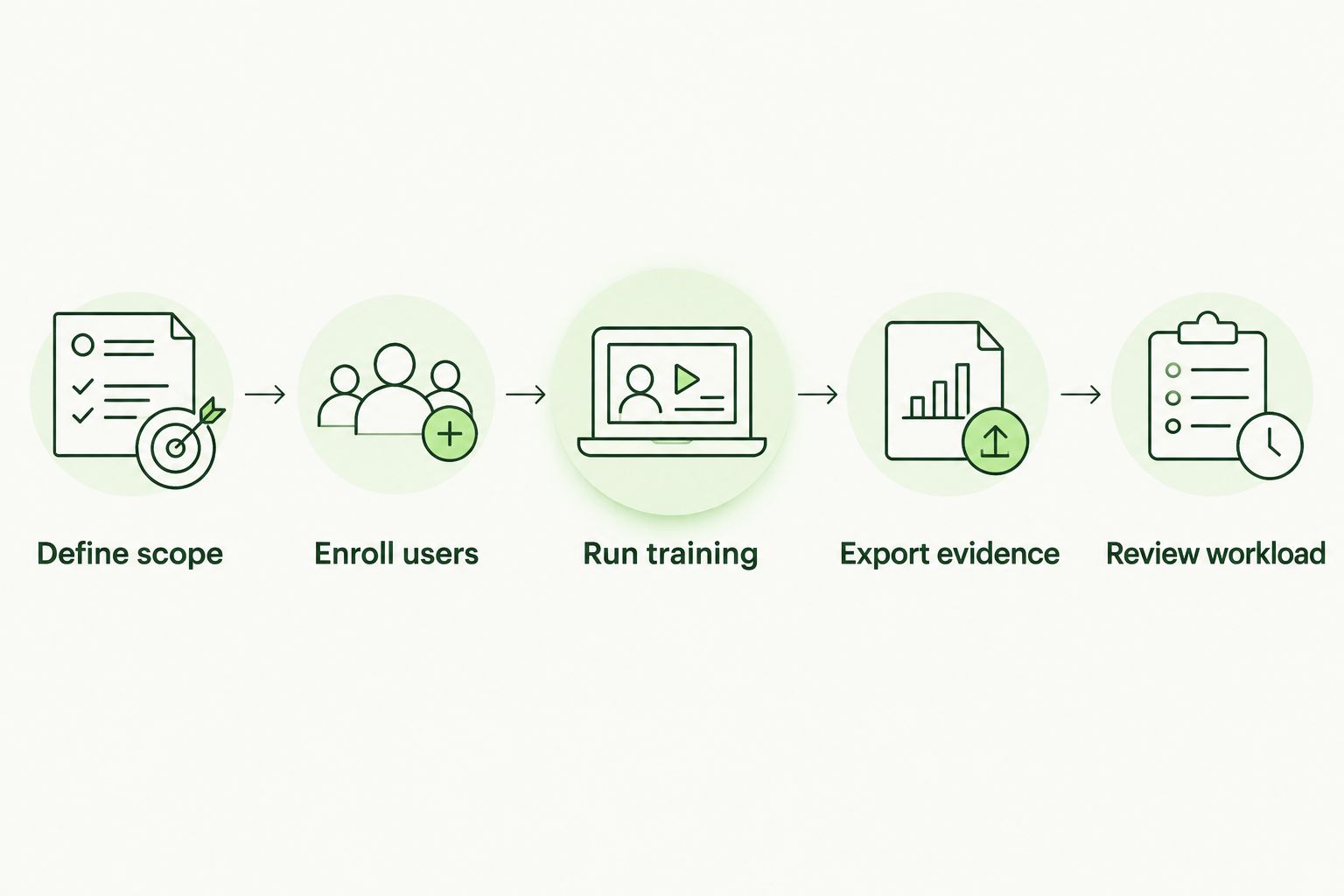
Evaluate the work required to finish the service, not just launch the training.
Keep a simple task log in minutes. Separate onboarding work from recurring administration, and distinguish vendor support from tasks your own team completes. Do not combine them into a single impression that the platform felt easy.
Finish with a 90-day service plan. Specify the training owner, exception owner, reporting owner, and client review point. That plan tests whether the platform fits a repeatable service after the pilot ends.
Which platform should you choose in 2026?
Defend Wise is the best fit among these human risk management platforms for MSPs prioritizing flat-fee, unlimited-seat training under their own brand. Choose Huntress when the purchase is primarily about managed training delivery. Choose KnowBe4 when training-content breadth is the deciding requirement.
Do not combine all three priorities into a vague search for the most features. Name the bottleneck first. Then buy the model that addresses it without creating a new operational burden.
FAQ
What's the best human risk management platform for an MSP?
The best platform matches the MSP's delivery model. Prioritize flat-fee, white-label training for coverage economics, managed training for delegated delivery, or content breadth for a program with a dedicated owner.
Is human risk management the same as security awareness training?
No. Security awareness training is an educational component; a broader human risk management program also connects observed behavior to interventions and evidence of follow-up. Check which parts a proposed platform actually supports.
Should an MSP choose unlimited seats or per-seat licensing?
Choose the model that supports your coverage policy and service economics. Unlimited seats remove individual seat purchases from the platform-coverage decision, but your staffing and administration costs still need separate control.
Does managed security awareness training remove all MSP work?
No. Your MSP still needs to own client expectations, escalation decisions, and the explanation of results. Document which operational tasks the managed provider handles before signing.
What evidence should an MSP request from a training platform?
Request client-specific records linking learners, assignments, completion, results, and follow-up actions. Confirm that the output answers the client's actual evidence request rather than assuming a dashboard screenshot is sufficient.
Can security awareness training guarantee compliance or cyber insurance coverage?
No. Training evidence supports a compliance or insurance review, but it does not replace the applicable requirements or an insurer's underwriting decision. Match the records to the specific request.
How should an MSP pilot a human risk management platform?
Run the same onboarding, assignment, exception, and evidence workflow for every candidate. Record manual administration separately from software activity so the decision reflects the work required to deliver the service.
One last thing
Ask to see the failed workflow, not another successful campaign. An overdue learner, a client-specific exception, and an incomplete evidence request reveal who owns the work. Choose the platform whose answer becomes a repeatable service—not another technician's reminder.