Can one program satisfy multiple compliance rules?
Security awareness training multiple compliance frameworks: use one program, map each rule, and keep client-specific evidence without duplicating training.
DefendWise
DefendWise
Yes. One security awareness training program can support multiple compliance frameworks when you map shared lessons, add requirement-specific content, and retain evidence for each applicable rule. The limitation is scope: training addresses awareness requirements, not every control needed for compliance, certification, or an audit opinion.
TL;DR
- Security awareness training multiple compliance frameworks: share core lessons, but map requirements and evidence separately.
- PCI DSS specifies training timing; HIPAA requires a security awareness and training program for workforce members.
- ISO 27001 and SOC 2 require evidence beyond course completion.
- Defend Wise suits MSPs seeking white-label security awareness training with unlimited seats.
Can one program satisfy multiple compliance rules?
One program can satisfy overlapping awareness requirements. One completion certificate cannot prove compliance with every framework. The distinction is between delivering training and demonstrating that training meets a particular obligation.
Defend Wise security awareness training is best for MSPs that need white-label delivery and unlimited seats. Keep the delivery decision separate from the client's obligation to demonstrate that the program covers its applicable requirements.
For a 2026 training plan, start with the actual requirements rather than a vendor's framework badge. These common examples show where a shared program works and where separate decisions remain necessary.
| Rule or framework | What supports a shared program | What needs separate attention | Evidence to retain |
|---|---|---|---|
| PCI DSS | Security awareness content about threats and employee responsibilities | Required timing, phishing and social engineering coverage, and acknowledgment requirements | Training dates, covered topics, attendance, and acknowledgments |
| HIPAA Security Rule | Security awareness and training for workforce members | The organization's risk analysis, workforce responsibilities, and applicable implementation specifications | Training content, workforce coverage, reminders, and documented decisions |
| ISO 27001 | Awareness, education, and training relevant to information security responsibilities | The information security management system's scope and applicable controls | Role mapping, training records, policy communication, and evaluation records |
| SOC 2 | Communication of security responsibilities and supporting awareness activities | Selected Trust Services Criteria, system scope, control design, and operating evidence | Control descriptions, communications, training records, and evidence for the examination period |
The advantage is reuse: you do not need separate lessons merely because separate frameworks address related behavior. The disadvantage is accountability: someone still has to verify coverage, manage exceptions, and preserve the right records.
Do not read the table as an equivalency statement. PCI DSS compliance, HIPAA obligations, ISO 27001 certification, and a SOC 2 examination are different processes with different scopes.
Why this matters
An MSP can standardize delivery across subclients without treating their obligations as interchangeable. A healthcare client and a payment-processing client can share phishing education while needing different policy instruction and evidence.
The old way duplicates courses under different framework labels. The new way separates the reusable lesson from the requirement mapping. That reduces unnecessary repetition without removing client-specific responsibilities.
For your 2026 service package, define the deliverable precisely: training administration, coverage tracking, evidence preparation, and exception handling. Do not sell a compliance outcome that training alone cannot establish.
The operational question is not whether everyone completed the same course. It is whether each client can explain who needed training, what they received, when it happened, and which requirement it addressed.
PCI DSS: reuse the lessons, preserve the required timing
PCI DSS v4.0.1 Requirement 12.6 addresses security awareness education. Requirement 12.6.3 calls for training upon hire and at least once every 12 months, using multiple methods of communication.
Requirement 12.6.3.1 specifically addresses phishing and related attacks, plus social engineering. Requirement 12.6.3.2 calls for personnel to acknowledge at least once every 12 months that they have read and understood the information security policy and procedures.
Those obligations fit within a shared awareness program, but the evidence must establish more than participation. A generic course certificate does not establish a policy acknowledgment or prove that new hires received training at the required point.
For a 2026 PCI DSS mapping, retain the course topics, assignment and completion records, communication methods, and policy acknowledgment separately. Use the same lesson elsewhere when appropriate; do not discard the PCI-specific record.
Shared content is the benefit. Required timing and acknowledgment are the constraints. An MSP should be able to show both without rebuilding the course for every subclient.
HIPAA: align training with workforce responsibilities
The HIPAA Security Rule, at 45 CFR §164.308(a)(5), requires a security awareness and training program for all workforce members, including management. Its implementation specifications address security reminders, protection from malicious software, log-in monitoring, and password management.
These topics overlap with general security awareness. The client-specific work is connecting them to the organization's risks, procedures, and workforce responsibilities involving electronic protected health information.
HIPAA distinguishes required standards from addressable implementation specifications. Addressable does not mean optional: the regulated organization must assess whether an implementation specification is reasonable and appropriate and document its decision as the rule requires.
Do not copy the PCI DSS 12-month interval into a HIPAA mapping and label it a universal HIPAA training deadline. That provision of the Security Rule does not prescribe the same training interval.
The shared program provides a delivery foundation; the organization's risk analysis determines what needs additional attention. A lesson about phishing does not replace instruction on the client's own escalation process or handling procedures.
ISO 27001 and SOC 2: training supports a wider control system
ISO 27001 addresses awareness within the information security management system, and Annex A control 6.3 addresses information security awareness, education, and training. The relevant instruction must connect to the organization's responsibilities, policies, and applicable scope.
SOC 2 examinations use the AICPA Trust Services Criteria. Awareness activities can support communication of responsibilities, but a course completion record does not demonstrate that every relevant control is suitably designed or operating effectively.
For your 2026 evidence plan, connect each training activity to the control it supports. Identify the population covered, the review period, the responsible owner, and the records that demonstrate implementation.
Both approaches allow you to reuse useful content. Neither turns an awareness platform into a substitute for policy management, access controls, incident response, or other controls within scope.
Treat training as supporting evidence, not the entire evidence package. If a control describes an escalation procedure, employees need instruction that matches the actual procedure—not merely a general warning about suspicious messages.
How do you build one program for several frameworks?
Build the program around shared behavior, then attach requirement-specific content and records. The following 5 review steps create a repeatable workflow without assuming every client has the same obligations.
1. Define scope
List the rules and frameworks that actually apply to each subclient. Record the covered workforce, systems, information, and organizational boundaries before assigning courses.
Scope determines the audience. A framework named in a sales conversation is not enough to establish an obligation, and a client's training population should not be inferred from its software license count.
2. Map requirements
Create a matrix that connects each awareness requirement to the lesson, policy instruction, timing rule, and evidence record that addresses it. Include the source requirement so the mapping can be checked.
Mark uncovered requirements explicitly. A blank mapping is work to resolve, not something to conceal behind a general statement that the platform supports compliance.
3. Assign content
Use shared lessons for common threats and behaviors. Add role-specific instruction where employees need different knowledge or responsibilities.
For example, personnel handling electronic protected health information need instruction relevant to their organization's procedures. Employees responsible for payment environments need training that addresses the relevant PCI DSS awareness requirements.
4. Retain evidence
Keep the learner identity, assigned content, completion status, relevant dates, policy acknowledgments, and exceptions. Preserve enough course detail to explain what a completion record represents.
Keep each subclient's evidence distinguishable. Standardized administration should not blur the boundary between one client's covered workforce and another's.
5. Review exceptions
Check missed training, new hires, role changes, and content that no longer matches current procedures. Assign an owner to resolve each gap and record the outcome.
Review the requirement mapping when the applicable rule, client scope, or program changes. A completed assignment remains evidence of that assignment; it does not establish that a changed requirement is covered.
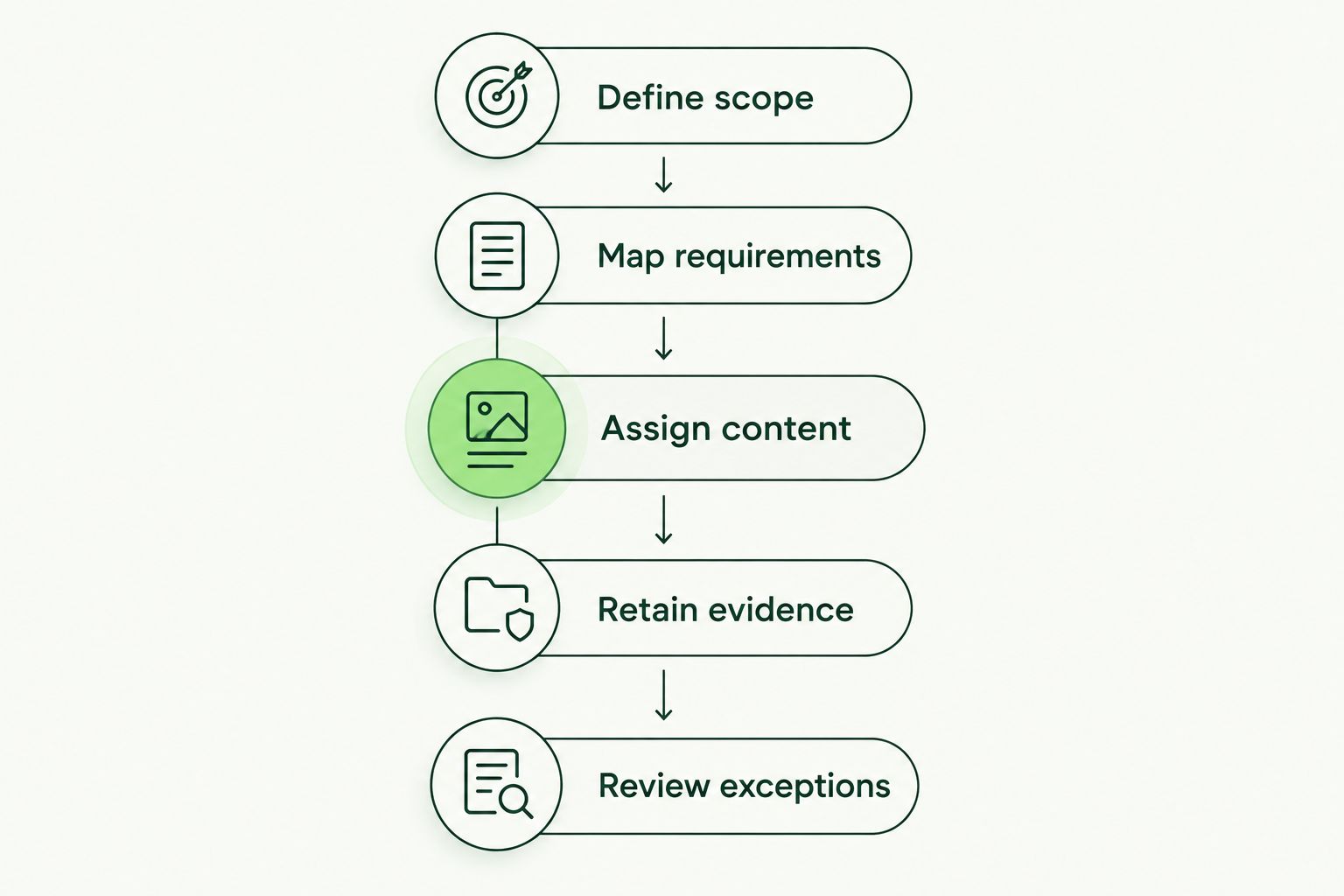
Reuse the delivery workflow while keeping each client's requirements and evidence distinct.
Why multi-framework training requirements vary
A shared program needs different configurations because the underlying obligations differ. Use these factors to explain the differences to clients instead of presenting every additional task as another course.
- Applicable requirements: PCI DSS specifies awareness timing and acknowledgments; HIPAA uses a different regulatory structure.
- Workforce responsibilities: Management, general users, and people with specialized responsibilities need instruction relevant to their work.
- Information and system scope: Payment environments, electronic protected health information, and an information security management system have distinct boundaries.
- Client procedures: Reporting, escalation, and handling instructions must match the organization that employees work for.
- Evidence purpose: A regulatory inquiry, certification audit, and SOC 2 examination do not ask identical questions about the program.
These differences explain why one delivery platform does not mean one identical assignment for everyone. Standardize the process; configure the coverage.
Does one completion certificate cover every framework?
One completion certificate can support several requirement mappings, but it cannot establish complete compliance. Its usefulness depends on the documented content, learner identity, training date, and connection to each requirement.
Keep policy acknowledgments and other supporting records where the applicable requirement calls for them. Do not assume a course certificate includes evidence it does not contain.
Do employees need separate courses for every framework?
Employees do not need duplicate courses solely because multiple frameworks apply. Reuse a lesson when its content genuinely covers the relevant requirements, then add instruction for uncovered responsibilities or procedures.
The test is coverage, not course count. Separate courses remain appropriate when combining them would leave the audience with irrelevant material or omit required instruction.
Is annual training enough for every compliance rule?
PCI DSS requires awareness training upon hire and at least once every 12 months; that is not a universal schedule for every framework. Evaluate each applicable requirement independently rather than copying one cadence across the client's compliance plan.
Also distinguish training from reminders, policy communication, and instruction following a role or procedure change. An annual course does not automatically address those activities.
Keep 4 evidence layers distinct
A useful evidence package separates 4 evidence layers: coverage, content, execution, and follow-up. Keeping these layers distinct makes a shared program easier to explain during a client review.
- Coverage: Identify who was included, who was excluded, and why the population matches the requirement's scope.
- Content: Preserve the topics, relevant policy instruction, and the mapping to applicable requirements.
- Execution: Retain assignment, completion, timing, and acknowledgment records where relevant.
- Follow-up: Document missed assignments, identified gaps, corrective actions, and the person responsible for resolution.
For a 2026 review, reconcile the covered workforce against the training records before preparing the evidence package. A clean report is not enough if the underlying population is wrong.
The same discipline applies to MSP packaging. Unlimited seats remove a licensing boundary; they do not define which people a client's program needs to cover or prove that those people completed training.
FAQ
Can one security awareness program support PCI DSS and HIPAA?
Yes, one program can support PCI DSS and HIPAA awareness requirements when it covers each applicable obligation. Retain separate mappings for required topics, timing, workforce scope, and supporting evidence.
Does security awareness training make a business compliant?
No, security awareness training alone does not make a business compliant. It addresses awareness obligations within a wider set of administrative, technical, and operational requirements.
How often does PCI DSS require security awareness training?
PCI DSS requires security awareness training upon hire and at least once every 12 months. It also requires multiple methods of communication and a policy acknowledgment at least once every 12 months.
Does HIPAA require the same annual training schedule as PCI DSS?
No, the HIPAA Security Rule awareness provision does not prescribe the same 12-month interval as PCI DSS. The organization must address its applicable requirements and determine appropriate implementation through its risk-based process.
Can phishing simulations replace security awareness training?
Phishing simulations alone do not establish coverage of all security awareness requirements. Compare the activities and content against each applicable requirement rather than treating a simulation result as complete evidence.
Is Defend Wise suitable for an MSP serving clients with different frameworks?
Defend Wise provides white-label security awareness training with unlimited seats for MSPs. Each client's framework coverage still needs its own requirement mapping and evidence review.
Does using Defend Wise guarantee that a client will pass an audit?
Using Defend Wise does not establish that a client will pass an audit. An audit evaluates the relevant scope, requirements, controls, and evidence—not simply the choice of training platform.
One last thing
Before adding another course, inspect the requirement mapping. The gap might be a missing policy acknowledgment, an uncovered workforce group, or evidence that does not identify the completed content.
Fix the actual gap. One well-mapped program is more defensible than several overlapping courses that nobody can connect to the client's obligations.