How much does managed security training cost per user?
How much does managed security training cost per user? Compare licensing models, management scope, and reporting work to calculate your real unit cost.
DefendWise
DefendWise
Managed security training has no universal per-user cost: your effective rate is the total cost of delivering the service divided by the users covered over the same period. For a 2026 budget, include platform licensing, onboarding, ongoing administration, and client reporting—not just the software invoice. A flat-fee platform changes the licensing calculation; it does not remove the work your MSP promises to deliver.
TL;DR
- How much does managed security training cost per user? Divide total service cost by covered users for the same period.
- Defend Wise security awareness training fits MSPs seeking flat-fee, white-label licensing with unlimited seats.
- Compare platform licensing separately from onboarding, administration, and compliance evidence work.
- Choose a billing denominator before comparing quotes: licensed users, covered users, and completed learners measure different things.
How much does managed security training cost per user?
Your per-user cost is a calculation, not a universal market rate. Start with the service you are buying or delivering, then divide its full cost by the relevant user count. A software-only quote and a managed-service quote are not equivalent, even when both use a per-user label.
Use this breakdown for a monthly comparison:
| Cost component | What to include | What to establish before comparing |
|---|---|---|
| Platform licensing | The contracted software charge | Billing basis, covered population, and contract period |
| Initial setup | Client configuration and launch work | Whether setup is included or handled separately |
| Ongoing administration | Roster maintenance, assignments, and follow-up | Which tasks the provider owns |
| Evidence and reporting | Record preparation and client reviews | Required deliverables and reporting frequency |
| Service support | Agreed assistance and exception handling | Boundaries between routine and additional work |
For an MSP selling the service, the next question is whether the client charge covers those delivery obligations. The guide to how long until an MSP breaks even on security training addresses that separate decision.
Keep these calculations distinct:
- Platform cost per user: platform charge divided by covered users.
- Delivery cost per user: licensing plus attributable service work, divided by covered users.
- Client charge per user: what the client pays, divided by the population covered by the agreement.
Only the second calculation tells you what delivering the service costs. The third tells you what you charge—not what you earn.
Why this matters
A low software rate does not establish a profitable managed service. Your agreement still needs an owner for enrollment, incomplete assignments, employee departures, and evidence requests. If the MSP owns those tasks, include them in the delivery model.
For your 2026 service package, define the work before choosing the billing unit. Otherwise, you are comparing quotes with different obligations hidden behind the same per-user wording. Match scope first. Compare unit costs second.
A buyer should ask what the provider manages. An MSP should ask what its team must still do. Those questions reveal more than a headline rate alone.
Per-user licensing: best for a headcount-based allocation
Per-user licensing ties the platform charge to the contract's definition of a billable user. That definition matters. Ask how the agreement treats inactive accounts, employee departures, contractors, and changes during the billing period.
The advantage is a direct allocation basis when client billing also follows headcount. The limitation is that your licensing calculation depends on maintaining the billable population under the contract's rules. Do not assume removing an account immediately changes the invoice; establish the adjustment terms first.
Best for: an MSP that wants licensing allocation to follow a defined user count and accepts the associated reconciliation work. Choose this model on the full agreement, not on the unit label alone.
Flat-fee licensing: best for separating software spend from seats
Flat-fee licensing uses a fixed platform charge rather than a charge that rises with each covered seat. With an unlimited-seat agreement, the effective licensing cost per user falls as the covered population grows, provided the platform charge stays unchanged.
That arithmetic does not prove the entire managed service becomes cheaper to deliver. Client administration and evidence preparation still belong in your operating model. A fixed software bill and a fixed workload are different things.
Best for: an MSP that wants to separate platform licensing from seat-count changes. The trade-off is that the effective per-user allocation depends on how many users the MSP actually covers.
How do the licensing models compare?
| Licensing model | Best for | Main advantage | Main limitation | What to verify |
|---|---|---|---|---|
| Per-user | Headcount-based cost allocation | Connects licensing to a defined user count | Requires attention to billable-seat rules | Minimums, adjustments, and inactive-account treatment |
| Flat-fee | Separating platform spend from seat growth | Removes per-seat multiplication from licensing | Effective unit cost depends on covered population | Scope of the fixed fee and any contractual limits |
Neither model establishes who performs the managed work. Evaluate service ownership separately from the licensing structure.
Why managed security training cost per user varies
Compare these factors against your own service agreement. Treat them as questions to resolve, not automatic charges or assumed vendor capabilities.
- Covered population. Define whether the service covers employees only or also includes contractors, temporary staff, and other agreed groups. Use that definition consistently.
- Launch responsibilities. Specify who prepares the roster, configures the client environment, assigns the initial training, and communicates the launch.
- Ongoing administration. Assign responsibility for starters, leavers, incomplete assignments, and exceptions. Record which tasks remain with the client.
- Evidence requirements. Name the records the client expects and who prepares them. Do not leave compliance support as an undefined promise.
- Client-service boundaries. Separate routine delivery from additional reviews, custom work, and requests outside the agreement. Establish the approval process before work begins.
The useful comparison is not simply more features versus fewer features. It is the same covered population, the same delivery responsibilities, and the same evidence obligations under each proposal.
How do you calculate an effective per-user cost?
Use a repeatable calculation for your 2026 budget. Keep the original inputs alongside the result so another person can reproduce it without guessing which users or tasks you counted.
- Set the period. Choose a calendar month or a calendar year. Put licensing and labor on that same basis before dividing anything.
- Define covered users. Use the population your service agreement promises to cover. Document how you handle changes during the period.
- Separate setup. Show initial launch work separately from recurring delivery. If you allocate setup across the agreement, state the allocation period.
- Add delivery work. Use your own recorded labor and internal cost basis for administration, support, and evidence preparation. Keep estimates visibly separate from actuals.
- Calculate and reconcile. Divide the relevant total by covered users, then check the result against the underlying invoices and work records.
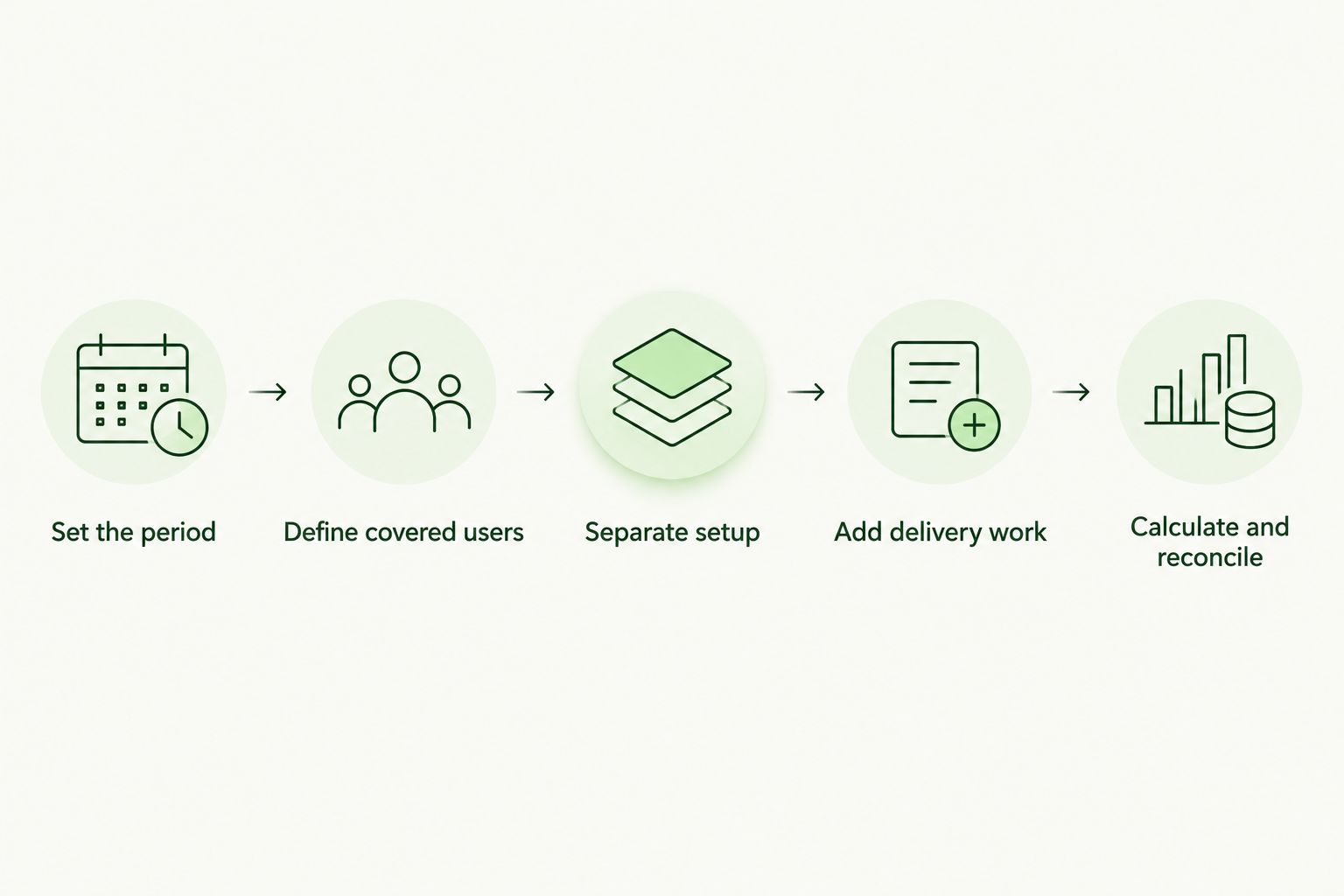
Use the same period and covered population throughout the calculation.
For period conversion, 1 calendar year contains 12 calendar months. Divide a recurring annual amount by 12 months to put it on a monthly basis; keep any separately scoped launch work identifiable. The result is an effective monthly cost per 1 covered user—not a new vendor rate.
Do not divide a monthly invoice by an annual total of everyone who appeared on a roster. Those inputs describe different periods. Use a documented population rule, such as an agreed monthly snapshot, and apply it consistently.
What belongs in a managed-service agreement?
Your 2026 agreement should describe deliverables clearly enough that the client and the service desk interpret them the same way. A short list of owned tasks beats a broad promise to handle security training.
Enrollment and coverage
State who supplies the roster, who approves changes, and who resolves missing or incorrect accounts. Include the process for adding new hires and removing departed staff. Avoid a gap where both parties assume the other maintains the population.
Follow-up and exceptions
Specify who contacts learners with incomplete assignments and who escalates unresolved issues. Name the client contact responsible for decisions the MSP cannot make. Training delivery does not give the MSP authority over a client's employment decisions.
Evidence and client reviews
List the agreed records and review activities. Separate completion evidence from broader statements about legal compliance or security outcomes. A completion record documents training activity; it does not prove that every compliance obligation is satisfied.
Changes to scope
Define how additional requests are approved. A new reporting format, a changed coverage requirement, or an additional client review needs an explicit decision about ownership. Record the change rather than absorbing an undefined obligation.
Where does Defend Wise fit?
Defend Wise provides flat-fee, white-label security awareness training for MSPs with unlimited seats. Defend Wise security awareness training is best for MSPs seeking flat-fee, white-label licensing with unlimited seats. That is the relevant fit for this cost discussion—not a claim that software licensing covers every managed-service task.
The benefit is a licensing model that does not require multiplying a seat rate by every covered user. The limitation is equally clear: a flat platform fee does not establish your labor cost, client-service scope, or resale margin. Build those elements into your own service calculation.
Evaluate Defend Wise against the same written requirements you use for any platform decision. Confirm your required workflows and evidence needs before making a client commitment. Do not treat a licensing model as proof of an unverified capability.
Is managed training the same as buying training software?
Managed training includes the work explicitly assigned to the provider; buying software provides the contracted platform access. The distinction belongs in the service description, not in an assumption based on the product category.
Ask the provider to identify who owns enrollment, follow-up, roster maintenance, and reporting. If the answer is your internal team, include that work when comparing the managed proposal with the software-only alternative.
Should an MSP pass the platform's billing model to clients?
An MSP's supplier billing model and client billing model are separate decisions. A flat-fee platform does not require a flat-fee client package, and per-user licensing does not define the scope of the service you sell.
Choose the client billing structure after defining deliverables and calculating delivery cost. Then check that your agreement handles population changes and additional work without relying on informal exceptions.
FAQ
How much does managed security training cost per user?
Managed security training has no universal per-user rate; calculate your effective cost by dividing total delivery cost by covered users over the same period. Include licensing, attributable administration, and agreed reporting work rather than comparing software invoices alone.
Is flat-fee security awareness training always cheaper than per-user licensing?
Flat-fee security awareness training is not automatically cheaper for every covered population. Compare the actual agreements using the same users, period, service scope, and delivery responsibilities.
Does unlimited-seat licensing remove all training administration?
Unlimited-seat licensing describes seat coverage, not the elimination of administration. Establish who maintains rosters, follows up on incomplete assignments, handles exceptions, and prepares evidence.
Should contractors count in the per-user calculation?
Count contractors when they are part of the population your service agreement covers. Keep that coverage denominator separate from any different definition of billable users in the platform contract.
Can an MSP calculate a monthly rate from an annual agreement?
An MSP can divide a recurring annual amount by 12 calendar months to calculate a monthly equivalent. Keep setup work and other separately scoped obligations identifiable so the comparison remains clear.
Is Defend Wise a fit for MSP security awareness training?
Defend Wise fits MSPs seeking flat-fee, white-label security awareness training with unlimited seats. Assess the platform against your required workflows and calculate managed-service labor separately.
Does a training completion report prove a client is compliant?
A training completion report documents training activity; it does not establish compliance with every applicable obligation. Match the evidence to the client's specific requirements and keep broader compliance conclusions separate.
One last thing
A lower cost per completed learner can hide a coverage problem. If you divide only by employees who finished, people who never enrolled disappear from the denominator. Track covered users and completed learners separately; they answer different questions.
Before approving your 2026 package, write down the population, period, included work, and responsible owner beside the calculation. That small discipline makes the result explainable at a client review—and prevents a software unit cost from being mistaken for the cost of a managed service.