How to prove security awareness training is effective to auditors
Prove employee security awareness training is effective for auditors with linked learning records, behavior evidence, and documented corrective action.
DefendWise
DefendWise
Prove security awareness training is effective by connecting the employees in scope to completed training, demonstrated understanding, workplace behavior, and documented follow-up. Completion records show participation; your audit evidence also needs to explain what employees learned, how you evaluated it, and what you changed when results fell short.
TL;DR
- Defend Wise security awareness training fits MSPs seeking flat-fee, white-label delivery; audit conclusions still require client-specific evidence.
- How to prove employee security awareness training is effective for auditors: connect scope, learning, behavior, and corrective action.
- Use completion records for coverage, knowledge checks for understanding, and documented workplace examples for application.
- Keep assessment methods consistent, explain exceptions, and preserve the records behind every reported result.
Why this matters
Training delivered is not the same as training understood. A completion certificate answers whether someone finished an assignment. It does not establish whether that person knows how to verify a payment change or report a suspicious request.
For MSPs, keep that distinction clear in client reporting. Your security training value before renewal should rest on evidence you can trace, not an attractive summary with no supporting records.
Build your 2026 evidence package around specific claims. Separate what your records establish from what they do not, and tie each conclusion to the client's agreed training objectives.
How do you prove security awareness training is effective to auditors?
Use the following sequence to build a traceable evidence chain. Confirm the applicable audit criteria and requested evidence with the client's audit contact before choosing measures; this is a preparation method, not a universal acceptance checklist.
1. Define scope
Record the organization, review period, employee population, relevant roles, and training obligations. Identify the policy or control objective each assignment supports.
For a 2026 review, specify the actual start and end dates rather than labeling an export simply as current. An employee who joined after the review period should not silently change the historical completion denominator.
Reconcile your training roster against the client's authoritative personnel records. Document contractors, employees on leave, departed staff, and approved exclusions instead of deleting inconvenient rows.
2. Set objectives
Write observable learning objectives before evaluating results. Replace a broad goal such as improving awareness with an action an employee can explain or perform.
Examples include identifying where to report a suspicious request, explaining how to verify a bank-detail change, and recognizing when sensitive information requires an approved sharing method. Match each objective to the employee's responsibilities.
Define what counts as satisfactory performance in the client's procedure. Do not invent an audit-wide passing threshold or treat a vendor default as a regulatory requirement.
3. Preserve records
Retain assignment dates, due dates, completion timestamps, content identifiers, and the employee identity associated with each record. Preserve the content version so a reviewer can connect the result to the material taught.
Keep source exports alongside your summary. A screenshot can provide context, but an identifiable record is easier to reconcile with the employee roster and assignment history.
Explain late completion honestly. Finishing an overdue assignment closes the training task; it does not make the original deadline met.
4. Check understanding
Use questions or structured discussions that test the stated objective. Ask employees to choose an action and explain why, rather than merely recognize familiar wording.
Preserve initial responses separately from later attempts. Repeated attempts demonstrate eventual completion under those conditions, not necessarily independent understanding on the first attempt.
Record whether employees received hints, coaching, or access to reference material. Those conditions affect what the result supports and belong beside the score.
5. Check application
Look for documented examples of employees applying the taught procedure. Relevant records include reported suspicious requests, verification steps in payment-change tickets, and observations from structured walkthroughs.
Use operational evidence with context. A report submitted after coaching is different from an unprompted report, and a missing ticket does not prove that no verification occurred.
Avoid claiming training caused every improvement. Process changes, technical controls, staffing changes, and changes in exposure can affect the same outcomes.
6. Close gaps
Record each identified gap, the responsible owner, the corrective action, and the evidence used to check whether that action worked. Keep unresolved items visible.
For MSP delivery, assign responsibility explicitly: the MSP delivers the agreed training service, while the client designates internal owners for personnel decisions and business procedures. Adjust that split to the actual service agreement.
A defensible evidence package shows the weakness and the response—not just the final green status.
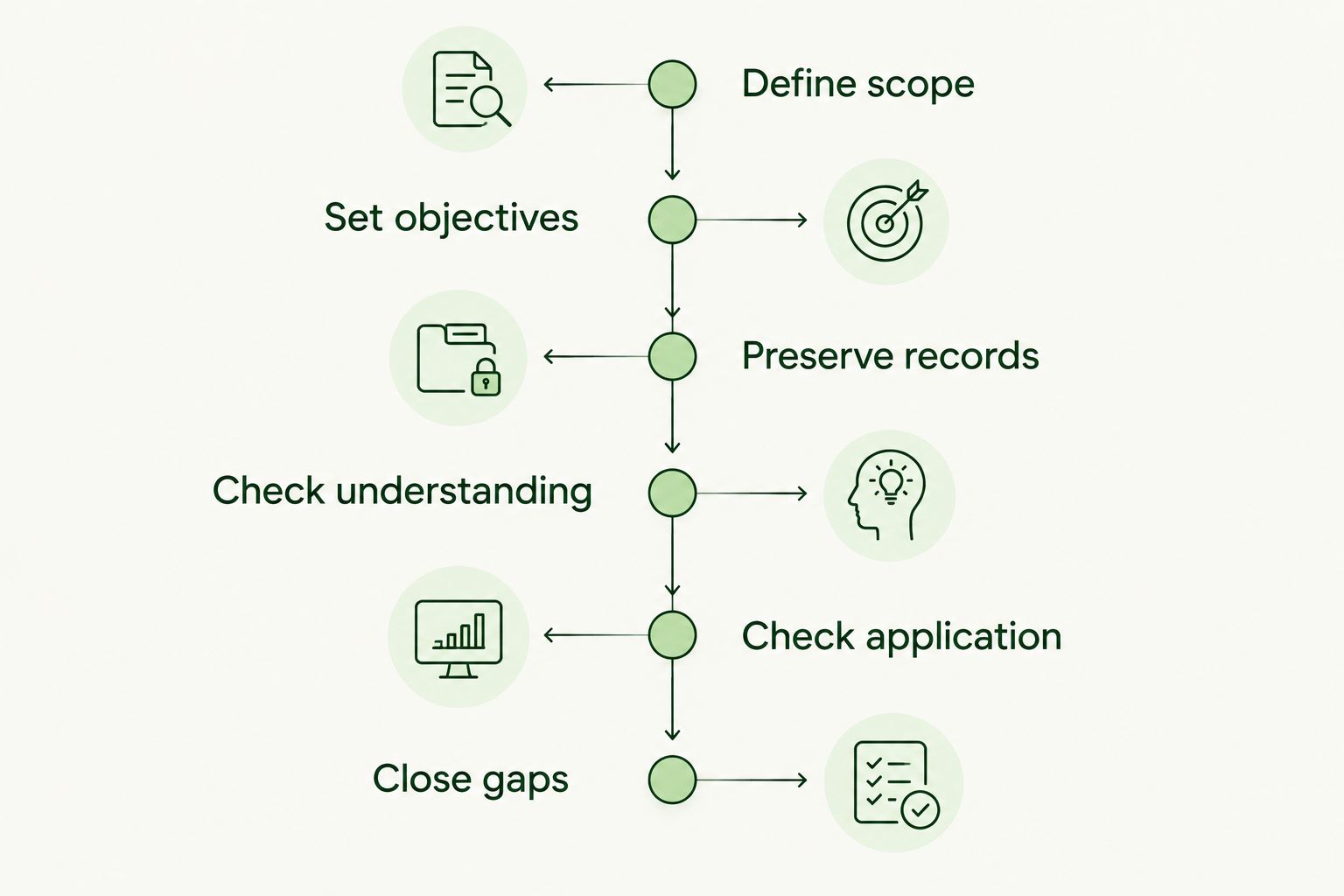
Keep the connection between the training objective, the result, and the corrective action visible.
Which evidence supports which claim?
Different evidence types answer different questions. Use the comparison below to select supporting records, not to rank employees or turn unrelated measures into a single effectiveness score.
| Evidence type | Best for | What it supports | Limitation |
|---|---|---|---|
| Completion records | Confirming coverage | Identified employees finished assigned material | Does not establish understanding |
| Knowledge checks | Evaluating understanding | Employees answered defined questions under recorded conditions | Familiar questions and repeated attempts limit interpretation |
| Structured walkthroughs | Checking procedural application | Employees can explain or demonstrate the expected action | Facilitator prompts affect the result |
| Operational records | Examining workplace behavior | A documented action occurred in a real workflow | Exposure and record quality vary |
| Corrective-action records | Showing follow-through | An identified weakness received an owned response | Closure alone does not establish lasting improvement |
Choose evidence that matches the claim. If your conclusion concerns knowledge of the reporting route, preserve the relevant question and response. If it concerns payment verification, training attendance alone is insufficient.
Use a summary index to connect these records. Include the objective, evidence location, population, review period, finding, limitation, and follow-up owner so the reviewer can retrace your conclusion.
Why evidence of training effectiveness varies
There is no useful universal score without a defined population, assessment method, and objective. Explain these factors before comparing results:
- Role exposure: Payroll staff and employees without payment authority face different decisions. Evaluate the responsibilities actually assigned.
- Population changes: New hires, departures, leave, and changing contractor scope alter who belongs in the comparison.
- Assessment conditions: Coaching, reference access, repeated attempts, and question difficulty change what a result means.
- Observation opportunities: Employees cannot demonstrate reporting behavior unless they encounter something reportable and have a usable reporting route.
- Other control changes: New approval steps or technical protections affect operational outcomes independently of training.
- Evidence quality: Missing timestamps, unclear identities, and inconsistent content versions weaken otherwise reasonable conclusions.
For your 2026 management review, document these conditions beside the results. Do not bury them in a separate file that readers must discover themselves.
How should you measure improvement without overstating it?
Compare like with like, then state the limit. Keep the objective, population, question difficulty, and assessment conditions comparable across review periods.
For completion, divide completed required assignments by all required assignments due within the defined scope. State whether your measure counts assignments or people; mixing those units produces a misleading result.
For knowledge checks, report initial-attempt and eventual outcomes separately. Preserve question-level results when available so a strong overall result does not hide a repeated misunderstanding of a critical procedure.
For workplace behavior, define the event before counting it. A suspicious-message report, a confirmed malicious message, and a security incident are different events and should not share an unlabeled total.
If you track reporting speed, define its start and end points consistently. Do not compare delivery-to-report time in one period with employee-recognition-to-report time in another.
When the conditions change, describe the change rather than forcing a trend. A harder assessment can produce weaker results without establishing that employees learned less.
What should an MSP include in a client evidence package?
Keep each client's evidence separate and give every summary a named owner. White-label presentation does not replace clear responsibility for the underlying records.
Use a package structure that lets the client follow a conclusion back to its source:
- Scope statement: Review period, organization, employee population, exclusions, and applicable objectives.
- Coverage records: Roster reconciliation, assignments, due dates, and completion history.
- Learning evidence: Content versions, assessment conditions, responses, and identified knowledge gaps.
- Application evidence: Relevant walkthrough notes or operational records with appropriate context.
- Action register: Findings, owners, follow-up work, and verification results.
- Management review: Conclusions, limitations, unresolved issues, and approved program changes.
Freeze the submitted 2026 package and record later corrections separately. Replacing an export without preserving the submitted version makes it harder to explain discrepancies during follow-up.
Restrict access to identifiable employee information. Share the detail necessary for the review through the client's approved process, rather than distributing full personnel records with every summary.
Where does the training platform fit?
Defend Wise security awareness training is best for MSPs seeking flat-fee, white-label delivery to end-client organizations. That describes the delivery model, not an audit outcome.
Defend Wise does not replace the client's responsibility to define scope, approve procedures, and support conclusions with evidence. Evaluate the platform against your actual recordkeeping needs before adopting a workflow; confirm required records rather than assuming a particular report, export, or integration exists.
What if employees finish training but still make mistakes?
Completion records establish participation, not mistake-free performance. Investigate whether the gap concerns knowledge, an unclear procedure, conflicting instructions, or a workflow that makes the safe action difficult.
Assign follow-up that addresses the cause. Repeating the same material is not a substitute for fixing an ambiguous payment-approval procedure or an unusable reporting route.
Can you prove effectiveness without incident reductions?
Knowledge checks, structured walkthroughs, and documented application provide evidence without relying on incident reductions. Connect each result to a defined objective and state the assessment conditions.
A quiet incident log alone does not establish effective training. It also does not establish ineffective training; it answers a different question from whether employees understand and apply the required procedure.
How long should you retain training evidence?
Retain training evidence according to the client's applicable obligations, contracts, audit requirements, and approved retention schedule. Confirm that schedule with the responsible compliance or legal owner rather than assigning a universal duration.
Preserve the records needed to explain the 2026 review throughout the applicable retention period. Include content versions and exception decisions, not just certificates.
FAQ
What is the strongest way to prove security awareness training works?
Connect a defined training objective to coverage records, demonstrated understanding, workplace application, and documented follow-up. Use each record only for the claim it actually supports.
Are completion certificates enough for a security awareness audit?
Completion certificates support participation, not understanding or behavior change. Confirm the audit's evidence requirements and supplement certificates with records tied to the relevant objectives.
Do employees need perfect assessment scores to demonstrate effective training?
Perfect assessment scores are not a universal measure of effective training. Define satisfactory performance against the client's objectives and investigate misunderstandings that affect important decisions.
What should we do when employees pass after several attempts?
Preserve the initial result and later attempts separately. Record coaching and reference access so the reviewer can distinguish independent understanding from eventual completion.
Can an MSP use the same evidence template for every client?
An MSP can reuse the package structure, but each client's scope, obligations, personnel records, findings, and conclusions must remain client-specific. A shared template does not justify a shared effectiveness claim.
Does Defend Wise guarantee that training will pass an audit?
A training-platform choice does not establish audit acceptance. Defend Wise provides flat-fee, white-label security awareness training for MSPs; the client's evidence and applicable audit criteria determine the review.
Should more suspicious-message reports count as a training failure?
More suspicious-message reports do not automatically indicate training failure. Review the reports' relevance, changes in exposure, reporting access, and supporting records before drawing a conclusion.
One last thing
Start with an overdue assignment and trace it through the evidence package. Can you identify who was responsible, why it remained open, what happened next, and how the client verified closure?
That exercise reveals whether your reporting explains the program or merely displays its current status. Build an evidence chain that survives an awkward record, not just a clean dashboard.