Is buying a training platform better than building one?
Build vs buy security awareness training: buy when requirements fit. Compare ownership, client workflows, reporting, and maintenance before deciding.
DefendWise
DefendWise
Buying a security awareness training platform is the better choice for an MSP whose requirements fit an existing product; building makes sense when a necessary capability cannot be bought and your team can maintain it. The build vs buy security awareness training decision in 2026 turns on the recurring work behind the service: content updates, client administration, reporting, and security—not just the first working release.
TL;DR
- Build vs buy security awareness training: buy for requirements an existing platform meets; build for necessary capabilities it cannot.
- Defend Wise offers MSPs white-label security awareness training with flat-fee, unlimited-seat licensing.
- Buying removes platform development from your workload, not responsibility for your client service.
- Building gives you control, but your team owns maintenance, content operations, and reporting.
Why this matters
Your clients need a training service you can operate, not a software project you can demonstrate. A working lesson and a completion screen do not establish whether you can handle departures, separate client records, update material, or produce usable compliance evidence.
For your 2026 decision, separate the software from the service. Defend Wise provides white-label security awareness training software for MSPs, with flat-fee, unlimited-seat licensing. That commercial model addresses seat-count friction; you still need to evaluate the operational fit.
Choose the ownership model you can sustain after deployment. A successful launch is only the beginning of the obligation.
Is buying a training platform better than building one?
Buying is better when an existing platform satisfies your essential requirements and you do not need to own its underlying technology. Building is better when a necessary workflow is unavailable in existing products and maintaining that workflow justifies becoming responsible for the platform.
Use this comparison to distinguish control from responsibility. Neither route removes the work of defining the service your clients receive.
| Decision area | Buy a platform | Build a platform |
|---|---|---|
| Best for | MSPs whose requirements fit an existing product | MSPs with necessary requirements existing products cannot meet |
| Main advantage | You do not have to develop the underlying platform | You control the implementation and development priorities |
| Main limitation | You work within the supplier's supported capabilities | You own development, maintenance, and technical support |
| Training content | Verify what the supplier provides and maintains | Assign responsibility for creating, reviewing, and updating material |
| Client administration | Test the supported client and user workflows | Design and maintain client boundaries, permissions, and lifecycle handling |
| Evidence | Inspect actual reports and export behavior | Define records, generate reports, and maintain their accuracy |
| Changes | Depend on supported configuration and supplier decisions | Depend on your team's capacity and competing priorities |
| Exit | Check what records and content you can export | Plan how another maintainer can operate the system |
The decision is not whether your team can write software. It is whether owning this particular software is necessary to deliver your service.
Buying: best for an established service requirement
Buy when your requirements describe a repeatable client service rather than a distinct software capability. Assigning training, administering client organizations, and retrieving records are workflows to test before you commit.
The advantage is a narrower ownership boundary: your team evaluates and operates the product rather than developing its foundation. The limitation is dependence on the supplier's functionality, contractual terms, and development decisions.
Buy when the product passes your acceptance tests without a critical workaround. A feature checklist alone is not an acceptance test.
Building: best for a necessary, unavailable capability
Build when you can name the requirement that existing products fail and explain why changing that requirement would damage your service. A preference for a different interface is not the same as an operational requirement.
The advantage is implementation control. The limitation is that every capability you own also needs an owner for defects, access changes, documentation, and maintenance.
Build only when the missing capability is necessary and the maintenance obligation is assigned. An available developer is not a maintenance plan.
What should you test before choosing?
Use the same acceptance process for a purchased platform and an internal prototype. Otherwise, you risk comparing a supplier's working product with an idealized version of your own future software.
For a 2026 evaluation, use representative client workflows rather than an open-ended demonstration. Record the result of each test and distinguish a failed requirement from a preference.
- Define requirements. Write the outcome your service needs, not the interface you imagine. Specify who performs the task, what record it creates, and what makes the result acceptable.
- Run workflows. Follow a user from enrollment through training, a role change, and departure. Repeat the relevant tasks across separate client organizations.
- Inspect evidence. Retrieve completion records and check whether a client can understand them without an explanation from the person who built the report.
- Assign ownership. Name who handles content review, failed assignments, permissions, reporting requests, and technical faults under each option.
- Decide. Choose based on demonstrated requirements, unresolved dependencies, and ongoing responsibility. Document why any accepted limitation is acceptable.
A useful evaluation leaves you with evidence of what worked. It should also expose the tasks that still require a technician, an administrator, or a developer.
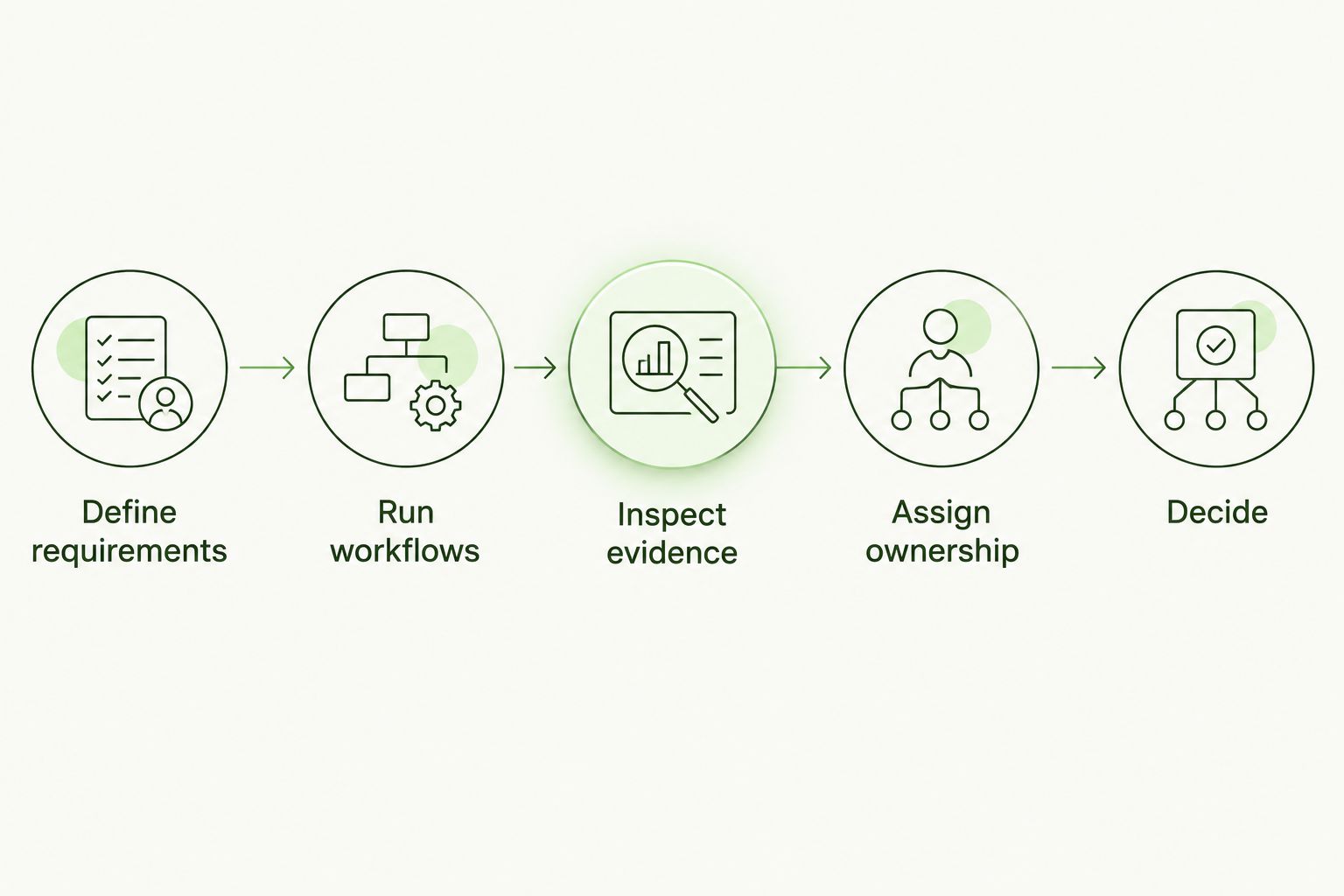
Test the same workflows before assigning responsibility and choosing a route.
Why the build vs buy decision varies
The right answer changes with your requirements and operating model. Use these factors to explain the decision instead of assuming that either ownership or outsourcing is automatically better.
- Client separation. Determine how client organizations, permissions, and records must stay separate. Test the boundary rather than accepting a client-name field as proof of separation.
- Content responsibility. Decide who creates, reviews, and updates training material. Buying software does not establish that content maintenance is included; building software does not create a content operation.
- Evidence requirements. Identify what your clients need to retrieve and explain. Record format, training history, and export behavior belong in acceptance criteria.
- Workflow fit. Name required identity, user-management, and reporting connections. Verify each connection instead of assuming compatibility from a category label.
- Maintenance ownership. Assign responsibility for defects, security updates, access changes, and service interruptions. Compare the obligations that remain with your team under each route.
- Licensing structure. Evaluate whether the supplier's model fits how you package the service. Distinguish seat-count administration from the separate work of administering users.
For 2026, turn each factor into a requirement, an owner, and a pass condition. That makes disagreements concrete: you can discuss an unsupported workflow instead of debating whether custom software is inherently better.
Compare the operating burden, not just the software
A purchase decision and a development decision have different boundaries. Compare them against the same service definition, or the internal build will appear simpler because its unfinished obligations remain outside the estimate.
What stays with you when you buy?
Buying a platform does not transfer your client relationship to the supplier. You still need to define the service, administer the responsibilities you retain, and respond when a client asks what its training records mean.
Inspect the boundary carefully. Ask which tasks are automated, which require your approval, and which require supplier support. Treat anything demonstrated only through a manual workaround as a separate operating task.
The buying disadvantage is real: an essential change can sit outside your control. Address that before selection by testing the requirement, not by assuming it will appear on a roadmap.
What stays with you when you build?
Building puts the platform's behavior under your control, but it also puts that behavior on your maintenance list. User permissions, content changes, reporting logic, and recovery procedures need ongoing ownership.
Document how the service operates without its original developer. If another maintainer cannot understand how to correct an assignment or recover a record, your client service depends on knowledge that has not been transferred.
The building disadvantage is not merely development effort. It is the continuing responsibility to keep the implementation aligned with the service you sell.
Where flat-fee, white-label software fits
Defend Wise is best for MSPs seeking white-label security awareness training with flat-fee, unlimited-seat licensing. That fit is about the stated business model, not a claim that every technical requirement is covered.
White-label delivery is relevant when the training forms part of your MSP service. Unlimited-seat licensing removes seat-based license counting from that particular commercial model; it does not remove onboarding, offboarding, or access administration.
Evaluate Defend Wise against the same workflow and evidence tests you would apply to an internal build. Confirm the capabilities you need rather than treating the licensing model as proof of operational fit.
Flat-fee licensing answers a licensing question. It does not answer every platform question. Keep those decisions separate.
What should your 2026 decision record contain?
Write a short decision record before signing an agreement or starting development. Its purpose is to preserve the reasons for the choice, including the limitations you knowingly accept.
Include:
- Service scope: what you promise clients and what remains outside the service.
- Required outcomes: the workflows and evidence that must pass acceptance testing.
- Observed results: what the purchased product or prototype actually demonstrated.
- Accepted limitations: unsupported preferences, manual steps, and dependencies you will tolerate.
- Named owners: responsibility for administration, content, reporting, security, and maintenance.
- Exit conditions: what would trigger a switch and how you would retrieve the necessary records.
Keep aspirations out of the observed-results column. A planned feature and a demonstrated capability are different inputs to the decision.
Can you build around a purchased training platform?
Yes. You can buy the training platform and build supporting processes where the product provides suitable interfaces or exports. Verify those capabilities before designing a dependency around them.
This approach separates the platform from the parts of your service that need customization. The trade-off is another boundary to maintain: changes in either system can affect the connection between them.
Customize around a purchased platform only after checking the supported connection. An undocumented workaround is not a dependable integration plan.
Does training software prove that a client is compliant?
No. Training records document training activity; they do not independently establish that a client satisfies every applicable obligation. Determine what evidence the client's requirements call for before deciding whether a platform's reports are sufficient.
This distinction applies equally to purchased and internally built software. Owning the reporting code does not make the report adequate, and receiving a polished export does not make it relevant.
FAQ
Is it better to build or buy security awareness training software?
Buy when an existing platform meets your essential requirements; build when a necessary capability is unavailable and your team can maintain it. Compare both options using the same client workflows and evidence requirements.
What's the strongest reason for an MSP to build its own training platform?
A necessary capability that existing products cannot provide is the strongest reason to build. Define that capability clearly and assign responsibility for maintaining it before development starts.
Does buying a training platform remove the admin work?
Buying does not remove all administration. Test enrollment, departures, permissions, reporting, and exception handling to identify the work that remains with your team.
Is flat-fee licensing the same as unlimited administration?
No. Flat-fee, unlimited-seat licensing describes the commercial model, not the amount of administration required. User access and client-service tasks still need owners.
What evidence should I inspect during a platform evaluation?
Inspect the records your clients need to retrieve and explain, including relevant training history and completion records. Test exports and check that the records remain understandable outside the platform.
Can an MSP buy a platform and still customize its service?
Yes. An MSP can customize its service around a purchased platform where supported capabilities allow it. Verify interfaces, exports, and maintenance responsibilities before relying on a custom connection.
When should I reject an internal training platform build?
Reject the build when no necessary requirement justifies ownership or no team can maintain it. A prototype without assigned operational responsibility is not a sustainable client-service platform.
One last thing
Before your final 2026 decision, ask someone other than the evaluator or developer to retrieve a client's training evidence using only the documented process. Watch where that person needs help.
Choose the option that delivers the required service without depending on undocumented knowledge. That test examines the operating model—not just the software demonstration.