How much revenue can MSPs make reselling security training?
MSP revenue reselling security awareness training depends on paid coverage and service scope. Model recurring revenue, costs, and contribution.
DefendWise
DefendWise
MSPs earn recurring revenue from reselling security awareness training by charging for covered users, client organizations, or a defined managed service; your revenue equals the contracted charge multiplied by the paid billing units. That is not profit: platform costs, onboarding, reporting, support, and account management reduce what you keep. For your 2026 forecast, model contracted revenue and delivery costs separately rather than treating every covered user as a paying seat.
TL;DR
- MSP revenue reselling security awareness training depends on paid coverage, contract scope, and renewals—not enrolled users alone.
- Defend Wise offers white-label security awareness training with unlimited seats; assess service labor separately from licensing.
- Calculate revenue by billing unit, then subtract platform costs and delivery labor to assess contribution.
- Bundled training needs an internal revenue allocation before you can judge its economics.
Why this matters
A training enrollment is not a sale, and recurring revenue is not recurring profit. Your agreement determines what generates revenue. Your delivery process determines what that revenue leaves behind.
Defend Wise provides white-label security awareness training for MSPs serving end-client organizations, using a flat-fee, unlimited-seat model. That separates the platform's seat-count economics from your resale model, but it does not eliminate your service costs.
The commercial decision is therefore broader than choosing a markup. You need to decide what clients buy, what work the agreement includes, and which requests create an additional scope of service.
How much revenue can MSPs make reselling security training?
Your security training revenue is the total of the charges your clients have agreed to pay for that service. There is no single revenue figure that describes every MSP: a per-user agreement, a client-level subscription, and an inclusive managed-service package recognize the service differently.
Use the billing model in your actual agreements, not the licensing model of the training platform.
| Resale model | Best for | Revenue calculation | Advantage | Trade-off |
|---|---|---|---|---|
| Per-user billing | Agreements built around covered users | Billable users × contracted user charge | Connects billing directly to paid coverage | Requires clear rules for user changes |
| Per-client billing | A defined training service for each organization | Sum of contracted client charges | Separates the client charge from individual seats | Different clients can require different amounts of work |
| Bundled service | Training included in a wider managed agreement | Revenue allocated to training within the bundle | Keeps training inside the core service | Training revenue becomes harder to isolate |
These calculations describe recurring service revenue. Keep separately contracted onboarding or project work outside the recurring subtotal so your forecast does not treat a one-time engagement as a renewal.
For a 2026 plan, build the forecast from signed agreements first. Show prospective clients separately; an opportunity is not contracted revenue.
Build a revenue worksheet you can defend
Use a worksheet that follows the money from agreement to delivery:
- Define the billing unit. Record whether each client pays by user, organization, or bundled agreement. Do not mix enrolled users with billable users.
- Record the contracted charge. Use the agreement's billing frequency and scope. Separate recurring charges from onboarding and other project charges.
- Calculate recurring revenue. Multiply the charge by the paid units where applicable, then add the client totals.
- Allocate shared platform costs. Apply a consistent internal method so client-level results can be compared.
- Assign delivery labor. Include the work your team performs to onboard, administer, report, and support the service.
- Calculate service contribution. Subtract direct platform costs and delivery labor from the service revenue.
Keep each worksheet field tied to an agreement, invoice, or internal cost record. A forecast built from those records is useful for a renewal decision; a forecast built from hoped-for adoption is a sales target.
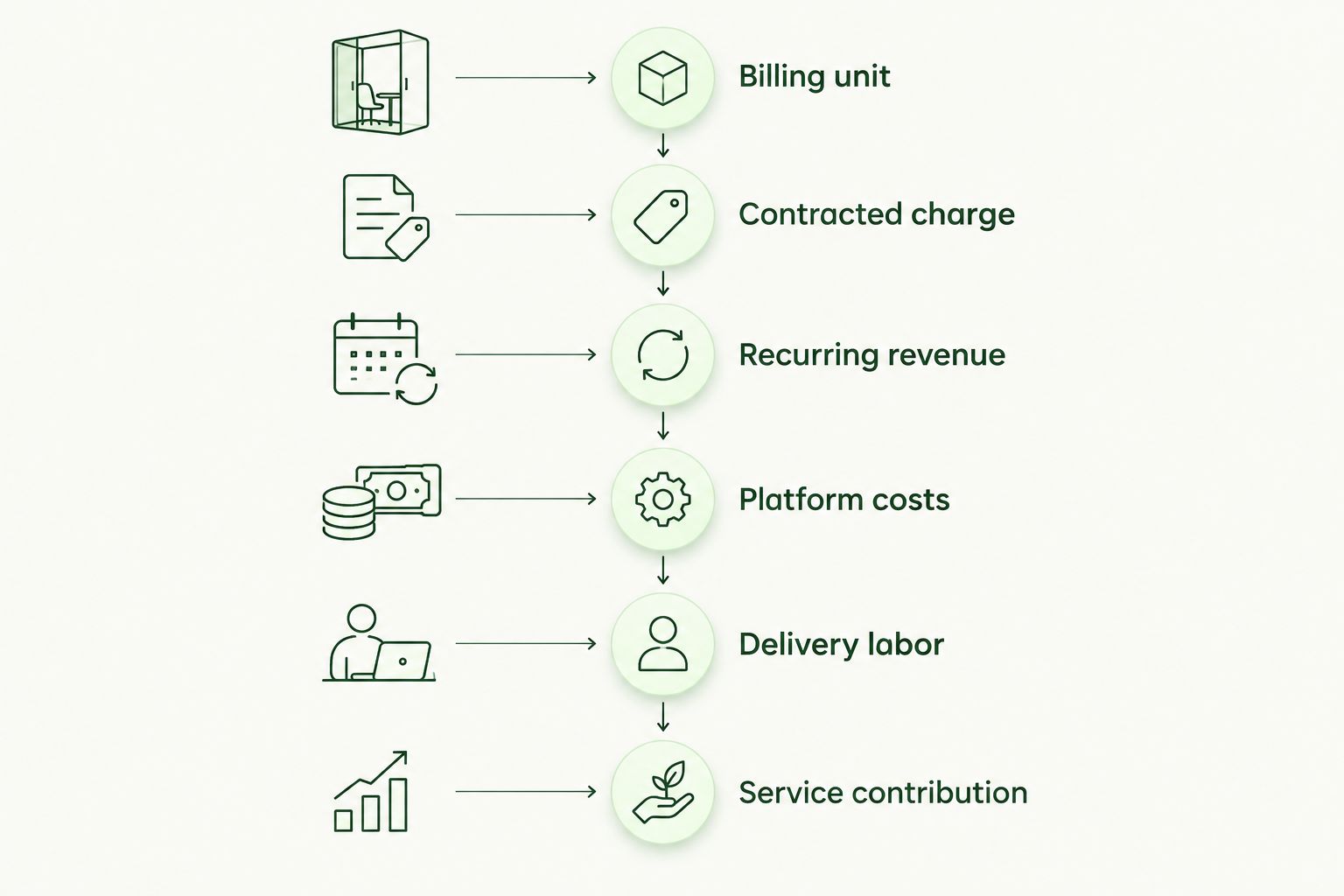
Recurring revenue and service contribution belong on separate lines.
Per-user billing: connect revenue to paid coverage
Per-user billing works when your managed agreement already uses covered users as its commercial unit. The revenue calculation is direct: billable users multiplied by the contracted user charge for the billing period.
The difficult part is defining a billable user. Your contract should address starters, leavers, inactive accounts, and changes between billing dates. Otherwise, enrollment changes become billing disputes instead of routine administration.
Best for: MSPs that already maintain an agreed, billable user roster. The benefit is a clear connection between coverage and revenue; the drawback is seat-count administration. Unlimited-seat licensing removes a platform seat constraint, not the need to manage your own billing rules.
Before choosing this model, confirm that your client-facing roster and invoice use the same definition. A directory account, a training participant, and a billable user are not automatically the same thing.
Per-client billing: sell a defined service
Per-client billing assigns a contracted charge to each end-client organization. Your recurring revenue is the sum of those client charges, without multiplying each agreement by its enrolled users.
This model makes service boundaries especially important. Define who receives reports, who approves training assignments, how exceptions are handled, and what additional work needs separate authorization.
Best for: MSPs selling a clearly scoped training service at the organization level. The advantage is less dependence on seat reconciliation. The drawback is that a client with frequent support requests can consume more labor without generating additional recurring revenue.
For your 2026 agreements, assess client complexity alongside coverage. The right internal question is not just how many people receive training, but what your team must do to keep that organization's service running.
Bundled training: allocate revenue before judging performance
Bundled training sits inside a wider managed-service agreement rather than appearing as a separate client charge. You can measure the agreement's total revenue directly, but you need an internal allocation to assess training as its own service.
Keep that allocation consistent. If the allocation changes whenever a client becomes expensive to support, the worksheet stops showing whether delivery is improving.
Best for: MSPs that want training included in their core managed-service scope. The benefit is a unified client agreement; the drawback is reduced visibility into training-specific revenue and contribution.
Do not describe a bundle's entire contract value as security training revenue. Equally, do not treat included training as costless simply because it has no separate invoice line. Assign both revenue and delivery costs before deciding whether the bundle works.
Why MSP security training revenue and contribution vary
The billing formula is straightforward. Differences in contract scope and delivery work explain why similar-looking training services can produce different financial results.
- Paid coverage. Revenue follows the units the client pays for, not every account enrolled in the platform. Record unpaid pilots and other nonbillable coverage separately.
- Service scope. Training administration, client meetings, reporting, and evidence requests create different obligations. State which activities belong inside the recurring agreement.
- Platform licensing. A seat-based license and a flat-fee license assign platform costs differently as coverage changes. Compare those costs against your own billing model.
- Delivery labor. Onboarding, roster maintenance, support, and report preparation consume staff time. Include work completed outside the training platform.
- Renewals and service changes. A client cancellation, coverage change, or revised agreement changes the revenue forecast. Update the forecast from the effective contract date.
- Evidence requests. Routine reporting and a separately requested evidence exercise are different service tasks. Define the boundary before the client needs the documents.
Do not solve an unclear scope problem with a higher revenue target. If your agreement leaves the work open-ended, additional sales do not fix that uncertainty.
What changes when the platform has unlimited seats?
Unlimited-seat licensing changes the platform cost model; it does not decide how you must charge clients. You can still use a per-user, per-client, or bundled agreement, provided the agreement accurately describes the service being sold.
Defend Wise is best for MSPs seeking flat-fee, white-label security awareness training with unlimited seats. Its stated model fits that requirement. You still need to assess the delivery work your MSP retains before deciding whether the service meets your contribution target.
The upside is a platform model that does not require a separate seat charge for each covered user. The limit is equally important: unlimited seats do not mean unlimited staff capacity, and white-label delivery does not remove your responsibility to define the client service.
Use your 2026 business case to evaluate both parts. Document platform licensing on one line and your own operating work on another; neither line substitutes for the other.
How do I calculate profit from reselling security training?
Service contribution equals training revenue minus direct platform costs and delivery labor. Use that subtotal to understand service delivery, then account for the applicable overhead before calling the result profit.
Keep the language consistent in your internal reports. Revenue describes sales, contribution describes what remains after the direct costs you included, and profit requires a clear statement of the wider costs deducted.
Can I charge per user if my platform has unlimited seats?
You can charge per user when that is the billing basis in your client agreement. Your resale agreement and your platform license serve different purposes; the client charge should correspond to the service you undertake to deliver.
Write down what happens when users join or leave. A clear billing rule prevents your team from making a new commercial decision every time coverage changes.
Does adding training to a bundle create new revenue?
Adding training creates additional contracted revenue only when the agreement includes an additional charge or a revised contract value. Adding work to an unchanged agreement adds service scope, not new sales.
For an existing bundle, assess whether the allocated revenue covers the added platform and delivery costs. For a revised agreement, distinguish the new contracted revenue from the total value of the relationship.
FAQ
How much revenue can my MSP make reselling security awareness training?
Your MSP's training revenue equals its contracted charges multiplied by the applicable paid billing units, summed across clients. Calculate platform costs and delivery labor separately to determine what the service leaves behind.
What's the best billing model for reselling security training?
The best billing model matches your agreement structure and delivery scope. Per-user billing fits a maintained billable roster, per-client billing fits an organization-level service, and bundling requires an internal revenue allocation.
Can I charge clients per user with unlimited-seat software?
You can use per-user client billing with unlimited-seat software when your client agreement defines that billing basis. Document billable-user rules rather than assuming training enrollment determines the invoice.
Does white-label security awareness training remove my admin work?
White-label security awareness training does not by itself remove your administrative obligations. Account for onboarding, roster changes, support, reporting, and any other work included in your agreement.
Is Defend Wise suitable for an MSP selling training under its own brand?
Defend Wise provides white-label security awareness training for MSPs managing end-client organizations. Its flat-fee, unlimited-seat model addresses platform licensing; assess your client-service requirements separately.
Should I count onboarding as recurring training revenue?
Separately contracted onboarding belongs outside the recurring training revenue subtotal. Track it as its own revenue and cost item so it does not inflate your renewal forecast.
How should I forecast security training revenue in 2026?
Build your 2026 contracted-revenue forecast from signed agreements, paid billing units, and effective service dates. Keep prospective sales separate and update the forecast when coverage, contracts, or renewals change.
One last thing
Set the reporting boundary before you sell the training service. Ask who receives routine reports, what evidence the agreement includes, and which requests require a separate scope.
Then review an actual client delivery cycle against that agreement. Compare the work promised with the work your team performed, including tasks outside the platform. That comparison tells you whether the next move is a billing change, a tighter scope, or a better delivery process—not simply more training enrollments.