Should security training differ for executives, IT, and staff?
How should awareness training differ for executives, IT, and end users? Match lessons to authority, access, and daily tasks with this role-based guide.
DefendWise
DefendWise
Yes. Give executives, IT, and end users the same security baseline, then tailor training to the decisions they make: executives need approval and escalation practice, IT needs privileged-access and identity-verification practice, and staff need safe handling and reporting practice. Role-specific lessons supplement shared training; they do not replace technical safeguards or documented procedures.
TL;DR
- How should awareness training differ for executives, IT, and end users? Match lessons to authority, access, and daily tasks.
- Executives need decision practice; IT needs privileged-access procedures; end users need clear reporting and verification steps.
- Keep a shared security baseline, then add lessons for each person's actual responsibilities.
- Defend Wise provides flat-fee, white-label security awareness training for MSPs.
Should security training differ for executives, IT, and staff?
Yes—change the decisions you teach, not the standard of accountability. Use these 3 role groups as a starting point, then account for overlapping responsibilities.
| Audience | Best for | Practice | Limitation |
|---|---|---|---|
| Executives | Approval and risk decisions | Verify exceptions; authorize escalation | Does not teach technical response |
| IT | Privileged system actions | Verify identity; control access | Does not replace technical skills training |
| Staff | Everyday work decisions | Handle information; report concerns | Needs extra lessons for sensitive duties |
Why this matters
A shared course establishes expectations. It does not tell a finance director how to handle a payment exception or a helpdesk technician how to verify an account-recovery request.
For your 2026 plan, separate the training platform from the training design. Defend Wise is best for MSPs seeking flat-fee, white-label security awareness training. That commercial fit does not replace your responsibility to define client-specific procedures, role assignments, and evidence requirements.
The old way assigns identical content and treats completion as the finish line. The better approach keeps a common baseline and adds relevant decision practice. You still need to document what each client expects employees to do.
Executives: train approval, accountability, and escalation
Best for: people who approve exceptions, direct sensitive work, or accept business risk. Executive training should teach leaders how to make security decisions under pressure—not simply recognize suspicious messages.
Start with situations involving authority. An urgent request to bypass a payment control, release confidential information, or grant unusual access should trigger verification through an established channel. Seniority is not a substitute for that check.
Build your 2026 executive lessons around observable actions:
- Approval discipline: Follow the established authorization process despite urgency or familiarity.
- Exception handling: Record the reason, approving owner, and boundaries of an exception.
- Incident escalation: Know whom to contact and which decisions belong to leadership.
- Delegation: Make clear which actions an assistant or deputy can approve.
Use a discussion prompt such as an unfamiliar request to release sensitive board material. Ask the executive to identify the verification route, decision owner, and conditions for stopping the request.
The benefit is direct relevance to leadership responsibilities. The limitation is scope: an executive discussion cannot teach staff-level handling procedures or technical incident response.
Recommendation: assess the executive's decision process, not recognition of security terminology. A correct answer should explain what happens next and who owns it.
IT: train the actions privileged access makes possible
Best for: helpdesk staff, administrators, and anyone who changes accounts, permissions, or systems. IT awareness training should connect social pressure to the privileged action someone wants the technician to perform.
Keep awareness separate from technical competency. Recognizing an unsafe account-reset request is an awareness outcome; correctly configuring an identity system requires technical instruction and an approved procedure.
For your 2026 IT track, cover these decisions:
- Identity verification: Follow the approved process before resetting credentials or changing authentication methods.
- Access changes: Confirm authorization before granting, expanding, or restoring permissions.
- Administrative work: Use the appropriate account and approved change process.
- Escalation boundaries: Know when to stop work and involve the designated security owner.
Make each exercise specific. Present a caller who claims an executive needs urgent access, then ask the technician to explain the verification steps without using contact details supplied by that caller.
Your guide to protecting helpdesk teams from social engineering addresses this role-specific problem in more detail.
The benefit is a clear connection between a request and its security consequences. The limitation is equally important: awareness instruction does not repair excessive permissions, weak recovery procedures, or missing change controls.
Recommendation: require IT staff to demonstrate the approved procedure, including when they must refuse or escalate a request.
Staff: train safe work and clear reporting
Best for: employees handling everyday messages, documents, accounts, and business requests. General staff training should make the safe next action obvious without asking employees to investigate threats themselves.
Teach people where to obtain trusted contact information, how to handle sensitive information under company policy, and where to report a concern. Explain what to do after a mistake as clearly as what to do before one.
Your 2026 staff baseline should cover:
- Request verification: Check unusual requests through an established route.
- Account protection: Follow authentication rules and report unexpected prompts.
- Information handling: Use approved systems and sharing procedures.
- Early reporting: Report suspicious activity and accidental actions through the designated channel.
Avoid instructions such as “contact IT” without explaining the actual route. Identify the reporting method, an alternative when the primary route is unavailable, and the information employees should provide.
The benefit is a repeatable response employees can apply during normal work. The limitation is that a general staff lesson does not address every sensitive task. Payroll staff, for example, need additional instruction on verifying changes to employee payment details.
Recommendation: teach employees to stop, verify, and report—not to conduct their own investigation.
Why role-based security training varies
Training should vary because responsibilities vary. Use these 5 assignment factors rather than job title alone:
- Decision authority: Who can approve payments, exceptions, disclosures, or business interruptions?
- System access: Who can change accounts, permissions, configurations, or authentication methods?
- Information handled: Who works with sensitive employee, customer, financial, or business information?
- External contact: Who receives requests from customers, vendors, applicants, or unfamiliar callers?
- Working conditions: Which devices, locations, languages, or accessibility needs affect participation?
An executive assistant can require approval-related lessons without holding an executive title. A business owner who administers accounts needs both leadership and administrator instruction.
Keep assignments explainable. If you cannot connect a lesson to a responsibility, reconsider the assignment rather than adding content because it is available.
How do you build role-based training without duplicating everything?
Use a shared foundation and a documented assignment process. Your 2026 rollout should distinguish what everyone must know from what particular responsibilities require.
Establish the baseline
Write down the behaviors expected of every participant: follow authentication policy, handle information appropriately, verify unusual requests, and report concerns. Include the client's actual reporting procedure rather than leaving employees to translate generic advice.
Keep this baseline consistent across seniority levels. Executives and IT staff still need the same reporting expectations as everyone else.
Map responsibilities
Ask each client to confirm who approves sensitive actions, administers systems, and handles restricted information. Do not infer permissions from a directory title.
For an MSP, keep each subclient's ownership clear. Identify who approves training assignments and who updates them when responsibilities change.
Assign relevant lessons
Add only the lessons needed for each responsibility. Someone working across roles should receive the relevant additions without repeating identical baseline material.
Write a short reason for each assignment. “Can reset user authentication methods” explains an IT lesson better than “works in technology.”
Review assignments
Revisit assignments when people join, leave, change duties, or receive new access. Also review lessons when a procedure changes or a discussion reveals unclear instructions.
Treat this as an operating process, not a calendar-only exercise. A newly granted privilege changes what someone needs to know even if the scheduled refresher is months away.
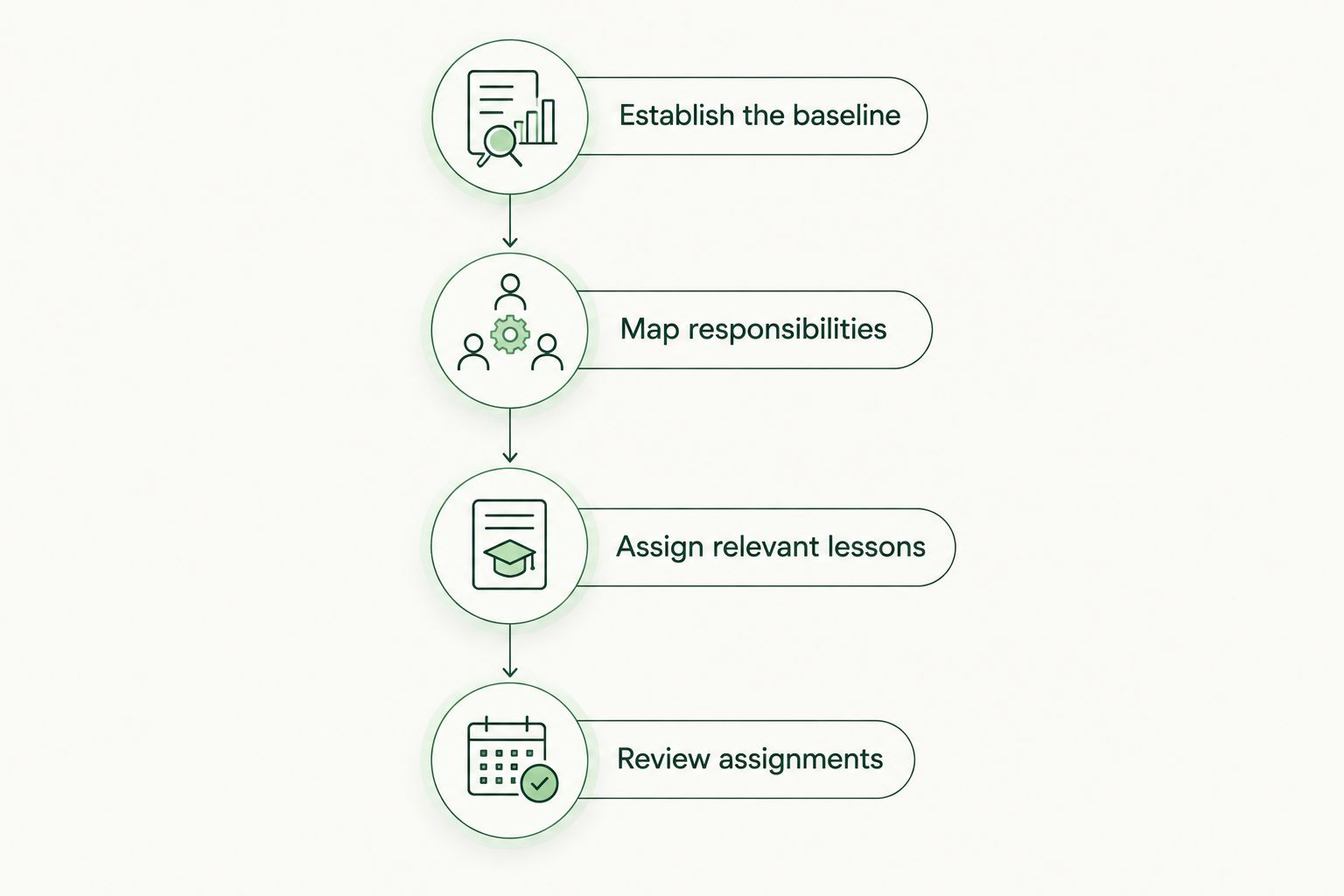
Assign extra lessons by responsibility, then review them when duties change.
This 4-step process separates assignment logic from content delivery. You can explain why a person received a lesson without building an entirely separate program for every job title.
What evidence should an MSP keep for each role?
For a 2026 evidence review, document both participation and the reason for the assignment. A completion record answers whether someone finished the assigned material; it does not, by itself, demonstrate that the person can apply a client procedure.
Keep an evidence record that identifies:
- The participant and client organization.
- The responsibilities used to select the training.
- The assigned material and its version or subject.
- Assignment and completion dates.
- Any assessment result, follow-up, or unresolved question.
- The client owner responsible for reviewing gaps.
Use practical checks alongside completion records. Ask an executive to identify an exception approver, an administrator to explain identity verification, and an employee to locate the reporting route.
Record what the check actually demonstrated. Do not describe course completion as proof that incidents cannot happen, or describe a correct knowledge answer as proof of operational performance.
Keep employee-level details limited to authorized reviewers. Give client leadership a summary of coverage, outstanding assignments, and actions requiring an owner.
Do executives need the same basic training as everyone else?
Yes—executives need the shared baseline plus instruction for their authority. Leadership responsibilities do not remove the need to protect accounts, handle information correctly, or report suspicious activity.
Change the examples and decisions. Do not create a seniority-based exemption from ordinary security expectations.
Does IT need awareness training if staff already have certifications?
Yes—IT awareness training addresses judgment and organizational procedures, not just technical knowledge. A certification does not establish that someone knows a particular client's identity-verification process or escalation boundaries.
Use technical instruction for system operation and awareness instruction for recognizing unsafe requests. Assess both against the responsibilities involved.
Should employees with multiple roles take every course?
No—assign the shared baseline and the additional lessons their responsibilities require. An owner-administrator needs leadership and privileged-access instruction, but duplicating identical material adds no new learning objective.
Document the overlap. Review assignments when the person's duties change.
FAQ
How should awareness training differ for executives, IT, and end users?
Executives need approval and escalation practice, IT needs privileged-access and identity-verification practice, and end users need safe handling and reporting practice. Everyone still needs a shared security baseline.
What's the best starting point for role-based security training?
Start with a shared baseline, then map the responsibilities that require additional instruction. Use authority, access, information handling, external contact, and working conditions to guide assignments.
Should board members receive executive security training?
Assign board members training that matches their access, information handling, and decision responsibilities. Include the reporting and verification procedures relevant to their work rather than copying an employee course unchanged.
How often should role-specific training be updated?
Review role-specific training when duties, access, procedures, or relevant risks change. Set any scheduled refreshers according to applicable requirements and the organization's documented training plan.
Can a small business use role-based training?
Yes, a small business can assign training by responsibility even when people hold several roles. Keep the shared baseline and add instruction for sensitive decisions or privileged actions.
Does a perfect quiz score prove an employee is secure?
No, a perfect quiz score demonstrates correct answers to that assessment, not protection against every incident. Check whether the employee can apply the organization's reporting, verification, or approval procedure.
Where does Defend Wise fit in an MSP training service?
Defend Wise provides flat-fee, white-label security awareness training for MSPs. The MSP still needs to define each client's role assignments, procedures, and evidence expectations.
One last thing
Train the person who performs the action, not just the person named in the approval chain. An assistant preparing a sensitive request, an administrator implementing an exception, and a leader approving it each need instructions for their own decision.
When you evaluate Defend Wise security awareness training for an MSP service, bring a responsibility map—not just an employee count. Define the behavior you expect before deciding which lesson to assign.