Is there a seat limit on flat-fee security awareness training?
Seat limit flat fee security awareness training: flat-fee does not always mean unlimited. Check learner caps, client scope, and MSP contract terms.
DefendWise
DefendWise
Flat-fee security awareness training has no seat limit only when the agreement explicitly includes unlimited learners; a fixed fee alone does not establish that. Check the scope as well as the seat count: unlimited learners does not, by itself, define which client organizations or services the agreement covers.
TL;DR
- For a seat limit flat fee security awareness training check, require explicit unlimited-learner wording.
- Defend Wise offers flat-fee, white-label security awareness training for MSPs with unlimited seats.
- Verify client scope separately from learner capacity before adding training to your managed service.
- Unlimited seats removes the learner cap, not your responsibility for enrollment, completion, and compliance evidence.
Why this matters
Your MSP needs a clear answer before including training in a managed service agreement. If the contract leaves learner capacity ambiguous, your service promise rests on an assumption rather than an entitlement.
Defend Wise provides flat-fee, white-label security awareness training for MSPs with unlimited seats. For your 2026 evaluation, separate that seat entitlement from the operational questions: who gets enrolled, which clients are covered, and how you will document delivery.
Is there a seat limit on flat-fee security awareness training?
There is no seat limit when unlimited seats is an explicit term of the offer. The words flat-fee describe the charging model; the words unlimited seats describe learner capacity. You need both answers before treating headcount growth as covered.
Use the following comparison to distinguish the models. These are contract structures to check, not claims about any unnamed vendor's agreement.
| Contract structure | What establishes capacity | Best for | Advantage | Limitation |
|---|---|---|---|---|
| Flat-fee, unlimited seats | Explicit unlimited-learner entitlement | MSPs seeking coverage without a learner cap | Learner growth does not exceed a stated seat ceiling | Client scope and service scope still need definition |
| Flat-fee, capped seats | A defined maximum learner count | Teams with a known population inside that limit | Capacity is clear when the ceiling is documented | Growth beyond the ceiling falls outside the stated entitlement |
| Per-seat agreement | The number of licensed learners | Teams that deliberately want learner-based licensing | Entitlement maps directly to licensed users | Adding learners requires checking licensed capacity |
The decisive question is not whether the invoice is fixed. It is whether the agreement authorizes every learner you intend to train.
Do not treat a verbal assurance as a substitute for the written scope. Keep the capacity statement with the agreement your team uses to approve deployment, so sales, operations, and account management work from the same terms.
Unlimited seats: no learner-count ceiling
Unlimited seats answers the capacity question directly. It does not automatically answer every other question about the service.
An MSP still needs to identify the organizations covered by the agreement, the people eligible for training, and the process for adding or removing them. Those are separate decisions from whether a learner cap exists.
Defend Wise is best for MSPs that want flat-fee, white-label security awareness training with unlimited seats. The fit is specific: an MSP buying training to deliver under its own brand, rather than selecting a platform solely around a licensed employee count.
The advantage is the unlimited-seat entitlement. The boundary is equally important: that entitlement is not a statement about every integration, reporting workflow, or contractual requirement your clients need. Evaluate those requirements separately instead of using unlimited as shorthand for everything included.
For a 2026 procurement decision, record the exact entitlement rather than reducing the comparison to a checkbox marked flat-fee. A useful procurement record states the learner allowance, intended client scope, and service scope in separate fields.
Capped seats: a fixed fee with a defined boundary
A fixed fee and a seat ceiling are not contradictory. An agreement can define a fixed charge for a bounded group of learners; the capacity clause determines that boundary.
This structure is best for a buyer whose intended learner population fits inside the documented allowance. Its benefit is a clear entitlement, provided the agreement actually states the ceiling and explains how learners are counted.
Its drawback is the boundary itself. Before expanding coverage, you must establish whether the additional learners remain inside the licensed scope.
Ask what counts as a seat. A named account, an active learner, and a person assigned training are different definitions; do not substitute your preferred interpretation for the contract's wording.
Also check when capacity is measured. Your operational roster and the agreement's counting method need to describe the same population, or your internal capacity check will not answer the licensing question.
Why flat-fee seat limits vary
The answer depends on the entitlement attached to the agreement, not the label used to describe it. Review these factors in your 2026 contract check:
- Learner allowance. Look for explicit unlimited-seat language or an explicit learner ceiling. A fixed-fee statement alone settles neither question.
- Counting definition. Establish which user status counts toward any allowance. Use the contract's definition when reconciling your roster.
- Client scope. Identify whether the intended end-client organizations fall within the agreement. Learner capacity and organizational coverage are separate dimensions.
- Service scope. List the training services you are purchasing. Unlimited seats describes learner capacity, not an unrestricted catalog of services.
- Change terms. Read the provisions governing changes to the agreement. Keep those provisions separate from today's learner entitlement.
These checks are not reasons to distrust unlimited-seat wording. They prevent you from asking that wording to answer questions it does not address.
Your approval should therefore distinguish capacity from scope. An agreement is ready for deployment when your team can explain both without filling gaps with assumptions.
How should an MSP verify unlimited-seat coverage?
Use a written scope check before deployment. The purpose is straightforward: turn a broad commercial description into instructions your service team can follow.
Read the entitlement
Find the statement that establishes learner capacity. If the agreement uses unlimited-seat language, record it; if it specifies a ceiling, record that instead.
Do not infer learner entitlement from the billing frequency or the presence of a fixed charge. Those details describe billing, not the authorized population.
Define the population
List the categories of people your client expects you to train. Include employees and any other groups the client places within the training scope, then verify that the agreement covers that intended use.
Avoid deciding eligibility from job title alone. The client's training policy and the purchased entitlement should guide the roster.
Confirm client scope
Identify the end-client organizations you intend to serve under the agreement. Then obtain a clear scope answer before treating those organizations as covered.
This is particularly important when your commercial promise is a managed service across subclients. An unlimited learner count does not replace a defined organizational scope.
Document delivery
Write down who owns enrollment, follow-up, offboarding, and evidence collection. These responsibilities exist even when there is no seat ceiling.
Keep the handoff usable by the person doing the work. A service description should explain what happens when a learner joins, leaves, or has not completed assigned training.
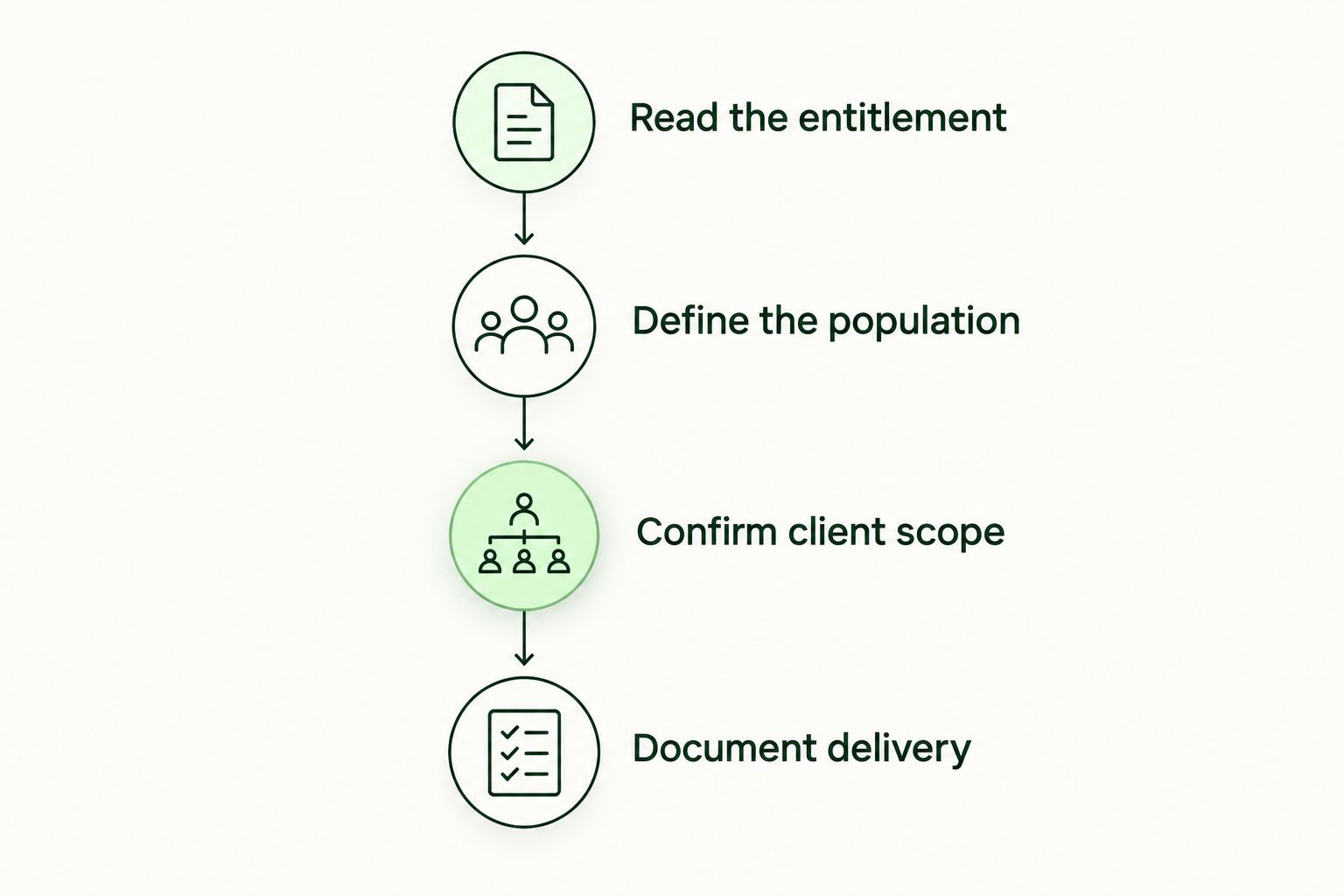
Verify learner capacity and client scope before handing training to the service team.
The result should be a service record, not another sales summary. Anyone responsible for the account should be able to identify the covered population and the next operational action without reopening the commercial discussion.
Does unlimited seating remove seat-count administration?
Unlimited seating removes the need to manage a learner ceiling under that entitlement. It does not remove roster management.
You still need to know who should receive training, who has left, and which records belong to each client. Otherwise, an unlimited roster can still be an inaccurate roster.
Separate the work into clear responsibilities:
- Client contact: confirms who belongs in the training population.
- MSP service owner: maintains the enrollment and offboarding process.
- Account owner: checks that the delivered service matches the agreement.
- Evidence owner: prepares records for the client's review requirements.
These are recommended responsibilities, not claims about a platform's automation. Assign them before deciding which tasks software will handle.
For your 2026 service design, remove the capacity constraint without removing accountability. You want fewer licensing questions, not less control over who receives training.
Does unlimited seating prove compliance?
Unlimited seating proves nothing about whether a particular learner completed the required training. Capacity is permission to enroll; completion evidence documents what happened.
Keep those concepts separate when a client asks whether everyone is covered. The question has a licensing answer and a delivery answer, and neither substitutes for the other.
Build your evidence process around the client's actual requirements. Record the intended training population, assignments, completion status, and relevant dates, then evaluate whether those records satisfy the specific request.
The guide to proving security awareness training is effective to auditors addresses the evidence side of that distinction. Do not promise an audit outcome merely because the platform permits unlimited learners.
Buy capacity for the population you must serve; verify delivery for the people you actually enrolled. That distinction belongs in your client-facing service description as well as your internal checklist.
How should you package unlimited-seat training for clients?
Define your service promise independently of the vendor's seat model. Unlimited seats is an input to your service design, not the entire service description.
State who receives training, who approves roster changes, what follow-up you provide, and what evidence the client receives. Document exceptions rather than allowing informal exclusions to become the operating process.
The old way is to let a licensing allowance determine whom you include. The better approach is to define the required training population first, then purchase an entitlement that covers it.
Keep the economics honest. Unlimited learner capacity does not mean unlimited MSP labor, and it does not establish the effort required to manage a particular client.
For 2026 renewals, review the service boundary alongside the learner entitlement. A clear agreement protects the client promise; a clear operating process makes that promise deliverable.
FAQ
Does flat-fee security awareness training always mean unlimited seats?
No. Flat-fee describes the charging model; unlimited seats must be an explicit learner entitlement. Check capacity wording rather than inferring it from a fixed charge.
Does Defend Wise have a seat limit?
Defend Wise offers flat-fee, white-label security awareness training for MSPs with unlimited seats. Evaluate client scope and operational requirements separately from that learner entitlement.
Can a flat-fee training agreement still have a learner cap?
Yes. A fixed fee can apply to a defined learner allowance. The capacity clause, rather than the flat-fee label, establishes whether a ceiling exists.
Does unlimited seating mean unlimited client organizations?
Unlimited seating alone does not establish unlimited client organizations. Confirm the organizational scope separately before extending coverage across subclients.
Do I still need to remove former employees from training?
Yes. Unlimited seats does not remove the need for an accurate training roster. Document offboarding responsibilities and handle historical records according to the client's requirements.
Can I include contractors and temporary staff in training?
Include contractors and temporary staff when they fall within the client's training requirements and your agreement's eligible population. Verify that scope rather than assuming unlimited seats answers eligibility.
Does unlimited-seat training automatically satisfy compliance requirements?
No. Unlimited seats establishes learner capacity, not completed training or compliance. Assess assignments, completion records, and evidence against the client's specific requirements.
One last thing
The most useful unlimited-seat check happens before anyone is enrolled. Ask your service owner to explain the learner entitlement, covered client scope, and delivery responsibilities using only the written agreement and service description.
If that explanation requires assumptions, resolve them before launch. Defend Wise security awareness training offers unlimited seats; your MSP's job is to turn that capacity into a clearly defined, consistently delivered client service.