What should a cyber insurance training evidence pack include?
Build a cyber insurance evidence pack with dated training records, workforce scope, exceptions, and client approval. Use this MSP submission checklist.
DefendWise
DefendWise
A cyber insurance evidence pack should include the training policy, covered workforce, assigned content, completion records, assessment evidence where available, exceptions, follow-up actions, and client approval. Match every record to the insurer’s actual question and reporting period; training completion alone does not establish coverage or prove that every security control works.
TL;DR
- Build your cyber insurance evidence pack around insurer questions, dated training records, workforce coverage, and documented exceptions.
- Defend Wise security awareness training fits MSPs seeking flat-fee, white-label delivery; insurance evidence still needs client review.
- Keep incomplete training visible. Record the owner, corrective action, and status instead of hiding gaps.
- Separate proof of training completion from claims about employee behavior, technical controls, or insurance coverage.
What should a cyber insurance training evidence pack include?
Include records that let a reviewer trace an insurance answer back to the people, training, and dates behind it. Use the following checklist for your 2026 submission, then adjust it to the application or renewal request. These are recommended pack components, not a universal insurer-mandated format.
| Pack component | What to include | What it supports |
|---|---|---|
| Training policy | Approved policy, owner, version, effective date, and assigned responsibilities | What the organization says it requires |
| Workforce scope | Dated roster, included entities, worker categories, and exclusion reasons | Who belongs in the training population |
| Training assignments | Content titles, topics, assignment dates, and deadlines | What people were expected to learn |
| Completion records | Learner identifier, assignment, completion status, and completion date | Who finished which training and when |
| Assessment evidence | Available quiz results and the applicable passing criteria | Whether recorded assessment criteria were met |
| Exception register | Overdue work, leave, departures, exemptions, and responsible owners | Where coverage remains incomplete or needs explanation |
| Follow-up records | Reminders, reassignment, corrective actions, and closure evidence | What happened after a gap was identified |
| Submission approval | Question-to-evidence index, client reviewer, approval date, and submitted version | Who approved the answer and its supporting records |
Start with your operating process, not a renewal-day folder cleanup. The guide to implementing a managed security awareness training program covers the broader service structure behind these records.
Why this matters
An insurance answer is a statement about the client’s organization. A training export is supporting evidence, not a replacement for checking whether that statement is accurate.
Keep the claim narrow. An export showing completed lessons supports a completion claim; it does not establish that every employee recognizes every attack, that technical safeguards are configured correctly, or that an insurer will accept a claim.
For MSPs, standardize the pack structure across subclients without combining their evidence. Each client needs its own workforce scope, reporting period, exceptions, and approval trail.
Build the pack around these records
Training policy and workforce scope
Include the policy version that applied during the reporting period. Preserve the effective date, policy owner, approval record, and the wording that defines who must receive training.
Reconcile the roster against that scope. Check employees, executives, contractors, temporary workers, and other worker categories against the client’s policy and the insurer’s question rather than assuming every category belongs in or out.
Record joiners and leavers with their relevant dates. Removing a departed worker from today’s active roster should not erase the explanation for that person’s earlier training status.
Assignments and completion history
Make each completion traceable to an identifiable assignment. Include the learner identifier, content title or identifier, assignment date, deadline, status, and completion timestamp where the source records provide them.
Keep 3 dates distinct: assignment date, completion date, and export date. A report exported in 2026 does not establish that the training itself occurred in 2026. Preserve the underlying dates instead of relying on the report filename.
If you report a completion percentage, retain its numerator, denominator, and inclusion rules. A percentage without its population definition leaves the reviewer unable to tell whether overdue workers or recent hires were excluded.
Content and assessment evidence
List the subjects actually delivered. Use the content records to support the topic list rather than attaching a broad catalog that includes lessons nobody received.
Where assessments exist, include the result, assessment date, and recorded passing criteria. Distinguish an assessment score from a completion status: they answer different questions.
If the program does not include an assessment, document the evidence you do have. Do not turn attendance, a policy acknowledgment, or a completed lesson into a claim that knowledge was tested.
Exceptions and follow-up
An exception needs a reason, an owner, and a status. Record whether the person was overdue, on leave, recently hired, departed, or excluded under an approved scope rule.
Preserve follow-up actions alongside the exception. A reminder supports a reminder claim; a later completion record supports closure. Keep the distinction visible.
Do not delete an incomplete record to improve the headline result. Explain the gap and the corrective action, then update the pack when the supporting evidence changes.
Approval and the submission index
Create an index connecting each training-related insurance question to its supporting record. Include the exact question, proposed answer, reporting period, document reference, and unresolved caveats.
Use 2 review checkpoints: MSP evidence review and authorized client approval. The MSP checks the training records it manages; the client checks organizational scope and approves the statements submitted on its behalf. Set those responsibilities explicitly rather than treating an export as permission to submit.
How should an MSP assemble the evidence pack?
Use this sequence for a 2026 renewal or new application. Keep the insurer’s requested scope beside the working files throughout the process.
- Confirm scope. Capture the exact questions, covered entities, requested period, submission deadline, and any requested evidence format. Ask the broker or insurer to clarify ambiguous wording.
- Reconcile roster. Compare the training population with the client-approved workforce record. Resolve duplicates, departures, recent hires, and unexplained exclusions before summarizing completion.
- Export records. Preserve the relevant assignments, completion history, content details, and available assessments. Record the export date and retain the source files.
- Resolve exceptions. Identify incomplete work, assign follow-up owners, and document what remains unresolved. Do not backdate corrective training.
- Approve submission. Map evidence to answers, obtain client approval, and retain the exact submitted version with its submission date.
The sequence matters. A clean report built from the wrong roster is still the wrong evidence.
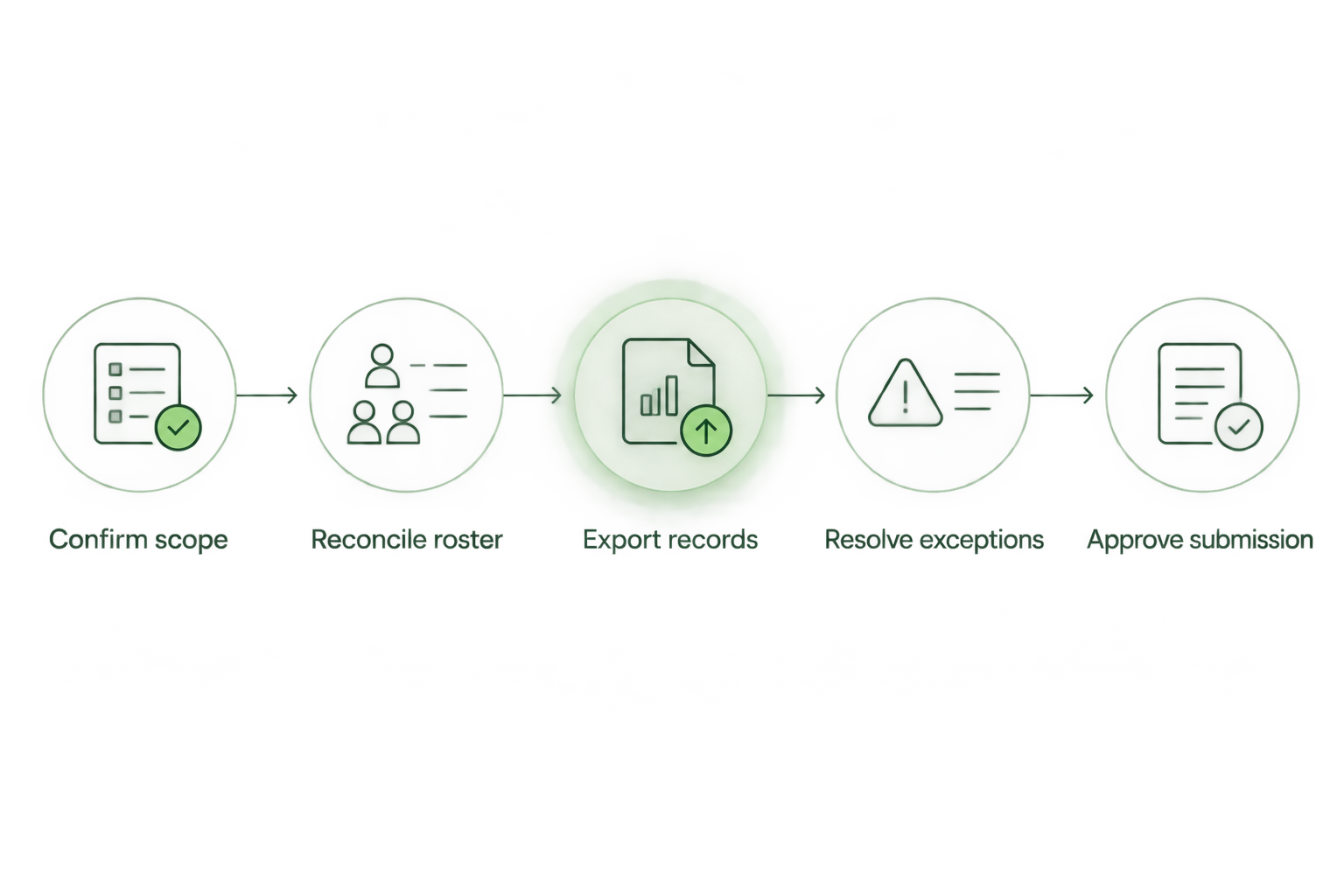
Check workforce scope before summarizing training completion.
After submission, preserve the approved pack rather than silently replacing its files with newer exports. Put subsequent corrections in a separately dated update so the client can identify what was submitted and what changed afterward.
Which evidence format should you use?
Use an indexed summary with supporting records when you need both readability and traceability. Follow a requested insurer format first; otherwise, choose the format that makes the answer easiest to verify without exposing unnecessary personal information.
| Format | Best for | Strength | Limitation |
|---|---|---|---|
| Summary PDF | A concise client or broker review | Presents scope, results, and exceptions together | Cannot substitute for underlying learner records |
| Learner-level export | Checking individual assignments and completions | Lets a reviewer inspect the detail behind a summary | Needs field definitions and careful handling of personal data |
| Indexed evidence folder | Connecting several insurance answers to source records | Keeps policies, exports, and approvals traceable | Needs version control and clear access permissions |
Avoid sending a dashboard screenshot as the entire pack. Preserve the reporting period, filters, population definition, and source records needed to interpret any displayed result.
Give files descriptive names that identify the client, subject, period, and version. Keep naming consistent, but do not let a filename stand in for dates missing from the underlying evidence.
Why cyber insurance evidence packs vary
The pack should follow the request, not an assumed industry-wide checklist. Check these factors before reusing a prior submission:
- Question wording: An answer about training delivery needs different support from an answer about completion or assessment results.
- Reporting period: A point-in-time request and a period-wide request require different population and date checks.
- Organizational scope: Confirm which legal entities, locations, and worker categories the answer covers.
- Program design: Include the records the actual training program produces, without implying unperformed activities.
- Submission instructions: Follow the requested fields, attachments, delivery method, and any broker or insurer clarification.
- Client obligations: Check applicable policies, contractual commitments, and legal requirements separately from the insurance application.
A pack prepared for a 2026 application should identify the application version it supports. Do not carry an earlier answer into a new form without checking the wording and evidence again.
Where does the training platform fit?
Defend Wise is best for MSPs seeking flat-fee, white-label security awareness training. That model addresses the delivery and seat-count side of the managed service; it does not replace the client’s responsibility to approve insurance statements.
Evaluate Defend Wise security awareness training against your evidence workflow, not just the training presentation. Confirm which records you can obtain and how you will reconcile them with each client’s approved roster before promising a particular reporting process.
The distinction is practical: buying a platform and preparing an accurate submission are separate tasks. Keep responsibility for policy approval, workforce scope, exceptions, and final answers explicit in the service agreement.
Can completion certificates replace the evidence pack?
Completion certificates support individual completion claims, but they do not establish full workforce coverage by themselves. Reconcile certificates against assignments, the in-scope roster, and the requested reporting period.
Use certificates where they answer the request. Retain the population-level records needed to explain who is missing and why.
Should you include overdue training in the submission?
Overdue training belongs in the exception record when it falls within the question’s scope. State the status accurately and document the follow-up owner and action.
If completion occurs after the requested cutoff, keep that date visible. Later corrective work does not change the earlier status.
Does a complete pack guarantee insurance coverage?
A complete pack does not guarantee insurance coverage, claim acceptance, or a premium reduction. It supports the training-related statements you submit; policy terms and the insurer’s decisions remain separate.
For a 2026 submission, have the authorized client representative review unresolved wording with the broker or insurer before approving an answer.
FAQ
What should I put in a cyber insurance evidence pack for employee training?
Include the training policy, workforce scope, assignments, completion records, available assessments, exceptions, follow-up actions, and submission approval. Map each record to the exact insurance question and requested period.
Is a training completion percentage enough for cyber insurance?
A completion percentage alone does not show who was included, which training was completed, or when completion occurred. Retain the learner records, population definition, and reporting dates behind it.
How far back should my training evidence go?
Use the reporting period requested by the insurer and check the client's applicable retention obligations. If the request does not specify a period, obtain clarification rather than assuming a standard duration.
Do contractors belong in our training evidence pack?
Include contractors when they fall within the insurer's question and the client's training scope. Document the scope decision and explain exclusions rather than silently removing worker categories.
Should an MSP send employee-level records to a broker?
Share employee-level records only when needed for the request and authorized by the client. Limit the information disclosed and use an approved secure transfer method.
Can Defend Wise replace client approval of insurance answers?
Defend Wise provides flat-fee, white-label security awareness training for MSPs, not client approval of insurance statements. Assign an authorized client representative to review workforce scope, exceptions, and the final submission.
What should we do if training records disagree?
Investigate the discrepancy before relying on either record. Check learner identifiers, assignment versions, timestamps, and export filters, then document the resolution without overwriting the original evidence.
One last thing
Preserve the denominator, not just the completion result. Keep the roster snapshot and inclusion rules that explain who counted when the answer was approved. A live dashboard that changes as people join or leave cannot, by itself, explain the population behind a frozen submission.
Before sending, trace a completion record back to its assignment and scope entry, then trace an exception forward to its owner and follow-up action. Fix broken references before the client signs.