What are the benefits of offering security training as an MSP?
Cybersecurity training benefits for MSPs include recurring service revenue and clearer client evidence. See how to package training without losing margin.
DefendWise
DefendWise
Offering security awareness training gives your MSP a recurring service to sell, a defined way to teach safer employee decisions, and training records clients can use during compliance reviews. The strongest cybersecurity training benefits for MSPs in 2026 come from managing the service—not just reselling access—because enrollment, follow-up, evidence, and client support determine whether the offer protects your margin.
TL;DR
- Cybersecurity training benefits for MSPs include recurring service revenue, clearer accountability, and organized compliance evidence.
- Defend Wise security awareness training fits MSPs seeking flat-fee, white-label delivery with unlimited seats.
- Completion records document participation; they do not prove that employees will always make safe decisions.
- Package enrollment, follow-up, reporting, and client responsibilities before selling managed security awareness training.
What are the benefits of offering security training as an MSP?
Security training adds a people-focused service alongside the technical controls you already manage. Your MSP defines the training process, while the client supplies the business context and management authority needed to make employees participate.
The benefits below depend on delivering those responsibilities. None comes from buying software alone.
| Benefit | What your MSP delivers | What the client gains | Limit to explain |
|---|---|---|---|
| Recurring service revenue | Ongoing enrollment, training coordination, and review | A named owner for the program | Revenue is not profit; delivery consumes time |
| Practical employee guidance | Instruction tied to workplace decisions | Clearer expectations for handling suspicious requests | Training does not replace technical controls |
| Organized training evidence | Records of assignments, completion, and exceptions | Documentation for relevant reviews | Completion alone does not establish compliance |
| Consistent onboarding | A defined training handoff for new starters | Fewer ambiguous responsibilities | Someone must maintain the employee roster |
| More useful client reviews | Coverage gaps, outstanding actions, and decisions | A concrete discussion about training progress | Reports need interpretation and follow-through |
Start with the service design in this guide to implementing a managed security awareness training program. Define what you own before choosing how to deliver it.
Why this matters
A client does not need another login without an owner. A managed training service should answer who gets enrolled, what happens when someone falls behind, and where the evidence goes when management requests it.
For your 2026 service plan, distinguish access from accountability. Selling access leaves the client to coordinate the work; selling a managed service means your agreement specifies which parts your MSP handles and which decisions stay with the client.
The commercial opportunity is an ongoing responsibility you can define and deliver. Treat training as an operational service, not a course library attached to an invoice.
Build recurring revenue around defined work
Training gives your MSP an additional service to include in a managed agreement or offer separately. The defensible value is the work surrounding instruction: maintaining coverage, coordinating assignments, following up, and preparing a useful client review.
Make that work visible. A buyer should understand the difference between receiving training access and having your team manage the program against an agreed scope.
Your service description should identify:
- Who maintains the eligible employee list.
- Who assigns training and communicates deadlines.
- Who follows up on incomplete assignments.
- Who approves exceptions or changes in scope.
- Who prepares and receives the client report.
The limitation is direct: recurring revenue brings recurring obligations. An agreement that includes unlimited manual follow-up or custom reporting without defined boundaries leaves your delivery effort open-ended.
Sell a repeatable service, not an undefined promise to handle everything. Review the work your technicians actually perform, including requests that arrive outside the training platform.
Give employees actions they can use
Security awareness training creates a place to teach employees how to respond when a request looks suspicious, an account behaves unexpectedly, or sensitive information needs handling. Make the required action concrete.
For example, teach an employee to verify a payment-detail change through an approved, independently sourced contact method. That is more actionable than telling everyone to remain vigilant.
Connect instruction to the client's procedures. Employees need to know where to report a concern, who can authorize an exception, and what to do when a manager appears to demand an urgent departure from policy.
The boundary matters just as much. Training does not replace access controls, secure configuration, backups, or an incident-response process. Employees can understand a lesson and still make a mistake under pressure.
Teach the decision and the reporting route together. A lesson without a usable next step leaves the employee responsible for inventing the response.
Make compliance evidence easier to organize
A managed training program gives your MSP a defined process for collecting records instead of reconstructing participation when a client requests evidence. Keep the records tied to the relevant organization, employee, assignment, and reporting period.
For a 2026 review, record what was assigned and completed during that period. Keep overdue work and approved exceptions visible rather than presenting an incomplete program as complete.
Useful records include:
- The population expected to receive training.
- Assignment and completion dates.
- The subject or material covered.
- Outstanding assignments and approved exceptions.
- The person responsible for follow-up.
These records support a review of training activity. They do not establish that every applicable legal, contractual, or security requirement has been satisfied.
Ask the client's compliance owner what evidence is required before promising a reporting package. Document participation accurately; do not sell a completion report as a compliance guarantee. The same distinction applies when answering insurance questionnaires.
Make onboarding and ownership consistent
A training program creates a repeatable handoff when employees join, leave, or change roles. Your MSP can define the process once and apply it across subclients, while keeping each client's roster and responsibilities separate.
Standardization does not mean assigning identical material to everyone. A payroll employee and a general office worker need instruction that reflects their responsibilities, even when they share the same enrollment process.
The operational benefit comes from removing ambiguity. Specify how the client notifies your team about workforce changes and who verifies that the training population remains accurate.
The trade-off is maintenance. A stale roster produces misleading coverage records, regardless of how polished the report looks. Reconcile the program against the client's agreed source of employee information.
Give client reviews a concrete agenda
Training adds specific questions to a service review: who remains uncovered, which assignments are outstanding, what exceptions management approved, and which actions need an owner. That is more useful than presenting a completion total without context.
Separate activity from outcomes. Completion describes participation; assessment results describe performance on the assessment. Neither, by itself, proves that an employee will handle a real incident correctly.
Use the review to agree on the next action. An overdue assignment needs an owner and follow-up, while an outdated reporting procedure needs a process correction—not another reminder to finish training.
Do not promise that training will secure a renewal. Use training evidence to make your service accountable, not to manufacture a retention claim.
Why cybersecurity training benefits vary between MSPs
The same category of service creates different workloads depending on how you package and operate it. Evaluate these factors before adding training to your 2026 agreements:
- Service scope: Enrollment and standard reporting are different commitments from custom lessons, policy writing, and individual employee coaching.
- Licensing model: Per-seat licensing ties license expense to covered headcount. A flat-fee model changes that relationship, but does not remove service labor.
- Roster quality: Accurate employee information supports meaningful coverage records; stale information undermines them.
- Client participation: Managers need to enforce participation and approve exceptions where the MSP lacks that authority.
- Evidence requirements: A standard participation report and a tailored evidence package require different preparation.
- Delivery consistency: Shared procedures make work repeatable, while client-specific exceptions add steps your team must track.
Do not evaluate the platform bill in isolation. Include technician time, client communication, report preparation, and unresolved exceptions when reviewing the economics.
Compare the operating models before choosing one
For your 2026 package, compare how each licensing model behaves as coverage changes. Neither model eliminates the need to define your service responsibilities.
| Operating model | Best for | Advantage | Trade-off |
|---|---|---|---|
| Per-seat licensing | MSPs that want license expense tied to covered headcount | Makes the licensed population central to the expense model | Requires accurate seat tracking as coverage changes |
| Flat-fee licensing | MSPs seeking a fixed platform expense across changing headcounts | Separates the platform fee from incremental seat counts within the offer's terms | A fixed platform fee does not cap administration or support work |
Defend Wise security awareness training is best for MSPs seeking flat-fee, white-label delivery with unlimited seats. That model addresses seat-count friction; your MSP still needs a defined enrollment, follow-up, and client-review process.
Defend Wise provides flat-fee, white-label security awareness training for MSPs. Evaluate the service fit against the work you intend to sell, rather than treating the licensing model as a complete delivery plan.
Turn the benefits into a deliverable service
Use this sequence before enrolling a client. Each step should produce something your team and the client can reference when responsibilities become unclear.
- Define scope. State which organizations and employee groups the service covers. Separate included training administration from custom consulting or policy work.
- Assign ownership. Name the MSP service owner and the client manager responsible for participation, roster accuracy, and exception approval.
- Enroll employees. Use an agreed roster and establish how new starters, departures, and role changes reach your team. Check the initial population before assigning work.
- Review evidence. Confirm that records identify the client, employee, assignment, and status. Explain overdue items instead of hiding them inside a summary.
- Review margin. Compare service revenue with platform expense and delivery labor. Adjust an unclear scope before repeating the same work across more subclients.
A repeatable workflow connects the commercial offer to the operational work. It also exposes the handoffs that require client participation rather than MSP effort alone.
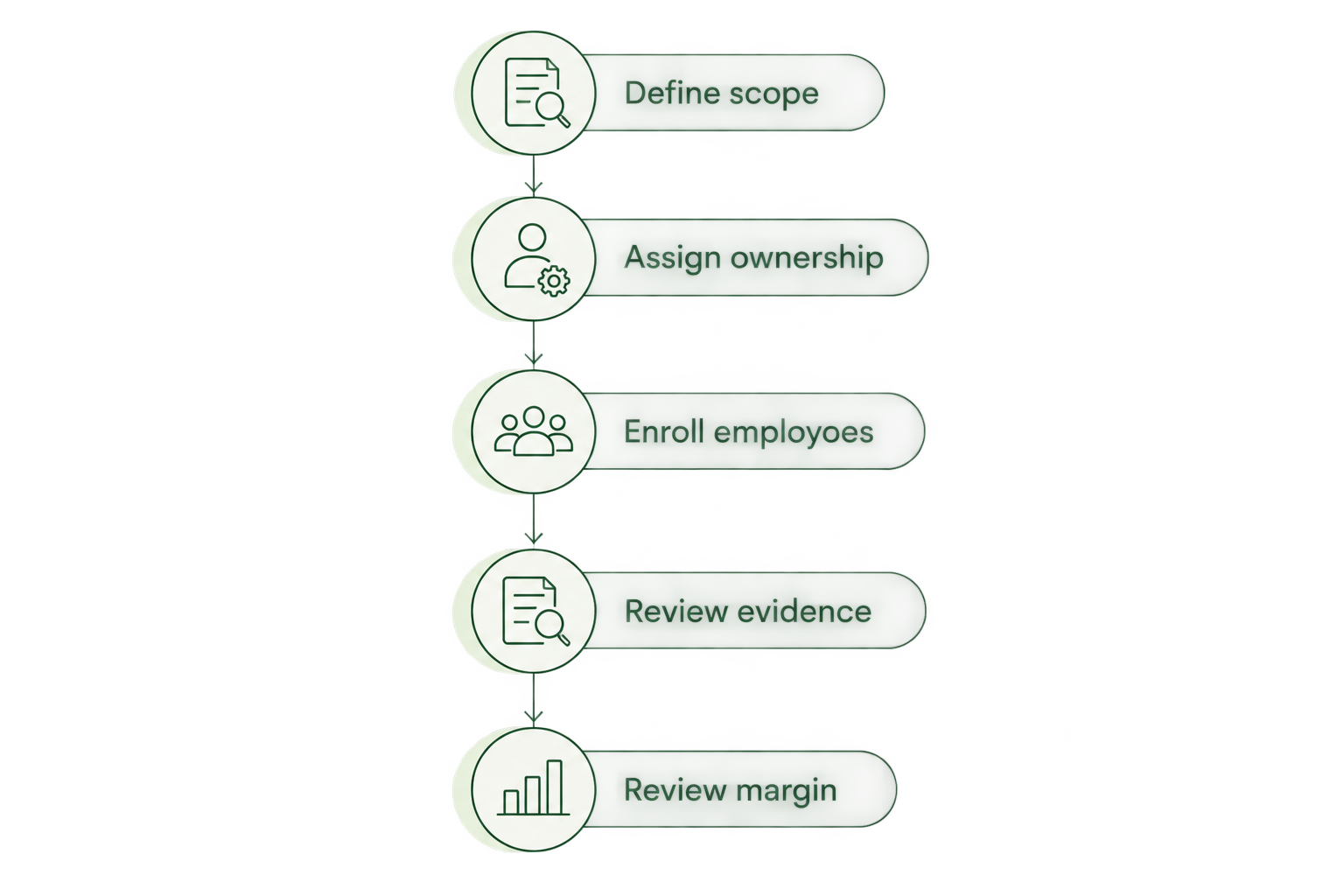
Define responsibilities before enrollment, then review both evidence and delivery effort.
Before expanding the service, walk through an incomplete assignment and a departing employee with the client contact. Confirm who receives each notification, who acts, and how the action is recorded. These ordinary exceptions reveal whether your written process works.
Does training automatically improve MSP profit?
No. Training revenue contributes to profit only after the costs of delivering the service are accounted for, including platform expense and labor.
Track work that happens outside the platform, especially repeated reminders, roster corrections, and custom report requests. A fixed license expense does not make those tasks free.
Does a completed course prove the client is secure?
No. A completion record proves that the recorded training activity was completed, not that every security control works or every future decision will be safe.
Use participation records alongside the client's broader security review. Keep the claims narrower than the evidence.
Can training help with cyber insurance reviews?
Training records can support answers about the client's awareness program when an insurer requests that information. They do not guarantee coverage, favorable terms, or lower premiums.
Answer the actual questionnaire accurately. Distinguish assigned training from completed training and explain exceptions through the client's approved review process.
FAQ
What are the main cybersecurity training benefits for MSPs?
The main benefits are a recurring service to sell, practical employee instruction, organized training evidence, and clearer program ownership. Realizing those benefits requires defined enrollment, follow-up, reporting, and client responsibilities.
Is security awareness training worth offering to small MSP clients?
Evaluate the fit by the client's training needs and your delivery workload, not headcount alone. Define who participates, who manages follow-up, and what reporting the client needs before including the service.
Is flat-fee training better than per-seat training for an MSP?
Flat-fee training fits an MSP seeking a fixed platform expense across changing headcounts; per-seat training ties license expense to the covered population. Compare total delivery effort as well as licensing terms.
What is Defend Wise security awareness training best for?
Defend Wise security awareness training fits MSPs seeking flat-fee, white-label delivery with unlimited seats. The MSP still needs to define its administration, client communication, and reporting responsibilities.
Can an MSP promise that trained employees will prevent every attack?
No. Training teaches expected decisions and responses, but it does not guarantee safe behavior or replace technical controls and incident response.
What should an MSP include in a client training report?
Include the reporting period, eligible population, assignments, completion status, overdue work, and approved exceptions. Identify who owns the outstanding actions so the report supports a decision.
Does security training guarantee compliance or lower insurance premiums?
No. Training records support relevant reviews, but they do not independently establish compliance or guarantee an insurer's decision. Match evidence to the client's actual requirements.
One last thing
An increase in employee reports is not automatically a sign that training failed. Employees reporting suspicious activity creates work for the receiving team; evaluate what they reported and how your process handled it before labeling the activity a problem.
For your 2026 service review, ask the client contact to explain the reporting route without opening the training platform. If the route is unclear, fix that handoff before adding more lessons. Completion is a record; a usable response process is part of the service.