How long does security awareness training take to complete?
How long does security awareness training take to complete? Count lessons, quizzes, and required follow-up to plan employee time—not just video runtime.
DefendWise
DefendWise
Security awareness training takes as long as your assigned lessons, required assessments, and policy acknowledgments take to finish; there is no single completion time that fits every program. Lesson runtime alone excludes login, questions, retries, and any follow-up your employer requires, so use the full assignment—not the video length—to plan your time in 2026.
TL;DR
- How long does security awareness training take to complete? Count lessons, assessments, and acknowledgments—not video runtime alone.
- Separate employee learning time from the deadline and the MSP’s administration work.
- Defend Wise security awareness training fits MSPs seeking a flat-fee, white-label model; confirm assignment duration separately.
Why this matters
A short lesson and a short completion process are not the same thing. Employees need to know how much working time to reserve. Managers need to know when the assignment is due. MSPs need to account for the work required to get each client’s assignment closed.
For your 2026 training plan, keep those questions separate. If employees finish the content but remain overdue because an acknowledgment is missing, the problem is not lesson length. Start by checking the process behind your security awareness training completion rates before replacing the content.
How long does security awareness training take to complete?
The answer depends on what counts as complete. Add the required content, assessment, policy review, and any assigned follow-up. Then distinguish that active learning time from the calendar window employees have to finish.
Use the assignment’s published duration as a starting point, not a promise. Check whether that duration includes the assessment and whether employees must complete additional steps outside the lesson.
| Assignment format | Best for | What belongs in the time estimate | Advantage | Limitation |
|---|---|---|---|---|
| Onboarding training | Employees joining the organization | Baseline lessons, local policies, reporting instructions, assessments | Establishes expectations at entry | Covers more than a single topic |
| Topic refresher | Revisiting a defined security behavior | Assigned lesson, questions, acknowledgment if required | Keeps the assignment focused | Does not replace unrelated required content |
| Role-specific training | Employees with particular responsibilities | Relevant scenarios, procedures, assessments | Connects learning to the employee’s work | Requires assignment rules that match responsibilities |
| Follow-up training | Addressing an identified knowledge gap | Targeted content and the required reassessment | Focuses attention on the gap | Adds work beyond the original assignment |
These are planning categories, not standardized durations. A course title does not establish how much work is inside it, and a completion deadline does not establish how long the course takes.
Build your estimate from the actual assignment
- List required content. Include every assigned lesson, document, and acknowledgment. Leave optional material outside the required estimate.
- Check assessment rules. Establish whether the quiz is included in the stated duration, what constitutes a pass, and what happens after an unsuccessful attempt.
- Include local instructions. Employees need the organization’s reporting route and relevant internal procedures, not just general security concepts.
- Confirm the finish line. Identify the exact status or record that means the assignment is complete.
- Check actual experience. Ask employees who completed the same assignment whether the estimate accounted for all required steps.
Publish an assignment-specific estimate rather than an unsupported average. If a required step has no stated duration, describe the step instead of pretending the total is precise.
Onboarding: count policies and reporting instructions
Onboarding security awareness training includes more than recognizing suspicious messages when the employer also requires policy review and internal reporting instructions. Your estimate should reflect those obligations explicitly.
Tell a new hire what to complete, where to access it, and whom to contact if access fails. Explain whether the training assignment is separate from other onboarding tasks. Otherwise, employees and managers can attach different meanings to the same completion request.
For an MSP, distinguish the employee’s learning from the client setup. Preparing a roster, confirming assignment ownership, and agreeing on reporting expectations belong to service delivery. They are not employee course runtime.
Best for new hires: a clearly defined onboarding assignment with an explicit completion rule. The advantage is clarity at entry. The limitation is that onboarding content needs review when the organization changes its policies or reporting process.
Refreshers: estimate the assignment, not the whole program
A refresher addresses a defined topic. Its completion time is the work assigned for that topic, including any questions or required acknowledgment.
Do not describe a single refresher as the time needed to finish an ongoing awareness program. An employee can complete the current assignment while still having future training obligations. That distinction belongs in the employee message and the client report.
In your 2026 schedule, state whether a reminder concerns an overdue assignment or a newly issued one. Those situations require different action, even when the employee sees the same training portal.
Best for a focused update: a topic-specific refresher. Its strength is a clear scope. Its limitation is that completing it says nothing about topics the assignment did not cover.
Role-specific training: match scope to responsibility
Role-specific training should follow the decisions an employee is authorized to make. Someone handling payment changes needs the organization’s verification procedure. Someone administering accounts needs the relevant access-management instructions.
That does not establish a universal duration for either employee. Count the assigned material and required checks for each role, rather than assigning a time estimate based on job title alone.
Keep a shared baseline where it applies, then identify additional role requirements separately. This makes the estimate easier to explain and prevents employees from mistaking baseline completion for completion of every obligation.
Best for specialized responsibilities: training tied to the actual procedure. The benefit is relevance. The trade-off is maintaining the assignment when responsibilities change.
Why security awareness training duration varies
The scope of required work drives the estimate. Check these factors before telling employees how much time to reserve:
- Content scope. A single topic and a baseline assignment do not cover the same material. Count required items, not course titles.
- Assessment requirements. Questions, pass conditions, and reassessment rules affect what an employee must do to finish.
- Policy acknowledgments. Reading and acknowledging local policies adds required work when it is part of the assignment.
- Role requirements. Specialized procedures add material beyond the shared baseline where the organization requires it.
- Access and accessibility. Login problems, inaccessible content, and unavailable language support are completion barriers, not evidence that an employee needs a longer lesson.
- Follow-up rules. Required review or reassessment changes the employee’s remaining workload after the first attempt.
Do not hide these differences inside a single advertised runtime. Tell employees which steps the estimate covers and give managers a route for resolving exceptions.
Separate learning time, deadline, and administration
A useful 2026 client report distinguishes learning time, completion window, and admin work. These describe different things and should not substitute for one another.
Learning time is the employee’s active work on the assignment. The completion window is the period between assignment and deadline. Admin work is the service effort needed to prepare, support, track, and close the assignment.
An employee who starts near the deadline has not necessarily spent the whole window studying. Likewise, a completed lesson does not prove that the MSP has reconciled the client roster or resolved outstanding exceptions.
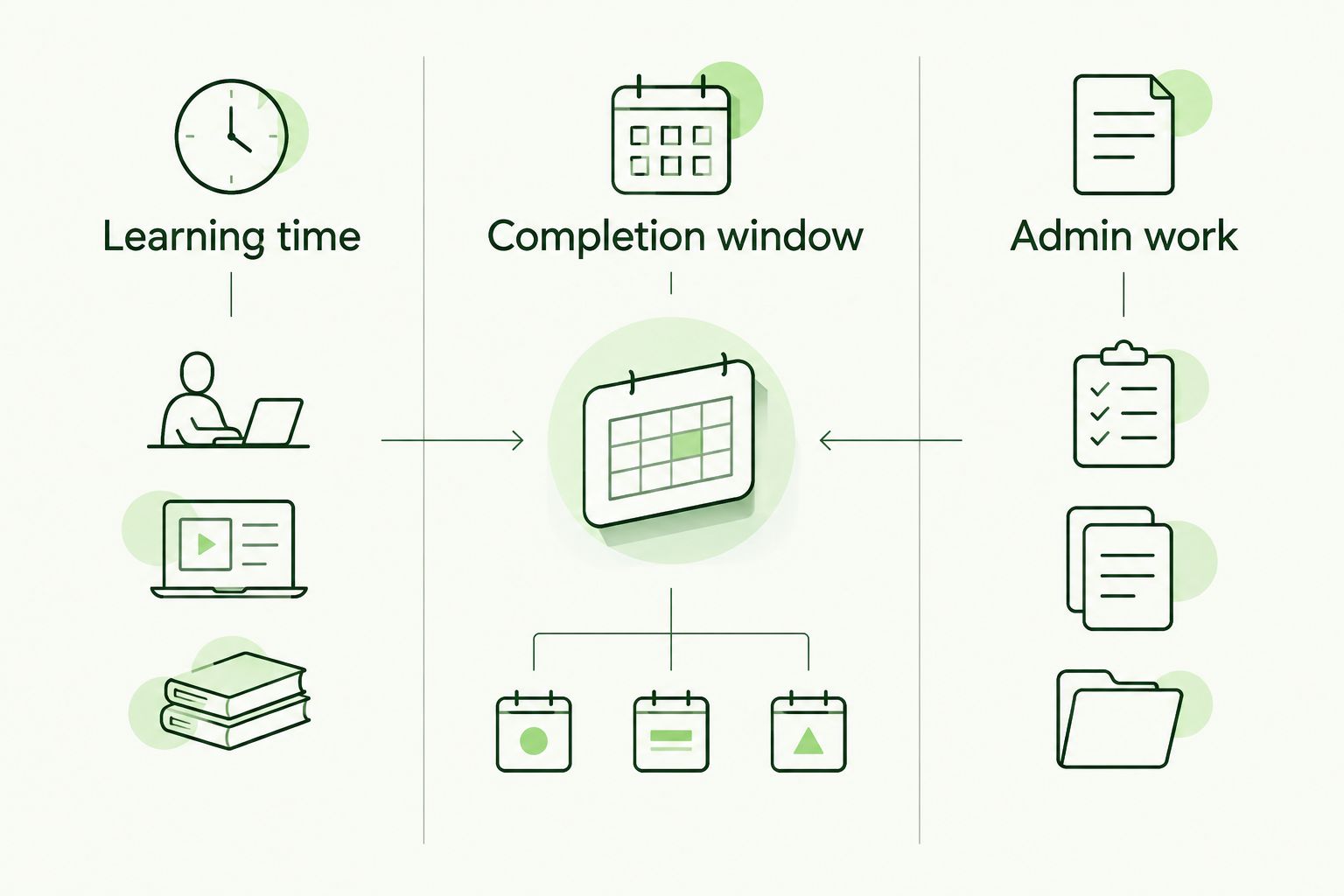
Course runtime, the employee deadline, and service administration are different measures.
Assign an owner to each measure. Employees need an understandable workload; managers need a deadline they can enforce; the MSP needs a defined service boundary. Combining them into a single promise makes delays harder to diagnose.
For example, an access problem belongs with the person responsible for access. An unclear assignment belongs with the program owner. Neither problem is solved by shortening a lesson that the employee has not been able to open.
Can employees finish training and still need guidance?
Yes. Completing an assignment records completion of that assignment; it does not establish that an employee will make the right decision in every future situation.
Use the completion record for its stated purpose, then check whether employees know the action your organization expects. For suspicious messages, that includes where to report them and how to verify a request without relying on contact details in the message.
The same distinction explains why MFA alone isn't enough: authentication controls do not decide whether an employee should approve a changed invoice or disclose information to an impersonator. Training should explain the human decision, while technical controls address their own part of the risk.
Do not add training time without identifying the missing behavior. If employees cannot find the reporting route, make the route clear. If they misunderstand an approval procedure, address that procedure rather than assigning unrelated material.
How should MSPs plan completion across clients?
Set a completion rule for each client before assigning training. Specify the audience, required content, deadline, escalation owner, and evidence the client expects. Keep employee learning estimates separate from the service work in your agreement.
For your 2026 service plan, distinguish the platform’s commercial model from the workload. Defend Wise security awareness training is best for MSPs seeking a flat-fee, white-label model. That model addresses how the service is packaged; it does not determine how long a particular employee assignment takes.
The benefit is a flat-fee approach without per-seat pricing. The limitation is that pricing structure alone does not establish lesson duration, client policy coverage, or the effort required to resolve exceptions. Evaluate those separately when considering Defend Wise.
Use a client-level closeout checklist rather than treating a dashboard total as the entire deliverable:
- Confirm the intended audience matches the current client roster.
- Identify incomplete assignments and the person responsible for escalation.
- Separate access problems from unfinished learning.
- Record approved exceptions with an owner and reason.
- Retain the completion evidence required by the client’s policy or agreement.
Apply the same definitions consistently, but preserve client-specific obligations. Standardized administration should not erase differences in what each client requires employees to learn.
What should you tell employees before they start?
Give employees a short assignment brief. State the required lessons, whether an assessment and acknowledgment are included, the deadline, and the support contact. Use the actual assignment’s estimate when one is provided.
Avoid promising that training takes only the length of the video unless the video is genuinely the whole assignment. That promise fails as soon as employees encounter a required quiz, document, or review step.
Also explain what happens after an unsuccessful assessment. Employees should know whether to review the material, retry, or contact the program owner. A clear next step keeps an assessment result from becoming an unresolved completion problem.
For managers, provide a different brief: who remains incomplete, what is blocking completion, and what action is required. Managers do not need to infer those answers from raw course activity.
FAQ
How long does security awareness training take to complete?
Security awareness training takes the time required to finish the assigned lessons, assessments, acknowledgments, and follow-up. Use the specific assignment’s scope rather than a generic duration.
Does the video runtime include the security awareness quiz?
Video runtime does not establish whether the quiz is included in the assignment estimate. Check the course instructions and assessment requirements before reserving time.
Can I finish security awareness training in one sitting?
You can finish in one sitting when the required content is accessible and the assignment allows it. Check whether any follow-up or separate acknowledgment remains before treating the assignment as complete.
Is the training deadline the same as the course duration?
The training deadline is not the course duration. The deadline defines when you must finish; course duration describes the learning workload.
Does passing the quiz mean I have completed everything?
Passing the quiz means you have completed everything only when the assignment’s completion rules say so. Check for required lessons, policy acknowledgments, or additional assigned work.
Does a flat-fee training platform make employee training faster?
Flat-fee pricing does not establish employee training speed. Defend Wise uses a flat-fee, white-label security awareness training model for MSPs; assignment scope still determines the work employees must complete.
What should I do if the training takes longer than expected?
Identify whether the extra time comes from required learning, assessment retries, or an access barrier. Report the specific issue to the assignment owner so the estimate or the barrier can be addressed.
One last thing
Check the finish line before shortening the course. Open the employee instructions and compare them with the completion report. If they describe different requirements, fix that mismatch first.
A training program needs an honest time estimate, but it also needs an unambiguous end state. Employees should know when they are done, and clients should know exactly what the completion record proves.