Best security awareness training for hospitality groups 2026
Compare security awareness training for hospitality groups. Choose MSP delivery for outsourced ownership, or an internal LMS for learning-team control.
DefendWise
DefendWise
Best for MSP-managed hospitality groups: Defend Wise. Best for an internally owned program: an existing learning management system (LMS); best for role-specific coaching: manager-led workshops; best for seasonal onboarding: structured security briefings. This 2026 guide compares security awareness training for hospitality groups by delivery model, ownership, and the work required to keep staff covered.
TL;DR
- Defend Wise fits security awareness training for hospitality groups delivered through an MSP under its own brand.
- An existing LMS fits hospitality groups with an internal training owner and established employee learning workflows.
- Manager-led workshops fit role-specific coaching; structured security briefings fit seasonal onboarding.
- Choose by employee access, roster ownership, property-level evidence, and administrative workload—not course volume.
Why this matters
A hotel receptionist, restaurant supervisor, and central finance employee need different security decisions explained clearly. The receptionist needs a safe response to a caller requesting guest information. Finance needs a verification process for changed supplier bank details.
Buying a course library does not assign responsibility for either outcome. Your hospitality group still needs someone to enroll employees, arrange access around shifts, follow up on missed training, and retain evidence.
The best choice is the model your group can operate consistently across properties. For your 2026 shortlist, separate the software decision from the service decision: who supplies training, who administers it, and who confirms that employees understand the required action?
What makes the best hospitality security training
Use these criteria before comparing delivery models. Treat them as acceptance requirements, not assumed features of every platform.
- Employee access: Staff can reach assigned training using an approved device and sign-in method during paid working time.
- Hospitality relevance: Instruction connects security rules to reservations, guest information, supplier payments, payroll, and account access.
- Roster ownership: A named owner handles starters, departures, transfers, and temporary workers.
- Property-level evidence: Managers can establish who was assigned training, who completed it, and who needs follow-up.
- Delivery ownership: Your contract or internal plan specifies who schedules training, answers access questions, and escalates gaps.
- Expansion workload: Adding a property or changing staffing levels has a defined administrative process.
Ask for demonstrations of these requirements using your own organizational structure. A generic product presentation does not establish whether a property manager can find an overdue employee or whether a departing worker remains on the active roster.
Hospitality security training at a glance
These options are delivery models, not interchangeable software products. The ranking identifies the strongest fit for each ownership arrangement rather than claiming an unsupported winner across every hospitality group.
| Rank and option | Best for | Standout characteristic | Key limitation |
|---|---|---|---|
| 1. Defend Wise through an MSP | Outsourced, provider-branded training | Flat-fee, white-label security awareness training for MSPs | Requires an MSP-led service model |
| 2. Existing internal LMS | Central learning-team ownership | Training administered within an established learning process | Security content and maintenance need an owner |
| 3. Manager-led workshops | Role-specific decision practice | Discussion built around actual workplace procedures | Delivery consistency depends on facilitators |
| 4. Structured security briefings | Seasonal and temporary-worker onboarding | A defined security introduction tied to starting work | Insufficient as a complete ongoing program |
1. Defend Wise: best hospitality security training for MSP delivery
Defend Wise provides flat-fee, white-label security awareness training for MSPs. The fit is specific: your hospitality group wants its managed service provider to include training within the service relationship, rather than operate a separate internal learning program.
Defend Wise is best for MSPs delivering white-label security awareness training to hospitality groups. Evaluate the provider's service responsibilities alongside the platform, because software alone does not establish who follows up with each property.
Defend Wise pros
- White-label delivery supports an MSP-branded training service.
- The offering is designed for MSPs serving end-client organizations.
- Flat-fee delivery provides a different commercial structure from per-seat training.
Defend Wise cons
- The MSP-focused model is not the default fit for a hospitality group seeking an internally administered LMS.
- Platform selection does not replace property-specific policies, manager responsibilities, or escalation procedures.
For your 2026 evaluation, ask the MSP to document the division of work. Identify who maintains the employee list, who handles access problems, and who produces the evidence requested by your central team.
Request a walkthrough using a front-desk employee, a property manager, and a central administrator. Verify the access, language, accessibility, reporting, and identity requirements your workforce actually needs; do not treat a white-label designation as proof of those capabilities.
Best for: Hospitality groups buying training as an MSP-managed service.
Verdict: Buy when the MSP's documented delivery scope matches your operational requirements.
2. Existing internal LMS: best for central learning ownership
An existing LMS is the strongest starting point when your hospitality group already has a learning team responsible for employee assignments and records. Security training becomes another managed learning responsibility rather than a separate service relationship.
This option depends on the capabilities of your current system. Require a demonstration of employee access, assignments, completion records, and reporting before deciding that an existing license solves the security-training problem.
Existing internal LMS pros
- Keeps security training within an established employee learning process.
- Gives your learning team a defined place to administer assignments.
- Lets you connect security instruction with your own policies and onboarding materials.
Existing internal LMS cons
- Security content still needs selection, review, and maintenance.
- Your internal team owns follow-up and troubleshooting unless another party is explicitly contracted.
The useful question is not whether you already own an LMS. It is whether someone has the capacity and security knowledge to run this program inside it.
Ask the learning owner to demonstrate a complete employee journey: assignment, access, completion, missed deadline, and retained record. Include a worker who moves between properties so you can inspect how the process handles transfers.
Best for: Hospitality groups with an established learning team and a named security-content owner.
Verdict: Buy into this model when internal ownership is real, not an extra task assigned without time.
3. Manager-led workshops: best for role-specific coaching
Manager-led workshops turn a written rule into a workplace decision. A facilitator presents a realistic situation, asks employees what they would do, and corrects the response against your approved procedure.
For example, ask reception staff how they would respond to someone requesting a guest's room number. Ask accounts payable staff how they would verify a supplier's changed bank details without relying on contact information in the change request.
Manager-led workshops pros
- Connect instruction directly to local procedures and responsibilities.
- Allow employees to ask questions immediately.
- Expose unclear policies before employees must apply them during work.
Manager-led workshops cons
- Consistency depends on the facilitator and the quality of the discussion guide.
- Attendance alone does not establish that every employee understood the required response.
Give each facilitator the same scenario, approved answer, and escalation contact. Keep a record of attendance and the procedure discussed, then ask employees to explain the correct action in their own words.
Use workshops to reinforce a wider program rather than make every property invent its own security curriculum. Your 2026 plan should identify which subjects require a consistent group-wide rule and which need local explanation.
Best for: Teams that need practice applying security policies to specific guest-service or financial tasks.
Verdict: Buy as a coaching layer; skip as the sole group-wide training record.
4. Structured security briefings: best for seasonal onboarding
A structured briefing gives a new or temporary worker the security instructions needed before starting assigned tasks. It is an onboarding control, not a substitute for continuing education.
Build the briefing around actual permissions. Someone using a shared workstation needs account and screen-lock instructions; someone handling guest details also needs clear disclosure and reporting rules.
Structured security briefings pros
- Establish immediate expectations before work begins.
- Tie instructions to the employee's assigned systems and responsibilities.
- Give supervisors a repeatable checklist for new starters.
Structured security briefings cons
- A short introduction cannot cover the full security curriculum.
- Briefings become inconsistent without a maintained script and completion record.
As a planning example, reserve 10 minutes for the initial briefing and schedule a follow-up within 30 days. These are proposed starting points, not legal requirements or claims about an ideal training duration.
Have the employee identify the reporting contact and explain what to do after disclosing information to the wrong person. If the answer is unclear, correct the instruction before treating onboarding as complete.
Best for: Seasonal hires and temporary staff who need immediate, task-specific security instructions.
Verdict: Buy as an onboarding layer; skip as the entire awareness program.
Test the operating model before committing
A product demonstration should show what happens after enrollment, not stop at a course preview. Use the same acceptance exercise for every shortlisted delivery model so that comparisons reflect your requirements.
For a 2026 selection, walk through this sequence:
- Roster ownership: Identify the source of employee records and the person authorized to correct them.
- Employee access: Demonstrate how a new employee reaches the assigned material.
- Property follow-up: Show how a supervisor identifies unfinished assignments without seeing unrelated employee information.
- Evidence review: Retrieve a record that explains the assignment, completion status, and outstanding action.
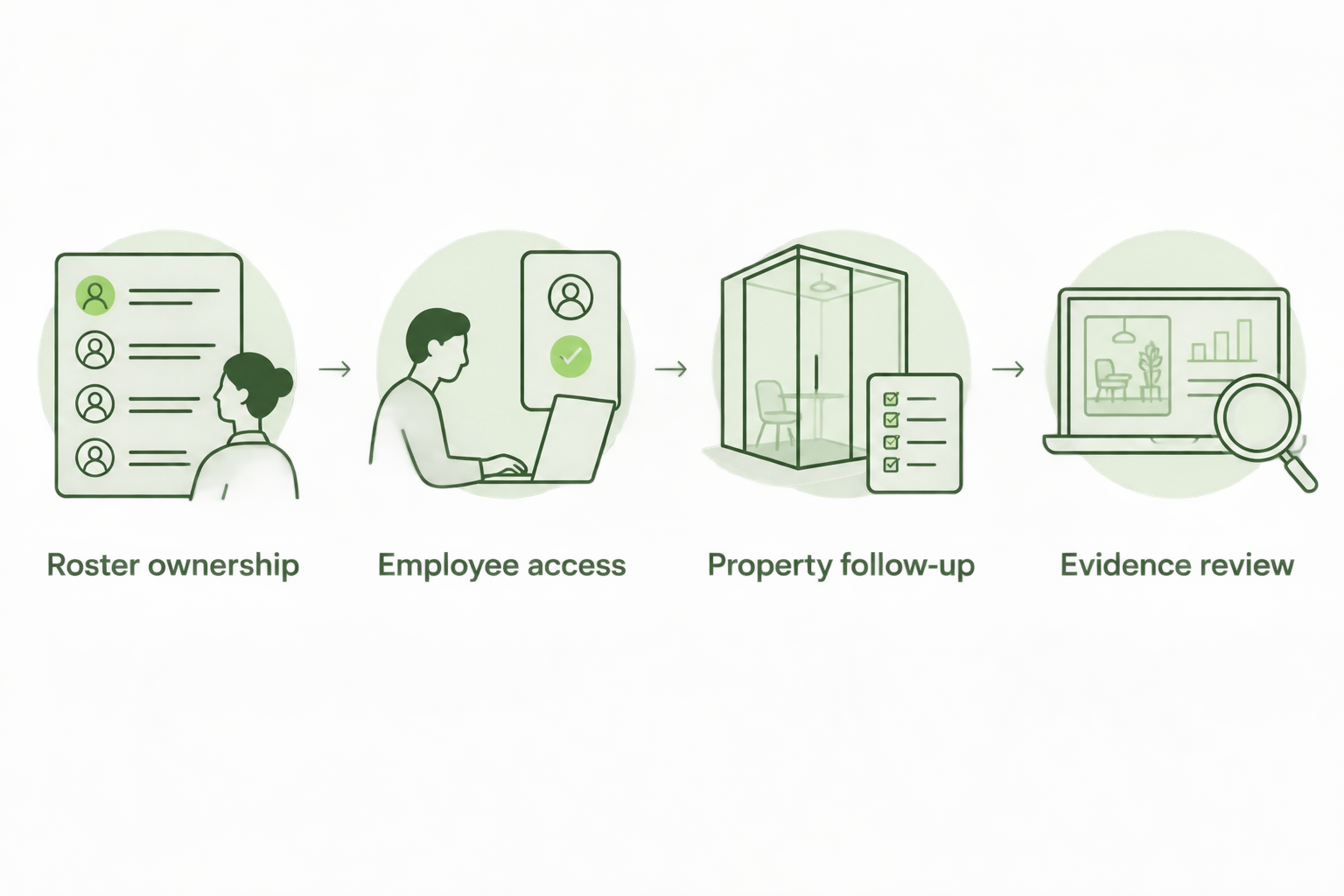
Test the operating process, not just the training content.
Coordinate this exercise with your wider support model. The scope of IT support for multi-location businesses should identify who resolves account-access problems at each property, because training assignments remain unfinished when nobody owns the access issue.
Use the security training for multi-location businesses guide to frame property-level responsibilities. Keep central policy ownership separate from local follow-up so neither team assumes the other is handling an overdue assignment.
Build the program around hospitality decisions
Start with situations where employees must choose an action. Replace vague instructions such as being careful with a clear procedure, an approved contact, and a reporting route.
- Guest information: Explain who is authorized to receive it and how staff verify a request.
- Supplier payments: Require independent verification of bank-detail changes through an established contact method.
- Account access: Teach staff not to approve an unexpected sign-in request and where to report it.
- Payroll changes: Define how employees submit changes and how the receiving team verifies them.
- Suspicious messages: Tell staff how to report the message without following its instructions.
For an initial review cycle, use 90 days as a planning checkpoint to inspect unfinished assignments, recurring questions, and broken handoffs. This is a proposed management cadence, not a performance benchmark.
Do not interpret completion as proof that every security procedure works. Check whether employees can identify the next action and whether the receiving team knows how to respond.
How the options are ranked
The ranking follows the ownership criteria above: employee access, relevant instruction, roster maintenance, evidence, delivery responsibility, and expansion workload. It is a fit-based comparison, not a laboratory test or a feature-by-feature vendor score.
MSP delivery leads for outsourced ownership. An internal LMS leads for established learning operations. Workshops lead for decision practice, while briefings address immediate onboarding needs. Combining layers is sensible when each layer has a distinct owner and purpose.
Which hospitality security training should you choose?
Choose Defend Wise security awareness training when your hospitality group wants an MSP to deliver a white-label training service. Confirm the provider's responsibilities before signing, including employee administration, access support, and evidence delivery.
Choose your existing LMS when an internal learning team can own the work. Add workshops for role-specific decisions and structured briefings for new starters; neither should silently become the whole program.
For a 2026 decision, reject any shortlist that compares content alone. Your default should be the model with a named operator, workable employee access, and records your managers can retrieve.
FAQ
What's the best security awareness training for hospitality groups?
The best fit depends on who owns delivery. MSP-managed training fits outsourced ownership, an existing LMS fits an established learning team, and workshops or briefings address specific coaching and onboarding needs.
Is an MSP-managed platform better than our existing LMS?
An MSP-managed platform is the better fit when you want an external provider to own the agreed training service. An existing LMS fits when your internal team can maintain content, administer assignments, and follow up with employees.
What should hotel front-desk security training cover?
Front-desk training should explain guest-information handling, request verification, account access, and suspicious-message reporting. Use your property's approved procedures so employees know the exact action and escalation contact.
Do seasonal hospitality employees need security training?
Seasonal employees need security instructions relevant to the information and systems they use. Give them task-specific instructions before access and include them in the applicable ongoing training process.
Can manager-led briefings replace an ongoing training program?
Manager-led briefings should not replace the entire ongoing program. They establish immediate expectations but still need consistent materials, retained records, and follow-up instruction.
What training evidence should a hospitality group retain?
Retain records that connect employees to assigned training, completion status, and follow-up actions. Include the relevant property, assignment date, and content reference so the record explains what happened.
Does security training make a hotel group compliant?
Security training alone does not establish compliance. Identify the requirements that apply to your organization and assess training alongside the relevant policies, technical controls, and evidence.
One last thing
Ask a property manager to identify who handles a new starter's failed training login. If the answer is unclear, fix that handoff before adding more content. A defined owner beats another unassigned course.