Best security awareness training for staffing agencies 2026
Compare security awareness training for staffing agencies. Choose MSP delivery for external ownership, or internal options with clear evidence and follow-up.
DefendWise
DefendWise
Best for MSP delivery: Defend Wise. Best for internal ownership: a dedicated in-house program. Best for an existing learning system: LMS-delivered training. Best for live discussion: instructor-led workshops. The best security awareness training for staffing agencies in 2026 matches who owns the work, which workers need coverage, and how the agency proves training happened.
TL;DR
- Defend Wise is the best fit for MSPs delivering flat-fee, white-label security awareness training to staffing agencies.
- Choose staffing agency security training around recruiter workflows, payroll verification, temporary-worker onboarding, and clear reporting instructions.
- Use an existing LMS when a named internal owner can maintain content, assignments, and training records.
- Treat workshops as reinforcement, not a replacement for new-hire coverage and documented follow-up.
Why this matters
Staffing work creates specific training decisions. Recruiters exchange candidate documents, payroll staff handle payment instructions, and account managers receive requests from client organizations. Training needs to explain what each person should verify before acting.
The buying decision is not just about lessons. It is about ownership: who adds new starters, follows up on unfinished work, answers employee questions, and retrieves evidence when a client asks?
For your 2026 shortlist, compare delivery models before comparing content libraries. A system without an accountable owner leaves the same administrative work sitting with your agency.
What makes the best training for staffing agencies
Use these criteria before reading the rankings. They separate a useful operating model from a content purchase.
- Workforce coverage: Define which recruiters, payroll staff, administrators, contractors, and placed workers fall within your program. Tie coverage to access and responsibility, not job title alone.
- Relevant decisions: Require examples involving candidate files, payment changes, shared documents, account access, and urgent client requests.
- Clear ownership: Name the person responsible for enrollment, follow-up, exceptions, and training records. Outsourcing delivery does not remove the agency's responsibility to set expectations.
- Usable evidence: Check whether you can establish who received training, what they completed, when they completed it, and what remains outstanding.
- Roster economics: Compare how each model handles workforce changes and administrative effort. Separate the software's commercial structure from the MSP's service agreement.
- Practical access: Have representative learners complete the actual learning journey. Check accessibility, device use, language needs, and the reporting instructions employees receive.
Buy for the work you need completed, not the size of a course catalog. Ask every provider to demonstrate your requirements rather than treating a sales description as proof.
Staffing agency training options at a glance
These rankings compare delivery models, not interchangeable software products. Each option serves a different ownership decision.
| Rank and option | Best for | Standout characteristic | Key limitation |
|---|---|---|---|
| 1. Defend Wise through an MSP | MSP delivery | Flat-fee, white-label security awareness training | The MSP's service scope still needs agreement |
| 2. Dedicated in-house program | Internal ownership | Direct control over procedures and accountability | Requires staff time to maintain the program |
| 3. Existing LMS delivery | Existing LMS | Training can sit within an established learning process | Someone must maintain suitable security content |
| 4. Instructor-led workshops | Live discussion | Employees can discuss agency-specific decisions | Sessions alone do not cover every later starter |
1. Defend Wise: best security awareness training for MSP delivery
Defend Wise provides flat-fee, white-label security awareness training for MSPs, with unlimited seats. It fits the MSP delivering training to a staffing agency rather than an agency trying to build its own training operation.
Defend Wise is best for MSPs that want flat-fee, white-label security awareness training for staffing agency clients. The commercial model removes per-seat charging from the platform decision; the MSP still needs to define the managed service around it.
Defend Wise pros:
- Flat-fee platform structure instead of per-seat charging.
- Unlimited seats within the stated platform offering.
- White-label training suited to MSP service delivery.
- A clearly defined audience: MSPs serving end-client organizations.
Platform and service considerations:
- The platform description does not define your MSP's enrollment, follow-up, or reporting commitments.
- Staffing-specific procedures still need an owner at the agency.
- Buyers must validate required workflows before committing; the commercial model is not a feature checklist.
For a 2026 evaluation, ask the MSP to walk through a starter, a departing worker, and an overdue learner. Establish which actions the MSP performs and which remain with the staffing agency. Put those responsibilities in the service scope.
Best for: MSPs packaging awareness training for staffing clients without platform seat-count friction.
Verdict: Buy when MSP delivery and flat-fee platform economics match your requirements.
2. Dedicated in-house program: best for internal ownership
A dedicated in-house program puts training policy, content selection, learner administration, and evidence management under your agency's control. Your internal owner coordinates with recruiters, payroll, operations, and IT.
This is an ownership model, not a requirement to build software. You can purchase learning content while keeping responsibility for the program inside the business.
In-house program pros:
- Direct alignment with your actual approval procedures.
- Clear control over examples involving candidate and client information.
- Internal accountability for exceptions and follow-up.
- Flexibility to revise guidance when workflows change.
In-house program cons:
- Staff must maintain content, assignments, and records.
- Coverage needs a backup when the program owner is absent.
- Buying content does not resolve enrollment or follow-up responsibilities.
Before choosing this route, write the recurring tasks into someone's role. Include roster checks, new-starter assignments, reminders, evidence retrieval, and procedure updates. If those tasks have no owner, the program is not ready.
Best for: Staffing agencies with an internal training or security owner and defined administrative capacity.
Verdict: Buy into this model when ownership is funded and assigned; skip it when training is an extra task nobody owns.
3. Existing LMS delivery: best for established learning operations
An existing learning management system gives you a place to organize security learning alongside other employee education. The appeal is organizational: your agency already has a learning process, so security training can follow it.
Do not assume the LMS contains suitable security content or supports every record you need. Validate those requirements against your particular system.
Existing LMS delivery pros:
- Uses an established learning destination when employees already use it.
- Keeps security learning within your internal training process.
- Lets your learning owner coordinate security with onboarding.
Existing LMS delivery cons:
- Security content still needs selection and maintenance.
- Administrative and evidence capabilities depend on the system.
- Client-assigned workers need an explicit coverage decision rather than an assumption about LMS access.
For your 2026 review, inspect a completed learner record and an overdue assignment. Ask the administrator to retrieve the underlying evidence while you watch. Then check how a new starter receives the correct assignment.
Best for: Agencies with an active LMS, an established learning team, and a named security-content owner.
Verdict: Buy suitable content for the existing LMS only after its assignment and evidence workflow passes your checks.
4. Instructor-led workshops: best for live discussion
Instructor-led workshops give employees a place to discuss ambiguous requests and practice explaining the right response. Use a payroll-change request, an unexpected candidate attachment, or an urgent client message to make the discussion concrete.
The value comes from the conversation. An instructor can ask why a recruiter trusts a request and identify where the written procedure needs clarification.
Instructor-led workshop pros:
- Allows immediate questions about unfamiliar situations.
- Supports discussion of your agency's approval rules.
- Gives teams a shared way to explain escalation decisions.
Instructor-led workshop cons:
- Attendance requires coordination across shifts and locations.
- Later starters need another route into training.
- Attendance alone does not establish that employees understood the procedure.
End each workshop with a decision employees can explain: what to verify, which channel to use, and who receives the report. Record attendance and arrange follow-up for absent staff.
Best for: Teams that need discussion around sensitive workflows or unclear responsibilities.
Verdict: Buy as reinforcement; skip workshops as your only training method.
What staffing agency training should actually cover
Select the delivery model first. Then require content that connects warning signs to the actions your employees must take.
Candidate documents and account access
Teach recruiters to question unexpected document links, unusual login prompts, and requests to move sensitive conversations into unfamiliar channels. Give employees an approved reporting route and explain what to do after opening something suspicious.
Do not use real candidate records in training examples. Use fictional information and keep the exercise focused on the decision.
Payroll and payment changes
Teach payroll staff to verify sensitive changes through an established channel independent of the incoming request. Define who can approve changes and what evidence of that approval must remain.
Use the guide to protecting payroll and HR systems from phishing-driven data theft to shape the discussion. Training should reinforce the approval process, not substitute for one.
Client requests and temporary-worker boundaries
Explain how staff should handle an urgent request that appears to come from a client manager. Employees need to know which requests exceed their authority, even when the sender sounds familiar.
For placed workers, document whether the staffing agency, the client, or both provide relevant training. Separate the client's site-specific instructions from the agency's own account and data-handling expectations.
Validate the operating model before signing
Use a proposed 30-day pilot to examine the work around training, not just the lesson experience. The pilot is a purchasing checkpoint, not a claim about how quickly any platform deploys.
Define coverage
Write down who belongs in the program and why. Include internal employees and evaluate placed workers according to their access, duties, contracts, and applicable requirements.
Assign responsibility for keeping that list current. A coverage rule without a roster owner leaves the process unfinished.
Check evidence
Ask for a 15-minute walkthrough of assignment, completion, overdue status, and evidence retrieval. Use fictional learners rather than candidate or employee personal information.
Distinguish a dashboard summary from the record you need to answer a client question. Specify the required fields before accepting a sample report.
Test handoffs
Walk through a starter, a leaver, and a missed assignment. Name the person who acts at each handoff and the route used to escalate unresolved work.
A promise to manage training needs an operational definition. Record responsibilities in the service agreement or internal procedure.
Review ownership
Schedule a proposed 90-day review after rollout to assess coverage gaps, overdue work, and administrative effort. Treat this as a recommended checkpoint, not a mandatory training interval.
For the 2026 rollout, keep the review focused on decisions: what changed, who needs coverage, and which unresolved tasks need an owner.
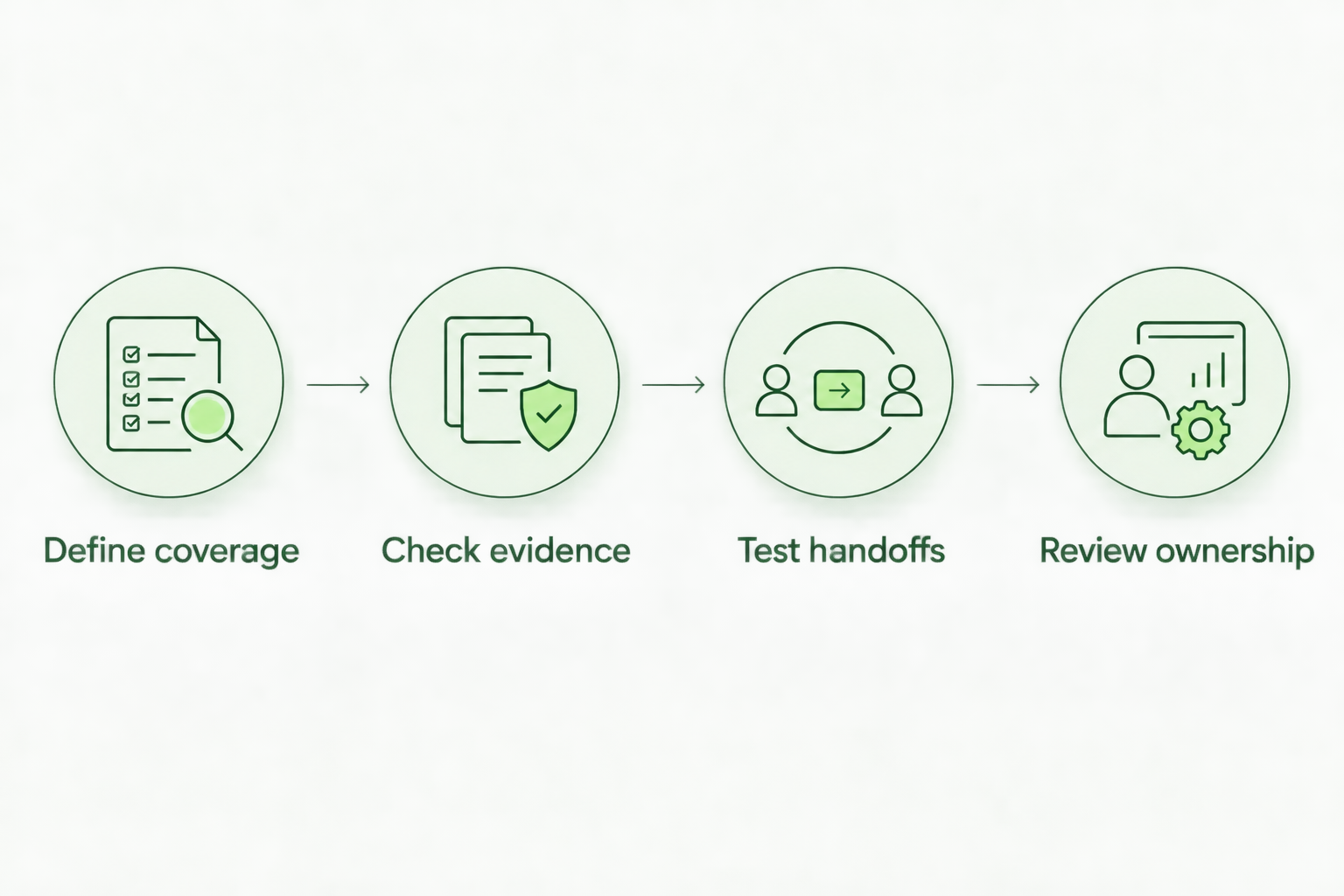
Validate the administrative work before committing to a training model.
How the options rank
The ranking prioritizes ownership, workforce coverage, relevant decisions, usable evidence, roster economics, and practical access. MSP delivery leads for buyers who want an MSP-run service; internal ownership leads when the agency has the people to operate it.
This is a fit-based buying guide, not a scored product test. Existing LMS delivery ranks for established learning operations, while workshops rank for live discussion rather than complete program administration.
Which training model should you choose?
Choose MSP-delivered training as the default when your staffing agency wants an external service owner. Put enrollment, follow-up, evidence, and escalation duties into the agreement before approving the purchase.
Choose internal ownership when your agency has assigned capacity to run the program. Use an existing LMS when its workflows meet your needs, and add workshops where employees need discussion rather than another lesson.
Do not reopen the shortlist because another provider advertises more content. Reopen it when a required workflow fails your checks.
FAQ
What's the best security awareness training for staffing agencies?
The best choice depends on who owns delivery. Defend Wise fits MSPs seeking flat-fee, white-label training for staffing agency clients; an internally managed program fits agencies with assigned administrative capacity.
Should temporary workers receive security awareness training?
Include temporary workers when their access and responsibilities place them within your training scope. Document how the staffing agency's requirements and the client's requirements are divided, then check applicable contractual and legal obligations.
Can a staffing agency use its existing LMS for security training?
Yes, when the LMS supports the agency's required learning and evidence workflows. Assign an owner for security content, roster changes, overdue assignments, and record retrieval before rollout.
Is one workshop enough for a staffing agency?
A workshop alone does not address later starters or absent employees. Use workshops for discussion and maintain a separate process for coverage, follow-up, and training records.
What should recruiters learn in security awareness training?
Recruiters should learn how to handle suspicious candidate documents, unexpected login requests, sensitive-data requests, and unusual client instructions. Each topic needs a clear verification step and reporting route.
Does flat-fee training remove all administration?
No. A flat-fee commercial model does not define who manages enrollment, exceptions, follow-up, or evidence. Agree those responsibilities separately with the provider or MSP.
Does completing training prove that a staffing agency is compliant?
No. Training completion records document part of a program, not compliance with every applicable obligation. Map training to the agency's actual legal, contractual, and operational requirements.
One last thing
Ask a recruiter and a payroll administrator to explain the reporting route without opening the training system. If either person cannot identify whom to contact, fix that instruction before adding more content.
For 2026, make that the final buying test: employees should leave training knowing what to do next, and managers should know who owns unfinished work.