Best security awareness training for accounting firms 2026
Compare security awareness training for accounting firms. Choose MSP-led delivery or an internal program based on ownership, evidence, and workforce fit.
DefendWise
DefendWise
Best for MSP-managed accounting firms: Defend Wise. Best for firm-specific procedures: an internally led program. Best for an established learning workflow: existing-LMS delivery. Best for rehearsing difficult decisions: specialist-led workshops. This 2026 guide ranks delivery approaches for security awareness training for accounting firms, so you can choose who owns the work before choosing the software.
TL;DR
- Defend Wise is the best security awareness training choice for MSPs seeking flat-fee, white-label delivery to accounting clients.
- Internally led training fits firms with a named security owner and documented accounting procedures.
- Existing-LMS delivery fits firms that already manage employee learning centrally.
- Specialist-led workshops fit teams that need to rehearse payment verification, sensitive-data handling, and incident escalation.
Why this matters
Your training program needs to address decisions accountants actually make: whether to release payroll records, accept changed bank details, open a shared document, or send a tax return. Recognizing a suspicious message is only the beginning. Employees also need a safe next step.
The best program connects a warning sign to a documented action. If someone spots an unusual payment request but cannot find the verification procedure, the lesson has not finished its job.
For your 2026 shortlist, separate software delivery from service ownership. A platform delivers training; a named person still owns your policies, exceptions, escalation contacts, and follow-up. Buying one does not automatically establish the other.
What makes the best training for accounting firms
Use these criteria before comparing delivery models:
- Accounting relevance: Lessons should connect to client documents, payroll changes, payment instructions, credentials, and confidential records.
- Clear ownership: Identify who enrolls people, follows up on incomplete work, updates procedures, and answers employee questions.
- Usable evidence: Require records that identify the learner, assignment, completion date, and material covered.
- Workforce coverage: Include partners, employees, temporary staff, and contractors according to their access and responsibilities.
- Administrative fit: Match the program to your MSP relationship, learning systems, and available internal time.
- Actionable practice: Require employees to explain what they would do, not merely identify a definition.
Treat these as acceptance criteria, not a wish list. Ask the proposed provider or internal owner to demonstrate the workflow with a fictional accounting employee before you commit.
Accounting security training options at a glance
These are delivery approaches, not interchangeable products. The order prioritizes MSP-managed firms, followed by alternatives for different operating conditions.
| Option | Best for | Standout characteristic | Key limitation |
|---|---|---|---|
| Defend Wise | MSPs delivering training to accounting clients | Flat-fee, white-label security awareness training | Designed around MSP delivery, not an internally authored program |
| Internally led program | Firms with a capable security owner | Direct control over firm-specific procedures | Internal staff own content upkeep and administration |
| Existing-LMS delivery | Firms with an established learning workflow | Security training sits within an existing learning process | The LMS alone does not supply an accounting security curriculum |
| Specialist-led workshops | Teams rehearsing sensitive decisions | Facilitated discussion of accounting workflows | Sessions alone do not provide ongoing coverage |
1. Defend Wise: best for MSP-managed accounting firms
Defend Wise provides flat-fee, white-label security awareness training for MSPs. The fit is specific: your MSP delivers training to accounting clients under its own brand rather than asking each firm to build a separate program.
Defend Wise is best for MSPs that want flat-fee, white-label security awareness training for accounting clients. That is a delivery-model recommendation, not a claim that software replaces your firm's security responsibilities.
Defend Wise pros:
- Flat-fee delivery gives the MSP an alternative to per-seat licensing.
- White-label delivery supports an MSP-branded training service.
- MSP positioning matches a provider serving end-client organizations.
Limitations:
- An MSP-focused platform is not the same as a firm-owned instructional design service.
- Your firm still needs documented verification procedures, reporting contacts, and an accountable program owner.
Before selecting this approach in 2026, ask your MSP to demonstrate how an accounting employee joins the program, completes assigned work, and appears in the firm's training records. Ask who handles overdue assignments and staff departures. Treat those as service acceptance questions, not assumed platform capabilities.
Best for: MSPs standardizing security awareness training across accounting clients.
Verdict: Buy when MSP-led, white-label delivery matches the service you want; assess the surrounding service responsibilities separately.
2. Internally led training: best for firm-specific procedures
An internally led program puts your firm's security owner in charge of lessons, assignments, and follow-up. You can build instruction around the exact process employees use to verify a payroll change or release a client document.
The strength is control. The burden is ownership: somebody must keep the material accurate when systems, contacts, and procedures change.
Internally led training pros:
- Uses the firm's actual approval and escalation procedures.
- Allows direct input from tax, audit, payroll, and administrative teams.
- Keeps decisions about assignments and exceptions inside the firm.
Internally led training cons:
- Content preparation and maintenance consume internal staff time.
- Enrollment, reminders, and evidence collection need an assigned owner.
- Coverage depends on the internal team's security and teaching skills.
Start with a procedure employees already need. For a bank-detail change, define the trusted contact source, verification method, approval authority, and record to retain. Then teach the procedure using fictional details rather than real client information.
Do not select this model because someone can create presentation slides. Select it because a named person has the responsibility and capacity to maintain the program throughout 2026.
Best for: Firms with an established security owner and documented internal workflows.
Verdict: Buy if ownership and maintenance time are assigned; Skip if the program depends on unallocated spare time.
3. Existing-LMS delivery: best for centralized employee learning
Existing-LMS delivery places security lessons within the learning management system your firm already uses. It is a delivery choice, not a substitute for selecting accurate material and defining employee responsibilities.
This approach fits a firm that already manages learning assignments centrally. Confirm the system's actual reporting, assignment, and access capabilities rather than assuming every LMS supports the same workflow.
Existing-LMS delivery pros:
- Keeps security learning within an established employee process.
- Lets the learning owner coordinate security with other required instruction.
- Supports firm-authored procedures alongside other material when the system permits it.
Existing-LMS delivery cons:
- A general LMS does not by itself provide security expertise.
- Content sourcing and updates remain separate responsibilities.
- Reporting suitability requires verification against your evidence requirements.
Ask the LMS owner to demonstrate a fictional employee assignment from enrollment through completion. Inspect the exported record. A completion label without enough context to identify the lesson does not answer what the employee learned.
For a 2026 evaluation, also check how temporary workers receive access and how departed workers' records remain available under your retention policy. These are requirements to verify, not universal LMS features.
Best for: Firms with a functioning learning system and someone responsible for security content.
Verdict: Hold until both the content source and evidence workflow meet your requirements.
4. Specialist-led workshops: best for decision rehearsal
Specialist-led workshops bring employees together to discuss realistic security decisions. The facilitator presents a fictional situation, asks participants what they would do, and connects the discussion to your firm's procedure.
Use workshops to expose uncertainty. A team that disagrees about who can approve a payment change needs a clarified process, not another recognition quiz.
Specialist-led workshop pros:
- Lets employees ask questions about ambiguous requests.
- Connects lessons directly to team responsibilities.
- Reveals conflicting interpretations of the same procedure.
Specialist-led workshop cons:
- Scheduling must accommodate the people whose decisions matter.
- Attendance alone does not establish understanding.
- A standalone session leaves onboarding and later reinforcement unresolved.
Give the facilitator your approved procedures before the session. Require fictional examples, a clear escalation route, and a written record of procedural questions that need resolution.
Separate the learning record from the action record: one shows who attended; the other assigns responsibility for fixing gaps. Do not leave a disputed approval rule unresolved after the workshop.
Best for: Partners, payroll staff, and payment approvers rehearsing high-consequence decisions.
Verdict: Buy as a targeted supplement; Skip as your only ongoing training method.
How the options were ranked
This ranking uses the criteria above: accounting relevance, ownership, evidence, coverage, administrative fit, and actionable practice. It ranks delivery fit rather than claiming a universal winner or assigning unsupported performance scores.
MSP-led software comes first for MSP-managed accounting clients. Internal delivery wins on procedural control; existing-LMS delivery fits established learning administration; workshops serve decision rehearsal. None removes the need for firm-specific procedures.
Put the choice into an operating plan
Use these planning targets for a 2026 rollout. They are suggested milestones, not regulatory deadlines or claims about implementation speed.
Assign ownership
Name a program owner and a backup. Write down who manages assignments, answers questions, approves exceptions, and retains evidence; distinguish the MSP's responsibilities from the accounting firm's responsibilities.
Map decisions
List the requests that require verification: changed payment instructions, payroll updates, sensitive-document transfers, and unexpected account-access requests. For each, document the trusted channel and authorized approver.
Train staff
Set an initial 15-minute discussion for each role group to explain its most important procedure. Treat that as a starting agenda, not proof that all required learning fits into that duration. Use additional instruction wherever the job requires it.
Check evidence
Schedule a 30-day review after launch to inspect assignments, completion records, exceptions, and unresolved questions. Check whether temporary staff and partners appear in the appropriate scope, rather than reviewing only permanent employees.
Review gaps
Set a 90-day review to examine reported concerns and procedural confusion. Update the relevant instruction when the firm's workflow changes; do not wait for the calendar if an unsafe process is already known.
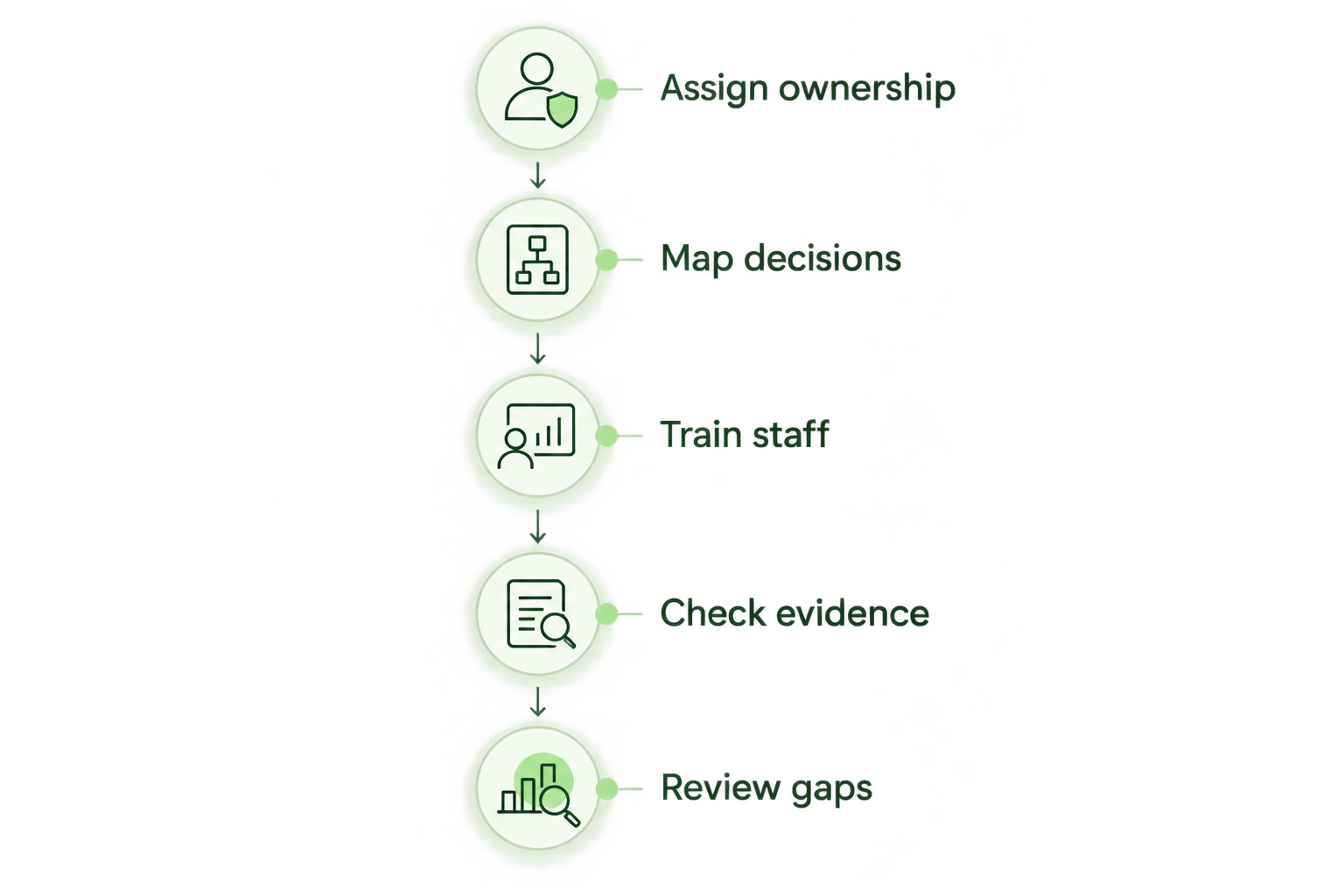
Assign responsibility before delivering lessons, then inspect evidence and resolve gaps.
Which training approach should you choose?
Choose MSP-led delivery as the default when your accounting firm already relies on an MSP to run security services. Ask for a written service scope covering ownership, workforce coverage, evidence, and follow-up before accepting the proposal.
Choose internal delivery only when someone owns the work. Use an existing LMS when its content and evidence processes meet your requirements, and add workshops where employees need to rehearse decisions together.
Do not make a larger content catalog your deciding factor. The decisive question is whether your employees can apply the firm's procedure when a sensitive request arrives.
FAQ
What's the best security awareness training for accounting firms?
The best choice depends on who will operate the program. Defend Wise fits MSPs seeking flat-fee, white-label security awareness training for accounting clients; internal delivery fits firms with a capable program owner.
What should accountants learn in security awareness training?
Accountants should learn how to verify sensitive requests, protect credentials, handle client records, and report concerns. Connect each topic to the firm's approved process for payroll changes, payment instructions, document sharing, or account access.
Is an annual training session enough for an accounting firm?
Do not treat annual attendance as proof of ongoing coverage. Your program also needs a way to train new starters, address changed procedures, and resolve gaps when employees report confusion.
Should temporary tax-season staff receive security training?
Include temporary staff according to the information and systems they can access. Teach the relevant handling and reporting procedures before assigning work that depends on those procedures.
Does security awareness training make an accounting firm compliant?
Training alone does not establish compliance. The FTC Safeguards Rule includes employee security awareness training requirements for covered financial institutions, including tax preparation firms; determine applicability and assess the rest of the required safeguards separately.
What training evidence should an accounting firm keep?
Keep records identifying the learner, assigned material, completion date, and relevant exceptions. Preserve the policy or procedure version associated with the instruction according to the firm's retention requirements.
Can an accounting firm use its existing LMS for security training?
Yes, if the LMS supports the firm's assignment and evidence requirements and someone supplies suitable security content. Demonstrate the complete workflow before relying on the system for training records.
One last thing
A verified message can still request an unsafe action. Recognizing the sender does not replace approval controls: a legitimate account can be compromised, and a genuine colleague can misunderstand a procedure.
Before approving your training program, ask a payroll employee and a partner to explain the same bank-change procedure separately. If their answers conflict, fix the procedure and teach it again. A completion report cannot resolve an operational disagreement.