Best security awareness training for restaurant chains 2026
Choose security awareness training for restaurant chains: MSP-led delivery wins for managed programs. Compare ownership, employee access, and evidence.
DefendWise
DefendWise
Best for MSP-led restaurant chains: Defend Wise. Best for internally managed onboarding: an existing learning management system with a restaurant-specific security curriculum. Best for manager decision practice: instructor-led workshops. This 2026 guide compares those three delivery options and explains what to require before choosing one.
TL;DR
- Defend Wise is the best fit for MSP-led security awareness training for restaurant chains seeking flat-fee, white-label delivery.
- An existing learning management system suits chains with an internal owner for onboarding, assignments, and training records.
- Instructor-led workshops suit restaurant managers practicing payment verification, account recovery, and incident escalation.
- Choose by delivery ownership, employee access, and usable evidence—not course-library size.
Why this matters
Restaurant security training needs to answer operational questions. What should a shift manager do when someone claiming to be technical support requests remote access? Who verifies a supplier's request to change bank details? Where does an employee report a suspicious payroll message?
A course completion record does not answer those questions by itself. Your program needs a delivery owner, clear employee instructions, and an escalation route that works during service—not just during headquarters' office hours.
For your 2026 shortlist, separate the software decision from the operating model. An MSP-managed platform, an internal learning system, and a facilitated workshop place different responsibilities on your team. Choose who owns the work before choosing how employees receive it.
What makes the best restaurant security training
Use these criteria to judge each option before reviewing a demonstration:
- Delivery ownership: Name the person responsible for assignments, roster changes, follow-up, and records. A shared responsibility without a named owner is unfinished work.
- Employee access: Require a demonstration using the devices and account types your employees actually have. Do not assume every worker has a corporate mailbox.
- Restaurant relevance: Include payment changes, payroll requests, remote-support calls, shared devices, and account recovery in your curriculum requirements.
- Location accountability: Require a way to reconcile training records with the correct restaurant, employer, and manager.
- Evidence quality: Ask for records showing who received which training, when they completed it, and what remains outstanding.
- Administrative fit: Compare roster maintenance, manager follow-up, content upkeep, and record preparation—not just the training subscription.
These are acceptance criteria, not claims that every option includes every capability. Ask each provider or internal owner to demonstrate the required workflow before making a commitment.
Restaurant security training options at a glance
| Option | Best for | Standout feature | Key limitation |
|---|---|---|---|
| Defend Wise | MSP-led restaurant chains | Flat-fee, white-label security awareness training for MSPs | Restaurant-specific access and evidence requirements still need validation |
| Existing LMS with a custom curriculum | Chains with internal learning ownership | Security assignments can sit within an internally managed learning program | Your team owns curriculum upkeep and program administration |
| Instructor-led workshops | Manager decision practice | Facilitated discussion of restaurant-specific situations | Attendance and follow-up require a separate operating process |
The ranking is a decision tree. Start with the first option if your MSP owns security training, the second if your internal learning team owns it, and the third when managers need practice applying your procedures.
1. Defend Wise: best security training for MSP-led chains
This option provides flat-fee, white-label security awareness training for MSPs. It belongs first when your restaurant chain wants training delivered through its managed service provider rather than building an internal learning operation.
The fit is specific. Your MSP supplies the service relationship; restaurant leadership still defines business procedures, escalation contacts, and the evidence it needs. White-label delivery does not remove those responsibilities.
Defend Wise pros:
- Flat-fee positioning matches an MSP service model rather than a seat-by-seat purchasing discussion.
- White-label delivery lets the MSP present training under its own service identity.
- The platform's stated audience is MSPs, making it relevant to a provider-managed shortlist.
Defend Wise cons:
- The MSP-focused model is not the natural starting point for a chain seeking an entirely internal learning operation.
- Restaurant-specific learner access, language needs, and evidence requirements need direct validation before selection.
Best for: Restaurant chains whose MSP will own the training service and coordinate with an internal operations contact.
Before committing, ask your MSP to walk through a new hire, a location transfer, and a departure. Then ask who resolves an overdue assignment and who supplies records when headquarters requests them. Treat these as service acceptance questions, not assumed product capabilities.
Verdict: Buy for an MSP-led program after the access and evidence workflow passes your acceptance checks.
2. Existing LMS: best security training for internal onboarding
An existing learning management system is a delivery option when your chain already assigns employee training internally. Add a security curriculum that reflects your procedures, then give someone explicit responsibility for keeping it current.
This is an operating model, not a recommendation for an unnamed software product. The approach depends on what your current LMS supports and whether your team can maintain the program without leaving security assignments behind other onboarding tasks.
Existing LMS pros:
- Security training can follow the same internal ownership structure as other employee learning.
- Your team controls restaurant-specific examples and escalation instructions.
- You can organize assignments around your own job roles and onboarding process.
Existing LMS cons:
- Someone must source, review, and update security content.
- Learner access and reporting depend on the capabilities of your current system.
- Your team remains responsible for roster reconciliation and overdue follow-up.
Best for: Chains with a named learning administrator and a security owner who can approve the curriculum.
Start by checking whether frontline employees can sign in without borrowing another person's credentials. Then confirm that records distinguish the employee from the device used to complete training. A shared terminal is not a substitute for an identifiable learner record.
Do not select this route merely because the LMS already exists. Assign the work first and confirm that the owner has capacity to perform it.
Verdict: Buy into this approach only when internal ownership and learner access are already workable.
3. Instructor-led workshops: best for manager decision practice
Instructor-led workshops let managers discuss how to respond to suspicious requests using your restaurant's actual procedures. A facilitator presents a situation, asks participants to explain their next action, and checks the answer against an approved process.
Use workshops for decisions that cross responsibilities. A supplier bank-detail change, for example, involves more than spotting an unusual message: someone must verify the request, control the payment change, and record the decision.
Instructor-led workshop pros:
- Managers can ask questions about ambiguous situations.
- Examples can use your approved payment, payroll, and support procedures.
- Discussion reveals disagreements about who should act or escalate.
Instructor-led workshop cons:
- Scheduling requires coordination across locations and shifts.
- Attendance records, makeup sessions, and follow-up need an assigned owner.
- Workshops alone do not establish a repeatable new-hire training process.
Best for: General managers, regional operators, payroll staff, and finance staff who approve sensitive requests.
Give participants a concrete task rather than a slide full of warning signs. Ask them to identify the trusted callback source, the person authorized to approve the change, and the reporting destination. If the answers conflict, fix the procedure before repeating the exercise.
Verdict: Buy as a targeted supplement; skip workshops as the sole chain-wide delivery method.
How this ranking works
This 2026 ranking prioritizes delivery ownership, employee access, restaurant relevance, location accountability, evidence quality, and administrative fit. It compares a named MSP-focused platform with two delivery models; it is not a feature-by-feature ranking of competing software vendors.
The default favors an MSP-led service when your chain already delegates security operations to an MSP. Internal LMS delivery ranks next for organizations that own the work themselves. Workshops serve a narrower purpose: practicing decisions rather than managing the entire training lifecycle.
Put restaurant decisions into the curriculum
Security awareness training for restaurant chains should connect recognition to action. Use the following scenarios as curriculum requirements, and have the relevant business owner approve the correct response.
| Audience | Training scenario | Required response to practice |
|---|---|---|
| Shift managers | An unexpected caller requests remote access to a restaurant device | Stop and verify through the approved support channel |
| Payroll and HR | A message requests a change to employee banking details | Follow the established identity-verification procedure |
| Finance and purchasing | A supplier sends replacement payment instructions | Verify independently before changing payment details |
| Frontline employees | A message asks for an account password or authentication code | Refuse the request and use the reporting route |
| Regional managers | An urgent request appears to come from an executive | Verify the request outside the original conversation |
Do not make employees invent the safe response. Supply the approved contact method and explain what to do if that contact is unavailable. Training that says only to contact IT leaves a gap when employees do not know how to reach IT.
For location ownership and record organization, use this security training guide for multi-location businesses alongside your selection checklist.
Run a 30-day acceptance pilot
Use a 30-day pilot as a proposed purchasing check, not a promised deployment timeline. Include 3 locations with different operating conditions so you can examine more than headquarters' preferred setup.
Give each stage a named owner and a written acceptance decision:
- Roster check: Reconcile participating employees with location, employer, role, and employment status.
- Access check: Observe employees signing in through the devices and accounts they normally use.
- Decision practice: Ask participants to explain the approved response to a relevant suspicious request.
- Evidence review: Reconcile completed and outstanding training against the pilot roster.
- Owner handoff: Confirm who handles new hires, departures, transfers, overdue work, and record requests.
Hold a 15-minute handoff between the training administrator and a location manager. Ask the manager to find an outstanding assignment and explain the next action without help. This is a proposed acceptance exercise, not a claim about how long administration takes.
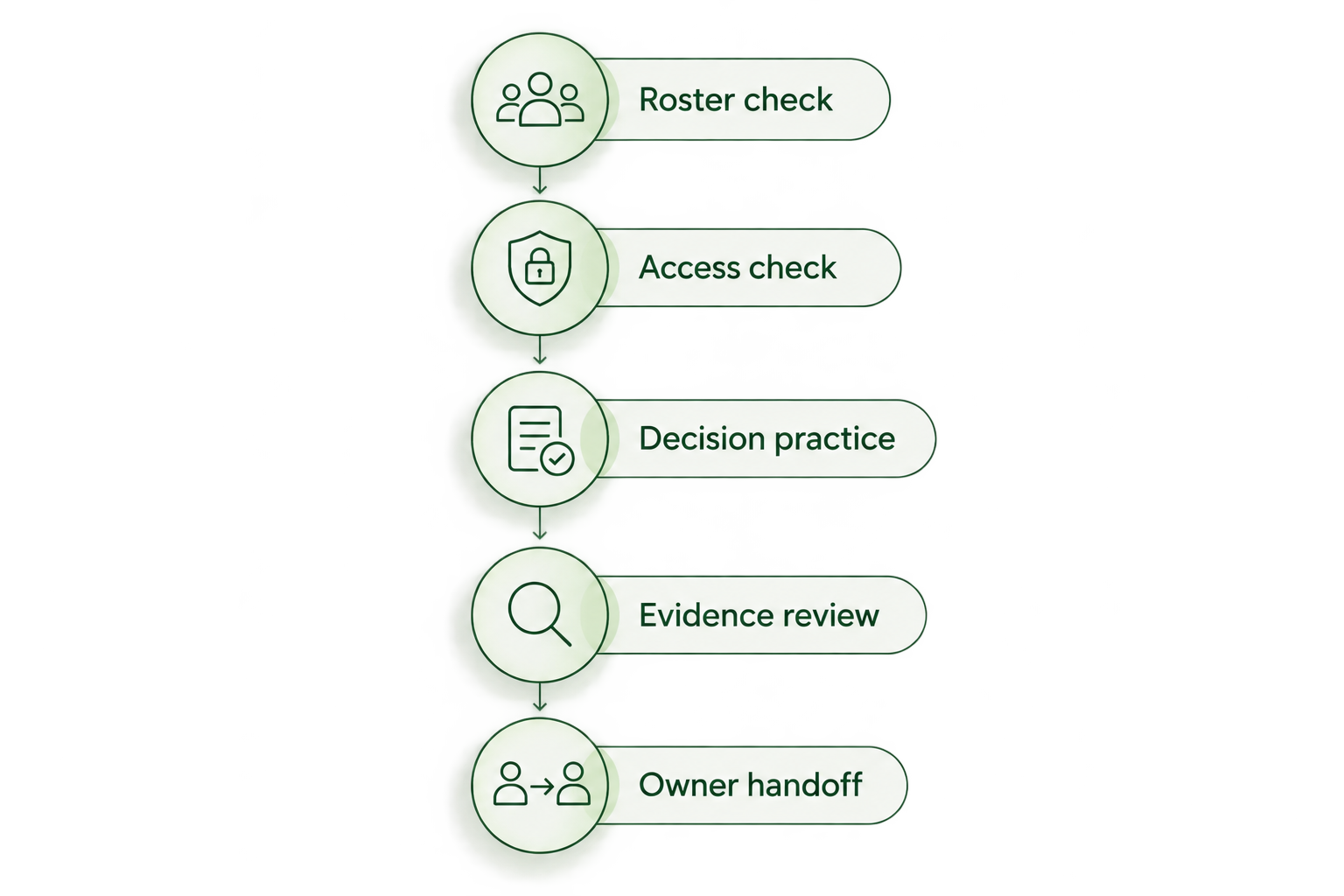
Validate the operating process before expanding training across the chain.
For a 2026 rollout, record the pilot decision against each criterion rather than approving the program on completion totals alone. A completed assignment does not resolve an inaccessible reporting route or an employee mapped to the wrong restaurant.
Require evidence without confusing it with compliance
Ask for a sample evidence package before signing off. Require employee identity, location or organizational assignment, training title or version, assignment date, completion date, and outstanding status. Add approved exceptions and follow-up ownership where relevant.
PCI DSS v4.0.1 Requirement 12.6 addresses security awareness for personnel within its applicable scope. Requirement 12.6.3 calls for training upon hire and at least once every 12 months; use the PCI Security Standards Council's standard to confirm the requirements that apply to your environment.
Training records support compliance work; buying a training platform does not establish compliance. For your 2026 review, have the responsible compliance owner confirm scope, required content, acknowledgments, and retention expectations. Keep those decisions separate from a vendor's general description of its platform.
Which option should you choose?
Choose Defend Wise when your MSP owns the training service and you want flat-fee, white-label delivery. Make employee access, restaurant procedures, and evidence handling explicit acceptance requirements rather than assumptions.
Choose your existing LMS when internal owners can maintain the curriculum and administer the program. Add instructor-led workshops where managers need practice with payment changes, support requests, and escalation decisions.
For an undecided buyer in 2026, the next move is not another demonstration. Write down who owns enrollment, follow-up, and evidence, then choose the delivery model that matches that answer.
FAQ
What's the best security awareness training for restaurant chains?
The best choice depends on who owns delivery: an MSP-led platform for provider-managed training, an existing LMS for internally managed onboarding, or workshops for manager decision practice. Require a demonstration of employee access, roster handling, and usable training records before choosing.
Can restaurant employees complete security training without company email?
Make non-email access an acceptance requirement if employees do not have company mailboxes. Ask the provider to demonstrate the exact sign-in process and how completion remains tied to an individual employee.
Should every restaurant employee receive the same training?
Use a shared baseline and add role-specific instruction. Payment approvers, payroll staff, and shift managers need practice with the sensitive decisions they are authorized to make.
Is an existing LMS better than a managed training service?
An existing LMS is the better fit when your team owns curriculum, assignments, follow-up, and records. A managed service fits when you want an MSP to own delivery under an agreed scope.
How often does PCI DSS require security awareness training?
PCI DSS v4.0.1 Requirement 12.6.3 calls for training upon hire and at least once every 12 months for applicable personnel. Confirm your scope and the full requirements with the person responsible for PCI DSS compliance.
What should restaurant managers practice during security training?
Restaurant managers should practice verifying unexpected support requests, refusing credential requests, and escalating suspicious messages. Use the chain's approved contact channels so the exercise teaches an actionable response.
What training records should a restaurant chain request?
Request identifiable employee records showing assigned training, completion dates, outstanding work, and the relevant location or organization. Confirm that records reconcile with the current roster and document approved exceptions.
One last thing
Test the contact instructions, not just the learner. Ask a shift manager to locate the approved support number without using contact details supplied in a suspicious message.
If the manager cannot find it, fix that gap before assigning another lesson. The safe action must be available at the moment an employee needs it.