Best security awareness training for veterinary clinics 2026
Choose security awareness training for veterinary clinics by delivery model. Compare MSP-led, clinic-led, group-led training and workshops for fit.
DefendWise
DefendWise
Best for MSP delivery: Defend Wise. Best for direct clinic control: clinic-led training. Best for veterinary groups: centrally governed training. Best supplement: facilitated workshops. This 2026 guide ranks security awareness training for veterinary clinics by who owns the work, how staff learn, and what evidence the clinic retains.
TL;DR
- Defend Wise is the best fit here for MSPs delivering white-label security awareness training to veterinary clinics.
- Choose security awareness training for veterinary clinics by ownership, staff access, practical relevance, and evidence.
- Clinic-led training requires a named owner; group-led training requires local accountability.
- Use workshops to rehearse decisions, not replace onboarding and completion records.
Why this matters
A clinic needs employees to recognize a suspicious request and know what to do next. A completed lesson alone does not tell a receptionist how to handle an unexpected password-reset call or tell a practice manager how to verify changed supplier banking details.
Buy a workable training process, not just access to lessons. Your decision should connect instruction, local procedures, and follow-up. The broader cyber security awareness program for veterinary clinics should also define reporting responsibilities and management ownership.
For your 2026 selection, start with the delivery model. An MSP managing training for several client organizations has a different job from a practice manager coordinating staff inside a single clinic.
What makes the best veterinary security awareness training?
Use these criteria before comparing demonstrations or signing an agreement. Each criterion should produce a clear answer, not a general promise.
- Ownership: Name the person responsible for enrollment, reminders, exceptions, and follow-up. Specify which tasks belong to the clinic and which belong to its provider.
- Workflow relevance: Require examples involving client communications, supplier invoices, account access, payroll, and requests for sensitive information.
- Staff access: Have reception, clinical staff, and managers try the learning process under their normal working conditions.
- Evidence: Define the records you need: assigned learners, completed learning, completion dates, outstanding work, and documented exceptions.
- Commercial fit: Compare the licensing model with your delivery responsibilities. Separate the platform agreement from the labor needed to operate the program.
- Local procedures: Ensure employees learn the clinic’s actual reporting route and verification rules. Generic advice must end in a specific action.
Veterinary training options at a glance
These are alternative ways to deliver training, not interchangeable software products. Choose the operating model first, then evaluate the platform or materials that support it.
| Ranked option | Best for | Standout characteristic | Key limitation |
|---|---|---|---|
| Defend Wise through an MSP | MSPs serving veterinary clients | Flat-fee, white-label security awareness training with unlimited seats | The clinic and MSP still need to agree on service responsibilities |
| Clinic-led training | An independent clinic with a named internal owner | Direct control over assignments and local procedures | Administration stays with the clinic |
| Centrally governed group training | Veterinary groups standardizing across locations | Shared standards with location-level accountability | Central policy needs local follow-through |
| Facilitated workshops | Teams rehearsing specific security decisions | Discussion built around the clinic’s actual procedures | Workshops alone do not create an ongoing program |
1. Defend Wise: best training for MSP delivery
Defend Wise provides flat-fee, white-label security awareness training for MSPs, with unlimited seats. The model lets an MSP offer training under its own brand rather than positioning the clinic as the operator of a separate training business.
Defend Wise is the best fit here for MSPs delivering white-label security awareness training to veterinary clinics. That recommendation is about the delivery model: the buyer is the MSP, and the veterinary practice is its end-client organization.
Defend Wise pros
- Flat-fee licensing removes per-seat charges from the platform’s commercial model.
- Unlimited seats let the MSP include staff without a platform seat ceiling.
- White-label delivery supports the MSP’s own client-service identity.
- The offering is specifically aimed at MSP-delivered security awareness training.
Defend Wise cons
- Selecting the platform does not establish who handles clinic-specific questions or overdue learning.
- White-label training does not replace the clinic’s account-access, payment-verification, or incident-reporting procedures.
- The MSP-focused model is not the same purchasing arrangement as a clinic running its own internal program.
Best for: An MSP that wants to include security awareness training in its veterinary client service.
Before deployment, put the service boundary in writing. Identify the clinic contact, the MSP contact, the escalation route, and who approves staff changes. Ask the MSP to demonstrate the exact learner journey and the evidence it will deliver to the practice.
Verdict: Buy for MSP-led delivery when the service responsibilities are agreed.
2. Clinic-led training: best for direct practice control
Clinic-led training puts the practice manager or another designated employee in charge of the program. The clinic selects its learning materials, assigns staff, follows up on incomplete work, and maintains its records.
This model gives you direct control over local examples and priorities. It also puts the administrative work on your team, so ownership must be explicit rather than added informally to someone’s workload.
Clinic-led training pros
- You can connect every lesson to the clinic’s own procedures.
- Managers can address staff questions directly.
- You control the schedule and assignment process.
- Training priorities can follow changes in clinic operations.
Clinic-led training cons
- Enrollment, reminders, records, and exceptions remain internal work.
- Staff changes require an active process rather than an assumption that new hires will catch up.
- The program depends on continuity when its owner is absent or leaves.
Best for: An independent practice with an accountable owner and protected time for administration.
Use a written handover document. It should explain where assignments live, how completion is recorded, and who covers the owner’s absence. Set a backup owner before the first assignment goes out.
Verdict: Buy into this model only when internal ownership includes time and backup coverage.
3. Group-led training: best for multi-location consistency
Centrally governed training gives a veterinary group a shared baseline across its locations. Group leadership defines required topics and evidence, while each practice appoints someone to handle local questions and follow-up.
The strength is consistency without requiring every location to design a separate program. The weakness is distance: a central assignment does not prove that employees know their local reporting contact.
Group-led training pros
- Shared requirements create a common baseline across practices.
- Central ownership avoids separate policy decisions at every location.
- Location-level reviews make outstanding work visible to responsible managers.
- A common evidence structure supports consistent internal reporting.
Group-led training cons
- Local managers still need to handle exceptions and staff questions.
- A single procedure will not fit locations with different systems or responsibilities.
- Central oversight adds coordination between group leadership and practices.
Best for: Veterinary groups that need common standards with named local accountability.
For a 2026 rollout, separate what must stay consistent from what must remain local. Keep the training standard and evidence definitions central. Keep reporting contacts, approved communication channels, and local escalation details accurate at each practice.
Verdict: Buy for group-wide consistency; hold deployment until every location has an owner.
4. Facilitated workshops: best for rehearsing clinic decisions
Facilitated workshops ask employees to talk through realistic security situations. A manager or security provider presents a scenario, asks what staff would do, and connects the answer to the clinic’s approved procedure.
A workshop is a teaching format, not a complete operating model. Use it alongside a documented program so absent employees, new starters, and follow-up actions are not forgotten.
Facilitated workshop pros
- Staff can ask questions about ambiguous requests.
- The facilitator can use clinic-specific procedures.
- Discussion exposes unclear responsibilities.
- Managers can rehearse escalation rather than only explain it.
Facilitated workshop cons
- Scheduling must account for staff who cannot attend.
- Attendance alone does not demonstrate understanding.
- Preparation and follow-up require an accountable facilitator.
Best for: Teams that need to practice a specific decision, such as verifying a supplier payment change.
Set a narrow objective. Ask staff to identify the approved contact, the independent verification channel, and the action they must avoid until verification is complete.
Verdict: Buy as a supplement; skip as the sole training program.
How these options rank
The ranking follows the criteria above: ownership, workflow relevance, staff access, evidence, commercial fit, and local procedures. MSP delivery comes first for the intended buyer managing training as a client service; internal and group-led models serve different ownership needs.
This is not a claim that one format produces a measured reduction in incidents. In 2026, your selection should turn on a demonstrated operating process, not an unsupported effectiveness promise.
Turn the selection into a clinic-ready rollout
Use the following sequence after choosing your delivery model. These are suggested implementation checkpoints, not vendor performance claims or regulatory deadlines.
Assign ownership
Write down who maintains the staff list, assigns learning, answers questions, and retains evidence. Give each responsibility an owner and a backup. Do not let the provider agreement substitute for this operational handover.
Map decisions
List the decisions employees need to make: whether to trust an unexpected request, how to verify it, and where to report it. Connect each decision to an approved clinic procedure.
Keep the technology boundary clear. When evaluating managed IT for healthcare providers, separate responsibilities for access controls, device maintenance, and recovery from responsibilities for employee learning; your veterinary clinic agreement should make that same distinction.
Test access
Schedule a 10-minute access check with representatives from reception, clinical staff, and management. Use that time to check sign-in, instructions, and the reporting route—not to claim that a complete learning program takes 10 minutes.
Have participants explain what they would do after receiving a suspicious request. Fix confusing instructions before wider enrollment.
Check evidence
At 30 days, review the staff roster against assignment and completion records. Investigate unmatched names, unexplained exceptions, and staff who never received the instructions.
At 90 days, review ownership and follow-up again. These are proposed checkpoints for your 2026 launch, not an evidence-retention requirement or a prescribed learning frequency.
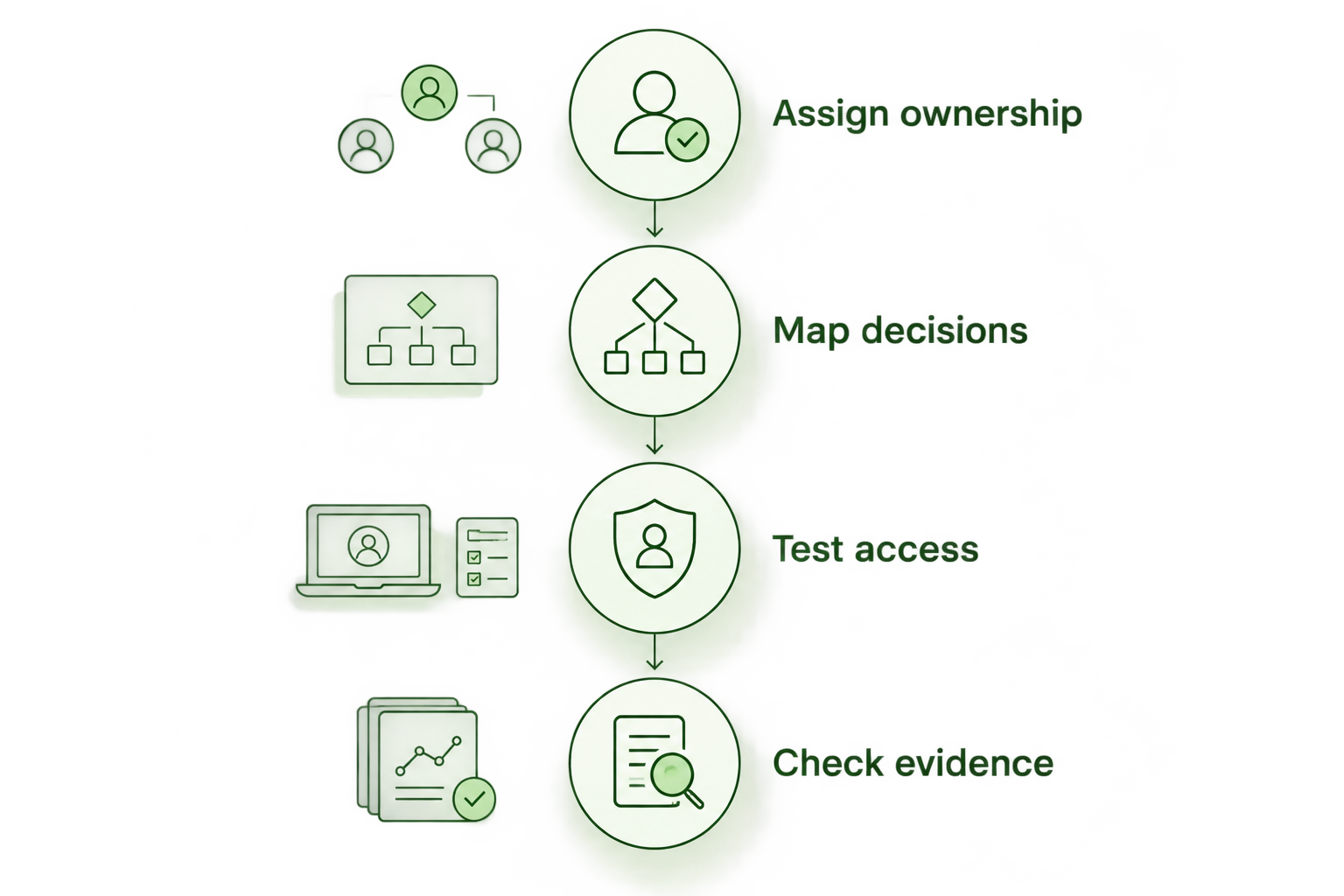
Choose the delivery model first, then prove that the clinic can operate it.
The sequence ends with a usable record, not merely a launched assignment. Keep unresolved access problems and responsibility gaps visible until an owner closes them.
What staff should be able to do after training
Security awareness training for veterinary clinics should end in observable actions. Ask employees to explain the procedure in their own words rather than repeat a slogan about being careful.
Use these clinic-specific discussion prompts:
- Reception: An unexpected caller requests a password reset. Which approved process verifies the caller before any access change?
- Practice management: A supplier emails new bank details. Which independently obtained contact will verify the change?
- Clinical staff: A message requests client information through an unfamiliar channel. Who authorizes disclosure, and which channel is approved?
- Payroll: An employee appears to request a deposit-account change. How does the authorized person verify that request?
These are suggested learning scenarios, not claims about any platform’s included content. Review the actual materials and add local instructions wherever a generic example stops short of the clinic’s procedure.
Which training model should you choose?
Choose MSP-delivered training when you want your technology provider to own the agreed training service. Specify the assignments, follow-up, evidence, and clinic responsibilities before enrollment.
Choose clinic-led training when your practice has the time and authority to operate it. Choose group-led training when several locations need a common standard. Add workshops when staff need to rehearse a difficult decision.
For your 2026 decision, reject any proposal that leaves ownership vague. A strong learning format cannot compensate for an unmanaged roster or an unanswered report.
FAQ
What's the best security awareness training for veterinary clinics?
The best choice depends on who will operate the program. MSP-delivered training fits clinics buying a managed service; clinic-led and group-led programs fit organizations with accountable internal owners.
Should a veterinary clinic manage training itself or use its MSP?
Use an MSP when you want a provider to handle agreed training responsibilities. Manage training internally only when someone has the time, authority, and backup coverage to maintain assignments and records.
What topics should veterinary clinic security training cover?
Cover suspicious requests, account protection, sensitive information handling, payment verification, and incident reporting. Connect each topic to the clinic's approved procedure and named reporting contact.
How often should veterinary staff receive security training?
Use onboarding and recurring follow-up rather than treating training as a single event. Set the schedule around staff changes, procedural changes, identified gaps, and applicable contractual or legal obligations.
What training evidence should a veterinary practice keep?
Keep records identifying assigned learners, completed learning, completion dates, outstanding assignments, and documented exceptions. Confirm retention requirements against the clinic's actual obligations rather than assuming a universal retention period.
Can a workshop replace an ongoing security training program?
A workshop should not replace ongoing training administration. It needs a supporting process for absent staff, new hires, completion records, and follow-up actions.
Does security awareness training replace managed IT security?
Security awareness training does not replace technical security controls. Keep responsibilities for employee learning separate from access management, device maintenance, incident response, and recovery.
One last thing
Ask an employee to show you how to report a suspicious request before you ask for a completion certificate. If the employee cannot find the reporting route, fix that gap immediately. The next lesson should reinforce a process the clinic can actually use.