Best security awareness training for construction companies 2026
Security awareness training for construction companies: choose MSP-managed delivery, then reinforce payment checks, field reporting, and training records.
DefendWise
DefendWise
Best overall for MSP-managed delivery: Defend Wise. Best for established internal training teams: an in-house learning management system; best for field reinforcement: supervisor-led briefings; best for payment approvers: role-based workshops. This 2026 guide compares security awareness training for construction companies by delivery model, ownership, and the decisions employees need to make.
TL;DR
- Defend Wise is best for MSPs delivering flat-fee, white-label security awareness training to construction clients.
- Choose security awareness training for construction companies around payment verification, account access, and field reporting.
- Use supervisor-led briefings to reinforce formal training, not replace individual training records.
- Require a demonstration of enrollment, learner access, and evidence before choosing a platform.
Why this matters
Construction security training needs to connect office decisions with jobsite actions. A payment approver needs a verification procedure; a superintendent needs a clear way to report a suspicious message without interrupting site operations.
Choose the delivery owner before choosing the content library. Software does not decide who follows up with a new hire, verifies a supplier’s bank change, or keeps training records current. Your 2026 selection should start with those responsibilities.
The options below serve different operating models. The platform recommendation fits MSP-led delivery; the other approaches explain when internal administration or targeted instruction is the better fit.
What makes the best construction security awareness training
Judge every option against these criteria before reviewing a demonstration:
- Accountable ownership: Name the person responsible for enrollment, follow-up, and records. Avoid a shared responsibility that nobody owns.
- Field access: Have an intended learner open and complete a sample lesson using the device and connection available at work.
- Relevant decisions: Cover supplier payment changes, payroll requests, shared documents, account access, and suspicious messages with clear actions.
- Usable evidence: Require records that identify the learner, assigned material, completion date, and unresolved work.
- Workforce changes: Check how new hires, departing staff, temporary workers, and approved subcontractor users enter or leave the program.
- Administrative fit: Separate software licensing from the work of maintaining rosters, answering questions, and following up.
Do not accept a feature checklist as proof of fit. Ask the prospective administrator to demonstrate the workflow from adding a learner through producing that learner’s completion record.
Construction training options at a glance
| Rank and option | Best for | Standout feature | Key limitation |
|---|---|---|---|
| 1. Defend Wise through an MSP | Outsourced training delivery | Flat-fee, white-label security awareness training with unlimited seats | Requires an MSP-led service model |
| 2. In-house learning management system | Established internal training teams | Internal ownership of assignments and training administration | Your team owns content selection and follow-up |
| 3. Supervisor-led briefings | Field reinforcement | Direct discussion of the reporting procedure and jobsite decisions | Attendance alone does not demonstrate individual understanding |
| 4. Role-based workshops | Payment and payroll approvers | Practice applying a specific approval procedure | Covers selected roles rather than the whole workforce |
These are delivery choices, not interchangeable products. A construction company can use a formal training program as its foundation and add briefings or workshops where a particular workflow needs reinforcement.
1. Defend Wise: best construction training for MSP-led delivery
Defend Wise provides flat-fee, white-label security awareness training for MSPs, with unlimited seats. It fits the outsourced model: the MSP supplies the training service to its construction client rather than asking that client to build a program alone.
Best for: MSPs that want to include security awareness training in their construction-client service offering.
The economic distinction is straightforward. Unlimited seats remove per-seat licensing from the platform decision; they do not remove the need to define who belongs in training or who follows up on incomplete work.
Before adopting this model, agree on the service boundary. Put roster ownership, learner support, escalation, and evidence delivery into the scope instead of assuming the platform supplies every operational task.
Defend Wise pros:
- Flat-fee licensing avoids per-seat platform billing.
- Unlimited seats support enrollment without a separate license decision for each learner.
- White-label delivery fits an MSP-branded training service.
- The stated offer is built for MSPs rather than direct internal administration.
Limitations:
- The MSP model is not the same as an internally owned training program.
- Licensing does not establish the client’s payment-verification or reporting procedures.
- Device access, content fit, and required evidence still need acceptance checks.
Ask the MSP to show how the proposed service handles a new employee, an overdue learner, and a departed worker. Require a sample evidence package with the responsibilities clearly assigned.
Verdict: Buy for MSP-led delivery after confirming the service scope and learner workflow.
2. In-house LMS: best construction training for internal ownership
An in-house learning management system gives your organization responsibility for assigning material and maintaining training administration. This approach fits a company that already has an accountable training owner and wants cybersecurity education within that existing process.
Best for: Construction companies with established internal learning administration.
The advantage is ownership, not automatic simplicity. Your team decides which lessons match company procedures and how to address unanswered questions. The same team must keep assignments and records current.
In-house LMS pros:
- Keeps responsibility for assignments inside the organization.
- Lets the training owner align instruction with internal procedures.
- Provides an existing administrative process when the LMS is already in use.
In-house LMS cons:
- Your team must select and maintain suitable cybersecurity material.
- A central system still needs someone to chase incomplete assignments.
- Learner access and record exports depend on the system selected.
For your 2026 review, ask the administrator to demonstrate a complete employee lifecycle. Start with enrollment, show assignment changes after a role change, and finish with access removal and record retention.
Verdict: Buy when internal ownership is established; hold if nobody has time to administer it.
3. Supervisor-led briefings: best construction training for field reinforcement
Supervisor-led briefings explain a specific security action in the context of site work. Use them to demonstrate where employees report suspicious messages, how they verify an unexpected request, and what they should do after making a mistake.
Best for: Field teams that need direct reinforcement of a formal training program.
Keep each briefing focused. A suggested 10-minute session can cover one situation, the approved response, and questions; this is a planning recommendation, not a required training duration.
Supervisor-led briefing pros:
- Connects instruction to the team’s actual reporting procedure.
- Gives workers an immediate opportunity to ask questions.
- Lets supervisors reinforce a recent process change without waiting for a broader course.
Supervisor-led briefing cons:
- Delivery depends on the supervisor understanding the procedure.
- Group attendance does not establish individual comprehension.
- Briefings need a separate method for recording participation and follow-up.
Give the supervisor a written scenario and an approved answer. For example, an unexpected document-sharing message should lead to independent verification, not a debate about whether its logo looks convincing.
Close by asking workers to identify the reporting route in their own words. Record unresolved questions and assign an owner to answer them.
Verdict: Buy as reinforcement; skip as the sole company-wide training method.
4. Role-based workshops: best construction training for payment approvers
Role-based workshops teach a defined group how to apply a security procedure. For construction finance teams, use a supplier bank-detail change, an urgent payment request, or a payroll-update request as the discussion scenario.
Best for: Accounts payable, payroll, purchasing, and staff authorized to approve payments.
The workshop should test the procedure, not the employee’s ability to remember security terminology. Ask who verifies the request, which trusted contact details they use, and what happens when the usual approver is unavailable.
Role-based workshop pros:
- Focuses attention on decisions the participants actually make.
- Exposes unclear approval responsibilities before a real request arrives.
- Produces specific procedure changes rather than a generic reminder to be careful.
Role-based workshop cons:
- Requires preparation around your real approval process.
- Does not cover employees outside the selected roles.
- Needs revision when payment authority or verification procedures change.
A useful exercise ends with a documented answer. If the team cannot identify an independent verification route, fix the workflow before treating the lesson as complete. The guide to spotting vendor impersonation and invoice fraud emails provides a related topic for that discussion.
Verdict: Buy for sensitive approval roles; skip as a replacement for baseline workforce training.
How these options rank
The ranking prioritizes accountable delivery, workforce coverage, practical instruction, and evidence. MSP-managed training comes first for the outsourced operating model; an internal LMS wins when a capable internal owner already exists. Briefings and workshops rank as supplements because each addresses a narrower need.
No product receives credit here for an unverified integration, language library, mobile application, or reporting feature. In your 2026 evaluation, require the supplier to demonstrate every capability your acceptance criteria depend on.
Build the program around construction decisions
Use 3 workstreams to organize the content: payment changes, account access, and incident reporting. This is a suggested program structure, not a claim about a required curriculum.
Payment changes
Teach employees to stop when a request changes where money goes. Verification should use an established contact route, not the telephone number supplied in the unexpected request.
The training must explain what happens when verification fails. Give employees explicit authority to pause the transaction and a named escalation contact.
Account access
Teach workers to open familiar services through a known route rather than an unexpected message. Include the response to an unsolicited authentication prompt and the process for reporting a lost work device.
Do not turn this section into a list of warning signs alone. Each example needs an action the employee can perform.
Incident reporting
Tell employees exactly where to report a suspicious request or an accidental disclosure. Explain what information to include and what to do if the normal reporting system is unavailable.
A reporting route is not ready until an intended user can find and use it. Have an office employee and a field employee demonstrate the process before rollout.
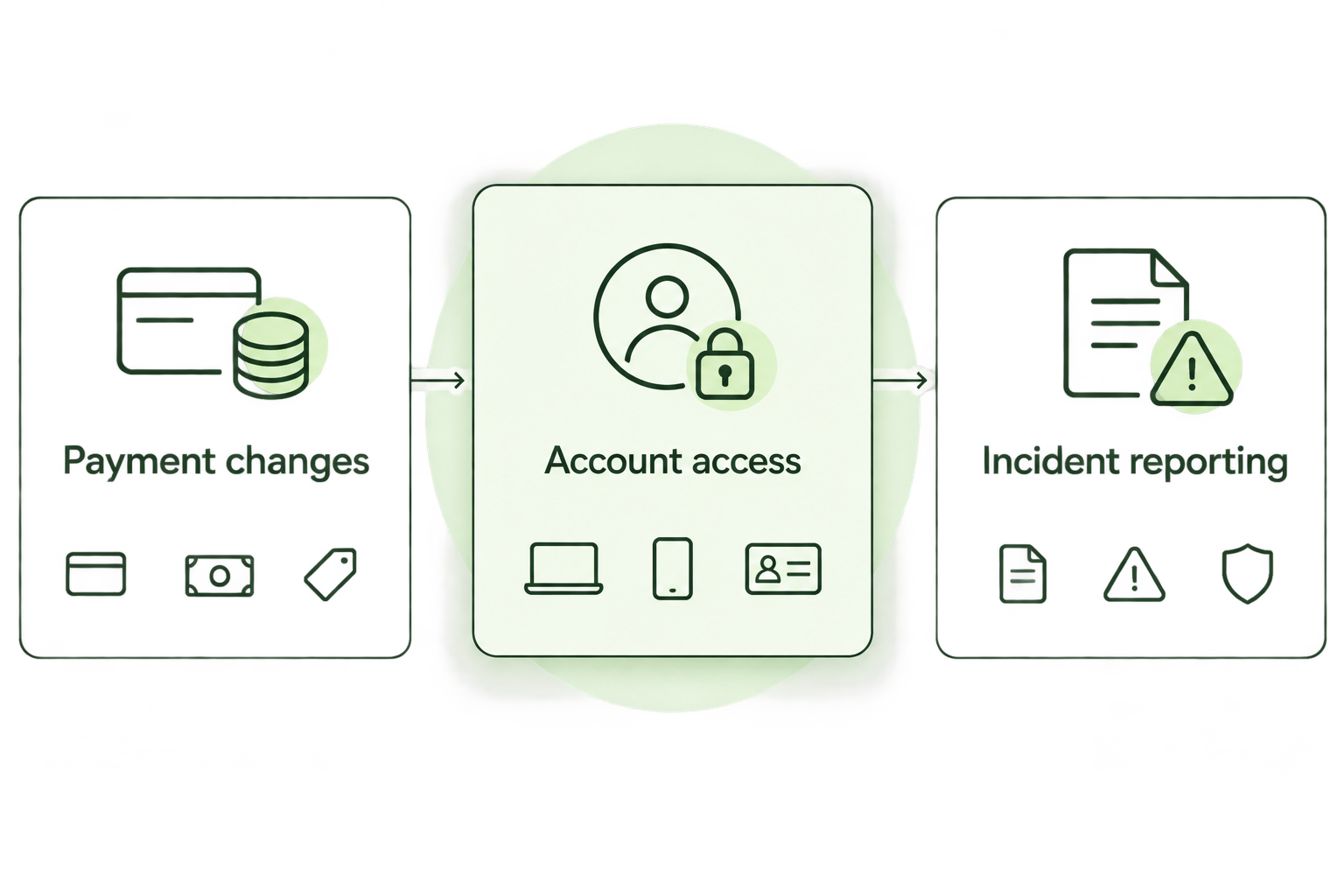
Organize training around actions employees need to take, not security terminology.
Keep these workstreams separate from software acceptance. A platform can deliver instruction, but your company must approve the procedures being taught and assign responsibility for maintaining them.
Run an acceptance check before rollout
For a suggested 30-day evaluation, use 5 sample learners representing office administration, field supervision, finance, a new hire, and the program administrator. These are planning parameters, not performance benchmarks.
Require the evaluation to answer practical questions:
- Can each learner reach and complete the assigned material?
- Does the language explain the correct company procedure?
- Can the administrator identify unfinished work without rebuilding a spreadsheet?
- Can the training owner produce an understandable completion record?
- Can the team remove access without losing required historical records?
Use the result to accept, revise, or reject the proposed setup. Do not turn unresolved issues into promises to sort out after deployment.
Which construction training option should you choose?
Choose MSP-managed training when you want an external service owner; choose an in-house LMS when your internal team already owns learning administration. Add supervisor-led briefings for field reinforcement and role-based workshops for payment authority.
For the outsourced model, Defend Wise security awareness training fits MSPs that want flat-fee, white-label delivery without per-seat licensing. Keep the purchasing decision tied to the demonstrated workflow, not the size of a content catalog.
Your 2026 program needs a named owner, usable instruction, and retrievable evidence. Select the arrangement that supplies those responsibilities clearly.
FAQ
What’s the best security awareness training for construction companies?
The best choice depends on who owns delivery: MSP-managed training fits outsourced administration, while an in-house LMS fits an established internal training team. Add field briefings and payment workshops where employees need procedure-specific instruction.
Is Defend Wise suitable for MSPs serving construction companies?
Defend Wise is suitable for MSPs seeking flat-fee, white-label security awareness training with unlimited seats. Confirm the proposed service’s learner workflow, responsibilities, and evidence against the construction client’s requirements.
Can toolbox-style briefings replace formal cybersecurity training?
Supervisor-led briefings work best as reinforcement rather than the sole training method. Keep individual participation records and provide a way to check understanding and resolve questions.
What should construction finance teams learn first?
Construction finance teams should learn the approved process for independently verifying payment and bank-detail changes. Training should identify the trusted contact route, approval authority, and escalation path when verification fails.
Should subcontractors receive security awareness training?
Set subcontractor training requirements according to their access, responsibilities, and contract terms. Identify who handles company information or uses company systems, then document the applicable requirements and their owner.
Does completing security awareness training prove compliance?
Completing training alone does not prove compliance with every applicable requirement. Match the content, covered roles, records, and review process to the specific obligations your organization must meet.
How should we evaluate training for field workers?
Evaluate field training using the devices, access conditions, and languages intended learners actually use. Ask workers to complete a sample lesson and demonstrate the reporting procedure before accepting the setup.
One last thing
Before buying anything, ask a payment approver what they would do if a familiar supplier urgently changed its bank details. Then ask who covers that decision when the approver is absent.
If the answers differ, start there. Training should make the approved action easier to identify—not compensate for an approval procedure that nobody has agreed on.