Best security awareness training for property managers 2026
Security awareness training for property managers works best with clear ownership. Compare MSP-led and internal options, evidence, and rollout steps.
DefendWise
DefendWise
Best for MSP-led delivery: Defend Wise. Best for direct internal control: an internally managed training platform. Best for payment-approval practice: instructor-led workshops. Best for reinforcing local procedures: manager-led briefings. The best security awareness training for property managers matches the way your team handles resident records, vendor payments, account access, and urgent requests.
TL;DR
- Defend Wise security awareness training fits MSPs serving property-management clients through a flat-fee, white-label model.
- Choose security awareness training for property managers around payment verification, resident privacy, and account security.
- Internally managed platforms suit teams with a named training administrator; workshops suit procedure practice.
- Keep completion evidence separate from proof that staff can follow payment and reporting procedures.
Why this matters
Property-management training needs to connect security advice to an actual decision. What should a leasing agent do with an unexpected document request? Who verifies a contractor’s changed bank details? Where does a maintenance supervisor report a suspicious text?
For your 2026 shortlist, start with those questions—not course-library size. A lesson earns its place when employees can explain the next safe action. Training supports your procedures; it does not replace access controls, payment approvals, or incident response.
What makes the best property-management security training
Use these criteria before comparing delivery models:
- Workflow relevance: Cover vendor changes, resident information, account recovery, and document sharing.
- Clear ownership: Name the person responsible for assignments, overdue work, and employee changes.
- Workforce access: Check whether leasing, maintenance, accounting, and temporary staff can complete the material using approved devices.
- Usable evidence: Require records that identify the learner, assigned material, completion date, and outstanding work.
- Administrative fit: Decide whether an MSP or your own team should operate the program.
- Procedure reinforcement: Pair general awareness with your actual verification and reporting instructions.
These are buying criteria, not claims that every option below includes every capability. Ask the provider to demonstrate the requirements you intend to purchase.
Best training options at a glance
This 2026 comparison ranks delivery models rather than making unsupported claims about competing software products. Each option serves a different operating need.
| Rank and option | Best for | Standout characteristic | Key limitation |
|---|---|---|---|
| 1. Defend Wise | MSPs serving property-management clients | Flat-fee, white-label security awareness training | Built for the MSP delivery model, not a substitute for local procedures |
| 2. Internally managed training platform | Teams wanting direct program control | Your administrator owns assignments and follow-up | Requires internal operating capacity |
| 3. Instructor-led workshops | Teams practicing sensitive decisions | Facilitated discussion of your procedures | Attendance and follow-up need coordination |
| 4. Manager-led briefings | Teams reinforcing location-specific rules | Direct connection to everyday work | Depends on manager consistency and recordkeeping |
1. Defend Wise: best for MSP-led property-management training
Defend Wise provides flat-fee, white-label security awareness training for MSPs. The model fits a provider delivering training to property-management clients under the provider’s own brand.
Defend Wise security awareness training is best for MSPs that want flat-fee, white-label delivery for property-management clients. The distinction matters: you are choosing a service-delivery model, not buying a replacement for your organization’s security policies.
Defend Wise pros:
- Flat-fee delivery removes per-seat pricing from the purchasing model.
- White-label training supports an MSP-branded client service.
- The stated MSP focus matches a provider-led training relationship.
Defend Wise cons:
- The MSP-focused model is not the same as choosing a program operated entirely by your internal team.
- You still need property-specific payment, privacy, and reporting procedures.
- Your buying decision still requires a demonstration of the workflows and evidence you need.
Best for: MSPs packaging security awareness training for property-management clients.
Ask the MSP to show how responsibility moves between the provider and your office. Who handles a new leasing employee? Who follows up when someone misses training? Who supplies records when an owner or insurer asks?
Verdict: Buy for MSP-led delivery when the demonstrated workflow meets your requirements.
2. Internally managed platforms: best for direct program control
An internally managed training platform puts your organization in charge of operating the program. You choose the provider and assign an internal administrator to manage the work.
This approach fits a property-management company that wants direct control over training decisions. It also makes the administrative responsibility yours: ownership must survive vacations, staff changes, and competing priorities.
Internally managed platform pros:
- Your team controls assignments and follow-up decisions.
- Training ownership sits directly inside your organization.
- You can evaluate providers against your existing internal processes.
Internally managed platform cons:
- Someone must maintain the roster and handle exceptions.
- Selecting software does not establish a repeatable operating process.
- Property-specific instructions still need to come from your organization.
Best for: Property-management teams with a named administrator and capacity to run the program.
Before choosing this model, write down the administrator’s recurring tasks. Then assign a backup. A platform without an accountable operator leaves basic decisions unresolved, regardless of the material it contains.
Verdict: Buy when you want direct control and have assigned the operating work.
3. Instructor-led workshops: best for payment-approval practice
Instructor-led workshops give your team a place to discuss ambiguous requests and rehearse procedures. Use a fictional contractor bank-change request or an urgent owner-payment instruction, then ask participants to explain the verification path.
The value is discussion. A facilitator can identify where accounting, property managers, and regional leadership interpret the same policy differently.
Instructor-led workshop pros:
- Employees can ask questions about unclear instructions.
- Different roles can compare their responsibilities.
- You can build the session around an actual approved procedure.
Instructor-led workshop cons:
- Scheduling must account for employees across properties and shifts.
- Absentees need a separate completion path.
- Discussion alone does not create a complete training record.
Best for: Accounting and management teams practicing payment verification and escalation.
Keep the exercise focused on decisions, not employee embarrassment. Ask which trusted contact method to use, who can approve the change, and what happens if the usual approver is unavailable.
Verdict: Buy as a targeted supplement, not your only training process.
4. Manager-led briefings: best for local procedure reinforcement
Manager-led briefings translate general security guidance into location-specific instructions. A property manager can explain where to report a suspicious request, how to handle a misplaced work device, or which channel is approved for resident documents.
Use these briefings to reinforce a broader program. Do not assume a conversation happened consistently just because it appeared on a meeting agenda.
Manager-led briefing pros:
- Instructions can reflect the property’s approved workflow.
- Employees can clarify who handles a local issue.
- Managers can reinforce a procedure after it changes.
Manager-led briefing cons:
- Delivery depends on the manager’s preparation and accuracy.
- Different properties can receive inconsistent instructions.
- Attendance and follow-up require deliberate recordkeeping.
Best for: Site teams that need clear local instructions alongside formal awareness training.
Give managers a written outline and an escalation contact. Ask them to record the topic, date, attendees, and unresolved questions rather than relying on memory.
Verdict: Hold as your sole program; use for local reinforcement.
How these options rank
The ranking prioritizes administrative fit, clear ownership, workflow relevance, and evidence. MSP-led delivery comes first for an MSP-managed buying situation; internal administration wins when direct control is the requirement.
Workshops and briefings serve narrower jobs. They help employees apply procedures, but you must separately organize coverage, completion records, and follow-up.
For a 2026 buying decision, request a demonstration using your own acceptance checklist. Do not treat this ranking as evidence of tested integrations, measured results, or property-management-specific course content.
Build the program around property-management decisions
Your training outline should identify the action an employee must take—not just the threat they should recognize. Start with these areas and adapt them to your approved policies.
Payment changes
Teach staff to stop a requested bank-detail change until it passes your verification process. Use a previously established contact method rather than contact information supplied in the change request.
Cover urgent exceptions explicitly. A procedure that explains routine approvals but says nothing about an unavailable approver leaves employees to improvise at the wrong moment.
Resident records
Explain which channels your organization approves for collecting and sharing resident documents. Include recipient checks, access decisions, and the response to an accidental disclosure.
Use fictional records in training. Employees do not need real applications, identification documents, or bank details to practice the decision.
Account recovery
Teach employees how to report unexpected sign-in prompts, recovery messages, and requests to change authentication settings. Assign responsibility for verifying identity before account access changes.
Training about preventing account takeover fraud belongs beside account-recovery procedures: staff need to distinguish an identity claim from evidence accepted by your organization. A familiar name or urgent story is not an approval process.
Incident reporting
Give employees a reporting route they can find without searching a training library. Include a backup route for situations where their usual account or device is unavailable.
Ask for prompt reporting of mistakes as well as suspicious requests. Your instructions should explain what information to preserve and who decides the next response.
A practical rollout for 2026
Use the following schedule as a proposed starting plan, not a compliance requirement. Adjust it to your staffing pattern and documented obligations.
- Map access. List the roles that handle resident data, payment instructions, shared accounts, and administrative access. Include temporary staff and contractors where their access warrants training.
- Assign ownership. Name the program owner, the person handling employee changes, and the contact responsible for overdue work.
- Teach decisions. Start with a proposed 10-minute briefing on the highest-priority procedure. Add the relevant awareness material without presenting the briefing as a substitute for it.
- Check records. At 30 days, reconcile your staff roster with assignments, completions, and exceptions. Investigate gaps rather than recording an unexplained completion percentage.
- Review gaps. At 90 days, review recurring questions and procedure changes. Update the program where employees still lack a clear next action.
The sequence separates setup from ongoing ownership. Every step should leave a named person responsible for the next one.
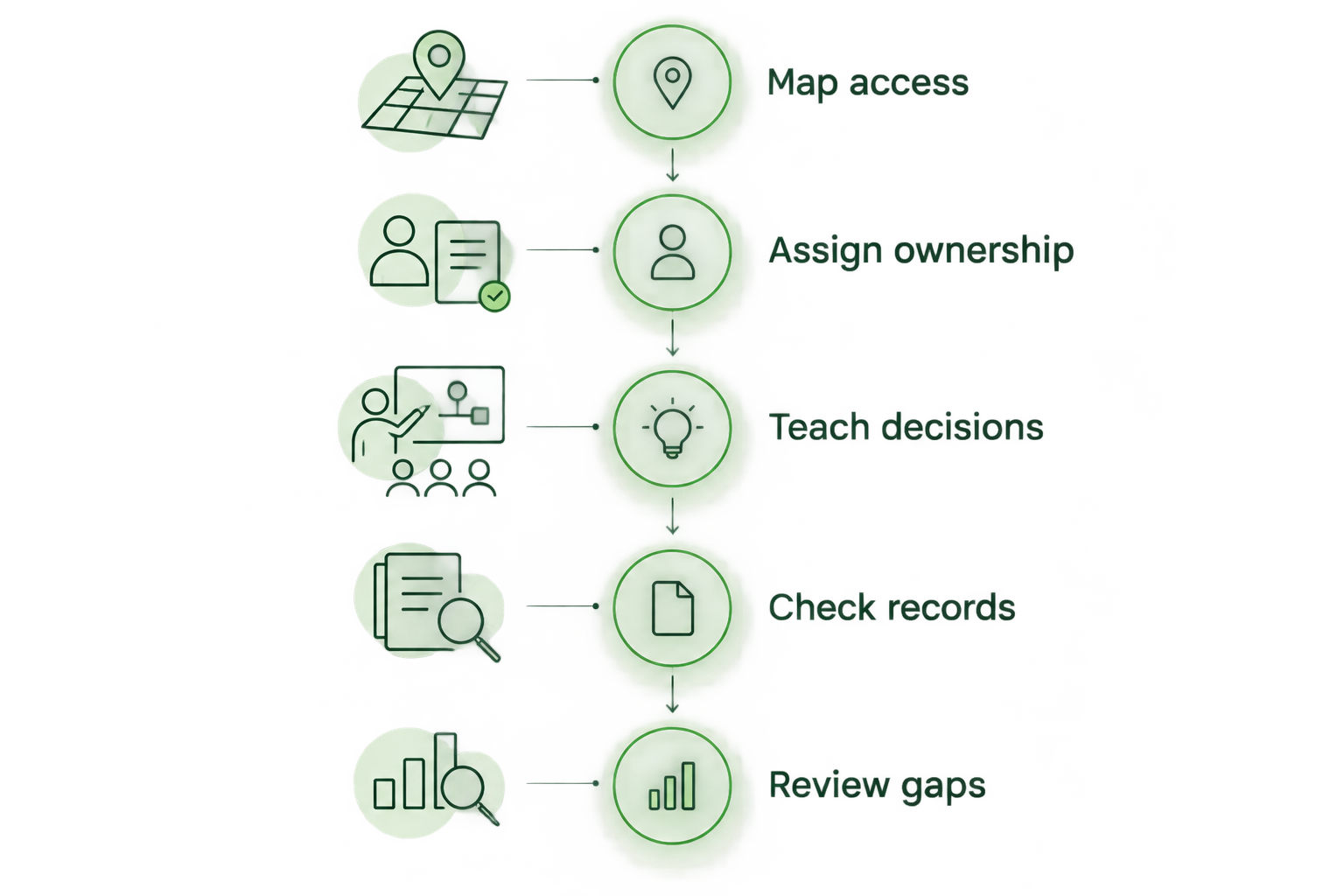
Assign ownership before launching lessons, then check coverage against your staff roster.
For portfolios spread across properties, apply the same ownership rules at every site. The security training for multi-location businesses guide addresses the broader operating context; your rollout still needs a property-level contact and a central owner.
Keep evidence that answers specific questions
Build your 2026 evidence requirements before choosing the program. Ask whether you can establish who received training, what they completed, when they completed it, and which assignments remain unresolved.
Keep these records distinct:
- Coverage: Compare the training roster with the people whose roles require participation.
- Completion: Record the learner, material, date, and status.
- Procedure acknowledgment: Record acceptance of your current internal instructions where appropriate.
- Exceptions: Document absences, access problems, departures, and the person responsible for resolving them.
Completion proves completion—not that every future decision will be correct. Use questions and procedure walkthroughs to identify misunderstandings, and retain the resulting follow-up actions.
Which training option should you choose?
Choose the operating model before comparing lesson catalogs. If your MSP will own delivery, Defend Wise belongs on the shortlist for flat-fee, white-label security awareness training. Require a demonstration against your property-management workflow before committing.
If your internal team will own delivery, choose an internally managed platform only after assigning an administrator and backup. Add workshops for sensitive decisions and manager-led briefings for local instructions.
The default is a repeatable training program with one accountable owner—not a collection of disconnected presentations.
FAQ
What's the best security awareness training for property managers?
The best option matches your operating model and covers payment verification, resident privacy, account security, and reporting. Choose MSP-led delivery when your provider owns the program, or internal administration when your team has the capacity to run it.
Is an MSP-managed program better than running training internally?
An MSP-managed program fits organizations that want provider-led delivery; internal management fits teams that want direct operating control. Compare the responsibilities each model leaves with your staff before deciding.
What should property-management employees learn first?
Start with the security decisions employees make in their own roles. Prioritize verification of payment changes, approved handling of resident information, account-recovery requests, and incident reporting.
How often should property managers run security training?
Set a documented schedule that addresses onboarding, role changes, procedure changes, and applicable obligations. Reinforce instructions when employees encounter confusion rather than waiting for the next scheduled lesson.
Should maintenance workers and temporary staff receive training?
Include maintenance workers and temporary staff when their access or duties create a training need. Match the instruction to the accounts, devices, information, and requests they actually handle.
Does completing security training prove compliance?
Training completion alone does not prove compliance. Match the program and its records to the legal, contractual, insurance, and policy requirements that apply to your organization.
What should a property manager ask during a training demonstration?
Ask the provider to show employee onboarding, assignments, overdue follow-up, departures, and evidence retrieval. Use your own requirements so the demonstration answers operational questions rather than simply displaying content.
One last thing
Before approving your 2026 program, ask a leasing agent, an accounting employee, and a maintenance supervisor where they would report a suspicious request. If their answers conflict, fix the reporting instructions before adding more lessons. A clear next action is more useful than another undefined warning to be careful.