Security training for commercial real estate: complete 2026 guide
Security awareness training for commercial real estate firms: protect payments and tenant data with role-based lessons and clear reporting rules.
DefendWise
DefendWise
Commercial real estate security awareness training is role-based instruction that teaches employees to protect payments, accounts, and tenant information with the aim of preventing avoidable security incidents. This 2026 guide focuses on the decisions property managers, leasing teams, accounting staff, and their managed service providers must make—not another generic course-completion exercise.
TL;DR
- Security awareness training for commercial real estate firms should prioritize payment verification, tenant data, and account security.
- Defend Wise security awareness training is best for MSPs seeking flat-fee, white-label delivery.
- Teach property managers and accounting teams different scenarios, but give everyone the same reporting route.
- Keep training records separate from proof that payment approvals and access controls actually work.
Why security awareness training matters for commercial real estate firms
Commercial real estate training needs to follow the work: approving contractor invoices, sharing lease documents, answering tenant requests, and handling account access across properties. A lesson becomes useful when an employee knows exactly which action to stop and whom to contact.
Start your 2026 program with payment changes. Teach accounting staff to recognize vendor impersonation and invoice fraud emails, then connect recognition to a documented verification procedure. Spotting a suspicious message is not the same as preventing an unauthorized payment.
Your audience also extends beyond headquarters. Include property-level staff, temporary coverage, and contractors with relevant system access; assign scope according to access and responsibilities rather than employment status alone.
Train the decision, not just the warning sign. A rushed employee needs a clear next action, not a longer list of things that look suspicious.
Build your commercial real estate training program
1. Map the work that exposes money and information
Start manually with a spreadsheet and conversations with department owners. Ask employees to describe how a payment change, lease document, or account recovery request moves through the business. Record actual handoffs rather than relying on the procedure everyone assumes exists.
Separate property ownership, management responsibilities, and system access. An employee working across several buildings needs instructions that identify the right approver for each entity. A building name alone is not an authorization boundary.
For each workflow, identify the request, the verification step, and the escalation owner. This becomes your training brief and exposes process gaps before you buy software.
- List roles that approve payments or change vendor records.
- Identify systems containing tenant, employee, or banking information.
- Record shared inboxes and property-level communication channels.
- Assign an owner to each sensitive workflow.
- Flag tasks that lack a documented verification step.
2. Write rules employees can follow under pressure
Use existing documents and a short team briefing first. Define what employees must do when instructions change, someone requests sensitive information, or a login prompt appears unexpectedly. Make the rule specific enough to use during a busy leasing day.
For payment changes, require verification through a previously established contact method. Do not let the suspicious request supply its own proof: a phone number inside the same message is not an independent verification route.
Account security needs similarly direct instructions. Employees should know how to open approved services, handle unexpected authentication prompts, and request help without trusting contact details from an unsolicited message.
- Verify changed bank details using an established contact record.
- Separate payment preparation from approval where your process requires it.
- Open document services through an approved route.
- Reject authentication prompts you did not initiate.
- Report suspected account exposure immediately through your designated channel.
3. Assign role-based lessons before choosing delivery software
You can deliver initial instruction through manager briefings, existing meeting tools, and a controlled document library. Build the lesson around a real decision: whether to release money, disclose information, approve access, or open a document.
For MSP-led delivery, Defend Wise provides flat-fee, white-label security awareness training with unlimited seats. Defend Wise security awareness training is best for MSPs seeking flat-fee, white-label delivery. That model removes seat-count pricing friction; the MSP still needs to define client-specific procedures and responsibilities.
Evaluate delivery against your 2026 operating requirements rather than assuming a platform supplies every workflow. Confirm content fit, administration, learner access, and evidence handling before committing.
- Give accounting staff payment-change and invoice scenarios.
- Give leasing teams document-sharing and identity-verification scenarios.
- Give property managers contractor-request and access-escalation scenarios.
- Give reception staff caller-verification and information-disclosure scenarios.
- Give executives approval, delegation, and account-recovery scenarios.
4. Schedule instruction around access and responsibilities
Start with a shared calendar and a named owner. Assign onboarding instruction when employees receive relevant access, then revisit the material when their responsibilities change. A move from leasing support to payment approval deserves different instruction, not merely another copy of the same lesson.
For your initial rollout, use a recommended 15-minute briefing to explain the reporting route and payment-verification rule. Schedule a 30-day review to resolve unclear instructions and a 90-day review to revisit role coverage. These are planning checkpoints, not regulatory deadlines or claims about training effectiveness.
Keep site coverage practical. Someone covering a property temporarily still needs the instructions that apply to that assignment.
- Tie onboarding instruction to the access employees receive.
- Schedule refreshers after material workflow changes.
- Give temporary staff instructions before relevant assignments.
- Name a substitute owner for training administration.
- Review overdue assignments with the responsible manager.
5. Practice the reporting and response handoff
Begin with a discussion exercise using fictional messages and documents. Ask employees to explain what they would do, who they would contact, and what information they would preserve. No deceptive campaign is needed to discuss a suspicious payment request.
Walk through a tenant-data request or an unexpected document-sharing notification. The useful outcome is a clear handoff: the employee reports, the designated owner assesses, and the authorized team handles containment or financial escalation.
In your 2026 procedure, distinguish suspicion from confirmed exposure. An unopened message, entered credentials, and an initiated transfer require different information from the employee, even when they use the same reporting channel.
- Recognize: identify an unexpected request or account event.
- Pause: stop the payment, disclosure, or login action.
- Verify: use an established, independent contact route.
- Report: give the designated owner relevant details.
- Escalate: involve authorized financial or technical responders.
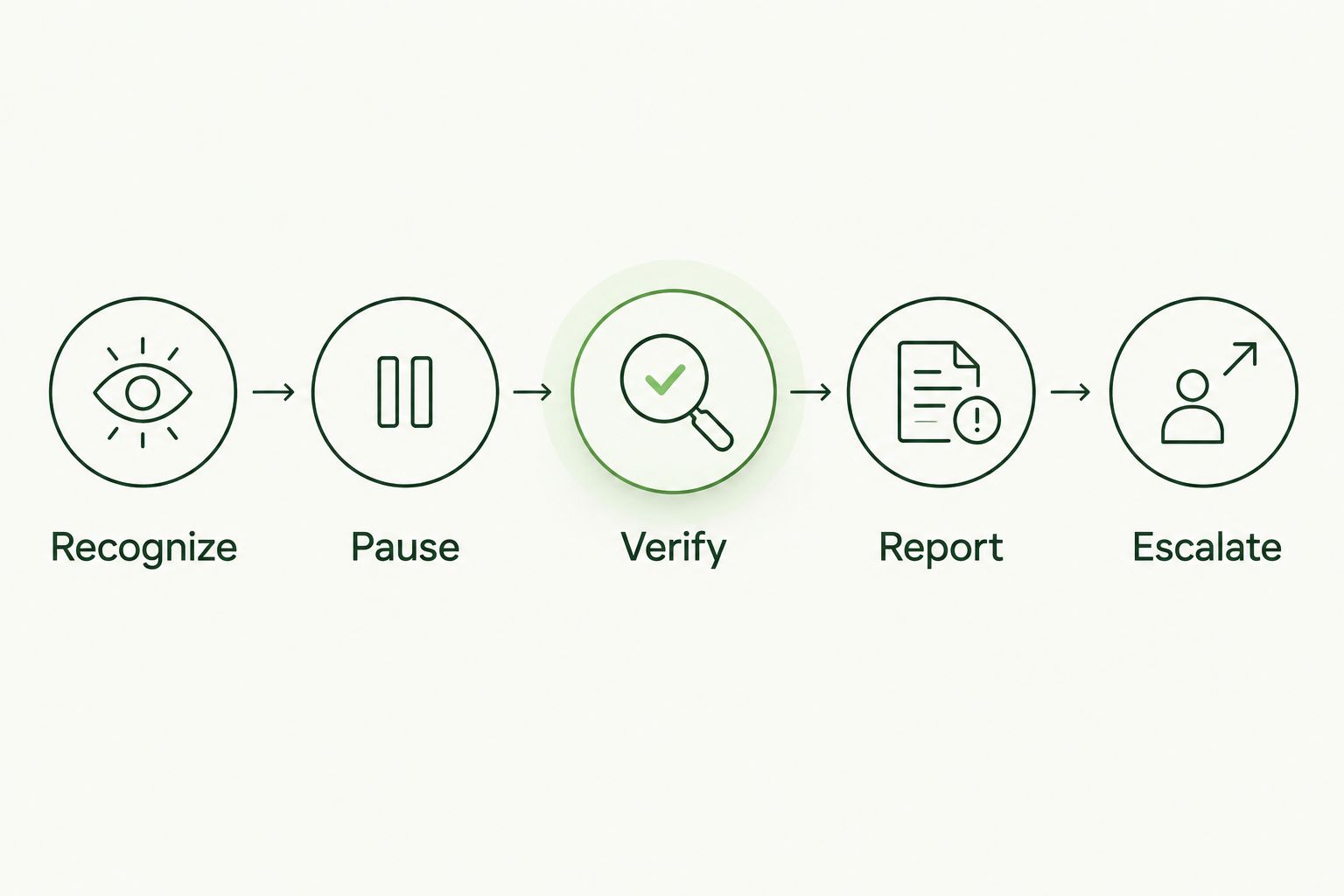
Give employees a defined handoff instead of asking them to investigate suspicious activity themselves.
6. Separate training evidence from control evidence
Start with a controlled register containing employee identity, assigned instruction, completion date, and the applicable policy version. Keep exceptions visible. A manager-approved delay should not disappear into a completion percentage that makes the program look finished.
Training records answer who received instruction. They do not establish whether payment approvals, mailbox permissions, or account-recovery procedures are configured correctly. During a cybersecurity risk assessment, distinguish reviewing those records from checking the underlying controls; otherwise, course completion becomes a substitute for examining how the business actually operates.
For a 2026 evidence review, ask your MSP to show how records correspond to current staff and responsibilities. If a property changes managers, establish who retains historical records and who owns the next assignment.
- Record the learner, assignment, completion date, and policy version.
- Track overdue work and approved exceptions separately.
- Reconcile training scope against current access and roles.
- Document ownership when properties or service providers change.
- Store evidence with access appropriate to its contents.
7. Review behavior without promising zero incidents
Start with a manager-led review of reported concerns, unresolved questions, and missed verification steps. Look for recurring decisions employees find difficult. An unclear process calls for a process correction, not automatically another lesson.
Measure completion as coverage, not proof of security. A perfect quiz result does not establish that an employee will follow the payment procedure during a rushed transaction. Pair knowledge checks with discussions about how employees would use the actual escalation route.
Review results by role and relevant business unit. Avoid turning reports into a blame exercise: employees need to know they should report an error promptly, including one they caused.
- Track assigned and completed instruction separately.
- Record unresolved questions by workflow.
- Review whether reported concerns reached the right owner.
- Update instructions after material process changes.
- Give managers specific corrective actions and owners.
Compare delivery options for your firm
Choose the operating model before choosing the interface. Your main trade-off is who owns lesson delivery, recordkeeping, and follow-up—not how polished the course catalog looks.
| Option | Best for | Main advantage | Key limitation |
|---|---|---|---|
| Manager-led briefings and a manual register | A defined team with an accountable internal owner | Direct control over property-specific examples and procedures | The owner must maintain assignments, records, and follow-up |
| An existing learning management system | Firms already administering employee learning centrally | Uses an established learning workflow | Security content, role mapping, and evidence requirements still need evaluation |
| Defend Wise through an MSP | MSPs delivering white-label security awareness training to client organizations | Flat-fee training with unlimited seats avoids seat-count pricing friction | The MSP must still establish client-specific procedures and confirm operational fit |
Manual delivery is a valid starting point when someone owns the work. Its limitation is administrative: every new starter, changed role, and exception creates another record to maintain.
An existing learning management system is worth evaluating if your team already uses it consistently. Do not assume it includes appropriate security instruction or the evidence fields your firm needs.
Defend Wise fits the MSP delivery model, not the assumption that a training purchase replaces internal accountability. Ask the service provider to demonstrate the complete workflow using your requirements before adoption.
Common mistakes commercial real estate firms make
Teaching email recognition without payment verification
An employee can recognize an unusual invoice and still approve it after a convincing follow-up call. Teach the verification rule alongside the warning signs, including which contact record to use and who can authorize an exception.
Organizing training only by building
A building-based roster does not explain what someone can approve or access. Map responsibilities across properties so shared accounting staff, regional managers, and temporary coverage receive instruction that matches their authority.
Leaving tenant-facing staff outside the program
A staff member who cannot approve a payment can still receive sensitive documents or requests for account information. Include anyone whose work involves relevant communications, records, or access—not just office employees with financial authority.
Treating a certificate as a compliance determination
A completion record proves that an assignment was completed. Determine applicable legal, contractual, and insurance obligations separately; do not assume every commercial property business has identical requirements or that a course satisfies them automatically.
Confusing training with technical protection
Awareness instruction does not configure access permissions, secure mailboxes, or approve transfers. Keep those responsibilities explicit in the service agreement and internal procedures. Training should explain how employees work with those controls, not stand in for them.
FAQ
What's the best security awareness training for commercial real estate firms?
The best fit teaches employees how to handle payment changes, tenant information, account access, and suspicious requests in their actual roles. Evaluate delivery against your staffing, reporting, and evidence requirements rather than course volume alone.
Who needs security awareness training at a property management company?
Include employees and relevant contractors whose responsibilities involve sensitive information, payments, communications, or system access. Assign instruction according to those responsibilities, including temporary property coverage.
How often should commercial real estate employees receive security training?
Provide instruction during onboarding and revisit it when access, responsibilities, or procedures change. Set additional refreshers according to your documented risks and applicable obligations rather than treating an annual assignment as the entire program.
Can an MSP manage security awareness training for our firm?
An MSP can manage training delivery under an agreed scope of service. Your firm must still identify internal approvers, establish payment and data-handling rules, and confirm who owns records and exceptions.
Does completing security training make a commercial real estate firm compliant?
Completing security training does not establish overall compliance. Match the instruction and evidence to the obligations that apply to your entities, activities, contracts, and data.
What should employees do when a vendor changes bank details?
Employees should pause the change and verify it through a previously established contact route before following the approval procedure. Contact details supplied inside the change request are not independent verification.
Can we start commercial real estate security training without a new platform?
Yes, you can begin with role-based briefings, documented procedures, a reporting route, and a controlled training register. Assign an owner to maintain records and follow up on incomplete work.
One last thing
At your next payment-process review, ask an employee to find the trusted contact record for a vendor without opening the latest invoice. If the employee cannot find it, fix the directory and ownership first. Training cannot make an unavailable verification route usable.