Security training for trade associations: complete 2026 guide
Security awareness training for trade associations works best by role. Build a practical plan for staff, boards, chapters, and MSP-managed delivery.
DefendWise
DefendWise
Trade association security awareness training is a role-based education program that helps staff, board members, and authorized volunteers protect member information and verify sensitive requests. This guide shows you how to separate headquarters training from member education, cover chapter responsibilities, and build usable evidence in 2026.
TL;DR
- Security awareness training for trade associations works best when staff, boards, chapters, and members have separate responsibilities.
- Defend Wise security awareness training is best for MSPs delivering flat-fee, white-label training to association clients.
- Train people on membership records, event payments, document sharing, and reporting—not just suspicious email recognition.
- Keep completion evidence tied to named learners, assigned responsibilities, and the material they received.
Why security awareness training matters for trade associations
Your association's training boundary is not the same as its membership boundary. A member receiving your newsletter does not have the same responsibilities as an employee exporting the membership database. Start with access and authority, not mailing-list size.
For your 2026 program, identify who handles renewal payments, sponsor agreements, registration records, and board documents. Where volunteers perform those tasks, include them in the relevant training rather than treating employment status as the deciding factor. The guide to security awareness training for nonprofit volunteers and staff covers that shared-access problem.
Separate education from enforcement. Training explains how to verify a payment change; your finance procedure determines who approves it. Neither replaces the other.
Build around these distinctions:
- Headquarters: protect association systems and records.
- Board and committees: handle confidential documents and delegated authority.
- Chapters: follow clearly assigned local and central responsibilities.
- Members: receive optional education unless a specific relationship creates additional obligations.
Build your association's training program
1. Define who belongs in the program
Start manually with an access roster. A spreadsheet is enough to list each person's role, systems, supervisor, and training owner before you select delivery software.
Use permissions to decide scope. Include a temporary event worker who can export attendee records, but do not automatically enroll every member business in your internal employee program. Document the difference so leadership understands what your coverage actually means.
Check shared accounts separately. A completed course under a generic chapter login does not identify which person received the instruction. Assign learning to named people even when their operational access needs separate cleanup.
- List employees with access to association systems.
- Identify board members and volunteers handling restricted material.
- Record chapter contacts with delegated access or payment authority.
- Separate internal learners from optional member education audiences.
2. Map lessons to association workflows
Write down sensitive tasks before assembling a course list. Ask the people doing the work what a legitimate renewal, sponsor payment, member-data request, or board approval looks like.
Then teach the decision inside that task. For a requested bank-account change, explain how to verify through an established contact channel rather than replying to the message that supplied the new details. For a member-list request, explain who approves disclosure and which sharing method is permitted.
Use sanitized examples. Real member records and confidential board papers do not belong in training screenshots merely because the session is internal. Replace identifying details while preserving the decision you want learners to practice.
- Teach membership teams how to verify requests for record exports.
- Teach finance teams how to confirm payment-detail changes.
- Teach event teams how to handle attendee and exhibitor information.
- Teach board members how to share restricted documents appropriately.
3. Choose delivery around your operating model
Begin with a documented briefing, an approved lesson, and a completion register. That manual approach gives you a working process to evaluate before you introduce software or outsource administration.
If an MSP manages training for your association, Defend Wise provides flat-fee, white-label security awareness training for MSPs. Its unlimited-seat model removes the per-seat pricing mechanism; your service agreement still needs to define enrollment, follow-up, and evidence responsibilities.
Defend Wise security awareness training is best for MSPs delivering flat-fee, white-label training to association clients. The trade-off is the delivery model: an association evaluating an MSP service must assess the provider's work, not just the underlying platform.
Do not assume a software purchase resolves ownership. Ask who handles a new chapter contact, a missed assignment, and a request for historical records.
- Name the person accountable for program administration.
- Decide whether delivery stays internal or sits with your MSP.
- Separate the platform's scope from the MSP's service commitments.
- Test a learner assignment and evidence handoff before expansion.
4. Set a cadence around access and events
Use a shared calendar first. Attach training to onboarding, role changes, and relevant association activities rather than relying on a single annual announcement.
A practical starting plan for 2026 is a 15-minute onboarding briefing, a 30-day roster review, and a 90-day program review. These are proposed operating intervals, not legal requirements or measured performance benchmarks. Adjust them to your association's responsibilities and applicable obligations.
An event briefing should cover the tasks event personnel actually perform. A committee transition should cover document access and reporting. Repeating unrelated material consumes attention without clarifying either job.
- Deliver the onboarding briefing before granting sensitive access.
- Review roster changes every 30 days under the proposed plan.
- Brief event personnel before they handle registration information.
- Review program coverage every 90 days and after role changes.
5. Give every learner a reporting route
Write the reporting procedure in plain language before teaching it. People need to know where to send a concern, what details to include, and what to do if the normal channel is unavailable.
Your internal procedure should connect Report concern, Triage request, Verify action, and Record outcome. Assign an owner at each stage so a report does not stop in a shared inbox without a decision.
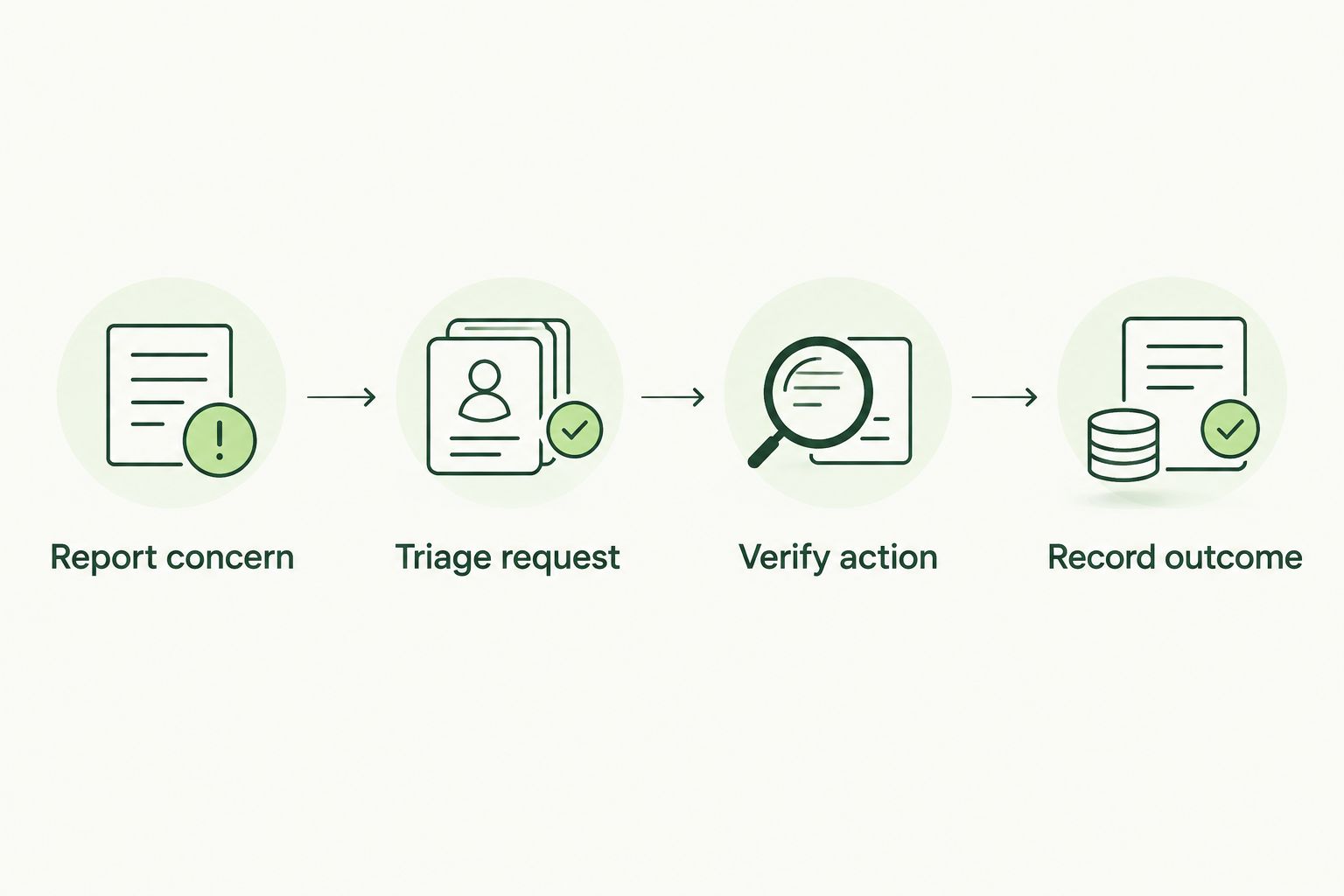
Give every report an owner and a recorded outcome.
Teach people to report after a mistake, too. Someone who opened a file or disclosed information needs an immediate next step, not a reason to hide what happened. Your response procedure should specify who handles containment and follow-up.
- Publish the primary reporting contact in an accessible location.
- Provide an alternate route for suspected account compromise.
- Explain what information to preserve without forwarding sensitive data unnecessarily.
- Assign responsibility for acknowledgment, escalation, and closure.
6. Keep evidence that answers a real question
Start with a controlled register and a consistent folder structure. Record who was assigned training, what they received, when they completed it, and which exceptions remain unresolved.
For the 2026 evidence file, preserve the material version alongside the completion record. A name and date alone do not explain what the learner was taught. Keep records accessible to authorized reviewers without turning completion reports into another uncontrolled source of personal information.
An insurer, customer, or auditor can ask a narrower question than your dashboard answers. Match the response to the actual request. Do not describe course completion as proof that every contractual or regulatory obligation has been satisfied.
- Record learner identity, role, assignment, and completion date.
- Preserve the lesson or policy version used.
- Log overdue assignments, exceptions, and responsible owners.
- Follow a documented retention and access policy for evidence.
7. Review coverage and correct the process
Review the roster against current access before judging the program by completion alone. An impressive completion percentage says little if chapter administrators or temporary event personnel were never assigned training.
Track administration as well as learning. Record the time spent chasing assignments, correcting rosters, and preparing evidence. For an MSP-delivered service, review those responsibilities with the provider instead of assuming they disappear inside the contract.
Assess Defend Wise within that service boundary: flat-fee, white-label security awareness training for MSPs. Judge the association's overall program separately on coverage, relevant instruction, reporting clarity, and evidence quality.
- Reconcile the learner roster with people holding sensitive access.
- Review unresolved assignments and documented exclusions.
- Ask learners to explain the verification and reporting steps.
- Update lessons when an association workflow or responsibility changes.
Compare delivery options for your association
Choose the operating model before choosing the software. Each option below can support a training program, but each leaves a different amount of administration with your association.
Evaluate a representative assignment from enrollment through evidence retrieval. That walkthrough exposes handoffs a feature list does not: who creates the assignment, who follows up, and who answers leadership's request for a record.
| Option | Best for | Main advantage | Key limitation |
|---|---|---|---|
| Internal briefings and a manual register | Associations with a defined audience and an accountable coordinator | Direct control over association-specific instruction | Your team maintains assignments, reminders, and records |
| Existing learning management system | Associations already administering other staff education | Training can sit within an established learning process | You must evaluate security content, reporting, and external-learner access |
| Association-managed security training platform | Associations assigning a dedicated internal program owner | A purpose-built delivery approach can replace separate manual steps | Your team still owns configuration, scope, and follow-up |
| MSP-delivered service using Defend Wise | MSP-managed associations seeking white-label security awareness training | Flat-fee, unlimited-seat platform model for the MSP | Service responsibilities must be agreed with the MSP |
For chapter-based organizations, add a governance test. Ask whether headquarters needs individual completion records, a chapter-level attestation, or both. Decide that requirement before collecting personal information across separate organizations.
Common mistakes trade associations make
Treating member education as internal coverage
A webinar invitation to member companies does not establish that your staff received assigned training. Keep the audiences, objectives, and evidence separate. Report internal coverage against the people who actually belong in the internal program.
Giving chapter leaders responsibility without a boundary
Do not ask chapters to “handle security training” without defining the people, systems, and records involved. State which responsibilities headquarters retains and which the chapter accepts. Record a named contact for exceptions and transitions.
Skipping board members because they are not employees
Base inclusion on access and authority. Where board members receive restricted papers or approve sensitive actions, teach the relevant sharing, verification, and reporting procedures. Use their actual responsibilities rather than an employee-only course assignment rule.
Expanding member benefits before assigning administration
If you offer training to member organizations, define it as a separate service. Establish who enrolls learners, supports them, receives reports, and handles organizational separation. Do not assume your internal program's permissions and evidence rules fit every member company.
Calling completion a compliance guarantee
A completion record documents an activity, not universal legal compliance. For the 2026 program, map training to the requirements that actually apply to your association, contracts, and data handling. Have the responsible adviser confirm applicability rather than copying obligations from the industry your members represent.
FAQ
What's the best security awareness training for trade associations?
The best approach is role-based training with a named administrator, a clear reporting route, and retrievable completion evidence. Separate staff, board, chapter, and member responsibilities before choosing a delivery platform.
Do all association members need to take our internal training?
Membership alone is not the right enrollment rule for your internal program. Base internal assignments on access and responsibilities, and keep optional member education separate unless a specific obligation requires otherwise.
Should board members and volunteers receive security training?
Board members and volunteers should receive relevant instruction when they handle association information or exercise sensitive authority. Match lessons to their access, document-sharing duties, and verification responsibilities.
How often should a trade association review its training program?
Use a proposed 90-day program review as a starting operating cadence, with additional reviews after significant access or workflow changes. This recommendation is not a universal legal interval; confirm any applicable requirements separately.
Can our MSP manage security awareness training for us?
Your MSP can manage the program if the service agreement assigns enrollment, follow-up, evidence, and escalation responsibilities. Defend Wise provides flat-fee, white-label security awareness training for MSPs serving end-client organizations.
Does finishing a course prove our association is compliant?
Course completion alone does not prove compliance with every applicable requirement. Preserve the training content, assignment scope, completion records, and exceptions, then assess them against the specific obligation.
What should we teach before a conference or member event?
Teach event personnel how to handle registration records, verify payment-related requests, share files appropriately, and report concerns. Limit access and instruction to the responsibilities each person actually holds.
One last thing
Ask someone to show you the reporting route before assigning another lesson. If a chapter treasurer or board member cannot find the right contact, fix that handoff first. Recognition has an operational purpose only when the person knows what to do next.