Best MetaCompliance alternatives for enterprise IT teams
Compare MetaCompliance alternatives for enterprise. Choose MSP-led training or an internal program based on service ownership, scope, and evidence.
DefendWise
DefendWise
MetaCompliance combines security awareness training with policy management, making it a useful starting point for enterprise compliance programs. That breadth is not the deciding advantage when your requirement is MSP-delivered, white-label training without seat-count friction. Among MetaCompliance alternatives for enterprise in 2026, Defend Wise is the best fit for MSP-delivered, flat-fee security awareness training; KnowBe4 belongs on your shortlist for an internally managed awareness program.
TL;DR
- Compare MetaCompliance alternatives for enterprise by service ownership, training scope, and compliance evidence—not course counts.
- Defend Wise security awareness training fits MSPs that need white-label delivery, a flat fee, and unlimited seats.
- Shortlist KnowBe4 for internally managed awareness training and Hoxhunt for adaptive learning.
- Keep MetaCompliance when its training and policy-management scope already meets your requirements.
Why this matters
An enterprise IT team and an MSP do not buy the same operating model. Your internal team manages employees; an MSP delivers a service to separate end-client organizations. Start by deciding who owns training administration, employee follow-up, and evidence requests.
For an MSP-led program, Defend Wise provides flat-fee, white-label security awareness training with unlimited seats. That is a specific fit, not a claim that it replaces every function of an enterprise compliance platform.
Your 2026 shortlist should separate training delivery from broader compliance management. Otherwise, you risk replacing a platform because of a training problem while overlooking policy workflows that another department still needs.
MetaCompliance alternatives at a glance
Use this table to choose a demonstration, not to skip procurement. Product positioning identifies the starting point; your acceptance tests determine whether the platform fits your organization.
| Platform | Best for | Standout focus | Difference from MetaCompliance |
|---|---|---|---|
| MetaCompliance | Enterprises evaluating awareness training alongside policy management | Training and policy-management scope | The benchmark when both functions matter |
| Defend Wise | MSPs delivering white-label awareness training to end clients | Flat-fee training with unlimited seats | An MSP training-service model rather than a broad compliance-suite replacement |
| KnowBe4 | Enterprise teams evaluating a dedicated awareness program | Security awareness training | A training-focused candidate to assess against your existing compliance workflows |
| Hoxhunt | Security teams prioritizing adaptive employee learning | Adaptive security awareness training | A candidate when personalized learning drives the selection |
Do not turn this into a feature-count contest. Ask each vendor to demonstrate the same workflow using your organizational structure, then record what your administrators must still do outside the platform.
1. Defend Wise: best for MSP-delivered white-label training
Defend Wise security awareness training serves MSPs that train and manage cybersecurity compliance for end-client organizations. Its flat-fee model includes unlimited seats, and its white-label positioning supports an MSP-branded service. Choose this route when the service-delivery model matters more than buying a broader enterprise suite.
Best for: MSPs delivering security awareness training, and enterprise buyers procuring that training through an MSP.
Where it shines
- Flat-fee structure: Unlimited seats remove per-seat purchasing from the training model.
- White-label delivery: The platform is positioned for MSPs providing training under their own brand.
- Clear buyer fit: The product serves MSPs and their end-client organizations rather than treating every buyer as an internal enterprise training department.
Where it falls short
- Narrower purchase scope: White-label awareness training is not a replacement for every policy, governance, or compliance-management workflow.
- Conditional enterprise fit: An internal IT department seeking a direct enterprise-suite replacement is not the same buyer as an MSP.
- Unlimited seats do not mean unlimited service capacity: Your MSP still needs to assign responsibility for enrollment, employee questions, and evidence requests.
Head-to-head: MSP training versus broader compliance scope
| Decision dimension | MSP training option | MetaCompliance |
|---|---|---|
| Starting requirement | White-label awareness training for end clients | Awareness training alongside policy management |
| Commercial structure | Flat fee with unlimited seats | Evaluate the terms proposed for your organization |
| Acceptance test | Demonstrate delivery across separate end clients | Demonstrate the training and policy workflows you need |
| Scope boundary | Do not assume broader compliance-suite replacement | Verify which existing functions must remain in scope |
For a 2026 evaluation, make the MSP explain the service around the software. Who handles a disputed completion record? Who follows up when a client changes its employee roster? A suitable platform does not answer those service-ownership questions by itself.
Verdict: Buy for MSP-led, white-label training; skip as an assumed replacement for a broader compliance suite.
2. KnowBe4: best for internally managed awareness programs
KnowBe4 is a security awareness training vendor and a relevant comparison when your enterprise security team will own the program. Evaluate it against the actual work your administrators perform, rather than assuming that category recognition proves operational fit.
Best for: Enterprise IT and security teams selecting a dedicated awareness-training platform.
Where KnowBe4 shines
- Direct category fit: Security awareness training is central to the product offering.
- Useful enterprise comparison: It gives an internally managed team a training-focused candidate to compare with MetaCompliance.
- Clear evaluation purpose: You can assess employee learning separately from the decision about where policy management belongs.
Where KnowBe4 falls short
- Not an automatic suite replacement: Selecting an awareness vendor does not establish that your policy-management requirements are covered.
- Service ownership remains yours: A product shortlist does not decide who will manage exceptions, overdue work, and evidence requests.
- MSP requirements need separate validation: Do not assume that the enterprise configuration you see in a demonstration matches your white-label service requirements.
Head-to-head: training requirements first
| Decision dimension | KnowBe4 | MetaCompliance |
|---|---|---|
| Core shortlist reason | Dedicated security awareness training | Training combined with policy-management scope |
| Administration test | Run your employee-training workflow | Run the same training workflow and required policy tasks |
| Evidence test | Request records against your acceptance criteria | Request equivalent records against the same criteria |
| Selection boundary | Do not infer policy-workflow equivalence | Do not buy broader scope without a defined need |
For your 2026 demonstration, bring a real exception rather than a perfect employee roster. Ask how an administrator handles a new starter, a leave of absence, and an employee who changes departments. Record the steps instead of accepting a verbal assurance.
Verdict: Hold for a workflow-based evaluation when your enterprise team will own awareness training.
3. Hoxhunt: best for adaptive employee learning
Hoxhunt focuses on adaptive security awareness training. Shortlist it when your selection hinges on how learning responds to employees, rather than on replacing a broader set of compliance workflows.
Best for: Security teams that make adaptive learning a primary selection criterion.
Where Hoxhunt shines
- Distinct evaluation angle: Adaptive learning gives you a specific capability to examine rather than another generic training demonstration.
- Employee-focused comparison: You can assess the learning experience alongside administrator requirements.
Where Hoxhunt falls short
- Adaptation is not policy management: A learning approach does not establish coverage for policy acknowledgments or other governance workflows.
- Fit still requires proof: Ask the vendor to show how employee progress becomes usable evidence for your organization.
Head-to-head: learning approach versus program scope
| Decision dimension | Hoxhunt | MetaCompliance |
|---|---|---|
| Shortlist reason | Adaptive awareness learning | Awareness training and policy management |
| Demonstration priority | Show how learning adapts | Show the required training and policy workflows |
| Evidence priority | Connect learning activity to retrievable records | Connect required activities to retrievable records |
Do not select adaptive learning solely because the demonstration feels more personalized. Require a clear explanation of how administrators review progress, handle exceptions, and answer evidence requests.
Verdict: Hold when adaptive learning is essential; skip if the purchase is primarily a policy-management replacement.
Why people switch from MetaCompliance
A sound switching decision starts with a documented mismatch, not a claim that MetaCompliance is bad. These are decision reasons to test against your own environment—not claims about customer churn, outages, or product failures.
Your delivery model has changed
If an MSP now owns training across end-client organizations, white-label delivery and the commercial model become central requirements. An internally managed enterprise shortlist no longer answers the entire buying question.
Write down which organization owns each task. Keep the distinction between the enterprise's obligations and the MSP's contracted service explicit.
You need training, not every adjacent workflow
A broader platform makes sense when you use its broader scope. If your organization already manages policies elsewhere, evaluate awareness training on its own requirements while checking for duplication.
Do not remove an existing function just because another department does not use it. Confirm ownership with compliance, HR, and security before changing scope.
Your learning requirements have changed
Adaptive learning is a legitimate reason to evaluate a different approach. It is not evidence that your existing platform has failed.
Define what employees should learn and what administrators must observe. Then ask competing vendors to demonstrate those requirements against the same scenario.
Use 4 criteria to make the decision
For a 2026 procurement, evaluate service ownership, training scope, evidence retrieval, and commercial structure. Keep these criteria separate so that a strong demonstration in one area does not conceal an unresolved requirement elsewhere.
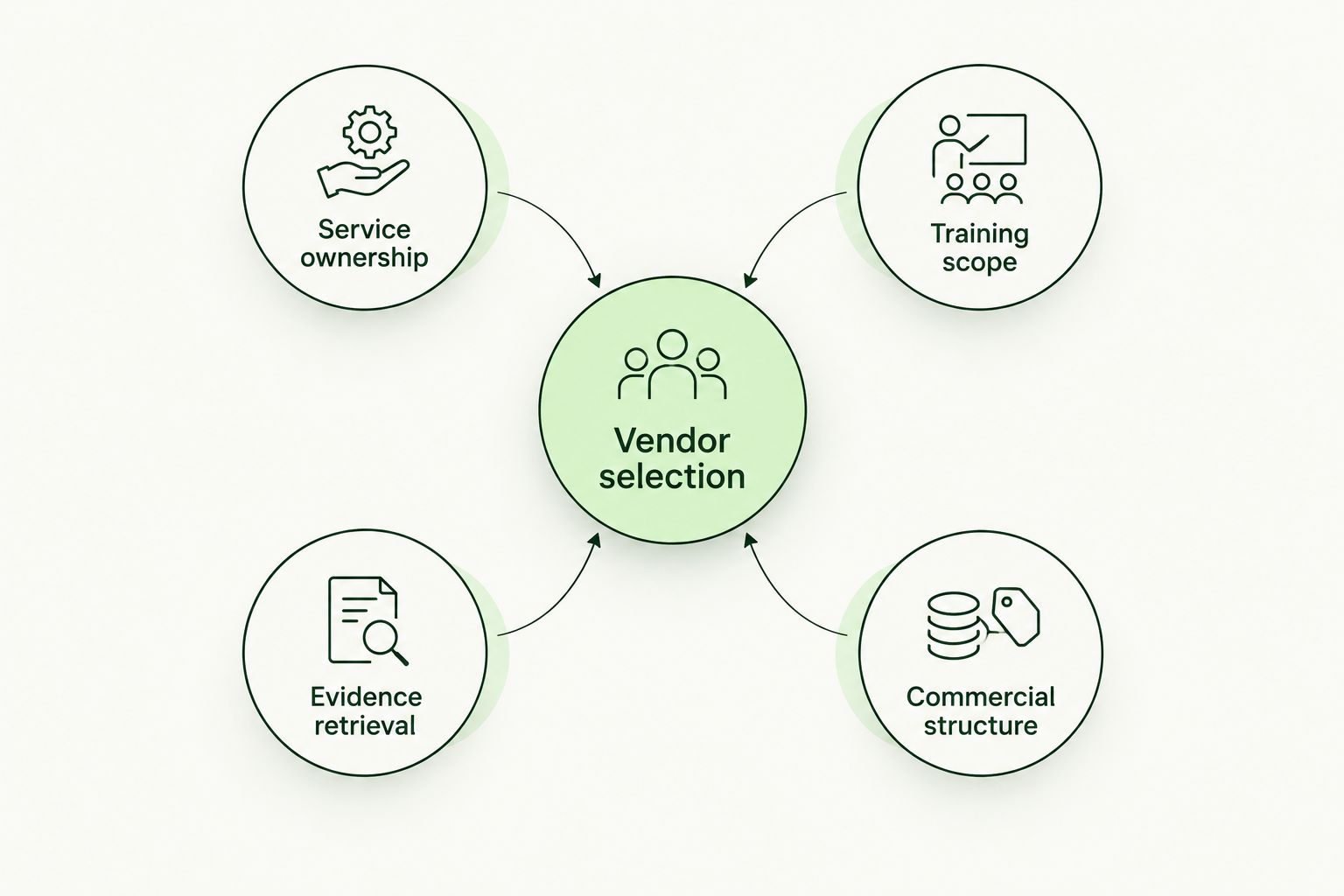
Evaluate the operating model separately from the learning experience.
- Service ownership: Name the team responsible for enrollment, follow-up, exceptions, and support.
- Training scope: Separate awareness learning from policy management and other compliance tasks.
- Evidence retrieval: Ask an administrator to produce the records your stakeholders actually request.
- Commercial structure: Check how the proposed agreement handles changes in the covered population and service scope.
Test 3 workflows before signing
- Employee onboarding: Demonstrate how a new employee enters the program and receives the correct assignment.
- Employee departure: Demonstrate how access and reporting change without losing records you need to retain.
- Evidence request: Produce a usable record for a named employee and reporting period.
These are acceptance tests, not promised capabilities of any vendor listed here. Use the same tests across your shortlist, and document manual work instead of leaving it outside the comparison.
Reconcile 2 records before migration
Compare the outgoing employee roster with the completion history you intend to retain. Resolve differences before the new program becomes your reporting source.
Keep an owner for historical evidence even after the previous contract ends. A new platform's current dashboard does not answer an old evidence request unless the necessary history remains accessible.
When staying with MetaCompliance is the right call
Stay with MetaCompliance when its training and policy-management workflows meet your requirements and your team can produce the evidence it needs. Switching is not an improvement unless the replacement resolves a specific problem without creating an unacceptable gap.
For your 2026 renewal decision, separate dissatisfaction with the program from dissatisfaction with the platform. Unclear ownership, inconsistent follow-up, and poorly defined reporting requests need operational fixes regardless of the vendor.
FAQ
What's the best MetaCompliance alternative for enterprise teams?
The best alternative depends on who delivers the program. Defend Wise fits MSP-delivered, flat-fee, white-label training; KnowBe4 is a candidate for internally managed awareness training, and Hoxhunt belongs on an adaptive-learning shortlist.
Is KnowBe4 better than MetaCompliance?
KnowBe4 is not a universal upgrade over MetaCompliance. Compare the training workflows you need, then separately verify whether policy-management functions must remain in scope.
When should an enterprise consider Hoxhunt?
Consider Hoxhunt when adaptive employee learning is a primary requirement. Require a demonstration of both the learning approach and the records your administrators need.
Can an MSP-focused platform replace an enterprise compliance suite?
An MSP-focused training platform is not automatically a replacement for an enterprise compliance suite. Map training, policy management, evidence retention, and service ownership before deciding what to replace.
Does unlimited-seat training remove all administration?
No. Unlimited seats address the seat-based commercial constraint, not responsibility for employee records, exceptions, follow-up, or evidence requests.
What should we test before switching training vendors?
Test employee onboarding, employee departure, and evidence retrieval before signing. Use the same scenarios for each vendor so that your comparison exposes manual work and unresolved requirements.
Should we keep MetaCompliance if it already works?
Yes, if MetaCompliance meets your training and policy-management requirements and supports the evidence your team needs. Change vendors to resolve a documented mismatch, not simply to obtain a different interface.
One last thing
Ask for an evidence export before you ask for the polished employee walkthrough. That reverses the usual demonstration: the vendor must show how the program answers a real operational question, not just how a lesson looks.
For Defend Wise or any other shortlisted platform, keep that acceptance test unchanged. Choose the operating model you can run and the records you can use.