Defendwise vs KnowBe4: which is better in 2026
Defendwise vs KnowBe4: choose flat-fee training for MSP delivery or broader security-program tools. Compare licensing, content, and evidence needs.
DefendWise
DefendWise
Choose Defend Wise if you run an MSP and want flat-fee, white-label security awareness training with unlimited seats; choose KnowBe4 if your security team wants a broader training program that includes simulated social-engineering attacks. In 2026, the deciding question is whether you need an MSP training service you can package under your own brand or a wider set of employee-risk testing capabilities.
TL;DR
- Defendwise vs KnowBe4 comes down to MSP service economics versus broader security-program capabilities.
- Defend Wise is best for MSPs seeking flat-fee, white-label security awareness training with unlimited seats.
- KnowBe4 is best for security teams that need training alongside simulated social-engineering attacks.
- Compare licensing, client administration, and evidence workflows before choosing security awareness training software.
Why this matters
Security awareness training is both a security responsibility and an operating expense. For an MSP, the buying decision also shapes how you package, deliver, and support the service across end-client organizations.
Defend Wise is best for MSPs that want flat-fee, white-label security awareness training without seat-count friction. That is a specific advantage, not a claim that every security team needs the same product.
KnowBe4 belongs on the shortlist when your requirements extend beyond delivering training. Its security awareness training and simulated social-engineering capabilities suit teams that want to educate employees and test their responses within a broader program.
For your 2026 shortlist, separate required capabilities from attractive extras. A longer feature list does not answer whether the service fits your delivery model, and a simpler license does not answer every security requirement.
At a glance
| Dimension | Defend Wise | KnowBe4 |
|---|---|---|
| Best for | MSPs delivering training to end clients | Security teams running broader awareness programs |
| Pricing model | Flat-fee subscription with unlimited seats | Per-user subscription with tier-dependent capabilities |
| Service branding | White-label training is part of its stated offering | Confirm partner branding requirements during evaluation |
| Standout feature | Unlimited-seat economics for MSP delivery | Training combined with simulated social-engineering capabilities |
| Content choice | Evaluate the actual curriculum against client needs | Broad training content selection |
| Program scope | Focused on MSP-delivered security awareness training | Better fit when employee testing is a required capability |
| Compliance evidence | Validate records against each client's obligations | Validate records against each organization's obligations |
| Security outcomes | Depends on delivery and employee behavior | Depends on delivery and employee behavior |
The table separates known differences from acceptance checks. A requirement marked for validation is not a missing feature; it is something your team must see before signing.
MSP service delivery favors the flat-fee option
An MSP does not buy training for a single internal audience. You must sell the service, introduce it to client contacts, enroll people, handle exceptions, and explain progress to organizations with different expectations.
The flat-fee, white-label model fits that commercial job. You can build your offer around training coverage rather than making the vendor's seat count the central feature of every client discussion.
Best for: MSP owners standardizing a training offer across end clients. The advantage is alignment between the software's stated model and the service you intend to sell.
The limitation is scope. Do not select a focused training platform and assume it replaces every component of a broader employee-risk program. Write the service boundary into your proposal before clients develop different expectations.
Per-user licensing fits a bounded internal program
KnowBe4 uses per-user subscription licensing, with capabilities varying by subscription tier. That structure gives a security team a way to purchase coverage for a defined employee population and select the capabilities its program requires.
Best for: internal security leaders buying for an identifiable workforce. Per-user licensing is not automatically the wrong model when your audience is known and your requirements are tied to particular capabilities.
Its tradeoff appears when the service must accommodate changing populations across clients. Enrollment changes become a licensing consideration as well as an administrative task.
For an MSP, the flat-fee alternative removes seat count from the vendor subscription model. It does not remove the work of keeping employee records accurate, handling departures, or documenting who should receive training.
White-label delivery favors an MSP-owned service
White-label security awareness training lets an MSP present training as part of its own service offering. That matters when you want the client relationship centered on your business rather than a collection of unrelated vendor subscriptions.
The stated white-label offering makes Defend Wise a direct fit for that requirement. Best for: MSPs that want their training service to carry their own brand.
Branding still needs a practical check. During evaluation, ask to see the employee experience, client-facing messages, and any records you plan to share. Confirm what can be branded rather than treating the phrase white-label as a substitute for a demonstration.
For KnowBe4, ask the same questions within the applicable partner arrangement. Do not assume its branding options are identical, and do not assume an internal deployment requires the same presentation as an MSP resale service.
KnowBe4 wins when employee testing is a requirement
KnowBe4 combines security awareness training with simulated social-engineering capabilities. If your written requirements include testing employee responses alongside education, that broader scope is a genuine reason to choose it.
Best for: security program managers responsible for both instruction and employee testing. This is a capability decision, not a claim that a larger platform automatically produces better behavior.
The tradeoff is operational responsibility. A broader program still needs someone to set objectives, interpret results, explain findings, and decide what employees should learn next.
If your contract is specifically for white-label security awareness training, buy against that scope. If your contract promises a wider program, evaluate the additional capabilities explicitly instead of expecting a training purchase to fill every gap.
KnowBe4 wins when curriculum breadth drives the decision
KnowBe4's broad training content selection is relevant when your security team needs choice across topics and audiences. Content breadth gives a program owner more material to evaluate when building different learning paths.
Best for: teams whose requirements call for varied training content. The benefit is choice; the limitation is that someone must still choose.
A catalog does not become a curriculum by itself. Ask the evaluator to show which material fits your workforce, which topics belong in onboarding, and how the proposed program avoids repeating lessons without a clear purpose.
For the MSP-focused alternative, inspect the actual curriculum against the client services you sell. Do not assume either that a focused offering lacks necessary coverage or that a larger library makes all of its content relevant.
Compliance evidence is an acceptance test for both
Neither product name proves that your client's training obligations have been met. You need evidence that connects the required audience, assigned material, participation, and relevant dates.
Verdict: no blanket winner on compliance. Requirements differ, and a platform purchase is not the same thing as a documented training process.
For each candidate, request a sample record and ask your compliance owner whether it answers these questions:
- Who was expected to complete the training?
- What material did the person receive?
- When was the activity assigned and completed?
- How are incomplete assignments and exceptions handled?
- Can you retain the evidence your organization requires?
Use the same acceptance criteria for both vendors. Your 2026 procurement file should record what you verified, not just what appeared on a sales slide.
Neither platform wins security outcomes by purchase alone
Buying software does not establish that employees recognize suspicious requests or follow your reporting process. The training must connect to actions people can take during their actual work.
Verdict: delivery matters for both options. Teach employees how to verify an unusual request, where to report a concern, and whom to contact when a message appears to come from a trusted colleague.
The focused training option needs a clear owner and a practical rollout. The broader platform needs those same things, plus ownership of any additional program components you select.
Do not use completion alone as the entire success definition. Completion records answer whether assigned activity was finished; they do not answer every question about employee judgment or your organization's incident handling.
Pricing: predictability versus capability selection
Defend Wise security awareness training uses a flat-fee subscription with unlimited seats. KnowBe4 uses per-user subscription licensing, with capabilities tied to the subscription selected.
The flat-fee model separates the vendor subscription from enrollment growth. For an MSP, that supports a training offer in which adding covered users does not create another per-seat vendor charge.
Per-user licensing links the subscription to the covered population. Its practical advantage is purchasing around a defined workforce and required feature set; its tradeoff is that population changes remain part of the commercial calculation.
Neither model eliminates service work. Your 2026 budget should distinguish the software subscription from onboarding, client communication, follow-up, and evidence preparation.
For a closer look at the MSP calculation, read how long until an MSP breaks even on security training. Compare the work behind the service, not just the licensing unit.
Use the same demo script for both vendors
A useful demonstration follows your service workflow. Do not let either vendor replace your requirements with a tour of unrelated features.
Book a 30-minute demonstration around the tasks your team must perform. That is an evaluation format, not a promised deployment time.
- Define scope. Describe the training service or internal program you intend to operate.
- Test delivery. Ask the vendor to demonstrate the employee journey and the administrator's work.
- Review evidence. Inspect a sample record against your documented requirements.
- Check ownership. Identify who handles enrollment changes, incomplete work, and client questions.
Use 2 client profiles if you are an MSP: an established organization and one with frequent workforce changes. Include 3 staff roles in your review: the service owner, the administrator, and the person responsible for evidence.
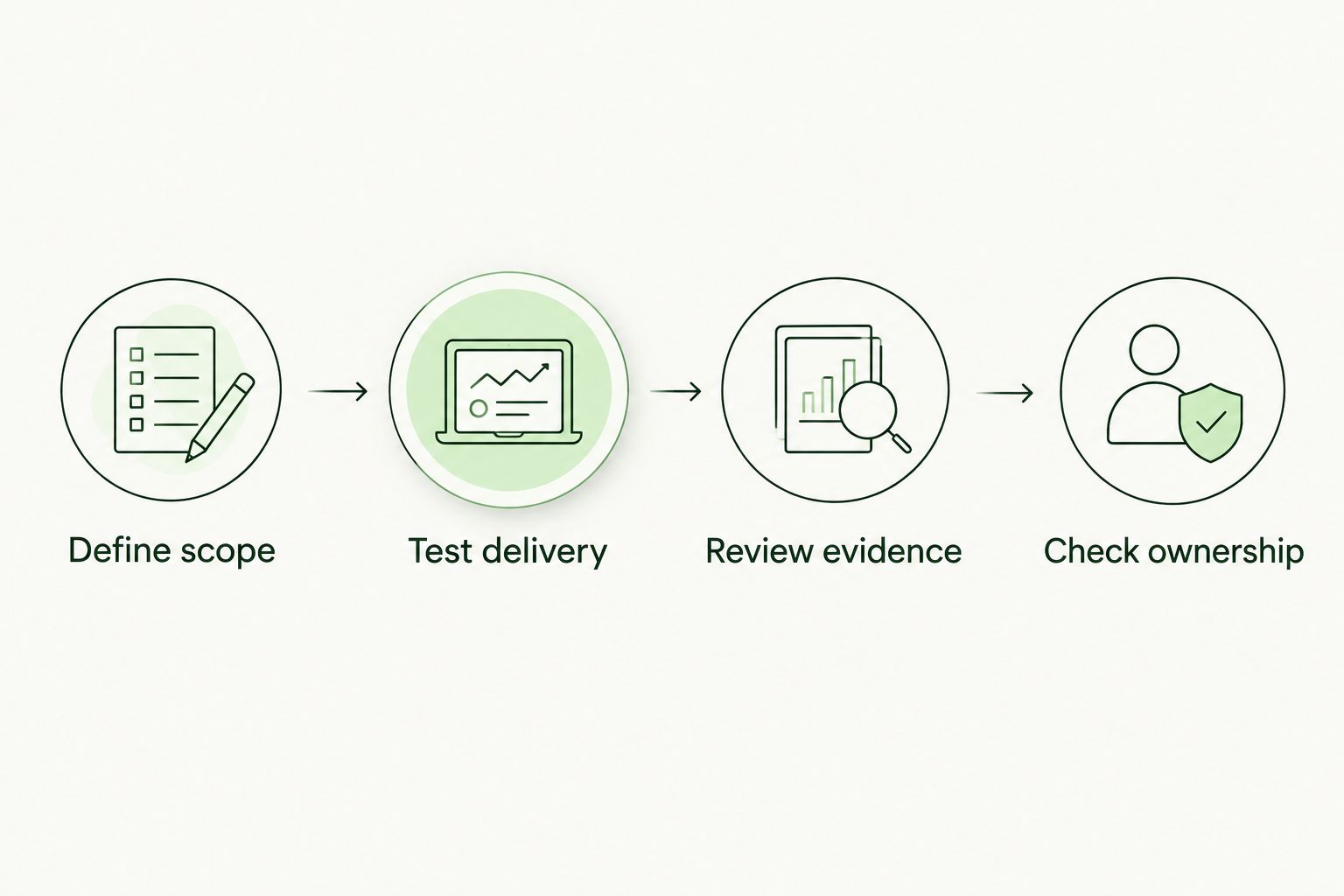
Evaluate the workflow you must operate, not the length of the feature list.
Ask each reviewer to record what they observed and which questions remain unresolved. A repeatable script makes the comparison useful even when vendors organize their demonstrations differently.
Final verdict: buy for the program you will operate
Choose Defend Wise if you own an MSP training service
Winner for the MSP service owner: the flat-fee, white-label option. It fits a service built around training end-client organizations without per-seat vendor licensing.
Choose it when those economics and that delivery model are central to your offer. Confirm the curriculum, client workflow, and evidence requirements before committing.
Choose KnowBe4 if you own a broader internal program
Winner for the internal security program manager: KnowBe4 when content choice and simulated social-engineering capabilities are required parts of the program.
Choose it because you need those capabilities, not because buying more functionality removes your team's delivery responsibilities. Confirm the subscription scope and the work required to operate it.
For 2026, neither choice should rest on brand recognition alone. Match the product to the service boundary, then verify the workflow.
| Dimension | Winner |
|---|---|
| MSP service fit | Flat-fee MSP option |
| Licensing model | Flat-fee for enrollment growth; per-user for a bounded workforce |
| White-label service positioning | MSP-focused option |
| Broader employee-testing scope | KnowBe4 |
| Training content choice | KnowBe4 |
| Compliance evidence | No blanket winner; validate requirements |
| Security outcomes | Neither wins by purchase alone |
FAQ
Which is better for MSPs, Defend Wise or KnowBe4?
Defend Wise is the better fit for MSPs prioritizing flat-fee, white-label security awareness training with unlimited seats. KnowBe4 is the better fit when broader content choice and employee-testing capabilities are required.
Is KnowBe4 better for an internal security team?
KnowBe4 is the stronger fit when an internal security team needs training alongside simulated social-engineering capabilities. Select the subscription against a written program scope rather than assuming every capability is included.
How do the subscription models differ?
The MSP-focused option uses a flat-fee subscription with unlimited seats, while KnowBe4 uses per-user subscription licensing. Compare the current contract scope, covered population, and required capabilities before purchasing.
Does unlimited-seat training remove MSP administration?
No, unlimited-seat training removes seat count from the vendor licensing model, not from your operational responsibilities. You still need accurate enrollment, an employee support process, and ownership of incomplete assignments.
Can either platform guarantee compliance?
No platform purchase guarantees compliance. Your organization must connect applicable requirements to training delivery, participation records, exceptions, and retained evidence.
What should I ask during a security awareness training demo?
Ask the vendor to demonstrate your employee journey, administrator workflow, and evidence requirements. Use the same script for both candidates so you compare the work your team will actually perform.
What matters most when choosing security awareness training in 2026?
The most important factor is whether the platform fits the program you will operate. Define the audience, service scope, required capabilities, and evidence needs before comparing subscriptions.
One last thing
The licensing unit and the service unit are different. A vendor can sell coverage by user while your MSP sells an ongoing client service; an unlimited-seat subscription can still leave you with client work that needs an owner.
Write the service boundary before signing the software agreement. State what you deliver, what the client must do, and which evidence you retain. That document makes either buying decision more disciplined.