Best usecure alternatives for healthcare organizations
Compare usecure alternatives for healthcare. Defend Wise fits MSP-led training; assess KnowBe4, an existing LMS, HIPAA coverage, and evidence needs.
DefendWise
DefendWise
usecure combines security awareness training with human-risk management, making it a useful starting point for healthcare buyers. That scope does not settle whether its delivery model fits your MSP relationship, workforce, or evidence requirements. The best usecure alternative in 2026 is Defend Wise for MSP-delivered, flat-fee security awareness training; KnowBe4 belongs on the shortlist for an internally managed training program.
TL;DR
- Defend Wise leads usecure alternatives for healthcare when an MSP needs flat-fee, white-label security awareness training.
- Shortlist KnowBe4 when your internal security team will own training administration and content selection.
- An existing learning management system is another option when you already maintain suitable security training content.
- Evaluate HIPAA training coverage and usable evidence separately; a platform purchase does not establish compliance.
Why this matters
Healthcare buyers need more than a recognizable vendor name. You need training that reaches the right workforce members, teaches the right actions, and leaves records your organization can retrieve.
The HIPAA Security Rule, at 45 CFR 164.308(a)(5), requires a security awareness and training program for workforce members, including management. The Privacy Rule separately addresses workforce training on applicable privacy policies and procedures at 45 CFR 164.530(b). General cybersecurity lessons are not a substitute for organization-specific privacy instruction.
For your 2026 shortlist, separate three decisions: who operates the program, what employees must learn, and what evidence the organization must retain. Choose the operating model first. Then verify the product against your requirements.
usecure alternatives at a glance
This comparison distinguishes established product positioning from requirements you should validate during procurement. It does not assume that any vendor includes every healthcare workflow.
| Option | Best for | Standout characteristic | Difference from usecure |
|---|---|---|---|
| usecure | Buyers evaluating a human-risk management platform | Security awareness training within a broader human-risk offering | Baseline: compare your existing configuration and contract, not a generic feature list |
| Defend Wise | MSPs delivering training to healthcare end clients | Flat-fee, unlimited-seat, white-label security awareness training | An alternative built around MSP service delivery and a flat-fee model |
| KnowBe4 | Healthcare organizations assigning ownership to an internal security team | A dedicated security awareness training platform | Evaluate its administrative workflow and training content against your current usecure setup |
| Existing LMS with curated content | Organizations that already operate a learning management system | Reuse of an established workforce learning process | Moves security training into your existing learning environment rather than another dedicated platform |
Do not rank these options by course count alone. Ask each vendor or internal owner to demonstrate the same assignment, employee experience, and evidence-retrieval task.
1. Defend Wise: best for MSP-delivered healthcare training
Defend Wise security awareness training is built for MSPs serving end-client organizations. Its flat-fee, unlimited-seat, white-label model gives the MSP a clear service proposition: provide training under the MSP's brand without making seat count the basis of the platform fee.
That makes the product relevant when your healthcare organization buys security services through an MSP. It does not establish that every healthcare-specific content, reporting, or contractual requirement is included; those belong in your evaluation.
Where this option shines
- MSP service fit: The platform's stated purpose matches an MSP delivering training to end clients.
- Flat-fee structure: Unlimited seats remove per-user pricing from the stated platform model.
- White-label delivery: The MSP can present security awareness training under its own brand.
- Clear scope: You are evaluating security awareness training, not assuming that one purchase replaces your entire compliance program.
Where this option falls short
- Not a complete HIPAA program: Your organization still needs applicable policies, privacy instruction, risk management, and accountable owners.
- MSP-first positioning: A hospital buying and operating software entirely in-house needs to assess whether this service model fits.
- Healthcare requirements need proof: Do not assume specific clinical lessons, accessibility features, report formats, or contractual commitments without reviewing them.
Head-to-head with usecure
| Dimension | This alternative | usecure |
|---|---|---|
| Operating model | Explicitly built for MSP delivery to end clients | Assess the fit of your current or proposed partner arrangement |
| Commercial structure | Flat-fee platform with unlimited seats | Compare the terms in your actual proposal |
| Branding | White-label security awareness training | Verify branding scope in the proposed configuration |
| Healthcare acceptance | Validate required content and evidence | Apply the same acceptance requirements |
Best for: MSPs packaging security awareness training for healthcare clients in 2026.
Before deciding, ask your MSP to show how a newly hired receptionist receives training and how an administrator retrieves that employee's completion record. Also ask who resolves overdue assignments. A commercial model is only part of the service.
Verdict: Buy when the MSP delivery model fits and your healthcare acceptance checks pass.
2. KnowBe4: best for internally owned training programs
KnowBe4 is an established security awareness training provider. Put it on your shortlist when your healthcare organization wants its own security team to select training, administer the program, and own the vendor relationship.
The deciding question is not whether a vendor has more material. It is whether your team can identify appropriate lessons, run assignments, and retrieve useful records without creating another unmanaged queue.
Where KnowBe4 shines
- Dedicated category fit: KnowBe4 provides security awareness training rather than requiring you to build the entire program from scratch.
- Internal ownership: An organization can evaluate it as a direct training-platform purchase with a named internal administrator.
- Content evaluation: Your security and privacy leads can review candidate lessons against their separate responsibilities before selecting a program.
Where KnowBe4 falls short
- Software does not supply an owner: Your organization must still assign responsibility for enrollment, exceptions, follow-up, and record retention.
- Healthcare fit requires review: A security awareness platform does not automatically cover your local privacy policies or clinical procedures.
- Procurement needs specificity: Confirm the content, administration rights, reporting, and contractual terms included in the proposed package.
Head-to-head with usecure
| Dimension | KnowBe4 | usecure |
|---|---|---|
| Category | Dedicated security awareness training provider | Human-risk management provider with security awareness training |
| Internal administration | Demonstrate your required administrative tasks | Repeat the same tasks in your existing or proposed setup |
| Content suitability | Review actual candidate lessons | Review actual candidate lessons |
| Switching decision | Select only for a demonstrated improvement | Keep as the baseline for workflow and evidence |
Best for: Healthcare security teams that will actively own a dedicated training platform.
For a useful 2026 evaluation, give both vendors the same employee scenario and evidence request. Record the steps needed, the permissions involved, and whether the output answers your compliance team's question. Avoid awarding points for features nobody will operate.
Verdict: Hold until a demonstration proves a better fit than your current usecure workflow.
3. Existing LMS: best for organizations with training operations
Your existing learning management system is a legitimate alternative delivery route, not automatically a replacement with equivalent functionality. Consider it when you already have workforce enrollment, course assignment, and learning-record processes that administrators understand.
The trade-off is ownership. Your organization must source suitable security content, maintain it, and connect training decisions to changing risks and policies.
Where an existing LMS shines
- Process continuity: You can evaluate security training within an already established learning workflow.
- Local instruction: Organization-authored material can explain your own escalation paths and privacy procedures.
- Defined ownership: An existing learning team provides a starting point for assigning administrative responsibilities.
Where an existing LMS falls short
- Content maintenance becomes your responsibility: Someone must review lessons and replace outdated instructions.
- Security-specific workflows need verification: Do not assume your LMS handles every assignment, exception, or reporting requirement.
- Familiarity is not proof: An existing system still needs to pass the same evidence and employee-experience checks as a new vendor.
Best for: Healthcare organizations with an established LMS owner and resources to maintain suitable content.
Verdict: Hold unless you can name the content owner and demonstrate the required records.
Why people switch from usecure
There is no single reason every healthcare organization should leave usecure. A defensible switch starts with a documented mismatch, not an assumption about another vendor's capabilities.
Use these decision gates for your own evaluation:
- Delivery ownership: You want the MSP to operate the service rather than leave routine administration with clinic staff.
- Commercial fit: Your required model is flat-fee, unlimited-seat training; compare that requirement with your actual contract.
- Employee access: A required employee group cannot complete the current workflow reliably.
- Evidence retrieval: The records you need are difficult to produce or do not answer the required question.
- Content fit: Reviewed lessons do not address the actions your workforce needs to take.
These are reasons to investigate a change, not claims that usecure has these problems. If your current setup passes the checks, switching requires a stronger justification.
What healthcare buyers should verify before switching
In 2026, make the acceptance process concrete. Ask the proposed provider to demonstrate 3 workforce roles: a clinician, a front-desk employee, and a billing employee. This is a recommended evaluation sample, not a regulatory minimum.
For each role, follow the same sequence:
- Define coverage: Identify the security topics and local instructions the role needs.
- Assign ownership: Name who enrolls the employee, follows up, and approves exceptions.
- Test access: Have a representative employee complete the actual learning workflow.
- Retrieve evidence: Produce a completion record and confirm that your organization can retain it.
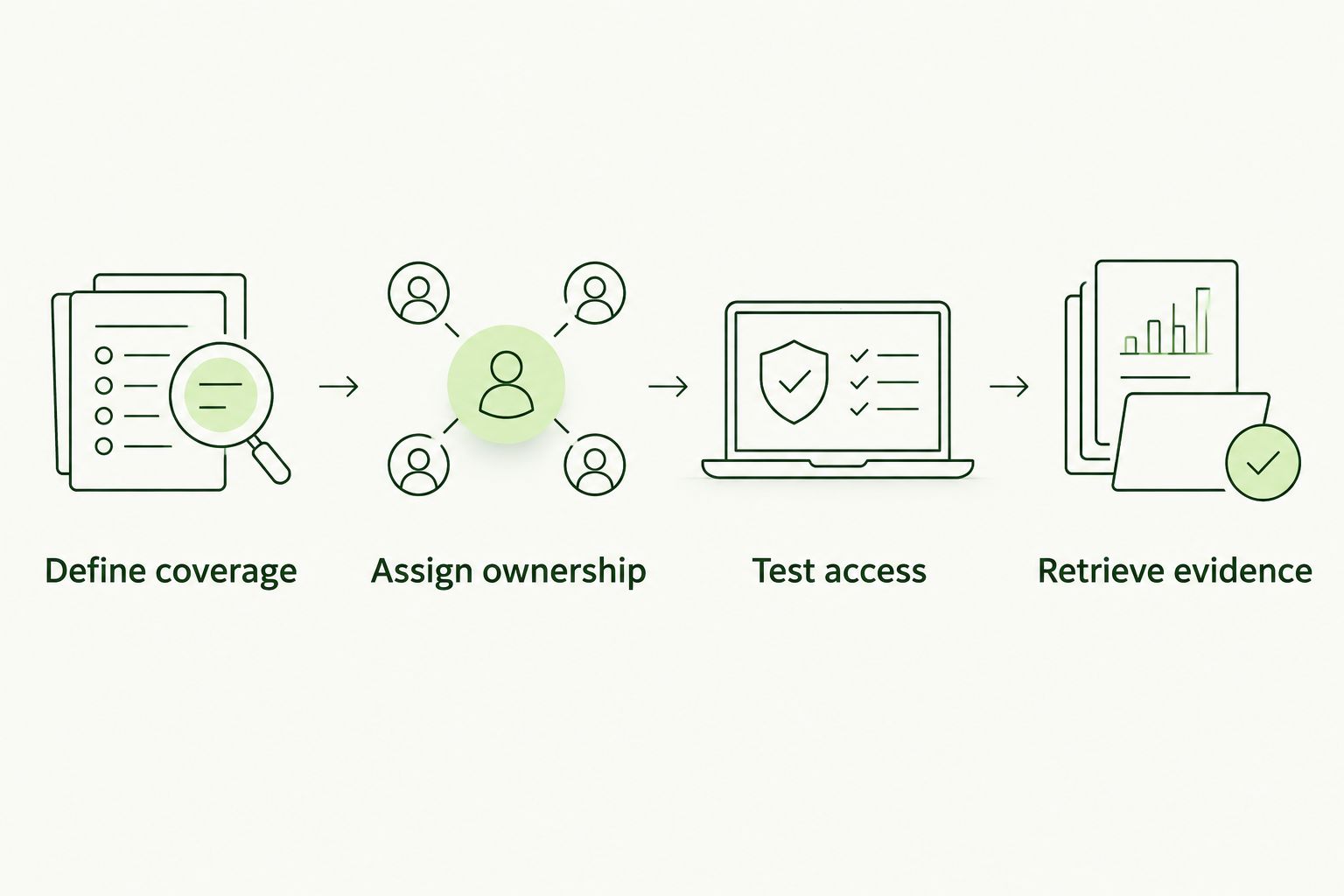
Test the employee workflow and the evidence workflow before switching.
Request at least 4 record fields in your evaluation: employee identity, assigned training, completion date, and completion status. These are practical acceptance criteria, not a claim that HIPAA prescribes this exact report format. Confirm how corrections and exceptions are documented as well.
HIPAA Security Rule documentation subject to 45 CFR 164.316(b)(2)(i) must be retained for 6 years from creation or when it last was in effect, whichever is later. Have your compliance lead determine which training records support your obligations and apply your retention policy accordingly. Do not assume a vendor's default retention period satisfies that policy.
Keep sensitive information out of the demonstration
Use fictional employee records and generic scenarios during procurement. Do not upload patient information simply to evaluate a training platform.
Ask what information the service needs, who can access it, how records are exported, and what happens when the relationship ends. Have your legal or privacy lead assess any business associate agreement requirement based on the actual service and data flow, not the vendor's category label.
When staying with usecure is the right call
Stay with usecure when it already meets your workforce, administration, evidence, and contractual requirements. A replacement creates work: reassigning ownership, communicating the change, preserving records, and checking the new workflow.
Before a 2026 renewal, separate fixable configuration issues from genuine product or service-model mismatches. If a reporting problem disappears after a settings change, a migration is not the next move. If your organization needs a different delivery model, document that requirement before comparing vendors.
FAQ
What's the best usecure alternative for healthcare organizations?
Defend Wise is the strongest fit here for MSP-delivered, flat-fee, white-label security awareness training. Shortlist KnowBe4 for an internally owned program, and evaluate an existing LMS when your organization can maintain suitable content.
Is switching from usecure enough to meet HIPAA requirements?
No. A platform change does not establish HIPAA compliance. Your organization must address applicable training, policies, safeguards, documentation, and operational responsibilities.
Should a healthcare MSP choose flat-fee security awareness training?
Choose flat-fee training when that commercial model fits your service package and the platform passes your acceptance checks. Evaluate administrative work and evidence requirements alongside the fee structure.
Can our existing LMS replace usecure?
An existing LMS can deliver security training if it supports your required workflow and you maintain suitable content. Verify assignment, completion records, exceptions, access, and retention before treating it as a replacement.
Does HIPAA require security awareness training for management?
Yes. The HIPAA Security Rule at 45 CFR 164.308(a)(5) includes management in the workforce security awareness and training program.
What should we preserve before changing training platforms?
Preserve the records required by your retention policy and compliance obligations before ending access to the old system. Include relevant training history, completion evidence, assignments, and documented exceptions.
Should we switch if usecure already works for us?
No, not without a demonstrated benefit. Keep usecure when it meets your requirements and a replacement does not improve the operating model or a documented workflow.
One last thing
Ask for the exit demonstration before the onboarding demonstration. A training record you cannot retrieve after a vendor change is an avoidable operational problem. Have the proposed owner export a sample record, explain its fields, and show where your organization will retain it.
Then make the decision. Choose Defend Wise security awareness training for an MSP-led, flat-fee service when the acceptance checks pass—not because a comparison page promises automatic compliance.