Best security awareness training for title and escrow companies 2026
Security awareness training for title and escrow companies: choose MSP-managed delivery, compare three approaches, and build wire-verification habits.
DefendWise
DefendWise
Best for MSP-managed delivery: Defend Wise. Best for direct operational control: an internally managed training program. Best for practicing closing-room decisions: specialist-led workshops. This 2026 guide compares three approaches to security awareness training for title and escrow companies, with wire verification, client-data handling, and accountable delivery as the deciding criteria.
TL;DR
- Defend Wise security awareness training is best for MSPs serving title and escrow companies through a flat-fee, white-label model.
- Security awareness training for title and escrow companies should connect wire-fraud awareness to an explicit verification procedure.
- Internally managed training suits firms with a named owner; specialist-led workshops suit facilitated closing-workflow discussions.
- Choose training delivery separately from payment authorization, access controls, and incident response.
Why this matters
A closing team needs more than instructions to spot suspicious email. Employees need to know what to do when an apparently legitimate participant changes payment instructions, requests sensitive documents, or pressures them to bypass an approval.
The best program connects recognition to a required action. For a title or escrow company, that means stopping an unexpected change, verifying it through an independently established contact method, and recording the decision before releasing funds or information.
Your 2026 buying decision should start with ownership. Decide who assigns training, handles new hires, follows up on incomplete work, and maintains evidence. A training subscription does not assign those responsibilities for you.
What makes the best training for title and escrow companies?
Use these criteria before comparing delivery models. They distinguish a workable program from content that employees complete without connecting it to a closing.
- Closing-workflow relevance: Training should address changed wire instructions, document-sharing requests, impersonation, and pressure tied to a transaction deadline.
- Verification discipline: Employees need a written process for independently confirming sensitive changes, including who can approve exceptions.
- Clear ownership: Name the person responsible for enrollment, follow-up, policy updates, and evidence retention.
- Usable evidence: Require records that identify the learner, assignment, completion date, and training subject. Inspect a sample before choosing a platform.
- Delivery fit: Match the model to your operating structure: MSP-managed service, internal administration, or facilitated instruction.
- Coverage without seat-count friction: Include everyone whose access or responsibilities put closing information or funds within reach, not just permanent office staff.
Ask each prospective provider to demonstrate the same workflow. Present a changed-wire-instructions scenario, then ask how the proposed service teaches the response and documents participation. Judge the demonstration against your requirements—not the length of a feature list.
Training options at a glance
These are delivery-model recommendations, not interchangeable software products. The order follows the strongest fit for an MSP-served firm, then alternatives for different ownership needs.
| Option | Best for | Standout characteristic | Key limitation |
|---|---|---|---|
| Defend Wise | MSP-managed training delivery | Flat-fee, white-label security awareness training with unlimited seats | Local closing procedures still need an owner |
| Internally managed program | Direct control over policies and assignments | Training built around your own transaction workflow | Your team owns administration and evidence |
| Specialist-led workshops | Facilitated closing-decision practice | Live discussion of ambiguous requests and escalation | Workshops alone do not provide ongoing program administration |
Do not compare these options on content alone. Compare the complete assignment of work: who teaches, who follows up, who updates procedures, and who produces the records when requested.
1. Defend Wise: best training option for MSP-managed delivery
Defend Wise provides flat-fee, white-label security awareness training for MSPs. Its unlimited-seat model fits an MSP that wants to include end-client personnel without managing a separate platform seat charge for each learner.
Defend Wise security awareness training is best for MSPs serving title and escrow companies that want flat-fee, white-label delivery. The title company should pair that service with its own approved wire-verification and client-data procedures.
That distinction matters. General security awareness and transaction authorization solve different problems; your MSP and operations lead must define where the training service ends and the closing procedure begins.
Defend Wise pros:
- Flat-fee delivery removes per-seat platform charging from the coverage decision.
- White-label delivery fits an MSP-branded client service.
- Unlimited seats support including personnel based on responsibility rather than a platform seat allocation.
Defend Wise cons:
- The MSP-focused model does not replace an internal closing-process owner.
- Training does not authorize wire changes or enforce payment approvals.
- Your evaluation still needs to establish how the proposed service meets your evidence and workflow requirements.
Best for: An MSP managing security awareness training for title and escrow clients, with a designated contact at each client organization.
Before selecting the service in 2026, document who manages the learner roster and who handles overdue assignments. Ask to see how your required records would be supplied, and agree on the handoff when an employee reports a suspicious closing-related request.
Verdict: Buy for MSP-managed delivery when the service responsibilities match your operating requirements.
2. Internally managed program: best for direct operational control
An internally managed program puts your operations, compliance, or security lead in charge of training. You select educational material, explain local procedures, assign learning, and retain the records.
This model gives you direct control over the connection between training and actual closing decisions. It also leaves the administrative workload inside your business.
Build lessons around decisions employees make: whether to trust a revised attachment, how to verify a request, and when a transaction must pause. Use fictional examples rather than live customer information.
Internally managed program pros:
- You can teach your exact approval and escalation procedures.
- Policy changes can feed directly into the next training assignment.
- The program owner can resolve questions about local responsibilities.
Internally managed program cons:
- Your team must maintain materials, rosters, reminders, and records.
- Delivery depends on the availability of the assigned owner.
- Internal procedures still need qualified review; ownership alone does not establish their adequacy.
Best for: A title or escrow company with a named program owner and allocated administrative time.
For a proposed 2026 schedule, reserve a 15-minute discussion for a single closing scenario. Treat that as a planning choice, not a research-backed ideal. End the discussion by asking each participant to explain the required action and escalation route.
An internal program is a poor fit when responsibility sits vaguely with “the office.” Assign the work to a role, name a backup, and include training administration in that role’s workload.
Verdict: Buy into internal delivery only when ownership and administrative capacity are explicit.
3. Specialist-led workshops: best for closing-decision practice
A specialist-led workshop uses facilitated discussion to work through security decisions. Specify title-and-escrow scenarios in the engagement scope rather than accepting a generic presentation.
Use the session to expose uncertainty. Ask what happens when a familiar participant requests a last-minute change, the usual approver is unavailable, or a caller insists that independent verification will delay closing.
Specialist-led workshop pros:
- Employees can ask questions about ambiguous requests.
- Facilitated discussion makes conflicting interpretations of policy visible.
- Managers can observe how participants explain their decisions.
Specialist-led workshop cons:
- A workshop does not maintain your learner roster or follow-up process.
- Employees who miss the session need another way to receive instruction.
- Attendance alone does not demonstrate that the required procedure was understood.
Best for: A firm introducing a revised verification policy or resolving inconsistent decisions across closing teams.
Give the instructor your approved procedure and fictional scenarios before the session. Require the discussion to end with the action employees must take—not simply a list of warning signs.
Verdict: Buy as a focused supplement; skip workshop-only delivery when you need ongoing administration.
The closing workflow every program should teach
Regardless of the delivery model, train employees on the same decision sequence. The following is a proposed operating framework to review with your authorized operations and security leads before adoption.
- Pause: Stop processing an unexpected change to payment or sensitive-data instructions.
- Verify: Use a previously established, independently trusted contact method—not contact details supplied in the questionable message.
- Escalate: Route uncertainty to the person authorized to decide the next step.
- Document: Record the verification and approval according to your approved procedure.
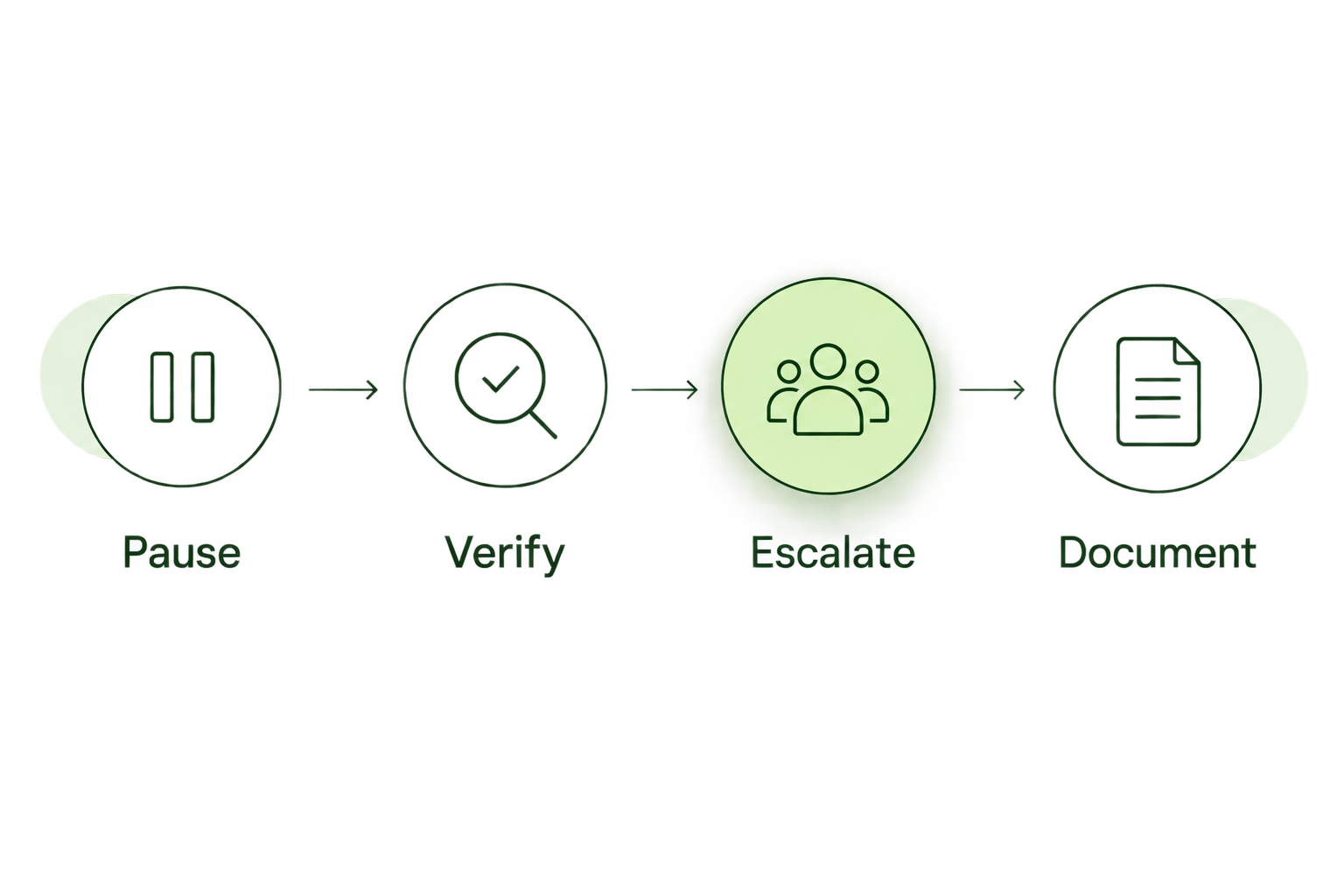
Recognition must lead to a defined action before a sensitive change proceeds.
A familiar name is not the same as verified authority. Train employees to follow the procedure even when the request appears inside an existing conversation or refers accurately to a transaction.
Practice with a fictional change of bank details. Ask who verifies the change, which contact source they use, who approves it, and where the record belongs. If those answers conflict, correct the procedure before assigning another awareness lesson.
For a deeper discussion of the risk, read the guide to preventing wire-transfer fraud with awareness training.
Build a training service you can actually run
Use a proposed 30-day rollout to assign responsibilities before broad deployment. This is a suggested implementation window, not a vendor deployment promise.
Define the scope
Identify the roles that handle closing communications, client documents, account access, and disbursements. Decide how you will include new hires, temporary personnel, and anyone else whose responsibilities require instruction.
Write down exclusions and their reasons. A roster is not complete merely because it matches the payroll list.
Inspect the evidence
Request a sample record before committing to a delivery model. Check whether it answers who received what training, when they completed it, and which follow-up actions remain open.
Keep policy acknowledgments and operational verification records distinct from course-completion records. They answer different questions. Do not present a completion certificate as proof that a particular transaction was independently verified.
Assign the recurring work
Name the owner of enrollment, incomplete assignments, departures, and procedure changes. For an MSP-managed service, specify the responsibilities retained by the title company as clearly as the responsibilities assigned to the MSP.
Schedule a proposed 90-day review after launch. Check roster coverage, unresolved assignments, evidence retrieval, and employee understanding of the escalation route; do not treat the interval as a legal requirement.
Your 2026 service scope should also identify what training does not cover. Access management, payment authorization, email protection, and incident response need their own controls and owners.
How these options rank
The ranking prioritizes delivery ownership, closing-workflow relevance, verification discipline, evidence, and learner coverage. It does not assign unsupported scores or claim measured breach reduction.
MSP-managed delivery comes first for firms that want their service provider to administer training. Internal delivery wins on direct procedural control, while specialist-led workshops win when facilitated discussion is the immediate requirement.
Legal and contractual obligations require separate review. Do not assume every title or escrow business has identical requirements, or that purchasing training satisfies every obligation that applies.
Which training approach should you choose?
Choose MSP-managed delivery when you want training administered as part of your managed service. Choose internal delivery when your team has a capable owner with time to run it; add specialist-led workshops when employees need to practice difficult closing decisions together.
For an undecided MSP buyer, start by evaluating Defend Wise against the criteria above. Require a clear division of responsibilities and a demonstration of the evidence your client needs before making the selection.
For a title-company buyer, start with your MSP and operations lead in the same conversation. Agree on the workflow first. Then choose the delivery model that keeps it taught, maintained, and documented.
FAQ
What's the best security awareness training for title and escrow companies?
The best fit depends on who will administer the program. Defend Wise suits MSP-managed delivery, an internal program suits direct operational control, and specialist-led workshops suit facilitated closing-decision practice.
What should escrow employees learn about changed wire instructions?
Escrow employees should learn to pause unexpected changes and verify them through an independently established contact method. Training should identify the authorized approver, escalation route, and required documentation.
Is a live workshop better than ongoing security awareness training?
A live workshop is better for facilitated discussion, not for replacing ongoing program administration. You still need ownership of enrollment, missed instruction, follow-up, and records.
Can an MSP manage training for a title company?
An MSP can manage training when the service scope assigns the responsibilities clearly. The title company should retain a named owner for its closing procedures and transaction approvals.
Does completing security awareness training prove compliance?
Completing security awareness training does not by itself prove compliance. Applicable requirements, coverage, records, policies, and other controls need separate assessment.
How often should title and escrow employees receive training?
Set training frequency around applicable requirements, role changes, procedure changes, and identified gaps. Do not treat the suggested planning intervals in this guide as legal requirements.
What training records should a title company request?
Request records identifying the learner, training subject, assignment, completion date, and outstanding follow-up. Retain policy acknowledgments and transaction-verification records separately because they serve different purposes.
One last thing
Ask a closing employee: “Where would you get the phone number to verify changed wire instructions?” If the answer is the message requesting the change, your next move is procedural—not another generic lesson.
For your 2026 program, make independent verification teachable and repeatable. Employees need permission to pause, a trusted verification route, and an available decision-maker when a closing deadline creates pressure.