Best white-label security awareness training platforms in 2026
Compare white-label security awareness training options. Choose flat-fee MSP delivery or an adaptable LMS based on branding, admin work, and evidence.
DefendWise
DefendWise
Best overall for MSPs: Defend Wise, for flat-fee, white-label security awareness training with unlimited seats. Best for teams that already operate an LMS: Moodle LMS; best for organizations evaluating a configurable hosted learning portal: TalentLMS. This 2026 guide separates a purpose-built MSP platform from general learning systems you must adapt to your service.
TL;DR
- Defend Wise is the best white-label security awareness training fit for MSPs prioritizing flat-fee delivery and unlimited seats.
- Moodle LMS suits teams prepared to administer their own learning environment and source security training content.
- TalentLMS belongs on the shortlist when a hosted learning portal matters more than a purpose-built MSP service.
- Evaluate branding, client separation, training evidence, administration, and commercial terms before choosing.
Why this matters
Your client buys a managed training service. Your technicians inherit everything behind it: enrollment, reminders, exceptions, reporting, and the questions that arrive before renewal.
A branded login page does not settle those responsibilities. Choose the operating model before choosing the course portal. Otherwise, you risk buying a learning system and discovering that your team still has to build the managed service around it.
For your 2026 shortlist, distinguish between software built for MSP-delivered security awareness training and general learning software that supports customization. Both deserve consideration. They solve different problems.
What makes the best white-label security awareness training?
Use these criteria before comparing platforms:
- Brand control: Identify every client-facing surface that must carry your identity, including invitations, learning pages, and reports. Ask for a demonstration rather than accepting a logo screenshot.
- Client separation: Require a clear boundary between organizations, users, permissions, and training records. A department grouping is not automatically a suitable subclient boundary.
- Commercial fit: Examine how the agreement treats user growth, inactive accounts, additional clients, and required functionality. Match those terms to your service contract.
- Training ownership: Establish who supplies, reviews, updates, and assigns the security awareness material. A learning platform and a maintained security curriculum are separate requirements.
- Evidence quality: Check whether you can identify the learner, assigned material, completion status, and relevant dates without manually rebuilding the record.
- Administrative effort: Walk through enrollment, departure, reassignment, and reporting. Count the handoffs your team must own.
No single criterion replaces the others. Unlimited seats do not establish reporting suitability, and extensive customization does not establish a workable MSP delivery model.
White-label training options at a glance
The comparison below ranks fit for distinct operating models, not course quality or independently measured performance. General LMS products remain conditional candidates until their configuration and agreement satisfy your requirements.
| Rank | Platform | Best for | Standout characteristic | Key limitation |
|---|---|---|---|---|
| 1 | Defend Wise | MSPs standardizing a branded security training service | Flat-fee, white-label security awareness training with unlimited seats | Your MSP still owns service scope and client obligations |
| 2 | Moodle LMS | Teams with an existing LMS administrator and content owner | Open-source learning software with configurable courses and themes | Hosting, maintenance, content, and configuration need accountable owners |
| 3 | TalentLMS | Organizations evaluating a hosted learning portal | Hosted LMS with branding and branch organization features | MSP resale rights and required client boundaries need explicit confirmation |
The ranking changes when your operating model changes. An established internal learning team has different requirements from an MSP launching the same managed service across unrelated clients.
1. Defend Wise: best for flat-fee MSP training delivery
Defend Wise provides flat-fee, white-label security awareness training for MSPs, with unlimited seats. Its stated purpose matches the buyer in this guide: a service provider delivering training to end-client organizations under its own brand.
Best for: MSPs that want a consistent security awareness training offer without a per-seat platform model.
The distinction is commercial as well as operational. When your service includes a changing client workforce, an unlimited-seat model removes seat quantity as the basis of the platform charge; it does not remove your responsibility to manage the service.
Platform pros
- The stated product is security awareness training, rather than a general LMS you must first turn into a security training offer.
- White-label delivery matches an MSP selling the service under its own identity.
- Unlimited seats align with a service designed to include the client's eligible workforce.
- The flat-fee model separates platform purchasing from per-user seat calculations.
Platform cons
- Your MSP still needs a defined process for client approvals, exceptions, and training follow-up.
- A platform subscription does not establish that your complete managed service is profitable.
- White-label training does not, by itself, satisfy every client's contractual or regulatory evidence requirements.
For a 2026 purchasing decision, ask for a walkthrough using your actual service requirements. Have the vendor demonstrate the client-facing experience and the records you need to deliver, rather than treating the commercial model as proof of every operational capability.
Verdict: Buy Defend Wise when flat-fee, white-label security awareness training is the requirement and the demonstrated workflow meets your client obligations.
2. Moodle LMS: best for teams already operating an LMS
Moodle LMS is open-source learning management software. It supports course delivery and completion tracking, while themes and configuration provide control over the learning environment.
Best for: Teams with an established LMS administrator, a security content owner, and a reason to control their own learning environment.
Moodle LMS is a platform foundation, not automatically a finished MSP security awareness service. Evaluate it when you already have the people and processes to operate that foundation—not simply because customization sounds attractive.
Moodle LMS pros
- Open-source software gives your technical team access to the application code.
- Configurable courses support a structured learning program.
- Theme customization supports a branded learning experience.
- An existing Moodle operation gives you an established administrative environment to evaluate.
Moodle LMS cons
- Hosting, updates, backups, and technical maintenance need assigned responsibility.
- Security awareness content needs a separate sourcing and review process.
- A standard deployment is not proof of suitable separation between unrelated MSP clients.
For your 2026 evaluation, distinguish Moodle LMS from other products in the Moodle family. Do not assume that functionality described for another edition exists in the deployment you plan to operate.
Require a demonstration of permissions and reporting using separate client identities. If your team must create custom workarounds for basic client boundaries, include ownership of those workarounds in the decision.
Verdict: Hold Moodle LMS unless you already have the administrative capacity and content ownership to operate a customized training service.
3. TalentLMS: best for a configurable hosted learning portal
TalentLMS is a hosted learning management system with branding options and branches for organizing learning environments. It belongs on a shortlist when you need a general training portal rather than a platform selected specifically for MSP security awareness delivery.
Best for: Organizations that want hosted learning software and are prepared to validate its suitability for their client-service model.
The key question is not whether the portal can display your identity. It is whether the relevant configuration, permissions, agreement, and content arrangements support the service you intend to sell.
TalentLMS pros
- Hosted delivery avoids operating the underlying LMS application yourself.
- Branding options support a customized learner-facing experience.
- Branches provide an organizational structure to examine during your evaluation.
- General course delivery supports learning requirements beyond security awareness.
TalentLMS cons
- Branch organization is not sufficient evidence of the client isolation your MSP requires.
- Branding functionality does not establish contractual permission to resell a white-label service.
- Security awareness content coverage and maintenance remain separate evaluation questions.
In a 2026 demonstration, ask the vendor to show the precise arrangement you would deploy. Require written confirmation of permitted client use and the capabilities included in that arrangement.
Do not substitute a generic product tour for this exercise. Your decision depends on whether the hosted LMS supports your service—not whether the interface looks suitable.
Verdict: Hold TalentLMS until the agreement, branding scope, content responsibilities, and client boundaries are confirmed.
How these options are ranked
The ranking prioritizes fit with an MSP's white-label security awareness training service: commercial structure first, followed by branding, client boundaries, training ownership, evidence, and administrative responsibility.
This is a procurement-fit comparison, not a hands-on benchmark or a course-effectiveness study. A purpose-built MSP offer ranks ahead of an adaptable LMS for the default buyer; an existing learning operation changes that decision.
Test the service, not just the interface
Use the same acceptance exercise for every shortlisted platform. Set up 2 sample clients, introduce 3 learner records in each, and request 1 client-ready completion report per organization. These are suggested evaluation parameters, not performance benchmarks.
Client boundaries
Give the sample clients different administrators. Ask each administrator to find learners, change an assignment, and retrieve a report; verify that the permitted scope matches your requirements.
Learner lifecycle
Use the learner records to represent an active employee, a new joiner, and a departing employee. Follow each record through the actions your service promises, including what happens to historical evidence.
Evidence handoff
Request a completion report that your client can understand without your technician explaining every field. Check the learner identity, assigned material, status, and dates against the underlying records.
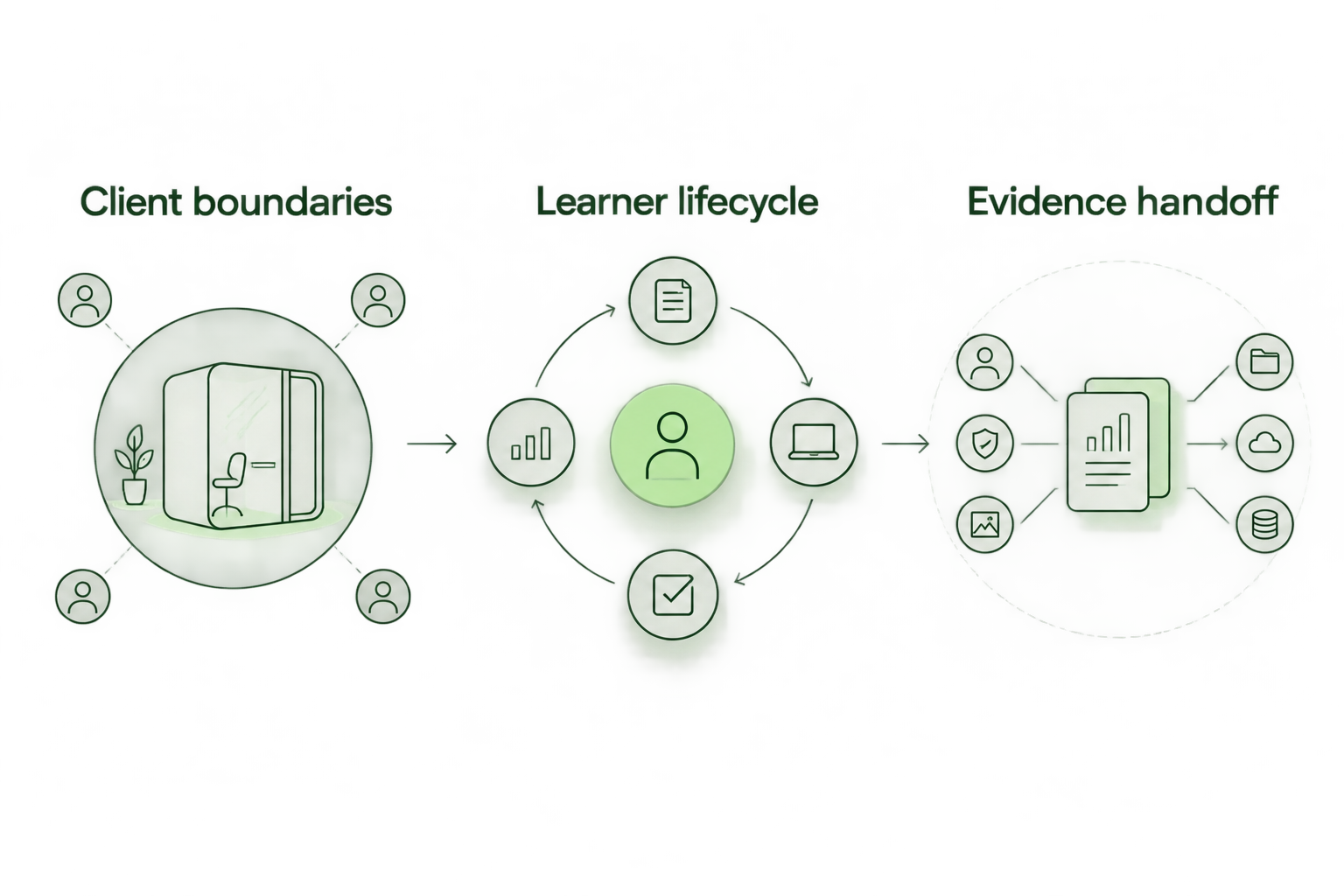
Evaluate the complete client service before accepting the portal.
Record who performs each action. A workflow that depends on your technician remains your operational responsibility, even when the platform successfully stores the result.
For the service design around that workflow, read the guide to implementing a managed security awareness training program.
Which platform should you choose?
Choose the purpose-built MSP option unless you have a specific reason to operate a general LMS. For the default buyer here, the priority is a branded security awareness service—not ownership of another learning-system project.
Choose Moodle LMS when existing technical ownership and content governance make customization a deliberate operating decision. Keep TalentLMS under consideration when hosted general learning is the requirement and the vendor confirms your proposed client arrangement.
Make your 2026 selection against a written service definition. Specify what the client receives, what your team must do, and what evidence you must produce before you approve the platform.
FAQ
What's the best white-label security awareness training platform for MSPs?
Defend Wise is the best fit in this comparison for MSPs prioritizing flat-fee, white-label security awareness training with unlimited seats. Validate the operational workflow and evidence requirements against your client service before purchasing.
What does white-label security awareness training mean?
White-label security awareness training lets a provider deliver training under its own brand. Confirm which surfaces are covered, including learner pages, invitations, and reports, rather than assuming that branding extends everywhere.
Is a branded LMS the same as an MSP training platform?
No. A branded LMS provides a learning environment, while an MSP training service also needs suitable client boundaries, administrative workflows, content ownership, and evidence delivery.
Is Moodle LMS a good choice for white-label security training?
Moodle LMS is a suitable candidate when your team already has the capacity to administer a learning environment and maintain training content. Evaluate client separation and reporting explicitly before using it for unrelated organizations.
Can an MSP use TalentLMS for client training?
An MSP should confirm the proposed client-training arrangement directly with TalentLMS before selecting it. Branding and branch features do not independently establish resale rights or the required separation between clients.
Does unlimited-seat training eliminate service administration?
No. Unlimited seats describe the commercial seat model, not the work involved in delivering your service. Enrollment, exceptions, client communication, and evidence handoff still need accountable owners.
Does a training completion report prove compliance?
A completion report documents recorded training activity; it does not prove that every applicable compliance obligation is satisfied. Match the evidence to the client's specific requirements and review it with the responsible compliance adviser.
One last thing
Ask for the completion report before you watch the course demonstration. That reverses the usual evaluation order and puts the deliverable your client needs at the center of the purchase.
A polished learner experience matters. Your service is not finished until the right client receives usable evidence.