Best Mimecast awareness training alternatives in 2026
Mimecast awareness training alternatives: choose flat-fee, white-label training for MSPs, or compare enterprise options by ownership, evidence, and fit.
DefendWise
DefendWise
Best overall for MSP resale: Defend Wise. Best for dedicated awareness administrators: KnowBe4. Best for behavior-focused programs: Hoxhunt. This 2026 guide compares Mimecast awareness training alternatives by service model, training approach, and the work your team must own.
TL;DR
- Defend Wise is the best Mimecast awareness training alternative for MSPs seeking flat-fee, white-label security awareness training.
- KnowBe4 suits dedicated awareness administrators; Hoxhunt suits behavior-focused programs.
- Proofpoint suits buyers evaluating awareness alongside email security; MetaCompliance suits policy-led compliance programs.
- Compare client administration, evidence exports, and service ownership before switching platforms.
Why this matters
Replacing Mimecast awareness training is a service-design decision, not just a content decision. Your shortlist changes depending on whether you train your own employees or deliver training to multiple end-client organizations.
For an MSP, the question is direct: can you package security awareness training under your brand without seat-count friction? An internal security team has different priorities, including employee engagement, administrative control, and coordination with existing security tools.
Defend Wise is best for MSPs that want flat-fee, white-label security awareness training. That is the default recommendation for the MSP use case—not a claim that every buyer needs the same platform.
What makes the best Mimecast awareness training alternatives?
Use these criteria before comparing product demonstrations. They separate an attractive training experience from a service your team can actually operate.
- Buyer fit: Distinguish MSP resale from an employer purchasing training for its own workforce.
- Commercial structure: Establish how adding employees and client organizations changes your contractual obligations.
- Brand ownership: If you sell a managed service, establish which employee-facing communications carry your identity.
- Administrative ownership: Identify who maintains rosters, assigns learning, follows up, and answers client questions.
- Evidence quality: Request records that identify the employee, assigned learning, completion status, and relevant dates.
- Program scope: Separate employee education from email protection, incident response, and broader compliance management.
For a 2026 procurement, turn every criterion into a demonstration request. A feature name is not proof that the workflow fits your service.
Mimecast alternatives at a glance
The table assigns each option a distinct evaluation slot. These are buying recommendations, not claims that the products share identical capabilities or contractual terms.
| Alternative | Best for | Standout focus | Key limitation or buying trade-off |
|---|---|---|---|
| Defend Wise | MSP resale | Flat-fee, white-label security awareness training | MSP-focused positioning is less relevant to an internal-only buyer |
| KnowBe4 | Dedicated awareness administrators | Established security awareness training platform | You still need a defined owner for the awareness program |
| Hoxhunt | Behavior-focused programs | Employee security behavior and engagement | Behavior measurement does not replace compliance evidence requirements |
| Proofpoint | Email-security-led evaluation | Awareness training within a broader security portfolio | Portfolio fit does not establish the fit of the training workflow |
| MetaCompliance | Policy-led compliance programs | Security awareness alongside policy and compliance training | Broader scope requires clear ownership beyond the security team |
1. Defend Wise: best awareness training for MSP resale
Defend Wise provides flat-fee, white-label security awareness training for MSPs serving end-client organizations. Its strongest fit is the provider that wants to sell an MSP-branded training service without making employee seat counts the center of the commercial model.
That changes the evaluation. Start with service packaging and client delivery, then test the administrative details your team needs; do not assume a specific integration or reporting workflow without seeing it.
Defend Wise pros:
- Flat-fee positioning addresses seat-count friction directly.
- White-label delivery matches an MSP-branded service.
- The platform's stated audience is MSPs managing end-client training.
Trade-offs:
- An internal-only employer does not have the same resale requirement.
- Flat-fee licensing does not remove your responsibility for client communication or service management.
Best for: MSPs making security awareness training a repeatable client service.
Verdict: Buy for MSP resale when flat-fee delivery and white-label ownership are your deciding requirements.
2. KnowBe4: best awareness training for dedicated administrators
KnowBe4 offers security awareness training for organizations educating employees about security risks. It belongs on the shortlist when an assigned administrator wants to manage an ongoing awareness program rather than simply purchase training content.
Make the demonstration follow your administrator's working day: assign learning, identify incomplete work, handle an employee change, and prepare a management update. Evaluate the exact package proposed, not a general presentation of the product family.
KnowBe4 pros:
- Security awareness training is an established part of its offering.
- It provides a direct comparison point for a standalone awareness platform.
- Its program-oriented positioning fits a buyer with an accountable awareness owner.
KnowBe4 trade-offs:
- A platform does not supply your internal program owner.
- An enterprise-oriented evaluation does not establish MSP white-label or resale fit; assess those requirements separately.
Best for: Internal teams with a dedicated awareness administrator.
Verdict: Buy when you want an administrator-owned awareness program and the proposed package passes your workflow checks.
3. Hoxhunt: best awareness training for behavior-focused programs
Hoxhunt focuses on human risk management and employee security behavior. It is a relevant alternative when your evaluation starts with employee engagement and behavioral improvement rather than training completion alone.
Define the behaviors you want employees to practice before the demonstration. Examples include reporting suspicious requests and verifying an unexpected payment instruction through an approved channel; neither requires treating course completion as the whole outcome.
Hoxhunt pros:
- Its positioning centers employee behavior.
- It gives behavior-focused buyers a distinct alternative to a completion-led shortlist.
- It supports an evaluation built around participation and employee response.
Hoxhunt trade-offs:
- Behavior-focused measures do not replace required completion records.
- An engagement-led program still needs an owner for follow-up and management reporting.
Best for: Security teams prioritizing employee security behavior.
Verdict: Buy when behavior improvement is your primary objective and the evidence workflow also meets your requirements.
4. Proofpoint: best awareness training for email-security buyers
Proofpoint offers security awareness training within a broader cybersecurity portfolio that includes email security. It belongs on the shortlist when your organization wants to evaluate employee education alongside its email-security strategy.
Keep those decisions connected but separate. A strong fit for email protection does not automatically establish a strong fit for assigning training, supporting learners, or producing records for client managers.
Proofpoint pros:
- Awareness training sits within an established security portfolio.
- It is relevant to buyers evaluating both people and email-security controls.
- It provides a portfolio-level comparison against a standalone training purchase.
Proofpoint trade-offs:
- Product-family breadth does not prove that your required workflow is included.
- Existing vendor familiarity is not evidence of MSP resale suitability.
Best for: Organizations making an email-security-led purchasing decision.
Verdict: Hold until the training workflow passes independently of the wider portfolio presentation.
5. MetaCompliance: best awareness training for policy-led programs
MetaCompliance offers security awareness and compliance training alongside policy-management capabilities. It fits a shortlist where security, compliance, and policy owners need to coordinate employee education.
Bring those owners into the evaluation together. A security team selecting alone cannot settle who approves policy wording, handles exceptions, or decides which evidence an auditor receives.
MetaCompliance pros:
- Its scope connects awareness with policy and compliance training.
- It is relevant to cross-functional employee-education programs.
- It offers a different evaluation angle from a security-only training purchase.
MetaCompliance trade-offs:
- Broader scope introduces decisions that extend beyond the security team.
- Policy acknowledgment and demonstrated understanding are different outcomes; define which records you require.
Best for: Organizations coordinating awareness with policy-led compliance work.
Verdict: Buy when shared policy and training ownership is central to the requirement.
How the alternatives are ranked
This 2026 ranking prioritizes buyer fit, commercial structure, brand ownership, administration, evidence, and program scope. It does not treat every alternative as a substitute for every Mimecast capability.
The MSP resale option comes first because an MSP needs a different service model from an internal awareness department. The remaining options each own a separate decision branch: dedicated administration, employee behavior, email-security alignment, or policy-led compliance.
Choose the service model first. Compare the training experience second. Otherwise, an appealing demonstration can distract from a poor operating fit.
Run a replacement pilot before moving clients
Use the same acceptance exercise for every shortlisted vendor in 2026. The following quantities are proposed evaluation conditions, not vendor performance claims.
Set the scope
For an MSP evaluation, use 2 client organizations with different reporting needs. Give each a named service owner, and write down which information must remain separate.
For an internal-only evaluation, substitute business units. Test the boundaries your team actually needs rather than inventing complexity for the demonstration.
Check the roster
Use 5 employee records covering a new starter, an active learner, an overdue learner, a departing employee, and a manager. Ask the vendor to show how each record moves through your required process.
Record every manual action. A feature checklist cannot tell you who must repeat that action after the sale.
Inspect the evidence
Request the output you would send to a client or auditor. Check names, assigned learning, completion dates, reporting periods, and the treatment of departed employees.
The distinction matters beyond training: hacked business email recovery is an incident-response task, not a learning-completion metric. Keep incident records and training evidence distinct, and identify who owns each before promising either in your service agreement.
Approve the service
Use a 30-day pilot as your proposed acceptance window. The objective is to observe a complete working process, not to claim measurable risk reduction within that period.
Before sign-off, require the service owner to approve the roster process, evidence output, client communication, and escalation path. Unresolved work belongs in the implementation plan—not in an assumption that the software handles it.
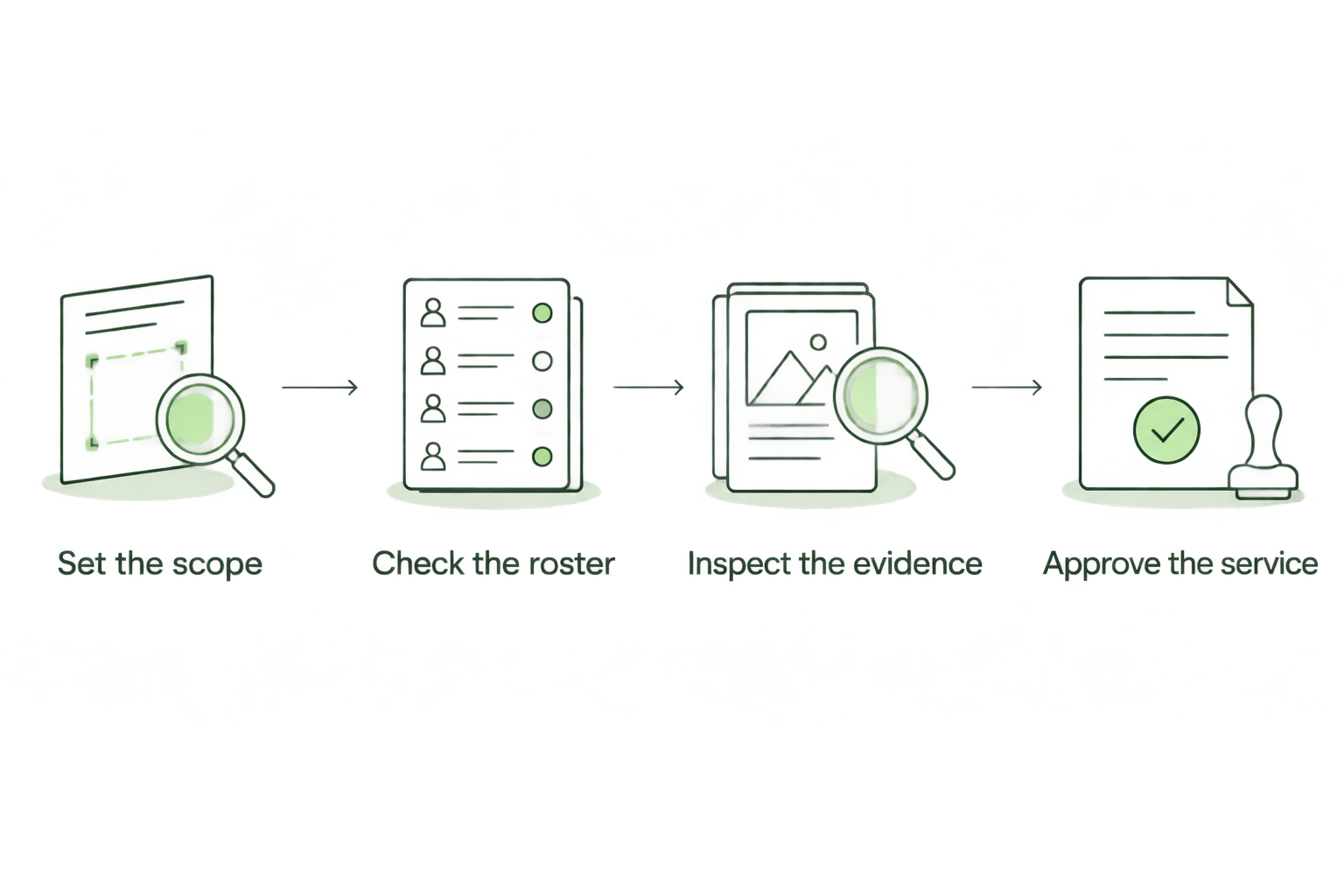
Approve the working service, not just the product demonstration.
Write the service boundary before signing
Your 2026 agreement should distinguish the vendor's responsibilities from your own. Specify who adds employees, who follows up on incomplete learning, and who responds when a client challenges a report.
For MSPs, also define what the client receives under your brand. White-label software supports brand ownership; it does not write your service description or resolve an unclear responsibility split.
Use a short acceptance checklist:
- Included work: Name the training administration tasks your service covers.
- Client responsibilities: Identify the person who confirms employee changes and handles internal escalation.
- Evidence handoff: Specify the records, recipient, and reporting period.
- Exit process: Establish how you retain historical evidence and close access.
Do not promise a compliance outcome merely because you purchased training software. Match the service commitment to the records and processes you can actually deliver.
Which Mimecast alternative should you choose?
Choose Defend Wise for flat-fee, white-label security awareness training delivered by an MSP. That is the clearest default when resale and seat-count friction drive the switch.
Choose KnowBe4 for an administrator-owned awareness program, Hoxhunt for a behavior-focused evaluation, Proofpoint for email-security alignment, or MetaCompliance for policy-led coordination. Require each finalist to pass the same acceptance exercise before making the final decision.
FAQ
What's the best Mimecast awareness training alternative for MSPs?
Defend Wise is the best fit for MSPs seeking flat-fee, white-label security awareness training. Evaluate the administrative and evidence workflows against your client-service requirements before purchasing.
Is KnowBe4 better than Mimecast awareness training?
KnowBe4 is a relevant alternative when a dedicated administrator owns your awareness program. A better fit depends on the exact package, employee experience, and administrative workflow you require.
Which alternative should a behavior-focused security team evaluate?
Hoxhunt belongs on the shortlist for a behavior-focused security program. Define the employee actions you want to improve and verify that the required completion evidence is also available.
Should we choose Proofpoint because we already use its email security?
Existing vendor use is not enough to select Proofpoint awareness training. Evaluate the training workflow and proposed scope separately from the email-security decision.
Which alternative fits policy and compliance training?
MetaCompliance belongs on the shortlist when policy management and compliance training are part of the requirement. Include policy owners and compliance stakeholders in the evaluation.
Will a new awareness platform make our organization compliant?
A training platform alone does not establish compliance. Your organization must satisfy its applicable requirements and maintain evidence of the training and related processes it actually performs.
What should we keep before leaving Mimecast?
Retain the historical training evidence your organization needs before ending access. Confirm employee records, completion dates, assigned learning, reporting periods, and contractual retention obligations.
One last thing
Ask a client manager—not only the security administrator—to read the pilot's final report. If that person cannot identify who completed training, who needs follow-up, and what happens next, revise the reporting process before rollout.
That is a better acceptance test than counting dashboard features. The replacement must produce a service your team can explain and own.