Best KnowBe4 alternatives for growing companies in 2026
Compare KnowBe4 alternatives for growing companies. Defend Wise leads for MSP-led training; compare service ownership, growth economics, and evidence.
DefendWise
DefendWise
Defend Wise is the best fit for MSPs seeking flat-fee, white-label security awareness training. Among KnowBe4 alternatives for growing companies in 2026, Defend Wise suits MSP-led delivery; usecure suits outsourced human-risk management; Hoxhunt suits behavior-focused security teams; MetaCompliance suits policy-led compliance programs.
TL;DR
- Defend Wise leads KnowBe4 alternatives for growing companies using MSP-delivered, flat-fee security awareness training.
- Shortlist usecure for MSP-oriented human-risk management, Hoxhunt for behavior-focused training, and MetaCompliance for policy-led programs.
- Choose security awareness training by service ownership, employee lifecycle, and compliance evidence—not content volume.
- Require a live workflow demonstration before replacing your existing platform.
Why this matters
Growth changes the training job. You need to cover new employees, assign responsibility for exceptions, and preserve records when people leave—not simply give a larger workforce access to lessons.
A company with an internal security team needs a different operating model from an MSP serving multiple client organizations. Choose who will run security awareness training before choosing the software. Otherwise, you risk replacing a platform without fixing the work that triggered the search.
This 2026 shortlist ranks alternatives by those operating models. It does not treat every product as an interchangeable replacement for every KnowBe4 capability.
What makes the best KnowBe4 alternative?
Use these criteria before looking at product demonstrations:
- Service ownership: Decide whether your internal team or an MSP owns enrollment, follow-up, exceptions, and evidence requests.
- Growth economics: Examine how the commercial model handles workforce changes and, for MSPs, additional client organizations.
- Employee lifecycle: Require a demonstration of joining, changing roles, and leaving—not just the learner experience.
- Evidence quality: Ask for records that connect the employee, assigned material, completion status, and relevant dates.
- Administrative fit: Check permissions, client separation, and reporting against your actual operating structure.
- Content fit: Review material for the people you employ, including language, accessibility, and role-specific relevance.
Treat mandatory requirements as pass-or-fail gates. A polished demonstration does not compensate for a missing workflow your team needs every week.
KnowBe4 alternatives at a glance
| Alternative | Best for | Standout focus | Key limitation or trade-off |
|---|---|---|---|
| Defend Wise | MSP-led training with flat-fee economics | White-label security awareness training with unlimited seats | MSP-centered positioning is not the same as an internal enterprise buying model |
| usecure | MSPs evaluating broader human-risk management | Human-risk management with an MSP-oriented offering | A broader scope requires a clear boundary between included capabilities and managed services |
| Hoxhunt | Security teams prioritizing employee behavior | Personalized security awareness training and human-risk management | Behavior-focused programs need owners who can interpret results and act on them |
| MetaCompliance | Compliance teams connecting training and policies | Security awareness, compliance learning, and policy management | Broader compliance scope requires coordination beyond IT |
These are distinct buying paths, not a claim that one platform wins every feature comparison. Keep your requirements consistent across vendors, then compare the work left with your team.
1. Defend Wise: best security awareness training for MSP-led growth
Defend Wise provides flat-fee, white-label security awareness training for MSPs, with unlimited seats. MSPs use the platform to train end-client organizations and manage cybersecurity compliance.
That model addresses a specific buying problem: delivering training as an MSP service without a seat-based platform model. It belongs first on your shortlist when the service provider—not an internal enterprise learning team—owns delivery.
Best for: MSPs building or expanding a branded security awareness training service.
Defend Wise pros:
- Flat-fee delivery gives MSPs a different commercial model from per-seat purchasing.
- Unlimited seats remove a seat ceiling from the stated platform offering.
- White-label training supports an MSP-branded service.
- The product's stated buyer is the MSP managing end-client organizations.
Defend Wise cons:
- The MSP-centered offering is not an automatic fit for a company seeking an internally owned enterprise program.
- Unlimited seats do not remove your responsibility for service scope, client communication, or exception handling.
Before choosing this route, define what your managed service includes. Enrollment assistance, employee follow-up, evidence requests, and management reviews are separate responsibilities even when you package them together.
Ask the provider to demonstrate your client-delivery process rather than accepting a general tour. Your decision should turn on whether the platform fits the service you intend to operate.
Verdict: Buy for MSP-led, white-label training when flat-fee economics are a primary requirement.
2. usecure: best alternative for MSP-oriented human-risk management
usecure offers security awareness training within a broader human-risk management offering and serves MSPs. It belongs on a shortlist where the buyer wants to evaluate training as part of a wider managed security service.
The useful comparison is scope. Define which responsibilities you want to consolidate, then ask usecure to demonstrate the relevant workflows within the proposed offering.
Best for: MSPs evaluating human-risk management beyond a training-only purchasing brief.
usecure pros:
- Security awareness training sits within a broader human-risk management approach.
- MSP-oriented positioning makes service-provider requirements relevant to the evaluation.
- The wider scope lets you assess related employee-risk responsibilities together.
usecure cons:
- A broader offering creates more scope decisions than a narrowly defined training requirement.
- An MSP-oriented product still needs evaluation against your client permissions, evidence, and service boundaries.
Bring your service description into the demonstration. Ask the vendor to distinguish what the platform does, what your technicians must do, and what the client must own.
Do not buy additional scope merely because it appears in the same presentation. Each capability needs an owner and a reason to exist in your client package.
Verdict: Buy when broader MSP human-risk management matches your service plan; skip if you only need a narrowly scoped training replacement.
3. Hoxhunt: best alternative for behavior-focused security teams
Hoxhunt focuses on human-risk management and personalized security awareness training. It suits an evaluation centered on how employees learn and respond, rather than training completion alone.
This is an internal security-program decision. Your team needs to define the behaviors it wants to improve and decide how it will respond to the information the program produces.
Best for: Security teams that want employee behavior to shape their awareness program.
Hoxhunt pros:
- Personalized training is central to its approach.
- Human-risk management provides a broader frame than assigning learning material alone.
- Behavior-focused positioning gives security teams a clear evaluation objective.
Hoxhunt cons:
- Behavior-focused reporting requires someone to interpret findings and decide what happens next.
- Personalization does not replace your need to verify language, accessibility, and workforce fit.
For a 2026 evaluation, bring examples of the decisions your security team actually makes. Ask how the proposed program helps the team choose a follow-up action, communicate with managers, or identify a learning need.
Keep completion evidence and behavior evidence separate. Finishing assigned material documents participation; it does not, by itself, establish how someone handles a real request.
Verdict: Buy when your security team owns behavioral follow-up; hold if nobody owns the response to the results.
4. MetaCompliance: best alternative for policy-led compliance programs
MetaCompliance offers security awareness training, compliance learning, and policy management. It belongs on your shortlist when training and policy responsibilities need to be considered together.
The buying group matters here. IT, compliance, HR, and legal should agree on ownership before the platform becomes the place where their processes meet.
Best for: Companies connecting security awareness with policy management and compliance learning.
MetaCompliance pros:
- Training and policy management sit within the vendor's offering.
- Compliance learning makes the evaluation relevant beyond the security team.
- The scope supports a joint review of learning and policy workflows.
MetaCompliance cons:
- Cross-functional scope requires agreement on approvals, ownership, and escalation.
- A company seeking only security awareness training must avoid expanding the project without a business requirement.
Ask for a demonstration built around a policy change. Follow the process from approval through employee communication, assigned learning, acknowledgment, and record retrieval.
Treat each step as a requirement to verify—not as an assumed product capability. The point is to expose handoffs before you commit your teams to them.
Verdict: Buy when policy and compliance coordination drives the project; skip if those workflows sit outside your buying brief.
How the alternatives are ranked
The ranking follows service ownership, growth economics, employee lifecycle, evidence quality, administrative fit, and content fit. The first position serves the MSP-led use case; the remaining positions separate broader MSP risk management, behavior-led security, and policy-led compliance.
This is a use-case ranking, not a laboratory performance score. No universal winner exists across those different operating models.
For your 2026 shortlist, disqualify a product that misses a mandatory requirement before comparing optional features. That keeps a large feature list from hiding a poor operating fit.
Run a workflow evaluation before switching
Require 3 workflows in the demonstration: enrollment, exception handling, and evidence retrieval. For an MSP evaluation, use 2 client organizations so the vendor must show how client boundaries work.
Assign 1 named owner to each workflow. These are evaluation requirements, not vendor performance benchmarks.
Enrollment
Bring a representative employee roster. Ask the vendor to show how your proposed setup adds an employee, assigns the right material, handles a role change, and removes a departed employee.
Record every manual intervention. A workflow is not automatic merely because the opening step happens without a technician.
Exceptions
Use realistic cases: extended leave, duplicate identities, an inaccessible learning format, or a manager disputing an assignment. Ask who resolves each case and what record remains afterward.
Separate product functions from your own service procedures. You need both, but they are not the same deliverable.
Evidence retrieval
Ask for the evidence you would hand to a client, auditor, or insurance contact. Review whether the records answer the actual request without requiring someone to reconstruct the story.
The guide to proving training effectiveness to auditors helps frame that review. Training records should support a clear account of what was assigned, completed, and followed up.
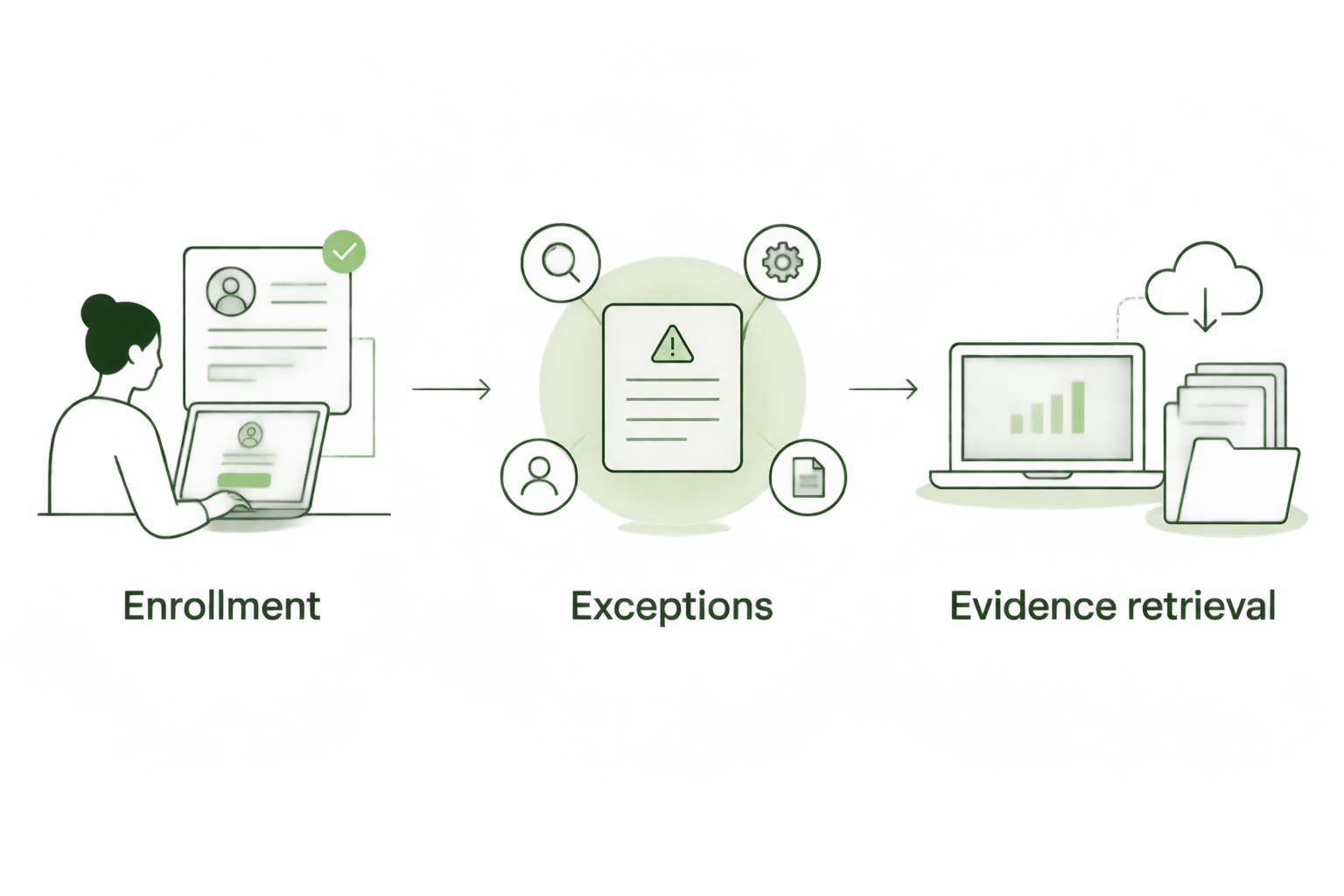
Evaluate the work your team must perform, not just the learner experience.
Which KnowBe4 alternative should you choose?
Choose Defend Wise when you are an MSP buying flat-fee, white-label security awareness training for end-client organizations. That is the clearest default for the MSP-led growth scenario in this comparison.
Choose usecure when your brief extends into broader MSP human-risk management. Choose Hoxhunt when an internal security team owns behavior-focused follow-up. Choose MetaCompliance when policy management and compliance learning belong in the same evaluation.
Before signing a 2026 agreement, document what you are replacing, what you are keeping, and who owns the handover. Preserve historical training records and resolve contractual obligations before retiring the existing service.
Do not switch simply to restart the same administrative problems under a different vendor name.
FAQ
What's the best KnowBe4 alternative for a growing company?
The best alternative depends on who operates the training program. MSP-led delivery, internal behavior-focused security, and policy-led compliance require different shortlists; choose the operating model before comparing features.
Which alternative should an MSP evaluate first?
An MSP should first evaluate platforms built for service-provider delivery. Check white-label requirements, client separation, growth economics, and the work your technicians must perform for each client.
Is unlimited-seat security awareness training enough to choose a platform?
No. Unlimited seats address the stated seat scope, but you still need to evaluate employee lifecycle workflows, evidence retrieval, permissions, content fit, and service ownership.
Is Hoxhunt better than MetaCompliance?
Hoxhunt is the more relevant shortlist candidate for a behavior-focused security brief, while MetaCompliance is relevant when policy management and compliance learning drive the project. Test each against your requirements rather than treating them as identical alternatives.
Can a growing company outsource security awareness training?
Yes, a company can make security awareness training part of an MSP-managed service. The agreement should assign responsibility for enrollment, employee follow-up, exceptions, reporting, and evidence requests.
What should I ask during a security awareness training demonstration?
Ask the vendor to demonstrate enrollment, exception handling, and evidence retrieval using representative situations. Record manual steps, ownership, and any capabilities that require separate confirmation.
How do I switch without losing training records?
Export and validate historical records before retiring the existing platform. Confirm that employee identities, assignments, completion dates, and exception records remain understandable and retrievable after the switch.
One last thing
Ask every shortlisted vendor to demonstrate an employee leaving the company. Enrollment gets attention during sales; offboarding exposes how identities, access, records, and ownership fit together.
A convincing 2026 demonstration ends with retrievable evidence—not just a completed lesson. Make that the final acceptance test for your buying decision.