Security training for vacation rental managers: complete 2026 guide
Security awareness training for vacation rental management companies: prioritize payment checks, guest data, and access with a role-based MSP plan.
DefendWise
DefendWise
Vacation rental managers’ security awareness training is staff education designed to protect guest information, booking accounts, and payments, with the aim of preventing unsafe decisions during daily operations. This 2026 guide shows you how to train reservation teams, property staff, and finance personnel around the decisions each role controls.
TL;DR
- Security awareness training for vacation rental management companies should prioritize payment verification, guest data, and account access.
- Defend Wise is best for MSPs that need flat-fee, white-label security awareness training for vacation rental clients.
- Train employees before granting sensitive access, then reinforce the decisions their roles require.
- Keep training records separate from evidence that payment, access, and incident procedures actually work.
Why security awareness training matters for vacation rental managers
A reservation message is not authorization to issue a refund. An owner’s name in an email is not proof that new banking instructions are genuine. Your training needs to make those distinctions usable during a busy check-in, not just recognizable in a presentation.
Build the program around actions employees can approve, not a generic list of cyber threats. Start with reservations, owner payments, contractor access, and guest records. If responsibilities span properties or offices, use the same core rules across locations; the security training guide for multi-location businesses provides a related planning framework.
Your 2026 program should answer three operational questions: who verifies a sensitive request, which trusted channel they use, and what happens when that person is unavailable. A policy without an after-hours answer leaves staff improvising precisely when you need consistency.
Training also needs a clear boundary. It teaches people how to act; it does not replace access restrictions, account protection, payment approvals, or incident response.
How to build your vacation rental training program
Map sensitive decisions before assigning lessons
Start manually with a spreadsheet and short conversations with the people doing the work. List each sensitive action, the role allowed to perform it, and the verification required before proceeding. Do not begin by buying a course library and asking everyone to complete the same material.
For example, reservation staff need a response to a guest requesting a refund through an unfamiliar channel. Finance staff need a different response to an owner requesting a payout-account change. Property staff need boundaries around access codes and maintenance-system invitations.
Make the map specific enough that a supervisor can use it during onboarding. Replace broad entries such as guest privacy with the actual decision: whether an employee can send a reservation record to someone claiming to represent the guest.
- List the systems holding guest, owner, employee, and payment information.
- Name the roles authorized to change bookings, payments, and access.
- Record the approved verification method for each sensitive action.
- Identify an escalation contact and an unavailable-contact fallback.
- Remove permissions that have no current business purpose.
Write verification rules staff can follow under pressure
Create a short operating procedure before introducing software. Staff should not need to judge whether a message looks convincing enough to override a payment or privacy rule. The procedure decides what verification is required.
Consider this training scenario: someone claiming to be a property owner requests an urgent banking change before the next payout. The employee should use an independently maintained contact record, not a telephone number supplied in the request. Urgency changes the escalation priority; it does not remove verification.
As a practical starting point, schedule a 10-minute team walkthrough of one scenario. This is a recommended exercise format, not a claim about how much training guarantees protection. Have employees explain their next action aloud and identify any missing instructions.
- Require independent verification for payout-account changes.
- Route refunds through the established booking and payment process.
- Prohibit sending passwords or verification codes through messages.
- Define who can release guest records and access instructions.
- Document how staff should handle pressure to bypass a rule.
Choose a delivery model with clear ownership
You can run the initial program with written procedures, staff briefings, and a completion spreadsheet. That approach gives you direct control over property-specific examples. Its limitation is the work required to keep assignments, records, and follow-up current.
If an MSP manages your IT, ask the MSP to own the training service while your operations lead owns the business procedures. Defend Wise security awareness training is a flat-fee, white-label option for MSPs, rather than a substitute for your reservation or finance policies. Review Defend Wise with the provider responsible for delivering the service.
The platform model removes per-seat pricing from the MSP’s training arrangement, but it does not remove operational responsibility. Confirm how your provider will handle enrollment, departed staff, training records, and exceptions before treating the service as ready.
- Name an internal program owner and an MSP contact.
- Specify which employees and contractors need training.
- Request a demonstration of the proposed administrative workflow.
- Confirm how completion evidence will be supplied and retained.
- Keep property-specific approval rules under your management team’s control.
Teach role-specific decisions using realistic examples
Build examples from your procedures without copying real guest records, access codes, or payment details. A useful lesson gives an employee a decision to make and a safe action to take. Merely identifying a suspicious-looking message is not enough.
For your 2026 training plan, separate the responsibilities of reservations, finance, and property operations. Someone handling arrival instructions needs to understand disclosure limits. Someone approving a contractor invoice needs to understand vendor verification. Neither needs unrestricted access to the other role’s records.
Use the same underlying response pattern across these examples: pause the requested action, verify through a trusted route, and escalate if verification fails. Consistency makes the procedure easier to apply when the wording of a request changes.
- Ask reservation staff to handle an unfamiliar refund request.
- Ask finance staff to verify changed owner-payment instructions.
- Ask property staff to assess a request for an entry code.
- Ask managers to handle an urgent request attributed to an executive.
- Ask every role to identify where suspicious requests must be reported.
Connect training to onboarding and access changes
Put the training trigger into your existing hiring and contractor process. A simple checklist works: identify the role, assign relevant instruction, explain reporting, and confirm that the person understands the limits of their access.
Repeat that review when responsibilities change. Moving an employee from guest messaging into owner accounting changes the decisions they can make, even when the employee has already completed general awareness training. Treat the new permissions as a new training requirement.
For an initial rollout, set a 30-day review point to reconcile your personnel list, system-access list, and training record. This is a recommended management checkpoint, not a legal deadline. Investigate mismatches rather than assuming that a completed course means the roster is accurate.
- Add training ownership to the new-hire checklist.
- Explain reporting procedures before employees handle live requests.
- Review training needs when payment or administrative access changes.
- Include relevant contractors according to their actual access.
- Remove departed personnel from both access and training rosters.
Measure coverage and correct the workflow
Begin with records you can maintain manually: who needs training, who completed it, which procedure was taught, and what remains unresolved. Keep the evidence tied to the role and the version of the instruction. Attendance alone does not show that someone knows how to verify a payout change.
Set a 90-day program review as a starting management cadence, then adjust it to your operating needs. Review reported requests and procedural questions without turning early reporting into a disciplinary trap. The point is to find unclear rules before staff repeat an unsafe workaround.
Your 2026 review should separate employee decisions from process defects. If staff cannot reach an authorized approver after hours, another awareness lesson does not fix the missing escalation route.
- Reconcile required learners against completed assignments.
- Record unresolved questions from scenario discussions.
- Check whether staff can locate the reporting instructions.
- Assign an owner to each identified process gap.
- Retain dated records of instruction and corrective action.
The working sequence is simple: map the decisions, establish verification, deliver relevant instruction, then review the evidence. Keep that order when expanding to another property or adding a new operating team.
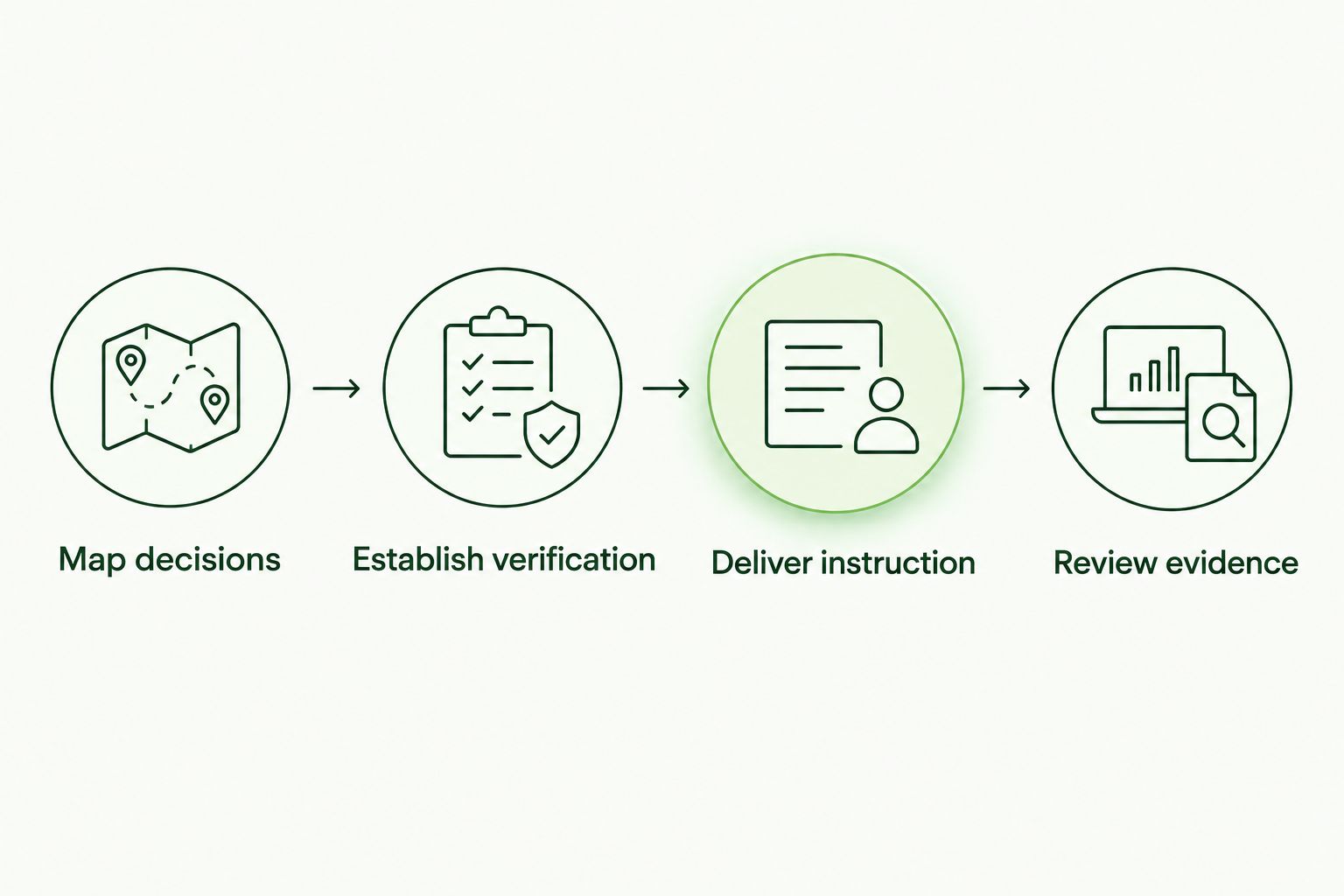
Define the operating rule before choosing how to deliver the lesson.
Compare training options for vacation rental teams
Choose the delivery model your team can maintain, not just launch. For a small initial rollout, an internal briefing and spreadsheet give you a direct way to establish the rules. As responsibilities expand, compare the administrative work each model leaves with your team.
The distinction is ownership. A training platform supplies a delivery option; your company still defines who can approve refunds, change owner banking information, and disclose access instructions. An MSP-delivered service needs that same division of responsibility in writing.
| Option | Best for | Main advantage | Key limitation |
|---|---|---|---|
| Internal briefings and a spreadsheet | A manager establishing an initial program | Direct control over examples and procedures | Your team maintains assignments, follow-up, and records |
| An existing internal learning system | Companies already managing employee instruction centrally | Keeps awareness instruction within an established learning process | You must check whether suitable security content and records are included |
| An MSP service using Defend Wise security awareness training | MSP-managed vacation rental companies | Flat-fee, white-label training with unlimited seats for the MSP | Requires an MSP delivery arrangement and separate business procedures |
For the 2026 selection process, ask each provider to demonstrate the tasks your administrator will actually perform. Do not assume a feature exists because a related article or sales category mentions it. Evaluate the proposed service against your roster, role boundaries, evidence needs, and escalation process.
Common mistakes vacation rental managers make
Treating guest urgency as proof of identity
A person who knows a reservation date or property address has supplied context, not authorization. Train employees to complete the required verification before releasing records, changing payment instructions, or sharing entry information.
Keep the verification requirement fixed even when the response needs to be fast. Establish an escalation route for urgent situations instead of expecting frontline staff to invent exceptions.
Training office staff but excluding property personnel
Base inclusion on access, not job title. A contractor who receives sensitive instructions needs clear handling rules even if the contractor never uses your accounting system.
Keep those rules proportionate. Someone who only needs a maintenance assignment should not receive broad guest or owner information merely to simplify coordination.
Using real guest data in training examples
Do not circulate live booking screenshots, identity documents, or working access codes to make a lesson feel realistic. Use fictional details and remove sensitive information from any incident material used for instruction.
The lesson should teach the decision. It should not create another copy of the data you are trying to protect.
Confusing completion evidence with compliance
A completion record proves that an assigned activity was recorded as complete. It does not establish that every applicable privacy, payment, insurance, or contractual requirement has been met.
Identify the requirements that apply to your business and match evidence to each obligation. Avoid blanket compliance claims based solely on a training dashboard.
Ignoring the after-hours approval gap
An escalation process that ends with an unavailable manager is incomplete. Assign a fallback for sensitive requests outside normal working hours and state which actions must wait.
Train staff to preserve service without bypassing controls. They can acknowledge a request and explain the verification process without approving the underlying change.
FAQ
What should security awareness training for vacation rental management companies cover?
Security awareness training for vacation rental management companies should cover guest-data handling, payment verification, account access, suspicious requests, and incident reporting. Tailor the instruction to the decisions each role is authorized to make.
What's the best way to start without a training platform?
Start with written verification rules, a role-based briefing, and a completion spreadsheet. Assign an owner to maintain the roster and resolve questions raised during the briefing.
Should cleaners and maintenance contractors receive security training?
Give contractors security instructions that match their access and responsibilities. Anyone handling entry information, guest details, or company accounts needs clear rules for protecting that information and reporting suspicious requests.
Can an MSP manage training for a vacation rental company?
An MSP can manage the training service while your operations team owns business approval rules. Defend Wise provides flat-fee, white-label security awareness training for MSPs; confirm the delivery responsibilities with your provider.
How often should vacation rental staff receive training?
Provide relevant instruction during onboarding, when responsibilities change, and when procedures need correction. Set a recurring review cadence based on your operations and applicable obligations rather than assuming one annual session covers every need.
Does awareness training replace account security controls?
Awareness training does not replace technical controls or access restrictions. Combine instruction with appropriate account protection, limited permissions, payment verification, and a documented response process.
What training evidence should a vacation rental manager keep?
Keep records identifying the learner, assigned instruction, completion date, applicable procedure, and unresolved follow-up. Set retention requirements according to your business obligations and restrict access to employee training records.
One last thing
Write the unavailable-approver rule before your next busy arrival period. Ask a reservation employee what happens when a sensitive request arrives and the normal manager cannot answer. If the response depends on guessing, fix the procedure before assigning another lesson.
That is the useful test of a training program: employees know the safe next action, including when the answer is to wait for verification.