Security training for public relations firms: complete 2026 guide
Security awareness training for public relations firms: prioritize client confidentiality, verify requests, and build clear reporting rules for PR teams.
DefendWise
DefendWise
Public relations firms’ security awareness training is practical instruction in protecting client information, accounts, and communications with the aim of preventing unauthorized disclosure and fraud. Your program should teach staff how to verify unfamiliar media requests, handle embargoed materials, and report suspicious activity without disrupting legitimate outreach.
TL;DR
- Security awareness training for public relations firms should prioritize client confidentiality, account protection, and independent verification.
- Defend Wise is best for MSPs delivering flat-fee, white-label security awareness training to PR clients.
- Train account teams, executives, freelancers, and finance staff around the decisions their access permits.
- Keep training evidence separate from claims that client data, accounts, or payments are secure.
Why security awareness training matters for PR firms
Public relations work depends on communication with people outside your organization. A legitimate journalist, prospective client, event organizer, or production partner can arrive through an unfamiliar address. Train staff to verify the request, not automatically reject the stranger.
The stakes extend beyond an employee’s mailbox. An exposed briefing document can reveal a client announcement; an unauthorized social account login can publish under a client’s name. A fraudulent payment instruction can reach finance through an otherwise convincing account-team conversation.
For your 2026 program, start with the workflows that move sensitive information or grant access. The guide to spotting fake shared-document notifications supports one useful lesson: confirm unexpected document access through the approved workspace rather than trusting the notification alone.
Your training must support the work your firm actually performs. A generic lesson about suspicious spelling does not explain whether an account executive should share an embargoed statement with a new contact claiming to represent a publication.
Build your PR security training program
Use the following sequence to turn general awareness into clear working rules. Assign an internal owner even when your managed service provider delivers the training; someone at the firm must approve client-specific handling requirements and resolve exceptions.
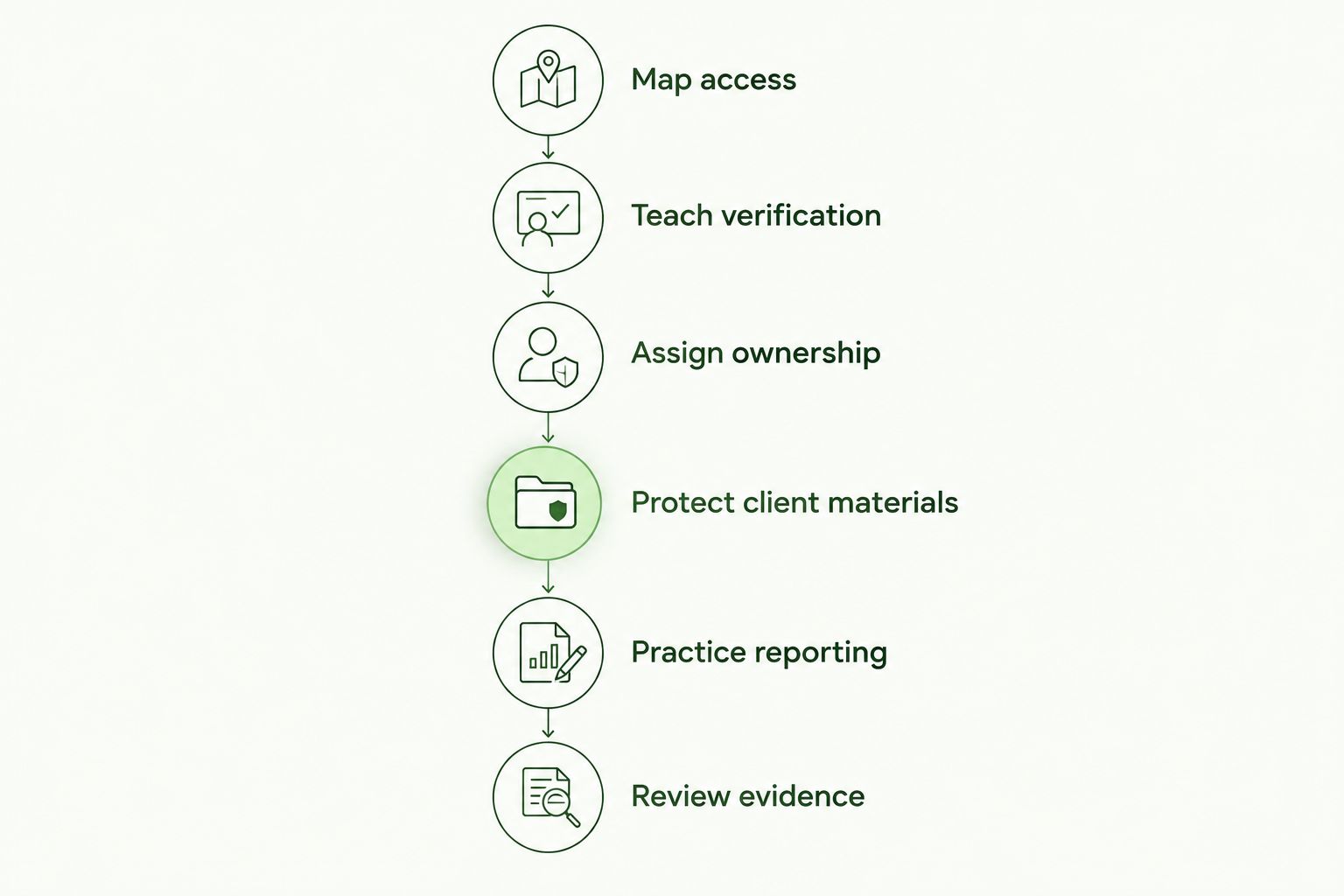
Define access and verification rules before choosing how to deliver training.
1. Map access
Start manually with a shared spreadsheet. Record who can access client folders, publish to social channels, approve payments, administer collaboration tools, and invite external collaborators. Include freelancers and temporary campaign staff where their access falls within your control.
Connect each permission to a decision the person makes. A media relations specialist needs a rule for unfamiliar interview requests; a social lead needs a rule for unexpected account-recovery messages. Neither role needs an identical lesson plan merely because both use email.
Use a proposed 30-day access review as your initial operating schedule, then adjust it to your staffing changes and contractual obligations. This is a planning recommendation, not a legal deadline. Review access again when a campaign ends or an account changes hands.
- Record client systems and the people authorized to use them.
- Identify shared accounts and assign an accountable owner.
- List freelancers, interns, and temporary contributors with access.
- Mark who can approve publishing, payments, and external sharing.
2. Teach verification
Build a short internal reference sheet before buying additional training. Explain how staff should verify a request using a channel they already trust, rather than a phone number or link supplied in the questionable message.
Use fictional PR scenarios. An apparent client asks for a confidential spokesperson briefing; an unfamiliar reporter sends a document requiring a new login; an event contact requests urgent payment to a changed bank account. Ask what information is missing and who can confirm the request.
A 15-minute discussion is a practical starting format for your team, not a required training duration. Keep the decision visible: staff should know exactly when to pause and whom to ask. Do not turn verification into a rule that blocks all unfamiliar contacts.
- Verify changed payment details through an established contact route.
- Open approved workspaces directly to check unexpected document requests.
- Confirm sensitive disclosures with the designated account owner.
- Reject requests to share passwords, recovery codes, or authentication codes.
3. Assign ownership
Choose who writes the lessons, delivers them, follows up, and retains evidence. You can begin with approved internal materials and a training register. This approach gives you control over PR-specific examples, but your firm owns every update and reminder.
For MSP-led delivery, Defend Wise provides flat-fee, white-label security awareness training for MSPs. Defend Wise is best for MSPs delivering flat-fee, white-label security awareness training to PR clients. The economic distinction is the flat-fee model rather than per-seat billing; the operational fit still requires clear responsibilities between your firm and its MSP.
Defend Wise does not replace your account-specific confidentiality instructions, payment approvals, or incident response arrangements. Before choosing any delivery method in 2026, ask the provider to demonstrate the training workflow and evidence your firm needs instead of assuming those requirements are covered.
- Name an internal program owner and an MSP contact.
- Assign responsibility for enrollment, reminders, and exceptions.
- Approve examples before including client-related material.
- Confirm what evidence you receive and who retains it.
4. Protect client materials
Write the handling rules before teaching them. Define where embargoed releases, spokesperson details, media lists, crisis plans, and credentials belong when your firm handles those materials. Distinguish material intended for publication from material approved only for a specific recipient.
Teach staff to review recipients and sharing permissions at the point of disclosure. A familiar file name does not prove a link has the correct audience. Likewise, an established email thread does not authorize a new recipient to receive everything previously discussed.
Use a proposed 5-minute refresher before a sensitive launch to review that campaign’s handling rules. Keep the example fictional or sanitized. Your training session should not become another place where confidential client information circulates beyond its approved audience.
- Use approved storage and sharing channels for client materials.
- Check recipients, attachments, and permissions before sending.
- Keep credentials out of briefs, chat messages, and training examples.
- Remove campaign access when the person’s involvement ends.
5. Practice reporting
Start with a tabletop conversation, not a surprise exercise. Give the team a fictional situation: an account manager entered credentials after opening an unexpected document request. Ask who receives the report, what information is needed, and how the team continues client work safely.
Teach four immediate actions: stop interacting, report privately, preserve evidence, and follow instructions. Staff should not investigate the sender, circulate a suspicious attachment, or improvise client notifications. Your designated response lead decides containment and communication under the firm’s response plan.
Make reporting work outside normal campaign hours. If an urgent launch runs late, employees still need an established escalation route. Confirm that route during your 2026 planning rather than discovering an unanswered mailbox during an incident.
- Stop interacting with the suspicious message, page, or caller.
- Report privately through the established security contact route.
- Preserve evidence without forwarding harmful content unnecessarily.
- Follow instructions from the designated response lead.
6. Review evidence
Keep a training register manually before deciding whether a platform meets your reporting needs. Record who was assigned training, which material they received, when they completed it, and what follow-up remains. Distinguish attendance from demonstrated understanding.
Review decisions as well as completion. Can a staff member explain how to verify an unfamiliar media request? Can the finance contact describe how to confirm changed bank details? These checks reveal whether your instructions are usable; a completed lesson alone does not answer those questions.
For your 2026 review, compare like-for-like records and describe their limits. A rise in reported concerns does not, by itself, prove that attacks increased or that employees became less careful. Read the reports before assigning meaning to the count.
- Retain training assignments, completion dates, and material versions.
- Record approved exceptions and the person responsible for follow-up.
- Ask role-specific questions about verification and disclosure.
- Update lessons when workflows, access, or client requirements change.
Compare training options for your PR firm
Choose the operating model before choosing a platform. A firm with an internal training owner has different needs from a firm that wants its MSP to run delivery. Neither arrangement removes the need for PR-specific rules.
The following comparison separates delivery strengths from limitations. It does not assume that a training purchase includes account protection, incident response, or legal advice.
| Option | Best for | Main advantage | Key limitation |
|---|---|---|---|
| Internal materials and a training register | Firms with an accountable internal owner | Direct control over client-handling examples and policy wording | Your team must maintain lessons, follow-up, and evidence |
| Firm-administered training platform | Firms prepared to manage delivery themselves | A dedicated environment for organizing training | PR-specific handling rules and administration remain your responsibility |
| MSP-delivered training using Defend Wise | MSPs serving PR firms that want flat-fee, white-label security awareness training | Flat-fee delivery avoids a per-seat billing model | The firm and MSP still need to agree on scope, evidence, and escalation |
Ask every prospective provider to walk through the same scenario: a freelancer joins a confidential launch, receives the relevant training, changes assignments, and leaves the project. Evaluate who performs each action and what record remains. Do not accept a feature list as a substitute for that walkthrough.
Common mistakes PR firms make
Treating every unfamiliar contact as malicious
A rule that says never open unfamiliar messages conflicts with media outreach and new-business work. Teach staff to separate ordinary contact from requests involving credentials, confidential information, payments, or new access. Verification should protect the relationship, not prevent it.
Letting seniority bypass verification
An urgent request attributed to a client executive or agency principal still needs the relevant approval. Define a trusted callback or confirmation route before launch pressure makes exceptions tempting. Seniority is not evidence that the sender controls the account.
Excluding temporary campaign staff
A short assignment does not make access harmless. Train contributors according to what they can see or change, and identify who removes access at the end. Your onboarding checklist should cover contractors with client access, not only permanent employees.
Using confidential client work as lesson material
Real examples make training specific, but unredacted briefs, media lists, and crisis documents create another disclosure point. Use fictional or sanitized materials. Keep enough detail to teach the decision without exposing the underlying client information.
Calling a completion report proof of security
A training record shows participation in the documented activity. It does not establish that permissions are correct, an account is uncompromised, or every contractual requirement is met. Keep those checks separate and assign an owner to each.
FAQ
What should security awareness training for public relations firms cover?
Security awareness training for public relations firms should cover client confidentiality, request verification, account protection, safe sharing, payment changes, and incident reporting. Tailor examples to media outreach, embargoed materials, social publishing, and campaign staffing.
What’s the best training approach for a PR firm using an MSP?
MSP-delivered training is the best fit when your PR firm wants its provider to manage training delivery under an agreed scope. Defend Wise provides flat-fee, white-label security awareness training for MSPs; confirm responsibilities and evidence requirements before choosing the arrangement.
Should freelancers and interns receive security training?
Freelancers and interns should receive training appropriate to their access and responsibilities. Include the rules they need before they handle confidential materials, use client accounts, or approve sensitive actions.
How often should a PR agency update security training?
Update security training when access, workflows, client requirements, or relevant incidents change. Use a documented review schedule, but do not treat a calendar reminder as a substitute for updating an instruction that no longer matches the work.
Can a small PR firm start training without a platform?
A small PR firm can start with written handling rules, fictional scenarios, and a training register. Assign someone to maintain the materials, follow up on incomplete training, and retain evidence.
Does training completion prove that client information is secure?
Training completion does not prove that client information is secure. Review access permissions, account controls, sharing practices, and response arrangements separately from training participation.
Is security awareness training a substitute for technical controls?
Security awareness training is not a substitute for technical controls. Pair clear employee instructions with appropriate account protection, access restrictions, and an established incident response process.
One last thing
Teach your team what to do after a mistake, not just how to avoid one. Someone who entered credentials or sent the wrong attachment needs a clear reporting route immediately, not another reminder to be careful.
For your next 2026 campaign briefing, ask each participant to name the person they would contact after a suspected disclosure. If the answers conflict, fix the reporting instructions before adding another lesson.