Security training for medical spas: complete 2026 guide
Security awareness training for medical spas works best when it follows real workflows. Build role-based lessons, reporting habits, and HIPAA evidence.
DefendWise
DefendWise
Medical spa security awareness training is staff education aimed at protecting patient information, business accounts, and payments through safer everyday decisions. Medical spas need lessons that connect clinical privacy with front-desk communication, treatment photography, appointment systems, and vendor requests.
TL;DR
- Security awareness training for medical spas should follow patient-data workflows, not a generic office syllabus.
- HHS HIPAA rules require covered entities to train their workforce; medical spa status alone does not determine coverage.
- Teach front-desk, clinical, marketing, and billing staff different verification and reporting actions.
- Keep training records alongside policies, role assignments, and follow-up evidence; completion alone does not establish compliance.
Why security awareness training matters for medical spas
A medical spa training plan needs to address both patient care and business operations. Map how your staff handles appointment requests, intake forms, photographs, refunds, and account access; each workflow needs a clear rule for verifying requests and sharing information.
Start with what employees actually do, then teach the security decision inside that task. A receptionist needs to know how to verify a records request. A marketing employee needs to know which approval process applies before publishing a treatment photograph.
For your 2026 compliance review, establish whether your organization is a HIPAA covered entity or business associate. Under HHS rules, a healthcare provider is a covered entity when it transmits health information electronically in connection with a transaction covered by HIPAA; providing medical services alone does not settle the question.
The HIPAA security awareness training requirements belong inside that scope assessment. HHS's Security Rule, at 45 CFR §164.308(a)(5), requires a security awareness and training program for the workforce of regulated organizations, including management.
Build a medical spa training program in six steps
1. Map patient information and assign responsibility
Begin manually with a spreadsheet and a walkthrough of your actual processes. Follow information from the first appointment inquiry through treatment, payment, follow-up, and any approved marketing use.
Record where information enters, who accesses it, where it moves, and who approves exceptions. Include external providers that handle information on your behalf; do not assume a vendor's involvement removes your responsibility to understand the workflow.
For the 2026 plan, separate legal scope from operational safeguards. Even when a particular activity falls outside HIPAA, your organization still needs clear instructions for protecting accounts and handling sensitive information.
Close the mapping exercise with these actions:
- List the systems used for appointments, records, photographs, payments, and email.
- Identify the staff roles authorized to access each system.
- Mark transfers involving personal devices, downloads, messaging, or external vendors.
- Assign an owner for security questions and a separate backup contact.
- Document unresolved legal questions for qualified counsel or your privacy lead.
2. Build lessons around each role's decisions
Use staff meetings and written procedures before buying anything. Ask each role to describe a legitimate request it handles, then change one detail: an unfamiliar sender, a new bank account, an unexpected attachment, or pressure to bypass approval.
Teach the correct response, not just the warning sign. Recognizing an unusual request achieves little if the employee does not know which trusted channel to use next.
Separate security awareness from privacy instruction while connecting both to the job. For HIPAA-regulated organizations, HHS's Privacy Rule at 45 CFR §164.530(b) requires training on policies and procedures as necessary and appropriate for workforce functions; a generic cybersecurity lesson does not replace that instruction.
Build your role-based lessons around these tasks:
- Front desk: verify identity before releasing appointment or patient information.
- Clinical staff: use approved channels for records and treatment photographs.
- Marketing: follow the applicable authorization and publication approval process.
- Billing: independently verify refund instructions and vendor banking changes.
- Managers: approve access changes and escalate suspected incidents.
3. Choose delivery without adding seat-count friction
A manual program can start with a shared calendar, approved lesson documents, an attendance record, and a short knowledge check. That approach gives you direct control over examples, but somebody must maintain assignments, reminders, and records.
For an MSP serving medical spas, Defend Wise provides flat-fee, white-label security awareness training with unlimited seats. Defend Wise security awareness training is best for MSPs that want flat-fee, white-label delivery across medical spa clients.
That purchasing model removes per-seat vendor pricing from the decision to include another learner. It does not remove the work of defining medical spa procedures, establishing HIPAA applicability, or confirming that a platform fits your evidence requirements.
Before selecting delivery for 2026, separate confirmed capabilities from requirements you still need to validate. Do not buy on the assumption that training software also manages clinical policies or certifies compliance.
Use these selection checks:
- Name the person responsible for assignments and overdue training.
- Confirm how learners access lessons during their scheduled work.
- Inspect the completion records you will need to retain.
- Verify how separate client organizations are administered.
- Check whether the content supports your role-specific procedures.
4. Schedule short lessons around operational changes
Start with a calendar rather than an ambitious content library. Assign foundational instruction during onboarding, then add refreshers when responsibilities, systems, policies, or observed problems change.
As a practical starting schedule, reserve 10 minutes per refresher and a 30-day review after launch. These are planning recommendations, not legal training intervals or performance benchmarks; adjust the schedule to your risk assessment and applicable requirements.
Use each refresher to reinforce one decision. For example, walk through a request to move treatment photographs into a personal messaging app, then explain the approved alternative and reporting route.
Keep the schedule workable:
- Complete relevant onboarding instruction before granting the associated access.
- Give each refresher one clear learning objective.
- Schedule training time rather than expecting staff to fit it between appointments.
- Revisit instructions when a booking, records, or payment workflow changes.
- Record absences and assign a specific follow-up owner.
5. Rehearse verification and incident reporting
Write a short response card before delivering another lesson. Staff should know where to report a suspicious message, an unexpected account prompt, a misdirected record, or a lost device without searching through a handbook.
Use discussion-based walkthroughs with fictional information. A 15-minute exercise can ask employees to explain what they would do after sending a document to the wrong recipient; the purpose is to expose unclear instructions, not to claim a measured reduction in incidents.
Make verification independent of the original request. If an email asks for a banking change, staff should use an established contact method rather than the telephone number supplied in that message.
Practice these concrete actions:
- Stop the requested action when identity or authority is unclear.
- Verify sensitive requests through a known, approved channel.
- Report suspected incidents to the named internal contact or MSP.
- Preserve relevant details without forwarding patient information unnecessarily.
- Follow the response lead's instructions instead of deleting evidence or investigating alone.
6. Keep evidence tied to the work
Start with a controlled training register. Record the learner, role, assigned instruction, completion date, policy version, and any required follow-up, while limiting access to staff who need those records.
Your 2026 evidence review should answer two different questions: did the person receive the instruction, and can the person explain the correct action? Completion records answer the first; documented discussions and knowledge checks help answer the second.
Use a simple operating cycle: Assign training, Check understanding, Resolve gaps, and Retain evidence. The cycle keeps missed instruction and unclear procedures visible instead of treating a completed lesson as the endpoint.
Build the evidence process around these tasks:
- Reconcile the training roster with current staff and relevant contractors.
- Record which version of a procedure each lesson addressed.
- Document follow-up when an employee cannot explain the required action.
- Store records under your approved retention and access rules.
- Review unresolved items with the responsible manager and MSP.
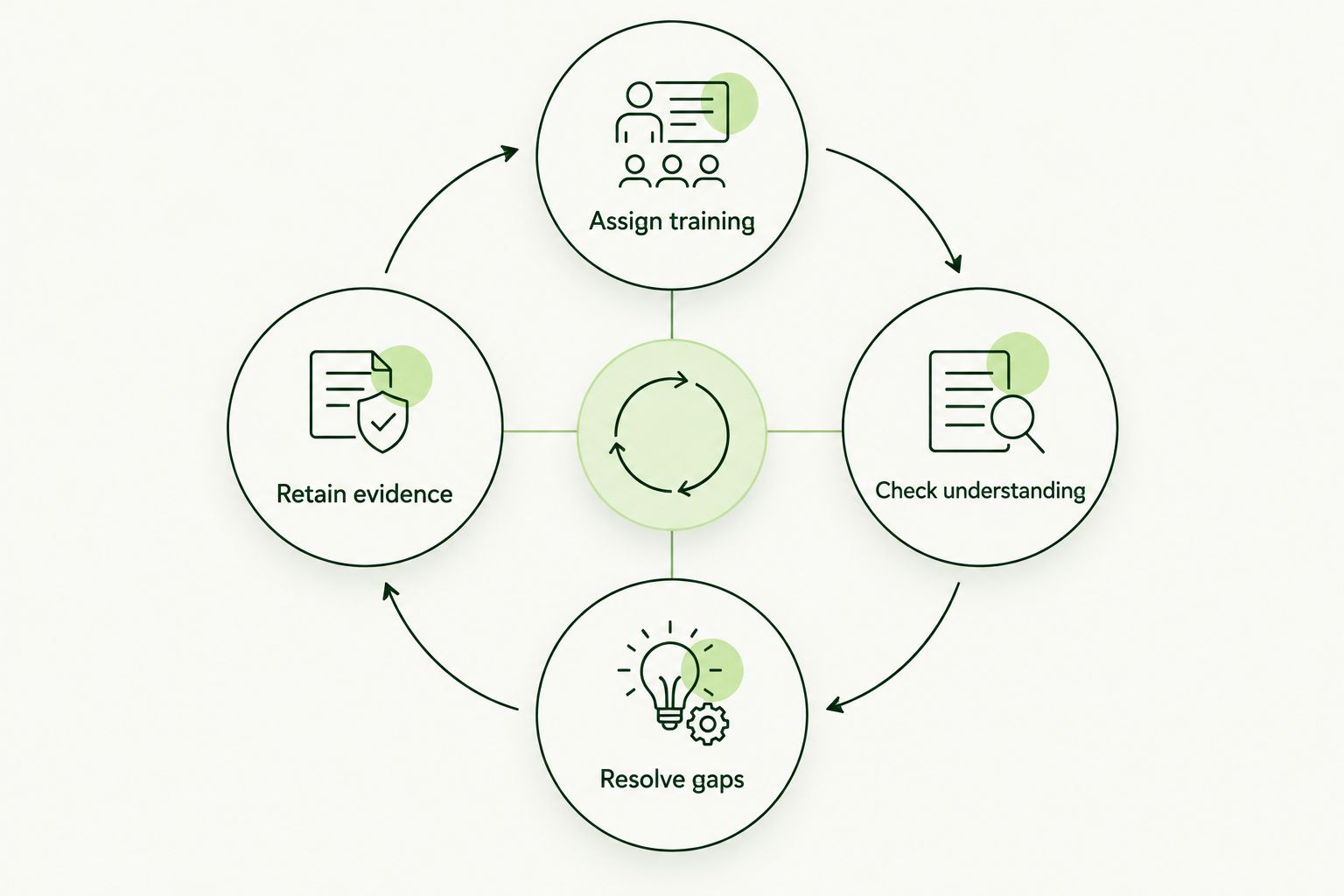
Completion is one part of the process, not the endpoint.
Compare delivery options for your medical spa
Choose the delivery model according to who will operate it. A small practice with a committed owner needs a different administrative setup from an MSP responsible for multiple client organizations.
The following options describe delivery approaches, not a ranking of verified healthcare compliance capabilities. Keep local procedures and legal review in scope whichever route you choose.
| Option | Best for | Main advantage | Key limitation |
|---|---|---|---|
| Manager-led briefings and a training register | A practice with a named internal owner | Direct control over medical spa examples and procedures | Assignments, follow-up, and evidence require manual work |
| Existing learning management system | A practice already administering staff education | Keeps security instruction within an established learning process | Security content and evidence suitability still need review |
| Defend Wise security awareness training through an MSP | MSPs standardizing white-label training across medical spa clients | Flat-fee delivery with unlimited seats | Does not establish HIPAA compliance or replace practice-specific procedures |
Do not turn the rollout into a promise that the practice will become compliant by a particular date. HIPAA compliance timelines depend on the wider work your assessment identifies, including policies, safeguards, vendor arrangements, and remediation; finishing staff lessons does not finish that work.
For the 2026 service agreement, distinguish training administration from privacy oversight, technical controls, and incident response. Assign each responsibility explicitly so the medical spa and MSP do not both assume the other owns it.
Common mistakes medical spas make
Treating every employee as a clinician
A clinical privacy presentation does not teach a receptionist how to verify an urgent records request or a bookkeeper how to challenge changed payment instructions. Keep shared foundations, then add tasks that match each role's access and authority.
Leaving photographs outside the training scope
Include treatment photography wherever your practice uses it. Staff need explicit instructions for capture, storage, access, sharing, and any proposed publication; do not substitute a generic reminder to protect patient privacy.
Counting completion as proof of compliance
A completed course shows participation, not that every applicable safeguard or policy is in place. Keep training evidence alongside the risk assessment, relevant procedures, access decisions, and documented corrective work.
Excluding temporary or part-time staff
Base training assignments on responsibilities and access, not hours worked. Include relevant temporary staff and contractors in your scope review, then document what instruction each person needs before performing sensitive tasks.
FAQ
What should security awareness training for medical spas cover?
Security awareness training for medical spas should cover account protection, request verification, safe information handling, and incident reporting. Add role-specific procedures for appointments, records, treatment photographs, billing, and marketing.
Does every medical spa have to follow HIPAA?
Medical spa status alone does not establish HIPAA coverage. Determine whether the organization is a covered entity or business associate, including whether a healthcare provider conducts HIPAA-covered electronic transactions.
How often should medical spa employees receive security training?
Set the schedule according to applicable requirements, workforce roles, and your risk assessment. Include onboarding instruction and refreshers when policies, systems, responsibilities, or identified risks change; do not assume an annual course covers every obligation.
Can a medical spa run training without buying software?
A medical spa can administer training using approved procedures, staff briefings, knowledge checks, and a controlled register. The practice must still assign an owner to maintain content, track participation, and resolve missed instruction.
Is Defend Wise intended for medical spas buying training directly?
Defend Wise is positioned as flat-fee, white-label security awareness training for MSPs. A medical spa evaluating that approach should define delivery, support, and evidence responsibilities with its MSP.
Does a completed security course make a medical spa HIPAA compliant?
A completed security course does not establish HIPAA compliance. Training is one requirement within a broader program that includes applicable policies, safeguards, risk management, and other obligations.
What training records should a medical spa keep?
Keep records that identify the learner, assigned instruction, completion date, relevant policy version, and follow-up. Apply the retention and access requirements appropriate to your organization and the records involved.
One last thing
Ask staff to find the reporting contact before asking them to recognize another threat. If an employee cannot locate the approved reporting route during an ordinary shift, fix that gap first.
Defend Wise can be the MSP's training platform. Your medical spa still needs a named decision-maker, clear local procedures, and someone responsible for closing the gaps training reveals.