Hook Security alternatives in 2026
Compare Hook Security alternatives for MSPs in 2026. Choose Defend Wise for flat-fee, white-label training, and check service fit before you switch.
DefendWise
DefendWise
Hook Security gives you a security awareness training option; the ceiling for an MSP is whether a training platform also fits the service you resell. That makes delivery model—not another feature checklist—the deciding factor. The best Hook Security alternative in 2026 is Defend Wise if you need flat-fee, white-label security awareness training with unlimited seats; KnowBe4 belongs on your shortlist if you need a broader security awareness content selection.
TL;DR
- For MSPs comparing Hook Security alternatives, Defend Wise is the flat-fee, white-label security awareness training pick.
- Shortlist KnowBe4 when security awareness content selection drives your decision; validate the MSP delivery workflow separately.
- Keep Hook Security if your existing training program meets client requirements and the service economics work.
- Compare enrollment, client administration, evidence, and transition work before replacing your current platform.
Why this matters
Your clients buy a managed training service. You still have to enroll people, explain outstanding work, answer evidence requests, and maintain the relationship when employees join or leave.
A platform decision that ignores those tasks is incomplete. For your 2026 shortlist, separate what employees learn from how your MSP delivers the service. Strong training content does not automatically settle branding, administration, or commercial fit.
Start with the service you promise clients. Then choose the platform that supports it without adding work your agreement does not cover.
Hook Security alternatives at a glance
Use this table to choose a demonstration, not to substitute for one. The distinction is between a flat-fee MSP offer, a content-led alternative, and your existing baseline.
| Platform | Best for | Standout consideration | How it differs from Hook Security |
|---|---|---|---|
| Hook Security | Keeping an established program that already meets requirements | Security awareness training | The baseline: compare alternatives against your actual deployment |
| Defend Wise | MSPs reselling white-label security awareness training | Flat-fee model with unlimited seats | An explicitly MSP-focused commercial and branding proposition |
| KnowBe4 | Buyers prioritizing security awareness content selection | Broad security awareness training content | A separate content-led option to evaluate against your required topics and learner experience |
Do not treat this as a feature-parity table. Ask each vendor to demonstrate your required workflow, and record the result against the same acceptance criteria.
1. Defend Wise: best for flat-fee MSP training services
Defend Wise is the Hook Security alternative for MSPs that need flat-fee, white-label security awareness training with unlimited seats. The offer addresses a specific service-design problem: selling training under your own brand without a seat-based platform model.
That is a reason to evaluate the platform, not permission to assume every operational requirement is covered. Your client structure, reporting requirements, and enrollment process still need a practical demonstration.
Where the flat-fee option shines
- Flat-fee model: Evaluate the service without making the platform fee depend on a changing seat count.
- Unlimited seats: Employee coverage is not defined by a purchased seat allowance.
- White-label training: The offer fits MSPs selling security awareness training under their own brand.
- MSP focus: The intended buyer is a service provider managing training for end-client organizations.
Where the flat-fee option falls short
- It does not include phishing simulation. Do not select it as a replacement for that separate capability.
- It is not a universal buyer fit. An organization buying only for its own employees has a different requirement from an MSP reselling training.
- Unlimited seats do not eliminate service work. You still need ownership for enrollment, client questions, exceptions, and evidence requests.
Head-to-head: flat-fee MSP offer versus Hook Security
| Decision dimension | Flat-fee MSP option | Hook Security decision check |
|---|---|---|
| Commercial fit | Flat-fee model with unlimited seats | Compare your current agreement against expected client growth |
| Branding | White-label security awareness training | Demonstrate the branding your client agreement requires |
| Intended buyer | MSP serving end-client organizations | Test the workflow against your MSP service requirements |
| Replacement scope | Security awareness training | Inventory what your current deployment does before replacing it |
Best for: An MSP making white-label security awareness training part of a repeatable client service in 2026.
Verdict: Buy if flat-fee training and white-label delivery match your requirements and the operational demonstration passes.
2. KnowBe4: best for content-led security awareness evaluation
KnowBe4 is a security awareness training vendor with a broad training content offering. Put it on your shortlist when the selection of learning material is a primary requirement, rather than treating the commercial model as the only decision.
Ask for examples matched to the people you train. A content selection matters only when you can assign relevant material and show what learners completed.
Where KnowBe4 shines
- Content-led evaluation: You can assess security awareness material against a defined topic list.
- Established category focus: Security awareness training is a core part of the offering.
- Learner-fit review: Sample content gives you something concrete to compare with your existing Hook Security program.
Where KnowBe4 falls short
- Content breadth is not an MSP workflow. Validate client administration, branding, and evidence delivery separately.
- More choice requires selection. Your team still has to decide what belongs in the client service.
- A recognizable vendor name does not prove replacement fit. Require demonstrations of the tasks your technicians actually perform.
| Decision dimension | KnowBe4 evaluation | Hook Security evaluation |
|---|---|---|
| Content fit | Review samples against your required topics | Compare with material your clients currently receive |
| Learner experience | Complete a sample assignment | Use the current learner journey as the baseline |
| MSP operations | Demonstrate your client-management requirements | Measure the same tasks in your existing deployment |
Best for: A buyer who wants to compare security awareness content before committing to a replacement.
Verdict: Hold until the content review and MSP workflow demonstration both pass.
Why people switch from Hook Security
A switch needs an identified mismatch, not a claim that Hook Security is bad. Use the following reasons only when they describe your own deployment; they are decision criteria, not allegations about the vendor.
The service model has changed
You started by arranging training for individual clients. Now you want a standardized, white-label service across your MSP portfolio.
That changes the buying question. Instead of asking whether employees can receive training, ask whether your team can deliver the same defined service consistently across clients.
Seat-count administration is part of your current workload
If your present agreement makes you reconcile changing user counts, document that work. Check the contract rather than assuming Hook Security uses a particular billing structure.
A flat-fee alternative is relevant when seat-count friction exists in your service today. It is not evidence that your current vendor has changed its terms.
Your evidence requirements have become clearer
Clients ask for records tied to their training obligations. A switch makes sense when your current process cannot supply the required records in a usable form and a replacement demonstrably can.
Specify the evidence before the sales call. “Better reporting” is too vague to accept or reject.
Your service scope has narrowed
You want a defined security awareness training offer, not every adjacent security function in the same purchase. A narrower scope can be the right fit when the remaining responsibilities already have an owner.
Switch for a verified requirement. Do not switch for a longer feature list.
Run a workflow check before you choose
For a 2026 evaluation, give each shortlisted vendor the same scenario. Ask for a live demonstration, then record which steps your team must perform outside the platform.
Use these 4 checks. They are an evaluation sequence, not claims about any vendor's capabilities.
- Enrollment: Add a new learner, assign the required training, and explain how departures are handled.
- Client boundaries: Show how an administrator works with the correct client organization and avoids exposing another client's information.
- Evidence: Produce the record a client would need to answer a training-completion request.
- Handover: Show what another technician needs to continue managing the service.
The result should be a written workflow, not a collection of screenshots. Record the owner, required action, and acceptance condition for each check.
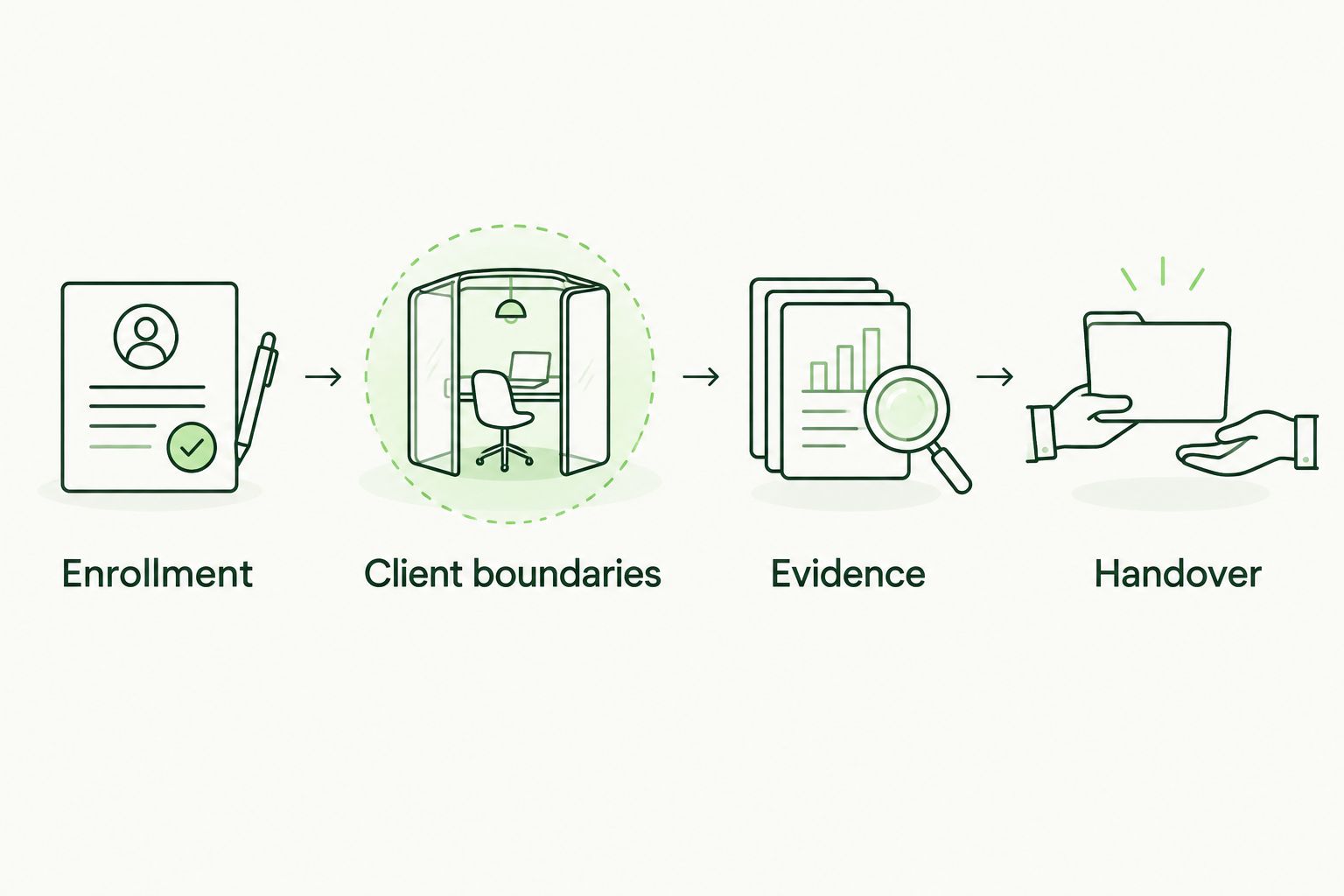
Use the same workflow checks for every shortlisted platform.
Add 3 client scenarios to that demonstration: a stable workforce, a client adding employees, and a client with frequent departures. These are test cases, not market benchmarks.
For each scenario, ask what changes in your team's work. Unlimited seats answers a commercial question; it does not answer every operational one.
Evaluate the economics without guessing savings
Your platform agreement is only part of the service model. Include onboarding work, recurring administration, client communication, and evidence preparation when deciding whether a replacement makes sense.
Use a simple worksheet:
| Service component | What to record | Decision it supports |
|---|---|---|
| Platform agreement | Applicable terms and billing structure | Whether the commercial model fits your portfolio |
| Onboarding | Tasks, owners, and actual time recorded | Whether setup belongs inside your standard package |
| Recurring administration | Repeated actions and exceptions | Whether the service remains manageable |
| Client evidence | Requests, preparation steps, and delivery | Whether your promised reporting is practical |
| Transition | Export, setup, communication, and validation work | Whether switching is justified |
Do not insert assumed time savings. Record your current work first, then repeat the relevant tasks during evaluation.
The MSP security training break-even guide gives this decision its proper context: the service has to work economically, not merely look attractive in a demonstration.
Plan the transition before ending the current service
Treat a 2026 platform change as a service handover. Assign an owner and preserve the records your clients need before making changes to access or assignments.
Use a 30-day review window as a planning recommendation, not a promised deployment time. Adjust it to your contracts and client obligations.
- Before rollout: Inventory active learners, outstanding assignments, required records, and client-specific commitments.
- During a pilot: Run the workflow checks with a limited client group and document exceptions.
- Before wider deployment: Confirm who handles learner questions, assignment errors, and evidence requests.
- At handover: Tell clients where training happens, who supports it, and what changes in their reporting process.
Avoid overlapping assignments unless you deliberately need them. Duplicate learner requests create confusion, and a platform replacement should not leave clients guessing which instruction to follow.
Keep the acceptance test concrete: the right person receives the right training, the administrator can manage the work, and the client can obtain the required evidence.
When staying with Hook Security is the right call
Keep Hook Security when your current program meets client requirements and the service economics work. Familiar administration and an established learner process are valid reasons not to replace a platform without a demonstrated benefit.
Stay if the alternative solves a problem you do not have. Also stay if the replacement cannot reproduce a requirement your client agreements depend on.
For your 2026 decision, require a clear answer to one question: which verified service problem disappears after the switch? If the answer is only a different vendor name, keep the existing program and improve its delivery.
FAQ
What's the best Hook Security alternative for an MSP?
Defend Wise is the best fit when an MSP needs flat-fee, white-label security awareness training with unlimited seats. Validate enrollment, client administration, and evidence requirements before committing.
Is KnowBe4 better than Hook Security?
KnowBe4 is a candidate when security awareness content selection is your priority, but that does not make it the better choice for every MSP. Compare sample learning material and the same client-management workflow.
Should I replace Hook Security just to get unlimited seats?
Unlimited seats alone are not enough to justify replacing Hook Security. Check whether the different commercial model solves a real service problem and whether the replacement meets your operational requirements.
Does white-label training remove MSP administration?
White-label training does not remove your responsibility for administering the service. Assign owners for enrollment, learner support, exceptions, and client evidence requests.
What should I ask vendors to show in a demonstration?
Ask vendors to show enrollment, client boundaries, evidence delivery, and technician handover. Use the same acceptance criteria for every platform so the comparison reflects your service requirements.
How should I compare the economics of Hook Security alternatives?
Compare the platform agreement alongside onboarding, recurring administration, evidence preparation, and transition work. Use your actual records rather than assuming that a different platform automatically saves time.
When should I stay with Hook Security?
Stay with Hook Security when it meets your clients' training requirements and your delivery model works. Replace it only when an alternative resolves a verified problem without losing an essential requirement.
One last thing
Ask a technician who did not attend the sales demonstration to follow the proposed workflow. Give that person the written instructions, not a guided tour.
If the service depends on knowledge that never made it into the handover, fix the process before rollout. The strongest platform choice is one your team can operate—not just one your buyer can explain.