Cofense alternatives in 2026
Compare Cofense alternatives for 2026. Choose Defend Wise for flat-fee, white-label MSP training, or KnowBe4 for an internally managed awareness program.
DefendWise
DefendWise
Cofense has a clear strength in phishing threat detection and response. That focus is not the same buying requirement as white-label security awareness training for MSP clients. The best Cofense alternative in 2026 is Defend Wise if you need flat-fee, white-label MSP training; KnowBe4 if you need a training-centered platform for an internally managed awareness program.
TL;DR
- Among Cofense alternatives, Defend Wise is best for MSPs seeking flat-fee, white-label security awareness training.
- KnowBe4 belongs on the shortlist for internally managed security awareness programs.
- Cofense remains relevant when phishing threat detection and response drive the purchase.
- Compare training delivery, service economics, and security operations separately before switching.
Why this matters
A Cofense replacement search can hide two different decisions: changing how employees learn and changing how your security team handles threats. Treating those decisions as one purchase creates a scope problem before implementation starts.
For an MSP, there is another question: can you deliver the training as your own client service? A platform can suit an internal security department without fitting an MSP's packaging, client relationships, or commercial model.
Your 2026 shortlist should start with the service you intend to deliver. Compare vendors against that requirement, not against the longest feature list.
Cofense alternatives at a glance
These options address overlapping needs, not identical jobs. The table separates the training purchase from the broader phishing-defense purchase so you can identify the right evaluation path.
| Platform | Best for | Standout focus | How it differs from Cofense | Main trade-off |
|---|---|---|---|---|
| Cofense | Teams prioritizing phishing threat detection and response | Phishing-defense workflows | Baseline for comparison | A phishing-defense evaluation does not settle the MSP training-service decision |
| Defend Wise | MSPs delivering white-label security awareness training | Flat-fee, white-label training with unlimited seats | Centers the purchase on MSP training delivery and service economics | Not a like-for-like replacement for Cofense's broader phishing-defense scope |
| KnowBe4 | Organizations running an internal security awareness program | Security awareness training | Provides a training-centered evaluation path | MSPs still need to validate their specific resale and client-management requirements |
Do not treat every training platform as a replacement for every Cofense function. Define which responsibilities move, which remain, and who owns the gaps.
1. Defend Wise: best for white-label MSP training
Defend Wise security awareness training fits MSPs that want to deliver training under their own brand with a flat-fee, unlimited-seat model. The buying argument is specific: choose the commercial structure around the client service you sell, rather than making seat counts the center of the decision.
This is a training-service alternative, not a claim of feature parity with Cofense. Evaluate it when your priority is packaging and delivering awareness training across end-client organizations.
Where this option shines
- White-label delivery: the platform is positioned for MSPs delivering training under their own brand.
- Flat-fee structure: the commercial model is not based on a per-seat training charge.
- Unlimited seats: seat licensing does not define the training population.
- MSP focus: the intended buyer is the service provider managing end-client training, rather than only an internal learning team.
Where this option falls short
- It does not offer phishing simulation, phishing tests, or phishing campaigns.
- It is not a like-for-like substitute for a broader phishing threat detection and response purchase.
- A flat-fee license does not eliminate your own onboarding, support, or client-reporting work.
That last limitation matters. A predictable software expense is useful, but your service still needs an owner and an operating process. Do not package unlimited seats as unlimited hands-on support unless your delivery model supports that promise.
Head-to-head: MSP training versus phishing defense
| Dimension | MSP training option | Cofense |
|---|---|---|
| Primary buying question | How will you deliver white-label training to clients? | How will you address phishing threats? |
| Confirmed commercial model | Flat fee with unlimited seats | Evaluate the proposed contract for your scope |
| Brand requirement | White-label training is part of the offering | Validate branding against your intended service |
| Replacement boundary | Security awareness training | Broader phishing-defense responsibilities require separate evaluation |
Best for: MSPs choosing a flat-fee, white-label security awareness training service.
Verdict: Buy for the MSP training requirement, not as an assumed replacement for every Cofense capability.
2. KnowBe4: best for internally managed awareness programs
KnowBe4 is a security awareness training vendor and a relevant alternative when employee education is the main requirement. Put it on the shortlist when your organization wants to own the awareness program internally and evaluate training as a distinct security function.
The comparison with Cofense is about scope, not a blanket winner. Training delivery and phishing threat response require different acceptance criteria.
Where KnowBe4 shines
- Training-centered evaluation: security awareness training is a core part of the offering.
- Internal program fit: it gives security and awareness teams a platform to assess against their employee-education requirements.
- Clear buying category: you can evaluate the training program separately from the tools responsible for email protection and response.
Where KnowBe4 falls short
- Choosing an awareness platform does not, by itself, replace a threat detection and response workflow.
- An MSP still needs to verify branding, client separation, administration, and contract terms against its service model.
- A training platform does not decide who handles exceptions, follows up with employees, or answers an auditor's questions.
These are purchasing boundaries, not claims that a particular configuration lacks a feature. Ask for a demonstration of your actual workflow rather than accepting a generic product tour.
Head-to-head: internal awareness versus phishing defense
| Dimension | KnowBe4 | Cofense |
|---|---|---|
| Evaluation focus | Security awareness training | Phishing threat detection and response |
| Primary acceptance test | Can your team run the required awareness program? | Can your team handle the required phishing-defense workflow? |
| MSP decision | Validate the proposed partner and client-management arrangement | Validate the proposed partner and client-management arrangement |
Best for: organizations comparing platforms for an internally owned security awareness program.
Verdict: Buy for a demonstrated training fit; hold if your unresolved requirement is threat detection or response.
Why people switch from Cofense
A valid reason to switch is a mismatch between the service you need and the scope you are buying. A competitor's reputation is not evidence that the same product is right for a different operating model.
For a 2026 decision, use these reasons as qualification criteria—not as claims about Cofense customers or their experiences.
Your requirement is white-label training
If you sell awareness training as an MSP service, your own brand is part of the deliverable. Make white-label delivery an acceptance condition before comparing secondary features.
The requirement is not simply that employees can complete training. It is that the training fits the client service you intend to own.
You want a flat-fee training model
A flat-fee model changes the commercial basis of the training purchase. It is relevant when you want unlimited-seat coverage rather than a training license organized around seat charges.
Do not assume this proves savings against your current agreement. Compare the actual scope, contract, and internal delivery work before making that claim.
You are separating education from security operations
Employee education and threat response can have different owners. Choosing a dedicated training platform is reasonable when you deliberately retain the operational controls elsewhere.
Write that separation down. Otherwise, a training migration can quietly become an incomplete security-tool replacement.
Four checks before you choose an alternative
Use 4 checks to turn the comparison into a buying decision. Each check should produce an artifact your team can review, not another vendor presentation.
Scope map
List the responsibilities in your current service and mark each one as retain, replace, or retire. Include training delivery, employee follow-up, evidence requests, and threat handling wherever they apply.
The result should show exactly what the new platform is expected to do. Anything outside that scope needs a separate owner or a deliberate retirement decision.
Service model
Describe who buys the service, whose brand employees see, and who supports the client. An internal awareness program and a white-label MSP service are different operating models.
Use a representative client scenario during evaluation. Ask the vendor to demonstrate the relevant steps and identify anything your team must do manually.
Evidence sample
Request an example of the records your client will need. Check whether the information supports the actual question being asked, rather than accepting a dashboard as sufficient evidence.
A useful starting point is 3 record types: enrollment, completion, and exceptions. These are evaluation categories, not a claim that every platform supplies the same records or exports.
Exit plan
Decide what you must retain before ending the existing arrangement. Historical records, unresolved tasks, and responsibility assignments belong in the transition plan.
Set the handoff criteria before the cancellation date. A completed purchase is not the same as a completed migration.
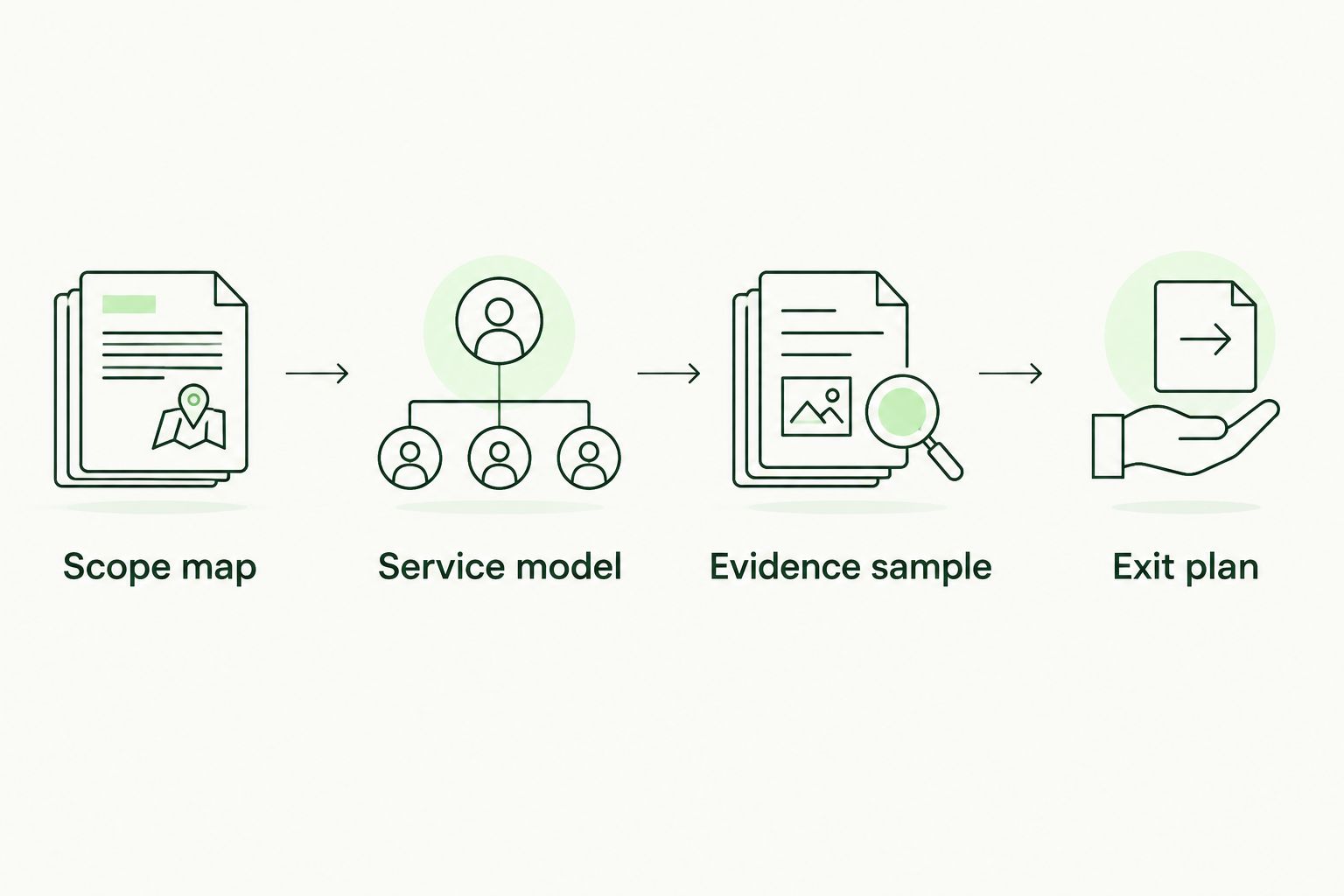
Agree on the replacement boundary before committing to a migration.
Compare the work, not just the license model
For your 2026 business case, separate the vendor agreement from the work your team performs. Flat-fee software and profitable service delivery are related decisions, but they are not interchangeable.
Use 2 named owners in the evaluation: a commercial owner and a service owner. The commercial owner checks the agreement against your package; the service owner checks whether your team can deliver what that package promises.
| Work item | Question to resolve before signing |
|---|---|
| Onboarding | Who gathers the client information and verifies the initial population? |
| Changes | Who handles joiners, departures, and corrections? |
| Follow-up | Who contacts employees or client managers about incomplete training? |
| Evidence | Who prepares the material requested by clients, insurers, or auditors? |
| Support | Which questions go to the MSP, and which go to the vendor? |
Require a practical answer for every row. Do not credit a platform with removing work until the relevant workflow has been demonstrated.
When staying with Cofense is the right call
Stay with Cofense when phishing threat detection and response remain central requirements and your existing arrangement meets them. A different training commercial model does not establish that your operational security tools should change.
Staying is also the right call when you have not mapped the replacement boundary. Resolve the scope first, then decide whether you need a training change, a broader security change, or neither.
For 2026, the strongest decision is a precise one: replace the requirement that is not being met, not every adjacent tool. That applies equally to an MSP standardizing its training service and an internal team reviewing its awareness program.
FAQ
What's the best Cofense alternative for MSPs?
Defend Wise is the best fit on this shortlist for MSPs seeking flat-fee, white-label security awareness training with unlimited seats. Treat it as a training-service choice, not an assumed replacement for Cofense's broader phishing-defense functions.
Is KnowBe4 better than Cofense?
KnowBe4 is the more relevant evaluation path when security awareness training is the primary requirement; Cofense remains relevant when phishing threat detection and response drive the purchase. Compare the specific scope you need rather than declaring a universal winner.
Can a security awareness platform replace phishing threat detection?
Security awareness training does not replace phishing threat detection. If you change training platforms, assign responsibility for the operational security controls that remain outside the training scope.
Should an MSP choose flat-fee or per-seat training?
Choose the commercial model that fits your client service and actual agreement. A flat-fee, unlimited-seat model removes seat-based licensing from that training purchase, but your internal delivery work still needs to be accounted for.
What should I ask vendors to demonstrate before switching?
Ask vendors to demonstrate your training delivery, administration, and evidence workflow using a representative client scenario. For an MSP, include branding and client-management requirements in the acceptance criteria.
What records should I review before leaving a training platform?
Review enrollment, completion, and exception records against your retention and client obligations. Confirm what you can retain and how you will retrieve it before ending the existing arrangement.
When should I stay with Cofense instead of switching?
Stay with Cofense when its phishing-defense scope matches your requirements and the existing arrangement meets them. A training-platform comparison alone is not a reason to replace a working threat-response process.
One last thing
Before requesting another demo, write this sentence: We are replacing this responsibility, while this owner retains everything outside it. Fill in both parts with named responsibilities and owners.
That sentence prevents a training purchase from becoming an accidental security downgrade. It also gives every vendor the same problem to solve.