Adaptive Security alternatives in 2026
Compare Adaptive Security alternatives for MSPs. Choose flat-fee, white-label training or an internal program using clear workflow and evidence checks.
DefendWise
DefendWise
Adaptive Security puts security awareness training at the center of employee risk reduction, but your MSP also needs a service model that works across end-client organizations. The best Adaptive Security alternative in 2026 is Defend Wise if you need flat-fee, white-label security awareness training; an internally managed training program fits teams that need direct ownership of delivery and administration.
TL;DR
- For MSPs comparing adaptive security alternatives, Defend Wise fits flat-fee, white-label security awareness training.
- An internally managed training program fits teams prepared to own content, delivery, and records.
- Compare service economics, client branding, and evidence requirements before choosing a replacement.
- Approve a switch only after a representative client pilot meets your written acceptance criteria.
Why this matters
An enterprise security team buys training for its employees. An MSP buys a platform to support a service delivered to multiple client organizations. Those are different purchasing decisions.
Your comparison needs to address who owns the client relationship, how training fits your service package, and what work remains with your technicians. A feature list does not answer those questions.
For your 2026 shortlist, separate the buying decision into two parts: the training requirement and the delivery model. Reject any option that satisfies one while creating unacceptable work in the other.
Adaptive Security alternatives at a glance
This comparison separates the incumbent platform, an MSP-focused replacement, and an internal delivery model. The last option is not another software vendor. It is a different way to run the program.
| Option | Best for | Defining characteristic | Difference from retaining Adaptive Security |
|---|---|---|---|
| Adaptive Security | Buyers whose existing deployment meets their written requirements | Incumbent platform against which to benchmark replacements | Retains the current platform; assess whether a change solves a documented problem |
| Defend Wise | MSPs seeking flat-fee, white-label security awareness training | Flat-fee model with unlimited seats and white-label training | Offers an MSP-focused replacement built around those commercial and branding requirements |
| Internally managed training program | Teams that want direct ownership and can assign an accountable program owner | Your team selects materials, delivers training, and maintains records | Replaces a vendor-led platform approach with an internally operated process |
Do not rank alternatives by how many features appear on a comparison page. Rank them by whether they meet your service requirements. Keep the incumbent in that exercise so that switching has to earn approval.
1. Defend Wise: best for MSP-branded training services
Defend Wise security awareness training is a flat-fee, white-label offering for MSPs serving end-client organizations. Its unlimited-seat model addresses a specific purchasing requirement: training coverage without a per-user commercial model.
That is the reason to shortlist it. Your business needs to package training under your own brand, rather than purchase another standalone service that sits outside your client relationship.
Where Defend Wise shines
- Flat-fee structure: A defined alternative when per-seat purchasing conflicts with how you want to package training.
- Unlimited seats: A fit when you want seat coverage to be part of the platform model rather than a separate purchasing decision for every user.
- White-label delivery: Supports an MSP-branded training offer for end-client organizations.
- MSP focus: Matches the buyer responsible for delivering training as a client service, not only running an internal employee program.
Where Defend Wise falls short
- It is not an in-house program: You are choosing a vendor platform rather than owning the entire delivery system.
- It does not replace service design: Your MSP still needs to define responsibilities, client communication, and escalation rules.
- Its positioning is specific: A buyer seeking an internal program rather than an MSP-branded service has a different primary requirement.
A flat fee answers a commercial question. It does not, by itself, prove that your onboarding, reporting, or evidence requirements are met. Put those requirements through a demonstration before approving a rollout.
Head-to-head: what to establish before switching
| Decision area | Defend Wise | Adaptive Security evaluation |
|---|---|---|
| Purchasing model | Flat fee with unlimited seats | Compare the current agreement against your required purchasing structure |
| Service branding | White-label security awareness training | Demonstrate whether the current client experience meets your branding requirements |
| Intended buyer | MSPs training end-client organizations | Assess fit against your actual client-service workflow |
| Acceptance decision | Validate the proposed replacement with a pilot | Retain as the benchmark throughout the pilot |
These are decision criteria, not claims that the incumbent lacks a particular capability. Require both sides of the comparison to satisfy the same written brief.
Best for: MSPs that want flat-fee, white-label security awareness training as part of their client service.
Verdict: Buy only after the client workflow passes your acceptance test.
2. Internally managed training: best for direct program ownership
An internally managed training program puts your team in charge of selecting materials, scheduling delivery, following up with employees, and retaining records. You can use it as an alternative operating model when buying another platform does not solve your main problem.
Ownership is the advantage. Ownership is also the workload.
Where an internal program shines
- Direct control: Your team chooses the training scope and delivery process.
- Business-specific instruction: You can teach the procedures employees actually follow, including verification and reporting responsibilities.
- Clear accountability: A named internal owner can connect training decisions to internal policies and operational needs.
Where an internal program falls short
- Administration stays with you: Someone must handle assignments, reminders, records, and follow-up.
- Consistency needs a process: Different managers need shared instructions if employees are to receive the same required training.
- Continuity needs a backup: The program must remain operable when its owner is unavailable or leaves.
| Decision area | Internally managed program | Retaining Adaptive Security |
|---|---|---|
| Delivery ownership | Your team owns the process | Continue using the incumbent platform within your operating process |
| Material selection | Your team selects and maintains materials | Assess the current platform against your required subject coverage |
| Recordkeeping | Your team defines and maintains the record system | Test the current evidence workflow against the same requirements |
Best for: Organizations willing to assign an owner, a backup, and recurring administrative time to training.
Verdict: Hold until staffing and recordkeeping responsibilities are assigned.
Why people switch from Adaptive Security
A defensible switch starts with a documented mismatch, not a claim that every competing platform is better. For MSPs, the reasons to evaluate a replacement concern the service model as much as the training itself.
Use these as qualification questions. They are not claims about Adaptive Security's contracts, capabilities, or performance.
The purchasing model does not match the service package
If your MSP wants to include every covered user within a flat-fee training service, make that requirement explicit. Compare written commercial terms rather than assuming that a platform's headline positioning answers the question.
Keep the platform agreement separate from your own client agreement. Your clients still need to understand what your service includes and which responsibilities remain theirs.
Your brand needs to own the client experience
White-label delivery matters when training is part of your MSP's service, rather than a vendor relationship introduced separately to each client. Define the required experience before evaluating replacements.
Specify which employee-facing and client-facing touchpoints must carry your identity. Then request a demonstration of those touchpoints. Do not treat the phrase white-label as a substitute for that review.
The operating process no longer fits
Write down the task that causes the problem: enrolling a client, handling a staff change, answering a training question, or preparing evidence. A replacement should address that task directly.
For a 2026 switch, require a before-and-after workflow. If the proposed process leaves the same manual work with your team, the business case needs more than a different vendor name.
How to evaluate an alternative without guessing
Use one acceptance brief for every option. This prevents the incumbent from being judged on daily frustrations while a replacement is judged only on a polished demonstration.
Start with four checks: Commercial fit, Client branding, Admin workflow, and Evidence handoff. Assign an owner to each check and define what a passing result looks like.
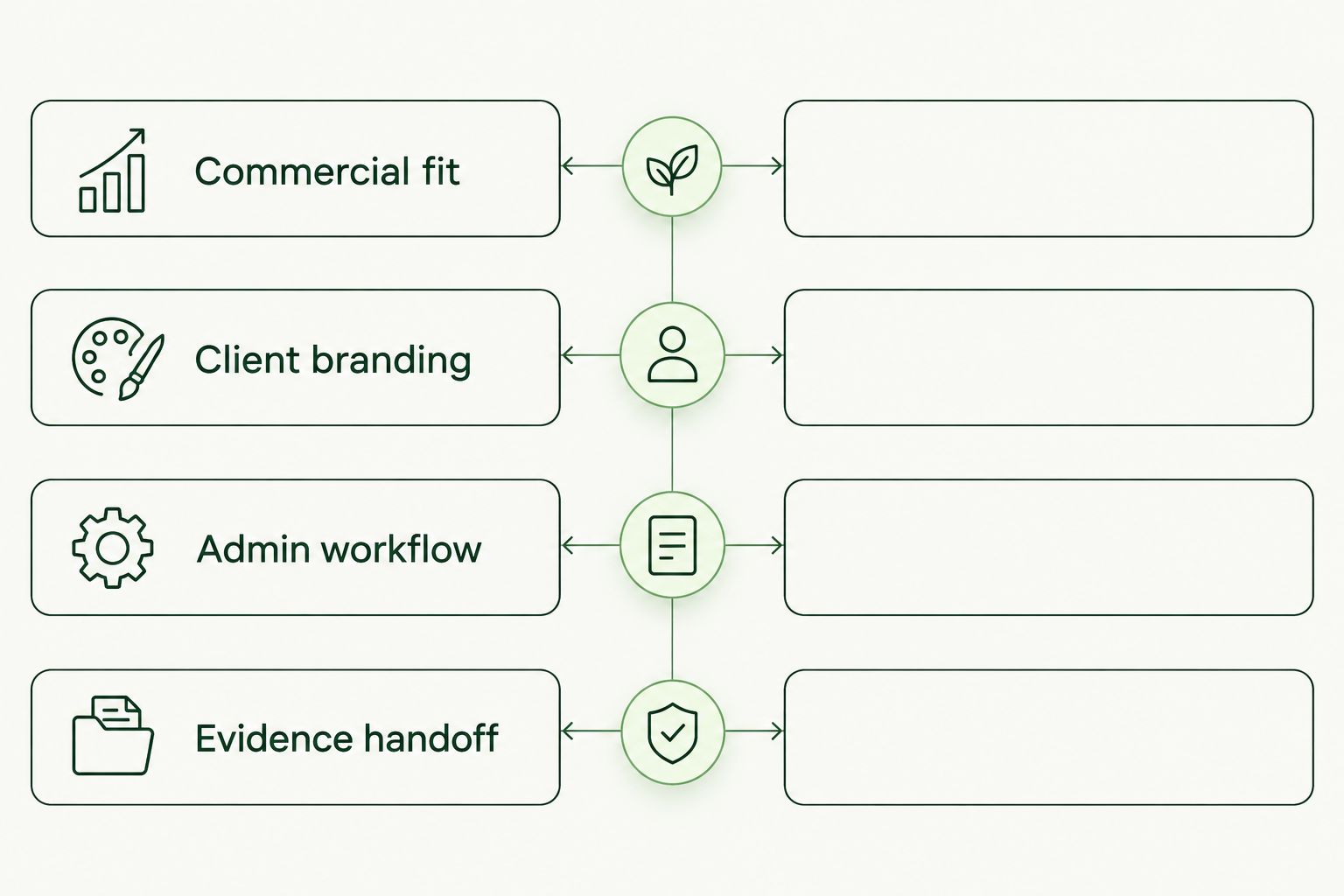
Evaluate the current platform and its replacement against the same acceptance brief.
Commercial fit
Request terms that explain how your intended deployment is covered. Identify the responsibilities that remain outside the platform agreement, including your own onboarding and support work.
Build your service package around those responsibilities. The guide to security awareness training for MSPs to resell provides a related starting point for that packaging decision.
Client branding
List the touchpoints that matter to your service: invitations, employee access, training communications, and client-facing outputs. Ask the vendor to show your required journey rather than a generic account.
Record which requirements are essential and which are preferences. That distinction keeps a minor presentation issue from outweighing a genuine delivery problem.
Admin workflow
Walk through a new client, a new employee, an employee departure, and a client administrator change. Ask who performs each action and what confirmation they receive.
Do not assume that a vendor handles a task because the task appears in its demonstration. Distinguish the platform action from the work your MSP performs before and afterward.
Evidence handoff
Define the training record your client needs before reviewing reporting screens. Include the identity of the learner, the assigned training, completion status, and the relevant dates in your acceptance criteria.
Ask the client's responsible contact to review the proposed output. A record that your team understands still needs to serve the recipient's actual review process.
Run a bounded pilot before your 2026 rollout
Use 3 client organizations in a 30-day pilot as a practical starting scope, not a claimed industry benchmark. Choose clients with different administrative needs so the exercise tests more than your easiest account.
Give the pilot a written pass-or-fail brief:
- Coverage: Can your team include the intended learners under the proposed agreement?
- Branding: Does the demonstrated experience meet your required client-facing presentation?
- Administration: Can the responsible staff complete the agreed routine tasks?
- Evidence: Can the client recipient interpret and use the required training records?
- Ownership: Does every exception have an assigned owner?
Record observations as they happen. Distinguish a configuration problem from a missing requirement, and distinguish both from a process your own team has not defined.
Schedule a 90-day review after rollout to revisit the assumptions behind approval. Treat that review as an operating check, not a reason to postpone fixing problems found during the pilot.
When staying with Adaptive Security is the right call
Stay with Adaptive Security when your current deployment meets the training requirement, supports your operating process, and gives clients usable records. A replacement needs to improve a documented requirement enough to justify the transition work.
Retain the incumbent if your shortlist has not passed the same acceptance criteria. A compelling commercial model is a reason to investigate, not a reason to skip validation.
For 2026 procurement, the honest comparison is current performance against demonstrated replacement performance. Do not compare a real deployment's exceptions with an alternative's promises.
FAQ
What's the best Adaptive Security alternative for MSPs?
Defend Wise is the best-fit alternative for MSPs whose priority is flat-fee, white-label security awareness training with unlimited seats. Validate the client workflow and evidence requirements before committing to a switch.
Should an MSP replace Adaptive Security just to get a different purchasing model?
A different purchasing model justifies an evaluation, not an automatic replacement. Compare the proposed agreement alongside administration, client branding, and training-record requirements.
Is an internally managed training program a real alternative?
An internally managed program is an alternative when your team can own materials, delivery, follow-up, and records. Assign a program owner and a backup before treating it as an operational option.
What should I ask during a security awareness training demonstration?
Ask the vendor to demonstrate your client onboarding, employee changes, branding requirements, and evidence handoff. Use the same written acceptance brief for the incumbent and each replacement.
How long should an MSP pilot a replacement training platform?
Use a 30-day pilot as a starting plan, with explicit acceptance criteria and representative clients. Extend the exercise if required workflows have not been demonstrated; elapsed time alone is not approval.
When should I stay with Adaptive Security?
Stay with Adaptive Security when the existing deployment meets your requirements and a replacement has not demonstrated a meaningful improvement. Keep the incumbent as the benchmark throughout your evaluation.
One last thing
Ask the person who receives the training records to approve the proposed evidence handoff before you approve the platform. That conversation connects the purchase to the client's actual need, rather than the appearance of a reporting dashboard.
Choose the service model first. Approve the platform only after it demonstrates that model.