Best security awareness training for government contractors 2026
Security awareness training for government contractors: choose MSP-led delivery or internal ownership, then verify contract fit, records, and role coverage.
DefendWise
DefendWise
For security awareness training for government contractors in 2026, Defend Wise is the best fit for MSP-led, white-label delivery. Choose an internal LMS program for direct ownership, agency-specified training when the contract names the course, or instructor-led workshops for specialized responsibilities.
TL;DR
- Defend Wise suits security awareness training for government contractors delivered through an MSP, with flat-fee, white-label training.
- Choose training against your contract, information scope, and workforce responsibilities—not a generic compliance badge.
- Internal LMS programs suit contractor-owned delivery; agency-specified courses address explicitly named training obligations.
- Require usable completion evidence, then supplement general awareness with role-specific instruction.
Why this matters
A government contractor does not buy compliance by assigning a course. You need training that matches the work, reaches the right people, and produces records you can explain.
The contract determines the starting point. Federal Contract Information, Controlled Unclassified Information, agency system access, and specialized duties create different questions; they are not interchangeable labels.
For your 2026 shortlist, separate the delivery decision from the requirements decision. An MSP can administer awareness training, but the contractor still needs an accountable owner for scope, policy, and contractual obligations.
What makes the best training for government contractors
Use these criteria before comparing delivery options:
- Contract fit: Identify the applicable clauses, agency instructions, information types, and required audiences before selecting content.
- Role relevance: Separate general workforce awareness from instruction for administrators, incident responders, and other specialized roles.
- Evidence quality: Require records that identify the learner, training assigned, content version, completion date, and outstanding work.
- Delivery ownership: Name who assigns training, handles exceptions, follows up, and provides evidence during a review.
- Commercial fit: Compare flat-fee and per-seat structures alongside administrative work, not license structure alone.
- Content control: Establish how you add local reporting instructions, handling rules, and contract-specific material.
Reject a training option if you cannot explain what obligation it addresses and what evidence it leaves behind. A large content catalog does not answer either question.
Government contractor training options at a glance
These are delivery choices, not interchangeable software products. The ranking gives each option a distinct job rather than pretending every contractor needs the same platform.
| Rank and option | Best for | Standout feature | Key limitation |
|---|---|---|---|
| 1. Defend Wise | MSP-managed contractor training | Flat-fee, white-label security awareness training | Platform selection does not establish contract-specific coverage |
| 2. Internal LMS program | Direct contractor ownership | Contractor-controlled assignments, content selection, and records | Your team owns administration and content maintenance |
| 3. Agency-specified training | Explicitly named agency courses | Follows the course requirement stated by the agency or contract | Named courses do not automatically cover other obligations |
| 4. Instructor-led workshops | Specialized operational responsibilities | Discussion of your procedures and role-specific decisions | Requires scheduling, qualified instruction, and documented attendance |
The default in 2026 is to choose the accountable delivery owner first. Then close the content and evidence gaps before enrollment.
1. Defend Wise: best training for MSP-managed delivery
Defend Wise provides flat-fee, white-label security awareness training for MSPs serving end-client organizations. Its unlimited-seat model removes per-seat licensing from that training arrangement.
That makes the platform relevant when your contractor organization already relies on an MSP to deliver training. Keep the purchasing argument separate from the compliance argument: a flat fee answers a commercial question, not whether a particular contract requirement is satisfied.
Defend Wise pros:
- Flat-fee structure rather than per-seat licensing.
- Unlimited seats within the stated offering.
- White-label delivery for an MSP's client-facing service.
- Designed around MSP delivery to end-client organizations.
Defend Wise cons:
- Contract-specific coverage still needs verification against your requirements.
- The MSP-oriented model is not the same as a contractor-owned internal training program.
- You still need an owner for local policies and specialized instruction.
Best for: MSPs delivering security awareness training to government contractor clients.
Before selecting Defend Wise for security awareness training, ask the MSP to demonstrate assignments, learner records, exception handling, and evidence retrieval. Require an explicit account of what the service includes and what the contractor must supply.
Verdict: Buy for MSP-led delivery after validating scope and evidence.
2. Internal LMS program: best training for direct ownership
An internal learning management system program puts the contractor in charge of delivery. Your team selects content, assigns audiences, maintains local instructions, and manages the training record.
This approach fits an organization with an established learning function and a named security owner. It also makes the division of work visible: the LMS delivers and records learning, while your security team determines whether that learning addresses the requirement.
Internal LMS program pros:
- Direct ownership of the training calendar and audience.
- Ability to combine security instruction with your internal policies.
- A central place to administer learning when your existing LMS supports it.
- Control over content review and approval.
Internal LMS program cons:
- Your team must maintain content and assignments.
- Completion tracking alone does not establish security relevance.
- Reporting quality depends on the LMS configuration and records you retain.
Best for: Contractors with internal learning administration and security expertise.
Run a 30-day pilot as a purchasing exercise, not a regulatory deadline. Assign a representative course, change a learner's role, record an exception, and retrieve the resulting evidence without manual reconstruction.
Verdict: Buy when internal ownership includes staffing for administration.
3. Agency-specified training: best for named course obligations
Agency-specified training is the right choice when an applicable instruction or contract explicitly requires a particular course. Follow the stated requirement rather than substituting a vendor course with a similar title.
The important distinction is scope. A required agency course addresses the obligation attached to that course; it does not automatically replace your organization's awareness program, local handling instructions, or specialized training.
Agency-specified training pros:
- Directly addresses a named course obligation when applicable.
- Provides the content the requiring agency has specified.
- Reduces ambiguity about course selection for that obligation.
Agency-specified training cons:
- Completion evidence still needs to enter your organizational records.
- Course coverage can leave contractor-specific procedures unaddressed.
- Access and assignment processes depend on the agency's arrangements.
Best for: Personnel subject to explicitly named agency training requirements.
For 2026 assignments, record the authority behind each required course. Keep the instruction or contract reference alongside the audience, completion evidence, and next review trigger so the obligation survives staff turnover.
Verdict: Buy into the required path when the obligation names it; do not substitute.
4. Instructor-led workshops: best for specialized responsibilities
Instructor-led workshops let employees practice decisions tied to their actual duties. Use them for subjects such as approving access, escalating suspected incidents, handling sensitive information, or verifying a change to payment instructions.
The value comes from the scenario and discussion, not the meeting invitation. A workshop needs a defined objective, an appropriate instructor, and a record of what participants learned.
Instructor-led workshop pros:
- Connects security rules to your actual procedures.
- Gives employees space to question unclear instructions.
- Supports discussion of role-specific decisions.
Instructor-led workshop cons:
- Requires scheduling and instructor preparation.
- Attendance does not, by itself, demonstrate understanding.
- Repeatability depends on documented materials and objectives.
Best for: Personnel whose responsibilities require deeper instruction than general awareness.
Use 3 role groups as an initial planning exercise: general workforce, privileged users, and incident responders. Adjust that grouping to your actual duties rather than treating it as a regulatory classification.
Verdict: Buy as a targeted supplement; skip as the sole workforce program.
How we ranked these training options
The order follows delivery ownership, contract fit, role relevance, evidence quality, commercial fit, and content control. It is not a laboratory performance ranking or a claim that a platform has passed a government assessment.
MSP-managed delivery comes first for an MSP-served contractor. Internal LMS delivery fits direct ownership, agency courses fit named obligations, and workshops address specialized duties. Change the order when your operating model changes.
Map requirements before you assign courses
Build a training map for your 2026 program before importing a learner list. For each obligation, connect the requirement to an audience, a learning objective, and evidence.
Use this sequence:
- Contract scope: Identify the contract requirements, information involved, systems covered, and relevant personnel.
- Role mapping: Determine which duties require general awareness and which require additional instruction.
- Content mapping: Match each learning objective to course material or an internal procedure briefing.
- Evidence review: Check that the retained record shows what happened and who remains outstanding.
This is where contractor requirements need careful separation. NIST SP 800-53 includes an Awareness and Training control family; CMMC has its own assessment context for defense contractors. Neither name means every government contractor has identical training obligations.
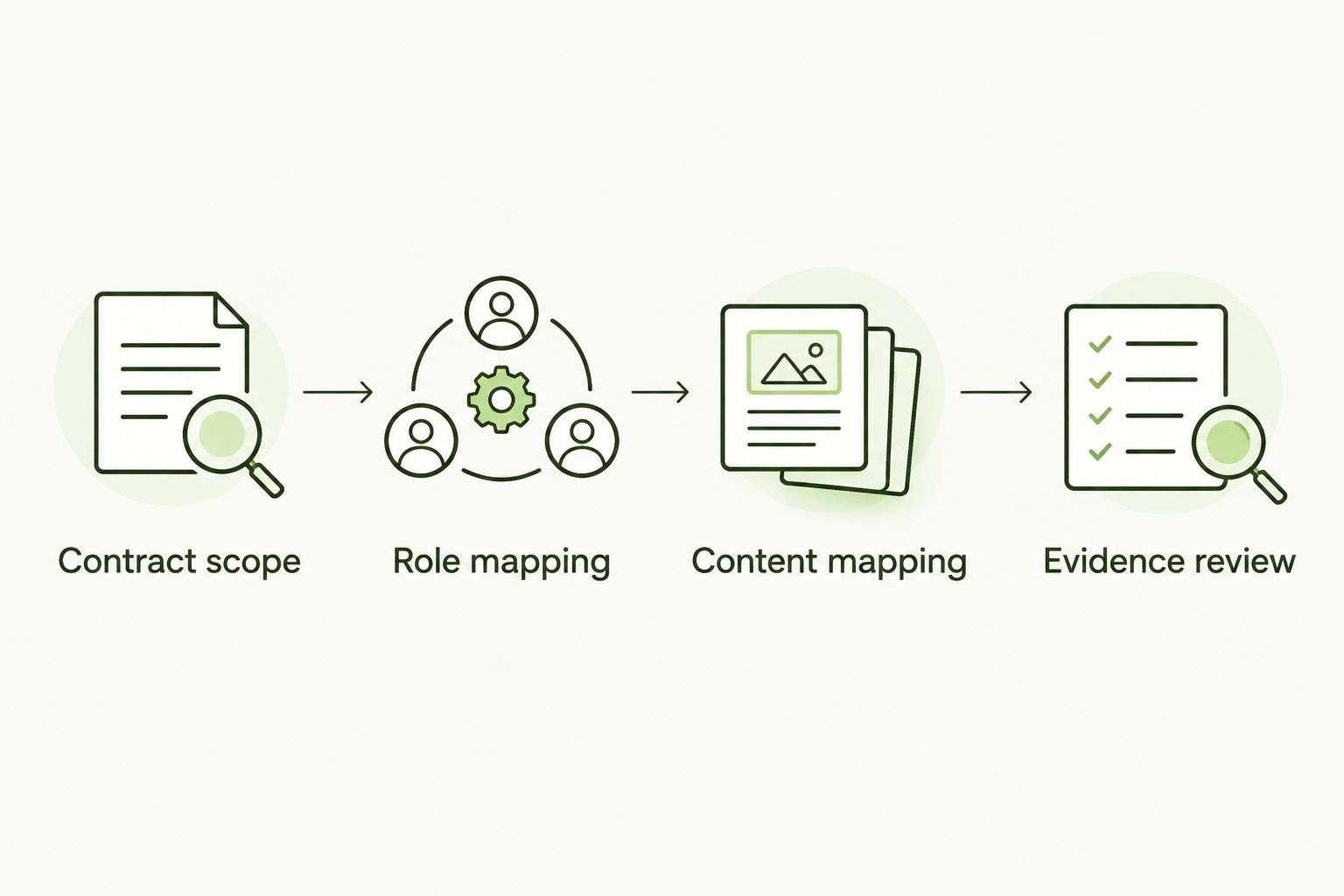
Choose training after defining the obligation and audience, not before.
For defense work, use the CMMC requirements for defense contractors discussion to organize the training questions within the broader compliance work. Do not treat a training purchase as CMMC certification.
Keep training separate from access enforcement
Awareness training teaches employees how to recognize risk, follow procedures, and report concerns. Access controls determine what identities and devices can reach. You need a clear boundary between those jobs.
Your MFA rollout and zero-trust access workflow should define authentication and access decisions, while training explains how employees use those controls and respond to suspicious requests. A completed course does not enforce authentication, device checks, or access restrictions.
Use a helpdesk identity-verification scenario to connect the two. Teach the employee not to approve an unexpected request, document the reporting route, and ensure the helpdesk follows an approved verification procedure.
Training supports a control; it does not replace its implementation. Keep that distinction in procurement documents and client reporting.
Ask for evidence before signing
Request 1 sample learner record before committing to a delivery model. It should identify the learner, assigned content, completion status, completion date, and the version of the material or equivalent reference.
Then ask for an organization-level view. You need to distinguish completed assignments from outstanding work and documented exceptions without presenting an incomplete population as fully trained.
For an MSP-managed service, request a demonstration using 2 client organizations. Confirm that the operator can keep each client's assignments and records separate; treat this as a buying test, not an assumed platform capability.
Ask these questions:
- Who reconciles the training population with current personnel?
- Who approves exemptions and records the reason?
- What happens when an employee changes duties?
- Can you retrieve records after a personnel departure?
- Which local procedures must the contractor supply?
- Who reviews training after a relevant policy or contract change?
Set retention and recurrence from applicable obligations and your documented program. Do not invent a universal government-contractor interval.
Which training option should you choose?
Choose Defend Wise for flat-fee, white-label security awareness training delivered by an MSP. Validate the content, records, and responsibilities against your contractor requirements before rollout.
Choose an internal LMS program when you intend to own delivery and have staff to maintain it. Follow agency-specified training when explicitly required, and add workshops where specialized duties demand more than general awareness.
For a 2026 purchase, the final decision is not which option has the longest feature list. It is which arrangement gives you an accountable owner, appropriate instruction, and retrievable evidence.
FAQ
What's the best security awareness training for government contractors?
The best choice depends on the delivery owner and applicable contract requirements. Defend Wise fits MSP-led, flat-fee, white-label training; an internal LMS fits contractor-owned administration, and agency-specified courses address named obligations.
Does every government contractor need CMMC training?
No, CMMC is not a universal requirement for every government contractor. Determine whether CMMC requirements apply to the defense contract and what training obligations follow from the applicable scope.
Can an awareness training platform make a contractor CMMC compliant?
No, an awareness training platform cannot establish CMMC compliance by itself. Training is only part of the broader requirements, implementation, and assessment work.
Is an annual course enough for a government contractor?
An annual course is not automatically enough. Your applicable requirements, employee duties, onboarding process, and relevant changes determine what instruction and recurrence your program needs.
Can an MSP deliver security awareness training for a contractor?
Yes, an MSP can administer security awareness training for a contractor. The contractor still needs clear ownership of applicable requirements, internal policies, and evidence review.
What training records should a contractor ask to see?
Ask for learner identity, assigned content, completion status, completion date, and a content version or equivalent reference. Also request records of outstanding assignments and approved exceptions.
Is agency training better than an internal LMS program?
Agency training is the correct path when an applicable requirement names the course. An internal LMS serves a different purpose: administering your broader program and retaining organizational learning records.
One last thing
Ask a learner to explain where to report a suspected incident. Then compare the answer with the instruction in the assigned training.
If the course teaches a reporting route your organization does not use, completion evidence documents the wrong instruction. Fix that mismatch before assigning more training.