Best security awareness training for credit unions 2026
Security awareness training for credit unions: choose an MSP platform, an internal LMS, or role-based workshops based on ownership and evidence needs.
DefendWise
DefendWise
Best overall: a blended program with a named owner. Best for MSP delivery: Defend Wise. Best for existing learning infrastructure: an internal LMS program. This 2026 guide compares security awareness training for credit unions by delivery model, accountability, and evidence—not course counts.
TL;DR
- Defend Wise security awareness training fits MSPs that need flat-fee, white-label delivery for credit union clients.
- Choose security awareness training for credit unions around ownership, role relevance, and retrievable compliance evidence.
- An internal LMS suits credit unions with established learning administration; workshops suit department-specific coaching.
- A blended program is the default when you need consistent coverage plus practice applying local procedures.
Why this matters
A training platform does not decide who approves a payment exception, verifies a member request, or escalates a suspected account takeover. Your credit union must teach those decisions. Generic lessons provide background; local procedures turn that background into action.
NCUA's information security guidelines in 12 CFR Part 748, Appendix A, Section III.C.2 address staff training to implement the information security program. That makes training part of an operating program, not a standalone completion exercise. Buying software does not establish compliance by itself.
For your 2026 selection, connect the purchase to actual responsibilities and review expectations. The guide to FFIEC training requirements for credit unions provides a related starting point; confirm the requirements applicable to your charter and activities with your compliance lead.
What makes the best security awareness training for credit unions?
Use these criteria before comparing delivery models:
- Clear ownership: Name who assigns training, handles overdue work, approves exceptions, and supplies evidence. Outsourcing delivery does not remove internal accountability.
- Role relevance: Require examples that match member service, lending, payments, IT support, and leadership responsibilities. A shared foundation is useful; identical instruction for every job is not enough.
- Evidence quality: Ask to see assignment dates, completion records, course versions, and exception handling. Confirm which records the proposed service actually provides.
- Administrative fit: Follow a new hire, transfer, and departure through the proposed workflow. Separate demonstrated functions from manual work your team will own.
- Economic fit: Compare the licensing model with the labor needed to operate it. Seat-count friction and report preparation belong in the decision, even without a quoted total here.
- Local procedures: Require a practical way to teach your reporting route, verification rules, and escalation contacts. Do not assume a vendor's standard content contains them.
Reject any option that leaves ownership unresolved. A larger content library does not repair an unassigned follow-up task.
Security awareness training options at a glance
These are delivery choices, not interchangeable software products. Table order matches the detailed recommendations below.
| Option | Best for | Standout feature | Key limitation |
|---|---|---|---|
| Defend Wise | MSPs serving credit union clients | Flat-fee, white-label security awareness training with unlimited seats | The credit union still needs an accountable internal owner |
| Internal LMS program | Credit unions with established learning administration | Training follows your existing assignment and recordkeeping process | Your team owns content selection and maintenance |
| Instructor-led workshops | Departments needing procedure-specific coaching | Staff can discuss decisions and practice local escalation | Attendance alone does not demonstrate understanding |
| Blended program | Credit unions needing baseline coverage and practical reinforcement | Combines assigned learning with role-based discussion | Requires coordination across training, security, and department owners |
1. Defend Wise: best security awareness training for MSP delivery
Defend Wise provides flat-fee, white-label security awareness training for MSPs, with unlimited seats. The model fits an MSP that wants to deliver training under its own brand across end-client organizations. For a credit union, the buying decision includes the MSP's service responsibilities—not just access to software.
Defend Wise security awareness training is best for MSPs delivering white-label training to credit union clients. The flat-fee model removes per-seat licensing calculations from that platform choice. It does not remove the need to scope onboarding, employee follow-up, or compliance support.
Defend Wise pros:
- White-label delivery fits an MSP-branded service.
- Unlimited seats avoid a platform licensing model tied to each additional learner.
- Flat-fee licensing gives the MSP a defined platform cost structure.
Defend Wise cons:
- The MSP-focused model requires agreement on responsibilities between provider and credit union.
- A platform subscription does not replace institution-specific procedures or compliance judgment.
Best for: MSPs standardizing security awareness training across credit union clients.
Before signing, request a walkthrough using a fictional credit union. Ask the MSP to demonstrate enrollment, overdue follow-up, record retrieval, and offboarding, identifying every manual step. Treat each item as a purchasing requirement until demonstrated, not an assumed platform capability.
For the 2026 service agreement, separate platform access from managed work. State who maintains the learner roster, answers employee questions, and responds to an evidence request. Verdict: Buy for MSP-led delivery after the service responsibilities are documented.
2. Internal LMS program: best for existing learning administration
An internal learning management system program puts security awareness into the learning process your credit union already operates. You select the material, assign it through the LMS, and manage follow-up internally. This is a delivery model, not a claim that every LMS supports every required function.
The strongest fit is an institution with a named learning administrator and a security owner who can review content. Existing infrastructure alone is not enough. Someone must decide whether lessons remain accurate and whether they reflect current procedures.
Internal LMS program pros:
- Uses an established assignment process when your LMS supports the required workflow.
- Gives your team control over content selection and local policy references.
- Allows security learning to sit alongside other employee obligations.
Internal LMS program cons:
- Content review, replacement, and maintenance remain internal work.
- Completion records still need interpretation; finishing a lesson does not prove correct behavior.
Best for: Credit unions with an operational LMS and staff assigned to maintain security learning.
Use a proposed 30-day pilot to test administration before expanding the program. Include a new hire, an employee changing roles, and an employee needing an exception. The pilot is a workflow check, not a promised implementation timeline.
Ask the administrator to produce the records a reviewer would request without rebuilding them in a spreadsheet. If the process depends on one person's memory, fix that dependency before rollout. Verdict: Buy into this model when you already own the administration capacity.
3. Instructor-led workshops: best for department-specific coaching
Instructor-led workshops teach employees through discussion of realistic work decisions. Your facilitator can connect a suspicious request to the credit union's actual verification and escalation procedures. That makes workshops useful when the problem is applying a rule, rather than remembering a definition.
Keep the exercise specific. A payments team can discuss an urgent beneficiary-change request; a member-service team can work through a caller seeking an account-access exception. Use fictional details rather than real member information.
Instructor-led workshop pros:
- Employees can ask questions about ambiguous situations.
- Facilitators can connect lessons directly to local procedures.
- Department managers can hear where instructions are unclear.
Instructor-led workshop cons:
- Scheduling and repeat delivery require coordination.
- An attendance sheet does not show whether each participant understood the decision.
Best for: Departments with a defined workflow risk or a procedure that employees interpret inconsistently.
Start with a proposed 20-minute workshop focused on one decision. Have employees explain what they would verify, which approved channel they would use, and when they would escalate. Short scope keeps the discussion tied to an action your team can assess.
Record the topic, participants, procedure version, and follow-up actions. Do not treat a lively discussion as a substitute for a maintained institution-wide program. Verdict: Buy targeted workshops for procedure coaching; skip them as your only delivery method.
4. Blended program: best overall for accountable coverage
A blended program combines assigned baseline learning with role-specific discussion and documented follow-up. The software component handles the portion your selected system supports; managers and security staff teach the local decisions. Neither side should assume the other owns the gaps.
A blended program is the best default for credit unions that need consistent coverage and practice applying their own procedures. It is a program design, not a single vendor purchase. You can deliver it through an MSP or an internally managed learning process.
Blended program pros:
- Separates common awareness topics from department-specific decisions.
- Combines completion records with documented practical follow-up.
- Gives managers a defined place to explain local procedures.
Blended program cons:
- Requires coordination between administrators and department owners.
- Creates duplicate work if responsibilities and records are not defined upfront.
Best for: Credit unions with an accountable program owner who can coordinate learning and operational reinforcement.
Structure your 2026 program around the following responsibilities. Keep the record for each activity with the person accountable for maintaining it.
| Responsibility | Recommended owner | Record to retain |
|---|---|---|
| Baseline learning | Training administrator | Assigned material and completion status |
| Role practice | Department manager | Scenario, participants, and follow-up |
| Exception review | Program owner | Reason, approval, and revised action |
| Evidence review | Compliance and security leads | Reviewed records and unresolved gaps |
The design works only when these responsibilities connect. Establish how an unresolved question from a workshop becomes a procedure update, rather than disappearing into meeting notes.
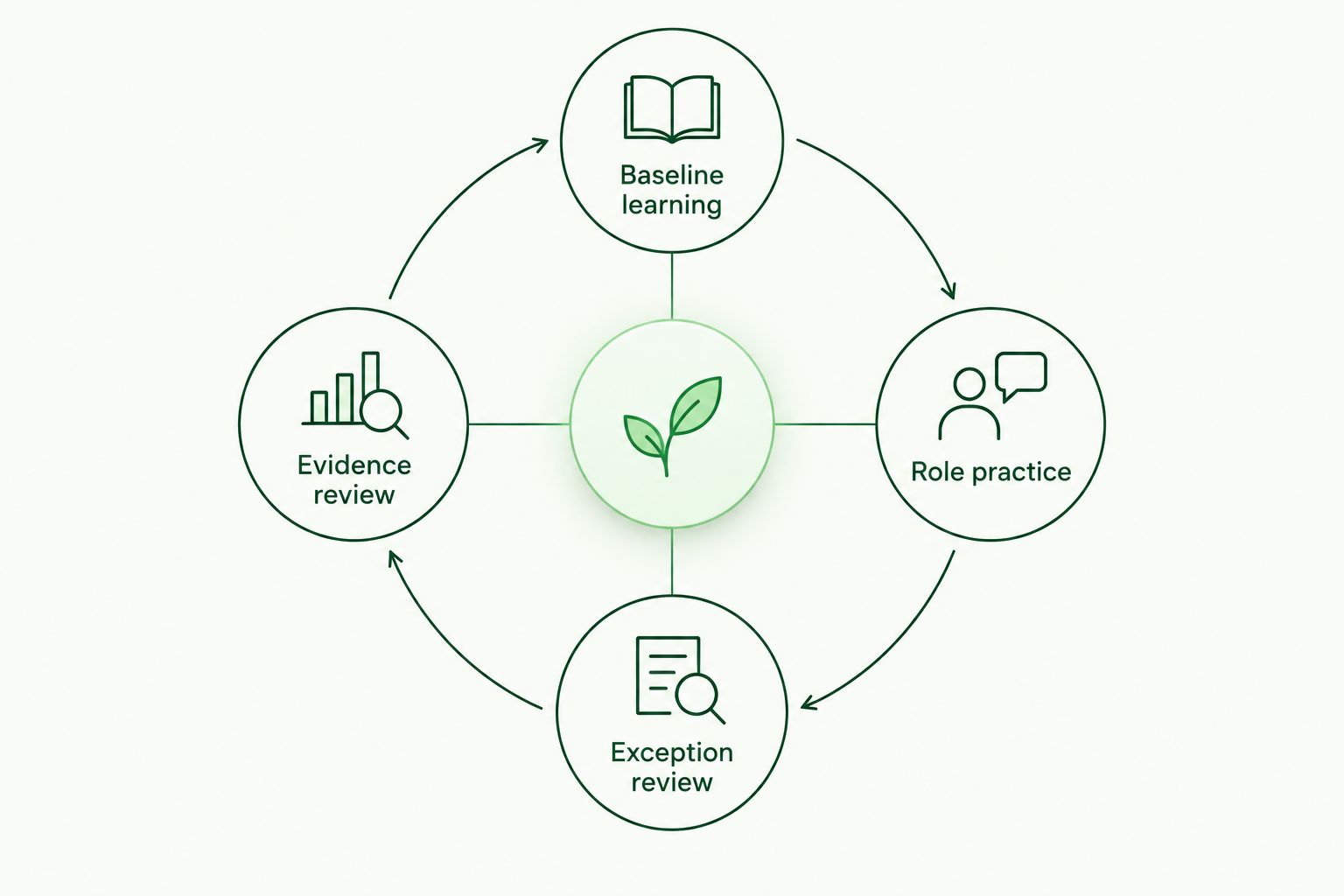
Assign an owner and a retained record to each part of the program.
Use a proposed 90-day review to check whether assignments, local instruction, and exception records agree. This is a management checkpoint, not a regulatory training interval. Verdict: Buy this program design as the default; choose its delivery tools second.
How these options are ranked
The ranking prioritizes ownership, role relevance, evidence, administration, economics, and local procedures. The MSP platform appears first for readers buying through a managed provider; the blended model wins the overall recommendation because it addresses both baseline instruction and local application.
These recommendations compare operating models, not measured vendor performance. No product receives credit for an integration, reporting function, or content feature that has not been established here.
Which option should you choose in 2026?
Choose the owner before the platform. If your MSP will deliver the service, assess the flat-fee, white-label option and document the division of work. If your internal learning team already operates the required process, test the LMS route before adding another system.
Use workshops to address specific procedural gaps. For an undecided credit union, select the blended design: baseline learning, local practice, exception handling, and an evidence review. Then purchase only the tools and services needed to support those responsibilities.
Before approval, request a 15-minute evidence walkthrough. Ask the proposed owner to find a learner's assigned material, completion status, and unresolved follow-up. The duration is a suggested demonstration format—not a vendor performance benchmark.
FAQ
What's the best security awareness training for credit unions in 2026?
A blended program is the best default when a credit union needs baseline instruction plus practice applying local procedures. Choose the platform after naming the program owner and defining the records you need.
Is an MSP-managed program better than running training internally?
An MSP-managed program fits when you want a provider to own defined delivery tasks; an internal program fits when you already have the staff and learning process. Document responsibilities before comparing the options.
Can a credit union use its existing LMS for security awareness training?
Yes, if the LMS and your operating process support the assignments, records, and follow-up you require. Test those workflows and assign someone to maintain the content.
Does buying a training platform make a credit union compliant?
No, a platform purchase does not establish compliance. Your credit union must connect training to its information security program, applicable requirements, and documented responsibilities.
How often should credit union employees receive security awareness training?
Set the schedule from applicable requirements, your risk assessment, and employee responsibilities. Include onboarding and relevant changes rather than assuming one recurring lesson addresses every need.
What records should a credit union request from a training provider?
Request assignment details, completion records, material versions, and documented exceptions or follow-up. Confirm which records the provider supplies and which your credit union must maintain.
Should every credit union employee take identical training?
Employees need a common foundation plus instruction relevant to their responsibilities. Payments, lending, member service, and IT support require different examples and escalation decisions.
One last thing
A perfect completion report can coexist with an unusable reporting procedure. Ask an employee to explain where a suspicious request goes and what to do if the usual contact is unavailable. If the answer is unclear, repair the procedure before assigning another generic lesson.