Zero-Admin Security Awareness Training for MSPs: A Practical Operating Standard
Zero-admin security awareness helps MSPs reduce recurring SAT work while keeping ownership, exceptions, and client decisions visible.
DefendWise
DefendWise
TL;DR
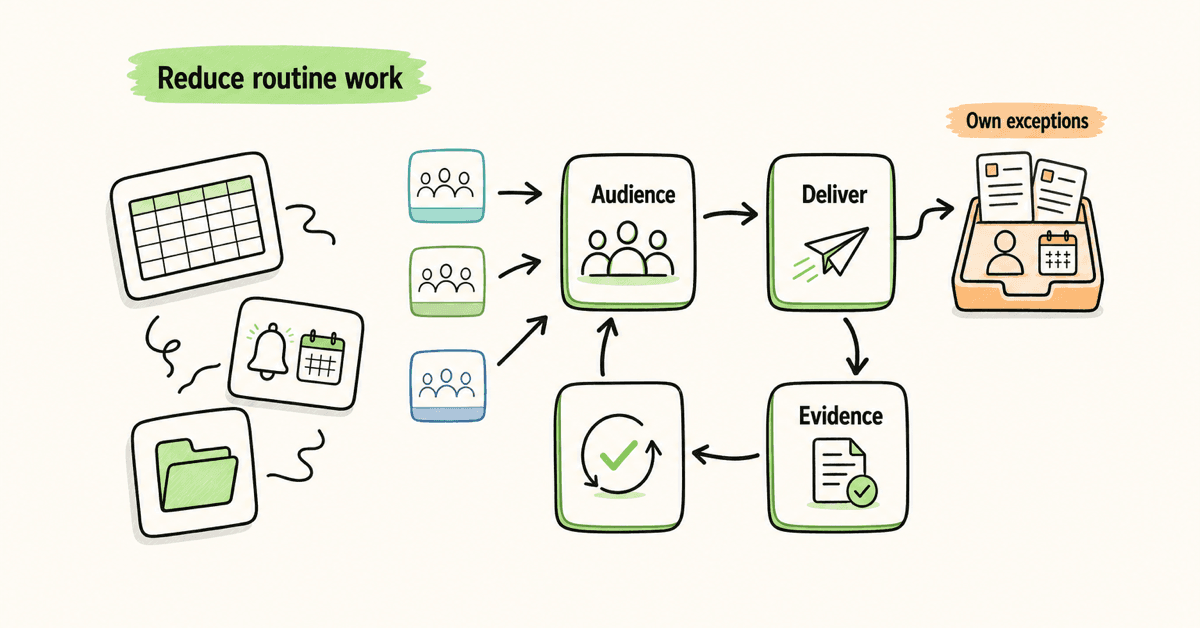
Zero-admin security awareness should mean low recurring effort with clear ownership, not a program that nobody watches. MSPs should expect approved audience data, enrollment, reminders, evidence capture, and standard reports to run without a technician rebuilding each step for each client. The remaining work should appear as a short, visible queue of decisions and exceptions with an owner and due date. Test the claim across a full month and several workforce changes, not a polished 10-minute setup.
What is zero-admin security awareness?
Zero-admin security awareness is an operating model that removes predictable, repetitive work from an MSP's security awareness service. Routine actions run from an agreed baseline. Failures, unusual cases, and client decisions are surfaced to people who can act on them.
The phrase needs a practical definition because “zero admin” can otherwise mean anything from automated reminders to a fully managed service. A better test is simple: which recurring tasks disappear, which decisions remain, and how does the MSP see when the workflow is wrong?
NIST SP 800-50 Rev. 1 describes cybersecurity and privacy learning as a lifecycle. It covers needs, design, development, implementation, assessment, and improvement. That lifecycle still needs ownership even when the delivery mechanics are automated.
For an MSP, zero-admin should reduce work in 4 places:
- maintaining the approved audience;
- delivering the agreed learning cadence;
- collecting consistent service evidence;
- preparing a useful client review.
It should not remove client accountability, technical controls, incident response, or qualified compliance advice. It should also not hide failed syncs, bounced emails, stale recipients, or out-of-scope requests.
A useful definition is:
Zero-admin security awareness minimizes predictable recurring work and turns the remaining work into visible, owned exceptions.
That is different from “set and forget.” A forgotten program can appear quiet because failures have no route into the MSP's queue.
Why this matters for MSPs
Small tasks multiply across clients
A single client may create only a few SAT tasks in a month: add a new starter, remove a leaver, resend an invitation, answer a support question, adjust a report recipient, and review the monthly result. Across 30 clients, those small tasks become a permanent background queue.
The operational problem is not one difficult campaign. It is repeated context switching. A technician has to remember each client's audience source, sender, schedule, exclusions, reporting contact, and escalation rule.
A low-admin model replaces memory with a standard service baseline. It should let the MSP operate the fleet from multi-tenant management while preserving client separation and controlled exceptions.
Client ownership still matters
CISA's Cyber Guidance for Small Businesses separates responsibility across leadership, a security program manager, and IT. The lesson transfers to an MSP relationship: the provider can operate part of the program, but the client still needs a business owner.
That client owner approves who is in scope, supports participation, resolves internal questions, and accepts actions that affect managers or employees. If the service silently transfers every responsibility to the MSP, the workload will return through exceptions and support tickets.
A quiet dashboard can be misleading
No open tickets does not prove the program is healthy. It may mean joiners are not reaching the platform, leavers are still active, reminders are bouncing, reports are going to a former contact, or employees do not know how to report suspicious messages.
CISA tells businesses to train employees to recognize and report phishing, keep them informed between formal training events, and provide a known reporting path in its phishing training guidance. A low-admin service has to maintain that route, not just send content.
Evidence needs context
An automatically generated completion number is useful only when the audience, exclusions, time window, and delivery failures are clear. The report should also state what happens next.
NIST's 2022 study of federal awareness programs, NISTIR 8420A, found that programs commonly used completion and phishing measures while also struggling with resources, engagement, customization, and measurement. It is federal research, not an MSP benchmark. Its value here is the warning: easy-to-produce numbers do not answer every operating question.
The zero-admin standard: 8 tests
Use these tests when designing the service or evaluating a vendor. A claim passes only when the MSP can see the rule, the evidence, and the failure path.
| Test | A credible low-admin model | A hidden-admin warning |
|---|---|---|
| Service baseline | One approved pattern covers routine delivery across clients | Every client starts as a custom project |
| Audience lifecycle | Joiners, movers, and leavers follow a tested source and scope | CSV uploads or technician memory control coverage |
| Client boundaries | Fleet controls preserve tenant-specific data, settings, and reports | Global changes can overwrite client exceptions |
| Failure visibility | Stale syncs, bounces, missing data, and failed reports create owned work | The schedule stays green while outcomes fail |
| Communication | Sender, cadence, support route, and stop conditions are documented | Reminders continue without limits or context |
| Evidence | Reports include scope, period, denominator, exceptions, and provenance | A polished PDF hides missing or stale data |
| Change control | Baseline changes have approval, version, and rollback | A template edit silently changes every client |
| Ownership | MSP and client decisions have named owners and target dates | “The platform handles it” replaces responsibility |
1. Start with a written service baseline
Define the default before connecting a directory or importing a learner. Record the intended audience, learning cadence, sender, reporting path, reminder policy, report recipient, exception owner, client review frequency, and material exclusions.
The baseline is not a detailed legal document. It is a shared operating record. Sales can describe the service accurately, operations can deliver it consistently, and the client can see what it still owns.
For a deeper service definition, use the managed service provider security training guide. The zero-admin question comes next: how much of that agreed service can run without repeated technician work?
2. Make identity changes boring
Most recurring administration starts with the audience. New starters need enrollment. Movers may need different learning. Leavers should stop receiving activity while required history remains available under the agreed retention policy.
Microsoft's automatic user provisioning deployment guide describes creation, maintenance, and removal of identities based on business rules. Its provisioning architecture explanation shows why scope, attribute mapping, group behavior, and target actions must be tested.
A connector alone is not the result. A tested lifecycle is the result.
Run these cases before calling the process low admin:
- a new employee in the approved group;
- a contractor who should be excluded;
- a user changing departments;
- a leaver removed from the source;
- a duplicate or changed email address;
- an unexpected large change in audience count;
- a sync that stops running;
- a user assigned to the wrong client.
Each case should produce the expected action or a clear exception. If a technician has to compare spreadsheets to discover the problem, the admin has only moved.
3. Preserve client boundaries
Fleet-level control matters because MSP economics depend on repeatability. Tenant separation matters because one client's people, reports, and settings must not bleed into another.
A low-admin platform should support an MSP baseline with client-level overrides. The operator should be able to answer:
- Which settings came from the fleet baseline?
- Which settings differ for this client?
- Who changed the exception?
- Does a global update preserve or replace it?
- Can a client administrator see only the agreed organization and fields?
Test those questions directly. The MSP security training platform architecture guide includes a broader lifecycle and tenant-boundary test.
4. Route failures into one queue
The exception queue is the heart of a credible zero-admin model. It is where the system admits that normal rules did not produce a normal result.
An exception record should contain:
| Field | Why it matters |
|---|---|
| Client | Prevents cross-tenant confusion |
| Workflow stage | Shows whether the issue is identity, delivery, reporting, or approval |
| Event and timestamp | Gives the operator a factual starting point |
| Impact | Explains who or what may be affected |
| Evidence | Links to the source, log, or failed output |
| Owner | Makes the next action explicit |
| Target date | Stops the exception from aging silently |
| Resolution | Records what changed and whether the baseline needs an update |
Keep the queue short by fixing recurring causes. If 12 clients produce the same report-recipient error, update the onboarding baseline rather than closing 12 tickets every month.
5. Put limits around communications
Reminders are easy to automate and easy to misuse. Define the sender, number of reminders, spacing, quiet periods, stop condition, escalation route, and treatment of leave or delivery failure.
Do not equate more messages with better service. Repeated reminders to the wrong person create support work and damage trust. Automatic manager escalation can also turn a data problem into an employment issue.
The client should approve any communication that could surprise employees or imply disciplinary action. Routine learning reminders can follow the baseline; sensitive scenarios and unusual escalations need review.
6. Assemble reports automatically, interpret them deliberately
Report assembly is a good candidate for automation because the required fields should be consistent. Pull the reporting period, approved audience, exclusions, delivery status, assignments, completions, open exceptions, reporting-path status, and prior actions into a standard client pack.
Then add interpretation. Explain whether the denominator changed, whether a delivery issue affected the result, which action remains open, and who owns it. Do not convert one score into a conclusion about the client's overall security posture.
CIS Control 14 calls for an established and maintained security awareness program. The control sits alongside account management, access control, logging, email protection, and incident response in the wider CIS Controls list. A report should reflect that boundary: training supports the program; it is not the whole program.
7. Control changes to the baseline
The most expensive admin often appears after launch. A client asks for a new cadence. The MSP changes a fleet template. A reporting contact leaves. A vendor updates content or a workflow.
Classify changes before making them:
- Routine data change: handled by the approved source and rule.
- Client exception: documented for one client, with an owner and review date.
- Fleet baseline change: reviewed for every client before release.
- Material service change: affects scope, responsibility, price, risk, or client communication and needs explicit approval.
Keep a version and rollback path for the baseline. A change that saves 5 minutes but creates 20 client corrections is not low admin.
8. Prove the claim over time
A first setup can be fast and still lead to a high-admin service. The pilot needs enough time to encounter normal change.
Run the service for at least one complete reporting cycle. Include a joiner, a mover, a leaver, a failed delivery, a changed report recipient, one client exception, and one baseline change. Record every manual touch.
The best question is not “How long did setup take?” It is “What work returned after setup, why did it return, and did the system make it obvious?”
What should disappear, shrink, and remain
Zero-admin is easier to evaluate when work is divided into 3 buckets.
| Work bucket | Examples | Standard |
|---|---|---|
| Disappear from routine operations | Repeated CSV imports, rebuilding the same assignment, manual monthly PDF assembly, copying the same reminder schedule | The approved workflow runs without a technician |
| Shrink to exception handling | Stale sync, bounce, missing field, changed report contact, client-specific quiet period | The issue appears once, with context and an owner |
| Remain human-owned | Scope approval, sensitive communications, interpretation, client action, service change, compliance conclusion | The decision is visible, documented, and not delegated to a rule |
The aim is not to eliminate people. It is to protect their time for judgment.
A 30-day zero-admin proof test
Week 1: define the service and baseline
Choose one representative client or a synthetic tenant. Name the MSP service owner and client business owner. Record the audience source, exclusions, cadence, sender, reporting path, reminder policy, report recipient, exception route, and review date.
Take a snapshot of the initial configuration. Count the steps required to create the tenant, apply the baseline, connect the audience, preview learner communications, and produce a test report. Setup speed is useful, but treat it as only one measurement.
Week 2: exercise the workforce lifecycle
Create the 8 identity cases listed earlier. Confirm that the right people enter, change, or leave the audience. Check that history, assignments, reminders, and reports behave as intended.
Review every anomaly. An ignored anomaly is future admin debt.
Microsoft's lifecycle workflows guidance emphasizes joiner, mover, and leaver processes, workflow history, and audit logs. Those ideas provide a useful test pattern even when the SAT platform uses a different connector or identity source.
Week 3: test delivery and support
Run an approved assignment to a limited or synthetic audience. Test the sender, links, mobile view, accessibility, completion record, reminder stop condition, bounce handling, and support route.
Ask a participant to report a suspicious test message through the client's documented route. CISA's advice to recognize and report phishing makes the reporting action part of the behavior, not an optional footnote.
Use the FTC Cybersecurity for Small Business resources as a plain-language check. Training should connect to actions staff can take and sit alongside technical safeguards.
Week 4: produce the report and count the work
Generate the client report. Verify its audience, time window, exclusions, delivery status, evidence source, recipient, and open actions. Change one report contact and confirm the next cycle uses the updated record.
Count:
- technician touches;
- minutes spent on routine work;
- exceptions created;
- exceptions resolved within target;
- ownerless exceptions;
- report corrections;
- client decisions requested;
- recurring causes that should change the baseline.
Do not publish those pilot numbers as a market claim. They belong to the MSP's own buying or service decision.
Metrics that show admin health
Training completion is a program measure, not an admin measure. Track the operating system separately.
A useful monthly scorecard includes:
- manual touches per active client;
- percentage of clients on the current baseline;
- audience sync freshness;
- unexpected audience changes;
- delivery failures and unresolved bounces;
- exception count and median age;
- ownerless exceptions;
- report rework;
- changes made outside the approved process;
- recurring incidents that produced a baseline fix.
Use the trend to find friction. One exception caused by a client merger may be reasonable. The same missing-field exception every month is a design problem.
Mistakes to avoid
Treating the phrase as a guarantee
No system removes every administrative decision. Use “zero admin” as a service-design target and prove which work is reduced. Do not promise that no person will ever need to review or act.
Counting hidden work as automation
A report that arrives automatically but needs an hour of correction is not automated reporting. A directory sync that silently misses contractors is not automated coverage. Count rework and investigation.
Letting sales define the exception policy
A custom request may sound small during a sales call. If it creates recurring operational work, document the owner, cadence, delivery impact, and commercial treatment before accepting it.
Using training as the only control
NIST Cybersecurity Framework 2.0 organizes risk management across Govern, Identify, Protect, Detect, Respond, and Recover. Security awareness supports that wider program. It does not replace authentication, email protection, access control, monitoring, response, or recovery.
Automating sensitive judgment
Do not let one result trigger public shaming, employment action, a compliance conclusion, or a client-risk claim. Data can create a review task. A qualified person makes the decision.
Forgetting the reporting route
Employees need to know what to do with a suspicious email, call, login prompt, or payment request. If the training route and real support route disagree, the program creates confusion at the moment it should create action.
Where DefendWise fits
For MSPs testing this model, the confirmed DefendWise capabilities include automated onboarding and reporting, Microsoft 365 sync, white-label multi-tenant delivery, AI-generated training content, unlimited users and client organizations, and a flat $399/month fee.
Those capabilities can carry the routine work. The MSP still defines each client baseline, resolves exceptions, interprets reports, and agrees service changes.
Use synthetic users during a Free 7-Day Trial to inspect the workflow before enrolling a real client.
Frequently asked questions
What does zero-admin security awareness mean?
It means the routine parts of the program run from approved rules and data, while exceptions and client decisions go to named owners. It does not mean nobody is accountable.
Can security awareness training really require zero administration?
No service is literally free of administration. A credible zero-admin model minimizes predictable recurring work, exposes failures, and makes the remaining decisions easy to own.
What work should disappear in a low-admin SAT service?
Repeated user imports, routine enrollment, scheduled reminders, standard report assembly, and recurring evidence collection should not require technicians to rebuild the same workflow for every client.
What work still needs an MSP or client owner?
Audience approval, client-specific exceptions, sensitive communications, interpretation, escalation, service changes, and any legal or compliance conclusion still need people.
How should an MSP test a zero-admin SAT claim?
Pilot the service with realistic joiner, mover, leaver, failure, exception, and reporting events. Measure touches, delays, hidden queues, and decisions rather than timing only the first setup.
Which metrics show whether administration is actually lower?
Track manual touches per client, exception age, stale syncs, delivery failures, ownerless work, report rework, and changes that require a technician. Do not use completion alone as an admin metric.
Does zero-admin SAT make a client compliant?
No. Lower administration can support a better-run program and cleaner records, but training alone does not prove compliance or prevent incidents.
Sources
- NIST SP 800-50 Rev. 1: Building a Cybersecurity and Privacy Learning Program
- NIST Cybersecurity Framework 2.0
- NISTIR 8420A: Approaches and Challenges of Federal Cybersecurity Awareness Programs
- CIS Control 14: Security Awareness and Skills Training
- CIS Critical Security Controls list
- CISA: Teach Employees to Avoid Phishing
- CISA: Cyber Guidance for Small Businesses
- CISA Tabletop Exercise Packages
- FTC: Cybersecurity for Small Business
- Microsoft: Plan an automatic user provisioning deployment
- Microsoft: How application provisioning works
- Microsoft: What are lifecycle workflows?
- DefendWise (product claims checked against the current claim register)