Security training for independent pharmacies: complete 2026 guide
Security awareness training for independent pharmacies works best around real workflows. Build staff habits, reporting procedures, and HIPAA evidence.
DefendWise
DefendWise
Independent pharmacy security awareness training is workforce education aimed at protecting patient information, pharmacy accounts, and daily dispensing operations. This guide explains how to build security awareness training for independent pharmacies around counter workflows, shared workstations, outside vendors, and clear reporting responsibilities in 2026.
TL;DR
- Security awareness training for independent pharmacies should connect HIPAA awareness with practical decisions at the counter and back office.
- Defend Wise security awareness training fits MSPs that want flat-fee, white-label delivery for pharmacy clients.
- Teach staff to verify support requests, protect credentials, and report suspicious activity without waiting for proof.
- Training records support compliance evidence; course completion alone does not establish HIPAA compliance.
Why security awareness training matters for independent pharmacies
A pharmacy's training program must address both patient information and business operations. A suspicious message about a prescription, an unexpected support call, and a request to change supplier banking details require different responses. A generic instruction to avoid suspicious links does not explain those decisions.
For pharmacy owners, the immediate priority is clear ownership: who teaches staff, who handles reports, and who keeps the evidence. For MSPs, the delivery model matters too. Defend Wise provides flat-fee, white-label security awareness training for MSPs, allowing the provider to include training in its client service without per-seat pricing.
Defend Wise security awareness training is best for MSPs serving pharmacies that want flat-fee, white-label delivery. The platform supplies the training component; the pharmacy and MSP still need to define local procedures, technical safeguards, and compliance responsibilities.
Separate the requirement from the delivery schedule
For HIPAA-covered pharmacies, 45 CFR §164.308(a)(5) requires a security awareness and training program for workforce members, including management. Its implementation specifications address security reminders, malicious software, log-in monitoring, and password management. HHS's HIPAA Security Rule is the federal baseline for this 2026 discussion, not a pharmacy-specific course syllabus.
Do not turn that requirement into an unsupported claim that HIPAA mandates a particular monthly course schedule. Choose a cadence based on your risk analysis, workforce changes, and actual incidents. Keep privacy training requirements distinct from security training, even when you deliver both through the same onboarding process.
How to build pharmacy security awareness training
1. Map access before assigning lessons
Start with a spreadsheet. List the people who use pharmacy systems, the information they handle, and the decisions they make. Include owners, pharmacists, technicians, counter staff, and temporary workers according to their actual access—not just their job titles.
Map tasks, not hypothetical threats. A technician processing prescriptions needs different examples from an owner approving supplier payments. Identify who uses email, who can export information, and who can authorize remote support. Record exceptions explicitly so that part-time schedules do not turn into permanent training gaps.
Your access map should produce a clear enrollment list and a named owner for keeping it current. Avoid copying patient information into the planning document; describe the workflow instead.
- Workforce roster: Record each person's role and supervisor.
- System access: Identify dispensing, email, payment, and administrative access.
- Sensitive tasks: Flag record exports, account changes, and payment approvals.
- Coverage gaps: Include temporary staff and workers without individual email accounts.
2. Translate pharmacy risks into observable actions
Use a short staff discussion and fictional examples before buying or configuring anything. Ask employees what they would do when a caller claims to support the dispensing system, or when an email requests an urgent account reset. Require an action, not a definition.
A useful lesson ends with a decision staff can repeat during a busy shift. For example, an unexpected remote-access request should trigger verification through an established support contact—not the number supplied by the caller. A supplier bank-change request should follow your payment verification procedure, regardless of the sender's display name.
Make the examples recognizable without reproducing real patient details, credentials, or internal security information. Training material should not create a new exposure.
- Support verification: Confirm unexpected requests through established contact details.
- Account protection: Reject unsolicited authentication prompts and report them.
- Patient information: Use approved channels and verify recipients before sending.
- Payment changes: Verify new banking instructions through a separate trusted channel.
- Workstation security: Lock unattended sessions and follow individual-account procedures.
3. Choose delivery without creating seat-count friction
The manual path is straightforward: maintain a roster, deliver role-specific briefings, record attendance, and follow up with absent employees. This gives a small pharmacy direct control over its examples. It also leaves someone responsible for every reminder, staff change, and record update.
For an MSP managing training across pharmacy clients, Defend Wise offers a flat-fee, white-label alternative with unlimited seats. That model removes per-seat licensing calculations from the training platform arrangement. It does not remove the work of agreeing responsibilities with each pharmacy.
Before selecting any platform, ask the provider to demonstrate the workflows you need. Do not assume that white-label training includes pharmacy-specific content, particular integrations, or a complete compliance evidence package. Confirm those details rather than treating them as standard features.
- Delivery owner: Name the pharmacy contact and MSP contact.
- Enrollment process: Explain how new workers enter the program.
- Access method: Confirm how staff complete training during their shifts.
- Evidence requirements: Specify the records your pharmacy must retain.
- Service boundary: Separate workforce education from technical and legal responsibilities.
4. Schedule training around access and workflow changes
Build the schedule into onboarding and staff management. A calendar and roster can handle the manual version; the important control is a named person who checks whether training happened. Do not rely on an email announcement as proof that everyone participated.
For your 2026 plan, use onboarding, role changes, revised procedures, and relevant incidents as training triggers. Set recurring refreshers through your risk-based program rather than presenting an arbitrary interval as a legal requirement. Coordinate sessions so that counter coverage does not depend on employees rushing through lessons.
Use a short explanation followed by a practical question. Ask staff to describe the approved response in their own words. Correct the procedure immediately when the answer exposes ambiguity.
- Onboarding: Explain security responsibilities before assigning sensitive tasks.
- Role changes: Update lessons when account privileges or duties change.
- Procedure changes: Brief staff when reporting or verification steps change.
- Incident follow-up: Address lessons from real events without exposing patient details.
- Missed sessions: Assign a responsible supervisor to close attendance gaps.
5. Make reporting easier than guessing
Write a reporting procedure that employees can follow without diagnosing an attack. A staff member should report an unexpected login prompt, mistaken disclosure, or suspicious support request even when the outcome is uncertain. Waiting for proof delays the people responsible for assessing it.
Start with a plain-language instruction sheet and a walkthrough. Name the primary contact, the backup contact, and what to do when email or the pharmacy system is unavailable. Make clear that a shift supervisor must not become a reporting bottleneck.
Keep the procedure focused on information the response team needs. Employees should not investigate suspicious attachments, delete evidence on their own, or send patient details through an unapproved reporting channel.
- Primary contact: Name the role that receives security reports.
- Backup contact: Provide an alternative when the primary contact is unavailable.
- Immediate action: Explain when to stop interacting with the message or caller.
- Evidence handling: Record the time, affected system, and observed behavior safely.
- Escalation boundary: Leave breach assessment and notification decisions to designated personnel.
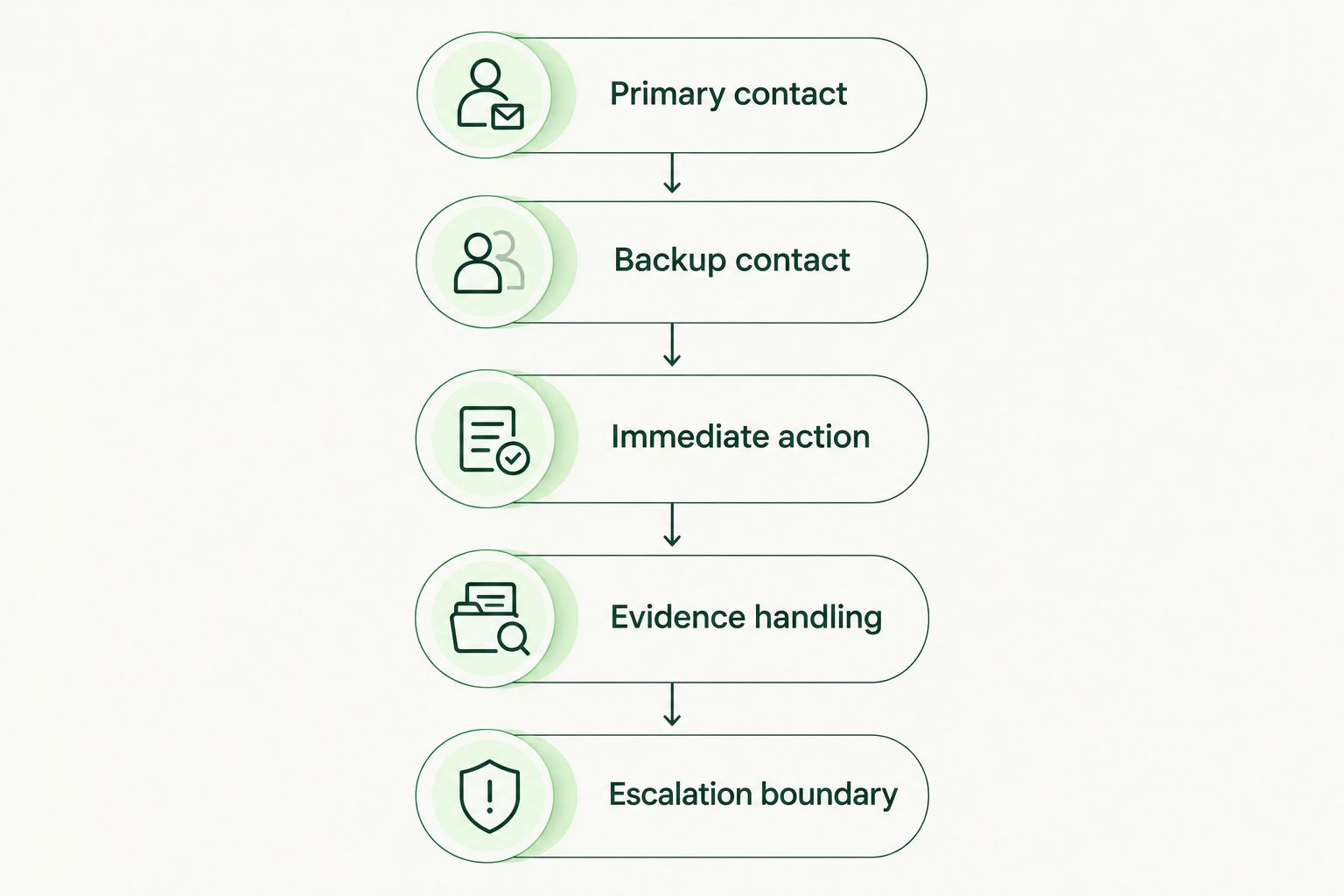
Staff report what happened; designated personnel assess the incident and decide the response.
6. Keep evidence and test the procedure
A spreadsheet and controlled document folder can establish the initial evidence process. Record who received which training, when it occurred, and how you addressed missed sessions or misunderstandings. Keep the material version alongside the attendance record so the record explains what staff actually learned.
For HIPAA-covered pharmacies, distinguish workforce education from the wider documentation obligation. Under 45 CFR §164.316(b)(2)(i), required Security Rule documentation must be retained for 6 years from creation or its last effective date, whichever is later. That is a documentation rule—not a requirement to repeat the same course for 6 years. Apply your retention policy to training evidence with appropriate compliance guidance.
During a 2026 review, check whether staff understand why MFA alone cannot stop phishing: authentication safeguards do not replace verifying payment instructions, protecting patient information, or reporting suspicious requests. Treat technical controls and workforce decisions as separate layers.
- Training record: Keep the participant, date, subject, and material version.
- Follow-up record: Document missed training and corrective instruction.
- Procedure walkthrough: Ask staff to explain how they would report an incident.
- Management review: Record gaps, assigned actions, and completion status.
- Retention policy: Define storage, access restrictions, retention, and disposal.
Compare training delivery options
Choose the operating model before choosing the course catalog. The best fit depends on who will maintain enrollment, teach pharmacy-specific procedures, and retrieve evidence when requested. No option transfers the pharmacy's compliance responsibilities to a training vendor.
| Option | Best for | Main advantage | Key limitation |
|---|---|---|---|
| Owner-led briefings and records | A pharmacy with a named internal training owner | Direct control over local examples and procedures | Scheduling, follow-up, and documentation remain manual |
| General-purpose learning system | A pharmacy already managing staff education centrally | Keeps security education within an existing learning process | Security content and pharmacy workflows still require evaluation |
| Defend Wise through an MSP | MSP-supported pharmacies seeking flat-fee, white-label training delivery | Unlimited-seat platform model avoids per-seat licensing calculations | Training does not replace local procedures or establish HIPAA compliance |
When evaluating the MSP route, request a written service scope. Specify who handles enrollment, missed training, content selection, and evidence requests. Flat-fee licensing addresses seat-count friction; it does not prove that the service includes every administrative task.
For a 2026 vendor review, ask to see a sample lesson and the proposed evidence handoff. Evaluate the actual material against your workflows. A familiar healthcare label is not enough if employees still cannot explain how to verify a support caller or report a mistaken disclosure.
Common mistakes independent pharmacies make
Treating a certificate as complete HIPAA compliance
A completion certificate documents an educational activity, not the effectiveness of your entire security program. Connect training to your risk analysis, policies, access controls, and incident procedures. The distinction is central to HIPAA security awareness training requirements.
Leaving owners and temporary staff outside the roster
An owner approving payments and a temporary technician handling patient information both need instruction matched to their work. Reconcile the training roster with actual workforce access. Do not let employment status become a substitute for evaluating responsibilities.
Using examples staff cannot apply at the counter
A lesson about abstract threats does not tell a technician what to do with an unexpected support call. Use fictional dispensing-system requests, supplier messages, and patient-information scenarios. End each example with the approved action and reporting route.
Counting seats but ignoring administrative work
Licensing is only part of the delivery decision. Identify who chases incomplete training, updates the roster, and answers evidence requests. An MSP service should explain those responsibilities before the pharmacy assumes they are included.
FAQ
What's the best security awareness training for an independent pharmacy?
The best fit teaches pharmacy-specific decisions and gives a named owner responsibility for enrollment, follow-up, and evidence. Evaluate support-call verification, patient-information handling, workstation practices, and reporting—not just course completion.
Does HIPAA require security awareness training for pharmacy staff?
HIPAA-covered pharmacies must implement a security awareness and training program for workforce members, including management, under 45 CFR §164.308(a)(5). Determine the program's content and delivery through the pharmacy's applicable obligations and risk-based security program.
How often should an independent pharmacy train employees?
Set a documented schedule based on workforce access, risk, procedure changes, and relevant incidents. Include onboarding and follow-up education rather than assuming a single annual course addresses every need.
Can an MSP manage security awareness training for a pharmacy?
An MSP can manage training delivery when the service agreement assigns clear responsibilities. The pharmacy still needs to own its policies, approve local procedures, and oversee its compliance program.
Is MFA enough to replace employee security training?
MFA does not replace employee security training. Staff still need to verify unusual requests, protect patient information, recognize suspicious activity, and report problems through approved channels.
What training records should a pharmacy keep?
Keep records that identify the participant, training date, subject, material version, and necessary follow-up. Apply a documented retention policy; required HIPAA Security Rule documentation has a 6-year retention requirement under 45 CFR §164.316(b)(2)(i).
Does completing security training make a pharmacy HIPAA compliant?
Completing security training alone does not establish HIPAA compliance. Training is one part of a broader program that includes applicable administrative, physical, and technical safeguards.
One last thing
Review the reporting procedure with the person covering the next shift. Ask that employee to explain what happens after an unexpected support call—not whether they remember taking a course. If the answer depends on finding an unavailable owner, fix the escalation path before assigning another lesson.