Huntress alternatives in 2026
Compare Huntress alternatives for MSP training. Choose Defend Wise for flat-fee, white-label delivery, and keep detection needs separate from training.
DefendWise
DefendWise
Huntress combines managed security services with security awareness training, making it a strong starting point for MSPs that want a connected security offering. That breadth does not settle a narrower decision: how to package white-label training across your client base. The best Huntress alternative in 2026 is Defend Wise if you need flat-fee, white-label security awareness training for MSPs; KnowBe4 if you need a dedicated employee security awareness program.
TL;DR
- For Huntress alternatives in 2026, choose Defend Wise for flat-fee, white-label security awareness training for MSPs.
- Shortlist KnowBe4 for a dedicated employee security awareness program.
- Compare Huntress Security Awareness Training separately from Huntress managed detection and response.
- Replace only the service you intend to change; training does not replace threat detection.
Why this matters
A search for Huntress alternatives mixes two different purchases: employee training and managed threat detection. Buying the wrong category leaves the original problem unsolved. Start with the service you intend to replace, not the vendor name.
This comparison focuses on security awareness training for MSPs. It does not rank endpoint detection products or suggest that a training platform can replace a managed security operation.
For your 2026 shortlist, separate the purchasing decision into three questions:
- Service scope: Are you replacing training, detection, or both?
- Commercial model: Do you want training costs tied to seats or a flat-fee model?
- Client ownership: Do you need to deliver training under your MSP’s brand?
Those answers matter more than a long feature checklist. A training platform can fit your delivery model without replacing every service you buy from Huntress.
Huntress alternatives at a glance
| Platform | Best for | Standout capability or model | How it differs from Huntress |
|---|---|---|---|
| Huntress | MSPs evaluating training alongside managed security services | Security awareness training within a broader managed security portfolio | The benchmark; distinguish its training service from its detection services |
| Defend Wise | MSPs reselling white-label security awareness training | Flat-fee training with unlimited seats | A focused training option, not a substitute for Huntress managed detection and response |
| KnowBe4 | Organizations building a dedicated employee awareness program | Security awareness training and assessments | A dedicated awareness platform rather than a replacement for Huntress managed security services |
Compare the training service with the training service. A portfolio-level comparison obscures what you will retain, replace, or administer separately.
Use the table to establish category fit. Then evaluate the actual contract, client workflow, and evidence requirements before selecting a platform.
1. Defend Wise: best for white-label MSP training
Defend Wise security awareness training is built around a specific MSP model: one flat fee, unlimited seats, and white-label delivery to end-client organizations. Choose it when your buying priority is packaging training as your own recurring client service. Do not treat it as a replacement for a security operations service.
The economic distinction is straightforward. Unlimited-seat licensing removes a seat-based calculation from the training platform’s fee structure; it does not remove your responsibility to manage the service.
Where the platform shines
- Flat-fee model: You can evaluate the platform expense without making licensed seat count the central variable.
- Unlimited seats: Your training coverage decision does not need to begin with choosing which employees deserve a licensed place.
- White-label delivery: The platform supports an MSP-owned training offering rather than requiring you to position training as an unrelated vendor purchase.
- MSP focus: The stated use case is training and managing cybersecurity compliance for end-client organizations.
These characteristics support a clear service proposition: include security awareness training in your client relationship and assess the delivery work separately. Keep the software model and the service margin calculation distinct.
Where the platform falls short
- It is not managed detection and response. If your Huntress requirement includes threat monitoring and response, training alone leaves that requirement untouched.
- Flat-fee licensing is not automatic profitability. Your onboarding, support, client communication, and evidence preparation still consume staff time.
- White-label delivery increases your client-facing responsibility. Your MSP must explain the training service, handle questions, and define what the engagement includes.
Do not read unlimited seats as unlimited service capacity. Your team still needs an operating model for the organizations and employees you serve.
Head-to-head with Huntress
| Dimension | This alternative | Huntress |
|---|---|---|
| Decision scope | Flat-fee, white-label security awareness training | Evaluate Security Awareness Training separately from managed security services |
| Delivery model | Training for MSP end-client organizations | MSP-focused security services, including training |
| Commercial question | Does unlimited-seat, flat-fee training fit your service package? | Does the quoted training agreement fit your intended delivery model? |
| Replacement boundary | Training only in this comparison | Keep any required detection and response services accounted for separately |
Best for: MSPs that want to sell white-label security awareness training without making platform seat count the organizing principle of the service.
For a 2026 purchase, request a walkthrough that follows your client lifecycle: onboarding, training administration, employee changes, and evidence retrieval. Evaluate each workflow directly rather than treating the commercial model as proof of operational fit.
Verdict: Buy for the flat-fee, white-label training use case; keep detection and response outside this replacement decision.
2. KnowBe4: best for a dedicated awareness program
KnowBe4 is a security awareness training platform with employee assessments. Shortlist it when the training program itself is the central purchase and you want to evaluate a dedicated awareness vendor against Huntress Security Awareness Training.
The useful comparison is program fit, not vendor size. Ask how each option supports your intended audience, administration process, and evidence needs.
Where KnowBe4 shines
- Dedicated category focus: Security awareness training is central to the platform’s purpose.
- Employee assessments: You can evaluate assessment capabilities alongside training rather than reviewing content alone.
- Direct comparison scope: It belongs on a training shortlist, unlike an endpoint product that solves a different problem.
Where KnowBe4 falls short
- It does not replace managed detection and response. Selecting an awareness platform does not cover the monitoring responsibilities of a security operations service.
- Category fit does not establish MSP fit. Validate the specific partner arrangement, client administration process, and branding requirements before choosing it for resale.
Head-to-head with Huntress
| Dimension | KnowBe4 | Huntress |
|---|---|---|
| Relevant service | Security awareness training and assessments | Security Awareness Training |
| Buying focus | Dedicated employee awareness program | Training evaluated within a broader security vendor relationship |
| Decision test | Does the program fit your training and administration requirements? | Does the training service fit your existing delivery model? |
Best for: Organizations and MSPs evaluating a dedicated employee awareness program on its training requirements.
Verdict: Hold for a requirements-led demonstration; choose KnowBe4 only after confirming your delivery needs.
Why people switch from Huntress
The defensible reasons to consider switching are requirements, not assumptions about Huntress failures. Do not build a business case around unverified claims about outages, contract changes, support problems, or training quality.
For this shortlist, the concrete alternative is a different training delivery model. An MSP that requires flat-fee, unlimited-seat, white-label training has a specific reason to evaluate another platform, even while retaining other Huntress services.
You want a different commercial model
If your requirement is a flat platform fee rather than seat-based planning, put that requirement in the shortlist before reviewing demonstrations. Compare the written agreements, including scope and exclusions. Do not assume that a vendor’s entire portfolio follows one commercial model.
You want an MSP-branded training service
White-label delivery is a valid selection criterion when your MSP owns the client relationship. Specify where branding must appear and ask each candidate to demonstrate the relevant workflow. A general statement about partner support is not the same as meeting your branding requirements.
You want to separate training from other services
You can change a training supplier without making an unrelated detection decision. Treat each service as a separate responsibility, then check the operational consequences of using different vendors. Separation is useful only when your team can explain who handles what.
Evaluate the replacement before you migrate
For your 2026 evaluation, use a defined sequence: establish scope, test the client workflow, inspect the evidence, and assign ownership. The objective is a service your team can run—not simply a successful demonstration.
Define scope
Write down exactly what leaves the existing agreement and what stays. Name the training service explicitly, and list any detection or response services separately. This prevents an awareness-platform purchase from being mistaken for a complete security replacement.
Test delivery
Ask the vendor to demonstrate the actions your staff will perform for an actual client. Include adding employees, handling departures, assigning training, checking progress, and answering client questions. Treat each action as a requirement to verify, not a capability to assume.
Inspect evidence
Request a representative training record and review it against your client’s documentation requirements. Check whether the record identifies the learner, activity, completion status, and relevant dates. A completion record supports documentation; it does not establish compliance with every obligation.
Assign ownership
Specify who maintains employee records, follows up on incomplete training, prepares client updates, and answers evidence requests. Put those responsibilities in your service definition. A software change does not decide them for you.
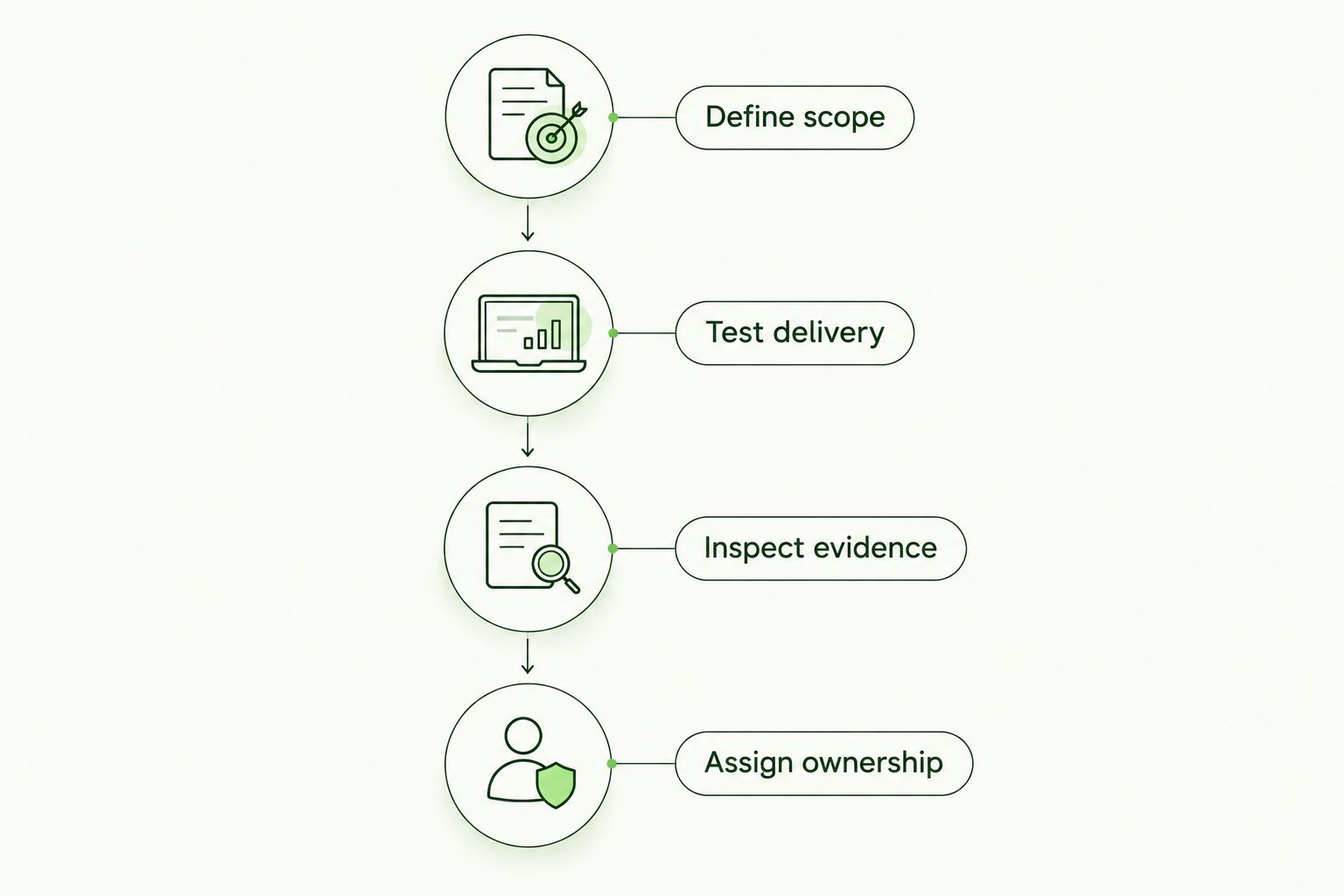
Confirm the service boundary before evaluating administration and evidence.
Keep the evaluation record short enough to use during procurement. For every requirement, record the demonstrated workflow, the responsible party, and whether it meets your needs. Unanswered questions remain open requirements, not assumed capabilities.
Calculate service work separately from licensing
A fixed platform expense and a fixed delivery workload are different things. Your team still needs to estimate the work required to operate the training service and support end clients.
Use these categories when reviewing the business case:
- Onboarding work: Employee lists, client expectations, and initial administration.
- Recurring work: Training follow-up, account changes, and client communication.
- Evidence work: Preparing records for client reviews and compliance requests.
- Exception work: Resolving access problems and handling unusual client requirements.
A platform comparison should connect those tasks to named responsibilities. For a deeper service-level calculation, use the guide to MSP security training break-even.
Flat-fee licensing changes the software economics. It does not make unpriced staff work disappear.
When staying with Huntress is the right call
Stay with Huntress when its training service meets your requirements and the existing arrangement fits your client delivery process. A different licensing model is a reason to evaluate an alternative, not proof that migration is necessary.
Also separate dissatisfaction from scope confusion. If the requirement you need to solve is detection and response, neither training alternative in this article answers that purchase.
For a 2026 renewal, make the decision explicit: retain the training service, replace the training service, or evaluate a separate security category. Avoid reopening your whole security stack when only one service needs attention.
FAQ
What is the best Huntress alternative for MSP security awareness training?
Defend Wise is the best fit on this shortlist for MSPs that require flat-fee, white-label security awareness training with unlimited seats. That recommendation applies to training, not managed detection and response.
Can I replace Huntress detection services with a training platform?
No. Security awareness training addresses employee learning, while managed detection and response addresses threat detection and response. Evaluate replacement products within the service category you intend to change.
Is KnowBe4 a Huntress alternative?
KnowBe4 is an alternative to evaluate for security awareness training. Compare it with Huntress Security Awareness Training, not with Huntress detection services.
Should an MSP switch every Huntress service at once?
No. Define each service separately and replace only what your requirements justify. Confirm the operational and contractual boundaries before making changes.
What should I ask during a training platform demonstration?
Ask the vendor to demonstrate your client lifecycle, including employee changes, training administration, and evidence retrieval. Verify branding and responsibility requirements against the actual workflow.
Does completing security awareness training guarantee compliance?
No. Training completion is evidence of a completed activity, not a guarantee that an organization meets every applicable obligation. Evaluate the training records against the specific requirements your client must satisfy.
How should I compare Huntress alternatives in 2026?
Compare service scope first, then commercial model, client administration, branding, and evidence. Retain any required detection and response coverage independently of the training decision.
One last thing
Write the replacement decision as a sentence before you sign: We are replacing security awareness training, while retaining responsibility for detection and response elsewhere. If that sentence does not describe your plan accurately, revise the scope first.
The strongest shortlist is not the longest. It is the one that keeps your service boundaries clear and tests the workflow your MSP will actually deliver.