White-Label Security Awareness Training: Build Your MSP Brand Without Adding Seat-Count Friction
White-label security awareness training helps MSPs deliver SAT under their own brand, protect pricing, and keep client proof manageable.
DefendWise
DefendWise
TL;DR
White-label security awareness training helps an MSP make SAT feel like part of its managed service, not a third-party add-on the client happens to receive. The commercial point is simple: if the platform is branded as the MSP, priced predictably, and easy to run across client tenants, the MSP can include training without turning every user into another seat-count conversation.
For MSP owners, the goal is not to make a vendor invisible for its own sake. It is to keep the client relationship, the service packaging, and the proof of delivery aligned under the MSP's brand. DefendWise supports that model with white-label delivery, multi-tenant control, and a $399/month flat fee for unlimited users and unlimited client organisations/subclients.
What is white-label security awareness training?
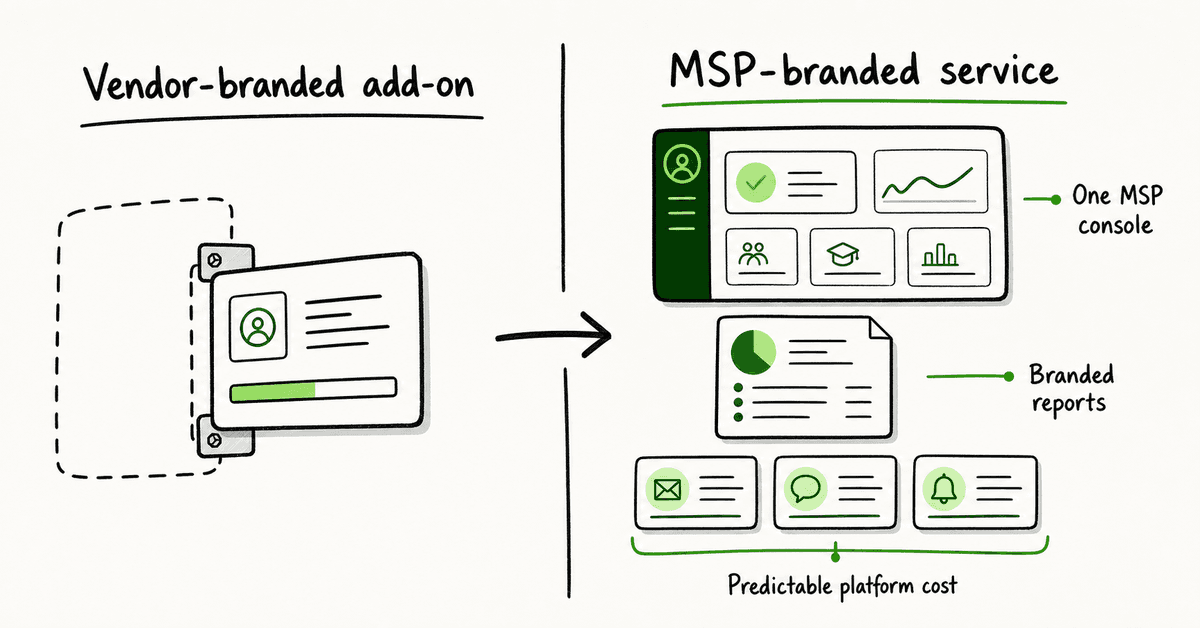
White-label security awareness training is SAT delivered under the MSP's brand. The client sees the MSP's logo, language, portal, reports, and training experience instead of a vendor-branded product bolted onto the managed service.
That matters because security awareness training is not just an annual video. CISA tells businesses to train staff to recognize and report phishing, keep employees informed as threats evolve, and build a culture of cybersecurity rather than treating training as a one-off event: https://www.cisa.gov/audiences/small-and-medium-businesses/secure-your-business/teach-employees-avoid-phishing.
NIST's security awareness and training guidance also frames awareness as a program lifecycle: design the program, develop material, implement it, and review it after implementation: https://csrc.nist.gov/pubs/sp/800/50/final. For MSPs, that lifecycle becomes a managed service problem. Someone has to onboard users, send reminders, run training, provide reporting, and explain results to the client.
If those touchpoints all carry a third-party vendor brand, the MSP is still doing the work, but the client may not see it that way.
The MSP problem: resold training can look like someone else's service
Reselling a vendor-branded SAT tool is not automatically wrong. It can be the right starting point when an MSP needs to add training quickly.
The problem shows up when the training becomes a visible client touchpoint.
A client buys a managed security package from the MSP. Then their employees receive training emails from another company. The portal has another company's name. The certificates and reports look like they came from the vendor. During QBRs, the MSP has to explain a service that the client's users experience as someone else's product.
That creates 3 practical issues:
- The MSP loses some of the brand credit. The client may remember the vendor name more than the MSP's role in packaging, managing, and explaining the service.
- The service feels like a tool stack, not a managed outcome. A branded MSP experience helps SAT sit beside helpdesk, endpoint, identity, backup, and compliance work as one coherent service.
- The commercial conversation can drift toward line-item comparison. If SAT is obviously a resold vendor product, clients can compare the visible vendor to other options instead of evaluating the managed service around it.
White-label delivery does not magically solve retention. It does give the MSP a cleaner way to show that SAT is part of the MSP's operating model.
White-label vs co-branded vs vendor-branded SAT
MSPs should be precise about the difference because the client experience changes.
| Model | What the client sees | MSP advantage | Watch-out |
|---|---|---|---|
| Vendor-branded SAT | Vendor logo, vendor portal, vendor emails, vendor reports | Fastest to resell | Client may see the vendor as the training provider |
| Co-branded SAT | MSP logo beside vendor branding | Some MSP visibility | Still gives the vendor client-facing credit |
| White-label SAT | MSP brand on client-facing surfaces | Training feels like part of the managed service | MSP must keep branding, support, and reporting consistent |
DefendWise's white-label feature page describes client-facing surfaces such as the learner portal, emails, reports, certificates, and login URL carrying the MSP's brand: https://www.defendwise.com/features/white-label. For public copy, that is the safe way to talk about the capability: client-facing delivery is designed to carry the MSP brand.
Avoid overclaiming that every possible technical trace, header, integration log, or edge case is always hidden. That level of detail should be verified before it becomes public copy.
Why white-label SAT supports client trust
Trust in an MSP relationship is built through repeated, visible proof.
Security awareness training creates those proof points naturally. Employees receive training assignments. New starters get enrolled. Managers see completion. QBRs include participation and phishing-simulation context. Client contacts ask whether their people are actually doing the work.
When those moments are branded as the MSP, the MSP gets to reinforce 3 messages:
- This is part of your managed service. Training is not a random extra tool. It is included in the security program the MSP runs.
- We are managing the human-risk workflow. The MSP is helping the client create a repeatable habit around suspicious emails, reporting, and follow-up.
- We can show evidence without creating another spreadsheet job. Reports become a client conversation, not an admin scramble.
That is the retention argument in a claim-safe form. White-label SAT can support trust and make value more visible. It should not be positioned as a guaranteed churn reducer, a wall around the client base, or a promise that the MSP becomes impossible to replace.
The margin issue: per-seat pricing can fight the managed-service model
White-label branding is only half the story. MSPs also need the economics to work.
Many MSPs sell managed services as a predictable monthly package. Per-seat SAT pricing can make that harder. Every new client employee, contractor, seasonal worker, or acquired user can become another vendor cost. If the MSP has included SAT inside a flat managed service bundle, user growth can quietly reduce margin.
This is why the pricing model matters.
A flat-fee SAT platform gives the MSP a more predictable platform cost. DefendWise's flat-fee page positions the offer as $399/month with unlimited users and unlimited clients: https://www.defendwise.com/features/flat-fee. The safer public framing is not "$0 COGS for every user". There are still operational costs, support time, packaging choices, and fair-use realities. The safer framing is this:
The platform cost is predictable, so adding legitimate users does not create a new per-seat vendor charge.
That is enough. It preserves the margin argument without pretending the MSP has no cost or effort.
A practical packaging model for MSP owners
A white-label SAT offer works best when the MSP packages it as a managed-service component, not a standalone software resale.
| Packaging layer | Decision to make | Claim-safe client language |
|---|---|---|
| Commercial model | Included in core managed security, premium tier, or add-on | "Security awareness training is part of our managed security service." |
| Brand experience | MSP portal, emails, certificates, and reports | "Your team sees our managed training experience, not a separate vendor relationship." |
| User coverage | Which users are included and how new users are handled | "We can support broad user coverage without per-seat vendor billing friction." |
| Reporting cadence | Monthly, quarterly, or QBR-based proof | "We'll review participation and training evidence with you on a regular cadence." |
| Support boundary | Who handles user questions and escalations | "Your MSP support path remains the front door." |
This keeps the promise grounded. The MSP is not guaranteeing that training prevents breaches, satisfies every compliance requirement, or reduces risk scores by a fixed amount. The MSP is promising a repeatable delivery model the client can understand.
What good white-label SAT looks like operationally
The best white-label setup is boring in the right way: repeatable, visible, and easy to explain.
1. A branded learner experience
The learner portal should look and feel like the MSP's service. Logo, colours, domain, and tone should be consistent enough that a client employee is not confused about who is providing the training.
2. Client-aware tenant management
MSPs need to manage multiple client organisations without turning each one into a separate admin project. Multi-tenant control matters because the MSP has to separate client data, client contacts, reporting, and training workflows while still managing the service centrally.
3. User onboarding that avoids spreadsheet work
For many MSP clients, Microsoft 365 is the practical source for user identity. Microsoft Graph exposes user resources and common user operations through its API: https://learn.microsoft.com/en-us/graph/api/resources/users?view=graph-rest-1.0. Microsoft Entra synchronization documentation also shows how identity data moves between environments and Microsoft Entra ID: https://learn.microsoft.com/en-us/entra/identity/hybrid/connect/how-to-connect-sync-whatis.
For public DefendWise copy, keep the claim simple: DefendWise supports Microsoft 365 sync and integrations as described on its integrations page: https://www.defendwise.com/features/integrations. Do not claim every edge-case onboarding path unless it has been verified.
4. Reports that support QBRs
Reports should help the MSP explain what happened: who was assigned training, who completed it, where reminders are needed, and what the next client conversation should be.
DefendWise's automated reports page describes branded PDFs and automated reporting workflows: https://www.defendwise.com/features/automated-reports. The safe language is "supports client reporting" or "helps provide evidence." Avoid "auditor-ready" unless Dan wants to verify the exact report language, framework mapping, and target compliance scenario before publish.
5. A QBR narrative the client can repeat
White-label SAT becomes more valuable when the MSP can explain it in plain language:
- Your people get regular security training.
- New users can be added without a new per-seat vendor conversation.
- Reports give us a basis for review.
- Training is part of the managed service we already run for you.
That is stronger than a pile of vendor feature names.
Mistakes to avoid
Mistake 1: Treating white-label as just a logo upload
A logo matters, but white-label delivery is broader than a header image. The client's experience includes emails, portal language, certificates, reports, support paths, and QBR materials.
Mistake 2: Making compliance promises the MSP cannot prove
Security awareness training can support compliance programs, insurance discussions, and audit evidence. That is not the same as guaranteeing compliance or claiming that a training platform satisfies a framework by itself.
If you mention NIST, ISO, Essential Eight, cyber insurance, or auditor evidence, be clear: SAT can provide training evidence and reporting inputs. The client's final compliance position depends on the broader control environment, policies, scope, evidence quality, and assessor expectations.
Mistake 3: Letting per-seat billing decide who gets trained
When every additional user has a per-seat vendor cost, the MSP may be tempted to restrict coverage. That can create awkward coverage decisions. A flat-fee platform can remove that particular vendor-billing friction, making it easier to include legitimate users across client organisations.
Mistake 4: Hiding the service after setup
Automation does not replace communication. If SAT is part of the managed service, talk about it in onboarding, QBRs, renewal conversations, and security reviews.
Mistake 5: Using vendor-hostile language
You do not need to attack other vendors to make the white-label argument. The point is not that all third-party SAT products are bad. The point is that MSPs should decide whether they want the vendor brand or the MSP brand to be the visible client experience.
How DefendWise fits the MSP model
DefendWise is built for MSP-led security awareness training: white-label delivery, multi-tenant control, automated onboarding and reporting, AI-native training content, and a $399/month flat fee with unlimited users and unlimited client organisations/subclients.
For MSP owners, the practical fit is packaging. DefendWise can help make SAT easier to include inside a managed service bundle because the platform cost is predictable and the client-facing experience can carry the MSP's brand.
If you are working through the commercial model, start with the companion guide on bundling SAT without losing margin: https://www.defendwise.com/blog/how-msps-can-bundle-security-awareness-training-without-losing-margin. Then review the feature pages for white-label delivery, flat-fee pricing, integrations, and automated reports.
CTA: Start Free 7-Day Trial.
Frequently asked questions
What is white-label security awareness training?
White-label security awareness training lets an MSP deliver SAT under its own brand. The client-facing experience can include the MSP's logo, colours, learner portal, emails, reports, and certificates instead of a vendor-branded training product.
Is white-label SAT better than reselling a vendor-branded product?
It depends on the MSP's packaging goal. Vendor-branded SAT can be fast to resell, but white-label SAT is usually better when the MSP wants the training to feel like part of its managed service and wants to keep brand credit for delivery.
Does white-label security awareness training improve retention?
It can support retention by making the MSP's value more visible and by embedding training into the client's regular managed-service experience. It should not be described as a guaranteed retention tool, because churn depends on pricing, service quality, client fit, relationship health, outcomes, and many other factors.
What should an MSP look for in a white-label SAT platform?
Look for branded learner surfaces, branded emails and reports, client-tenant separation, predictable pricing, user onboarding support, reporting workflows, and clear boundaries around what the platform does and does not promise.
How does flat-fee pricing change SAT packaging?
Flat-fee pricing makes the vendor cost more predictable. For MSPs, that can make it easier to include training broadly across clients without turning every new learner into a new vendor charge.
Can white-label SAT help with compliance evidence?
It can help produce training participation and reporting evidence. That evidence may support a client's compliance program, but it does not guarantee compliance by itself. The final compliance position depends on the full set of controls, scope, evidence, and assessor requirements.
Does DefendWise include white-label delivery?
Yes. DefendWise positions white-label delivery as a core MSP feature. The current public offer is $399/month flat, with unlimited users, unlimited client organisations/subclients, white-label delivery, multi-tenant control, automated onboarding and reporting, and AI-native training content.