Which is better for MSPs: Defendwise or usecure?
Compare Defendwise and usecure for MSP security awareness training by pricing, scope, white-label fit, and admin load.
DefendWise
DefendWise
TL;DR
Which is better for MSPs: Defendwise or usecure? The honest answer depends on the service you want to sell.
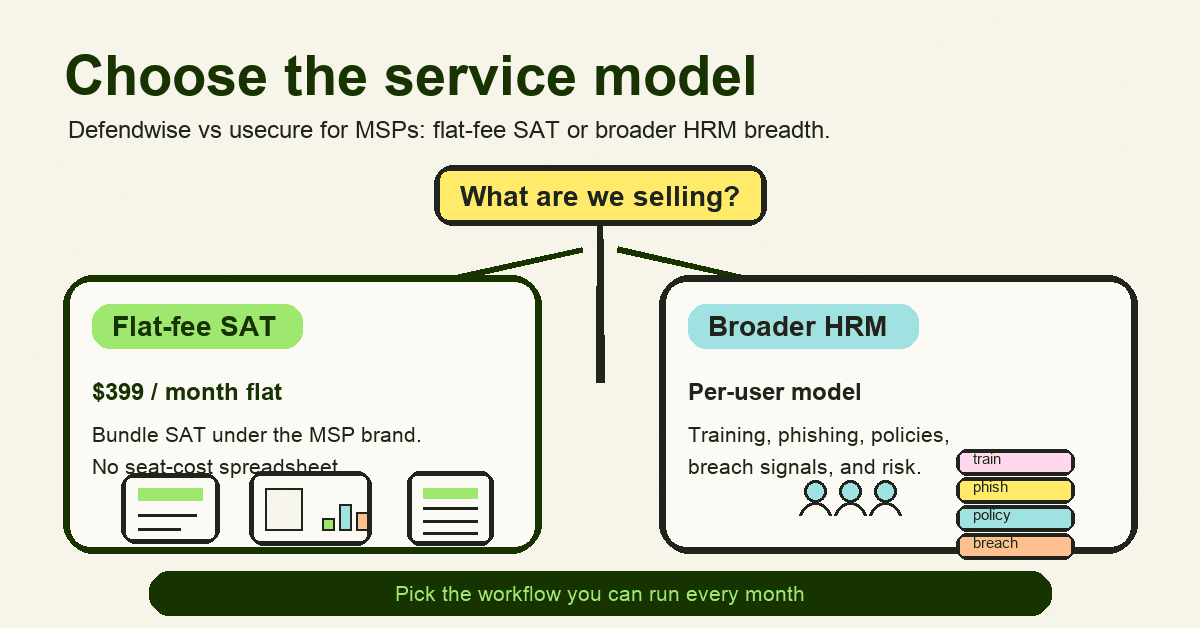
Defendwise is the cleaner fit when an MSP wants security awareness training to become a standard, white-label, fixed-cost layer inside managed services: $399/month flat, unlimited users, unlimited client organizations, one MSP dashboard, automated onboarding, and branded reporting.
usecure is the broader fit when an MSP wants a human-risk management suite that combines training, phishing simulations, policy management, breach monitoring, and risk analytics. Its pricing page describes MSP billing as per-user, per-month with monthly usage billing, no minimum licenses, and quote-based pricing.
So the buying question is not simply "which tool has more features?" It is: do you want a focused flat-fee SAT platform that protects MSP margin, or a wider per-user HRM suite that covers more human-risk workflows?
What the search really means
MSPs searching for Defendwise versus usecure are usually trying to answer 1 of 4 questions:
- Can we bundle security awareness training into every client package without seat-cost anxiety?
- Can we deliver the service under our own brand?
- Can we see and manage every client from 1 place?
- Do we need awareness training only, or a broader human-risk product line?
That is a different decision from an internal IT team buying training for 1 company.
An internal IT buyer can compare content libraries, phishing templates, admin experience, and compliance reporting inside a single organisation. An MSP has to compare the operating model across many clients, many user counts, many QBRs, and many renewal conversations.
NIST's Cybersecurity Framework is about helping organizations better understand and improve cybersecurity risk management. NIST SP 800-50 Rev. 1 frames cybersecurity learning as a lifecycle program that should encourage behaviour change, use metrics, and update as risks change. CIS Control 14 says organizations should establish and maintain a security awareness program to influence workforce behaviour and reduce risk.
For MSPs, that turns security awareness into a managed workflow, not a module library.
Defendwise in one paragraph
Defendwise is a flat-fee, AI-native security awareness training platform built for MSPs.
The public offer is simple: $399/month flat, unlimited users, unlimited client organizations, full white-label delivery, multi-tenant control, automated onboarding, Microsoft 365 sync, Zapier integrations, and client-ready reporting. The main promise is not "more training content than everyone else." It is MSP packaging: protect every user, keep the MSP brand in front, and avoid per-seat vendor economics.
That makes Defendwise strongest when an MSP wants SAT to become part of the default managed service stack rather than a fragile add-on priced by user count.
usecure in one paragraph
usecure positions itself as a human-risk management platform for MSPs and IT teams.
Its site describes a broader product set: uLearn for automated personalised training, uPhish for phishing simulations, uBreach for dark web or breach monitoring, uPolicy for policy management, plus human-risk reporting, risk analytics, reminders, nudges, and user progress tracking. Its pricing page says MSPs get per-user, per-month pricing, monthly usage billing, no minimum licenses, no long-term commitments, a multi-tenant admin portal called uService, a fully white-labelled platform, Microsoft 365 and Google Workspace sync, and a dedicated usecure account manager.
That makes usecure strongest when an MSP wants to package a broader human-risk service, not only a SAT layer.
Comparison table: Defendwise vs usecure for MSPs
| Decision area | Defendwise | usecure | What it means for MSPs |
|---|---|---|---|
| Primary category | MSP-first security awareness training / human-risk platform | Human risk management platform for MSPs and IT teams | Defendwise is more focused on SAT packaging. usecure is broader across HRM workflows. |
| Pricing model | Public $399/month flat fee, unlimited users and unlimited client organizations | Public pricing structure is quote-based; MSP pricing page says per-user, per-month with monthly usage billing | Defendwise is easier to model for bundled services. usecure may fit MSPs that prefer usage-aligned client billing. |
| MSP brand ownership | Full white-label portal, emails, reports, certificates, and login URL according to public feature page | Fully white-labelled platform according to pricing page | Both speak to MSP brand ownership. Verify exact surfaces in trial or demo. |
| Multi-tenant control | One MSP console across client organizations; public page says unlimited subclients | Multi-tenant admin portal, uService, for MSP management | Both target multi-client delivery. Test daily admin steps before deciding. |
| Product breadth | SAT, onboarding, reporting, Microsoft 365 sync, Zapier/PSA workflow language, compliance mapping at high level | Training, phishing, policy management, breach monitoring, risk analytics, reporting | usecure covers more adjacent workflows. Defendwise keeps the SAT service simpler. |
| Reporting/evidence | Branded reports, certificates, compliance mapping, automated reports in the Defendwise feature set | Exportable training, phishing, breach, policy, and risk reports in the usecure pricing page | Compare sample reports, not sales claims. The client has to understand the output. |
| Best fit | MSPs that want flat-fee, low-admin, white-label SAT across every client | MSPs that want a wider HRM suite and are comfortable validating per-user economics | The right answer depends on package design. |
When Defendwise is the better MSP fit
Defendwise is usually the better fit when the MSP's main problem is margin-safe, low-admin security awareness training across many clients.
1. You want one vendor cost, not a seat-cost spreadsheet
The strongest Defendwise difference is the flat fee.
If the MSP sells SAT as a pass-through line item, per-user pricing can work. The client adds users, the client pays more. But many MSPs do not want SAT to sit as a visible, negotiable add-on forever. They want it in the managed services package.
That is where a flat fee changes the conversation. The MSP can protect every user, include contractors or seasonal staff where appropriate, and stop checking whether a client headcount change damages margin.
Defendwise's flat-fee page says $399/month covers every feature, every seat, and every subclient. That is a clear commercial model for MSP owners who want predictable packaging.
2. You want the MSP to own the client experience
White-label delivery is not cosmetic for an MSP.
If training emails, learner portals, certificates, and reports all point to the vendor, the client sees the vendor. If those surfaces carry the MSP's brand, the client sees the MSP delivering a managed security service.
Defendwise's white-label page says the portal, emails, reports, certificates, and login URL carry the MSP's logo, colours, voice, and domain, with no Defendwise branding in client-facing content. That is useful when the MSP wants SAT to strengthen its own service relationship.
usecure also states that its MSP offer includes a fully white-labelled platform. The practical test is which surfaces are white-labelled, how easy they are to configure, and whether reports feel like a client-ready MSP deliverable.
3. You want SAT as a standard service, not a new product line
Some MSPs want to build a full human-risk management offering. Others want a clean awareness training layer that can sit inside existing security packages.
Defendwise is easier to explain in that second motion:
- one flat fee
- unlimited clients and users
- white-label experience
- multi-tenant console
- automated onboarding and reporting
That is enough for an MSP that wants every client covered without launching a complex new practice area.
4. You want the buying decision to be simple
The more modules in a product, the more things to evaluate.
That is not a criticism of usecure. Breadth can be valuable. But it can also create a longer buying process: policy workflows, breach monitoring, risk scoring, phishing simulation, reporting, training content, user sync, remediation, and package pricing.
If the MSP's immediate need is SAT under its own brand with predictable economics, Defendwise is the simpler decision.
When usecure is the better MSP fit
usecure is usually the better fit when the MSP wants a broader human-risk service, not only security awareness training.
1. You want training, phishing, policies, and breach monitoring together
usecure's pricing and product pages describe a wider platform than a focused SAT tool.
That matters if the MSP wants to sell a more complete human-risk package. The service can cover training adoption, phishing simulation performance, policy acknowledgement, exposed credential signals, user-level risk, and reporting from one platform.
Sherweb's usecure overview describes it as consolidating awareness training, phishing simulations, dark web credential monitoring, security policy management, compliance reporting, and tracking. That is a broader operational surface than a pure SAT rollout.
2. You want per-user MSP billing that scales with client usage
usecure's MSP pricing page says the MSP model is per-user, per-month with monthly usage billing, no minimum licenses, and no long-term commitments.
For some MSPs, that is a good fit. If the MSP sells HRM as a user-based service, or wants client pricing to rise directly with usage, per-user billing can be straightforward. It also may be easier for an MSP to map vendor cost to a client bill when SAT or HRM is sold as a separate line item.
The tradeoff is margin modelling. If the MSP plans to bundle HRM or SAT into fixed-fee packages, every user-based vendor cost needs to be tested against client growth.
3. You need policy and breach modules in the same buying motion
If the MSP is already fielding client questions about policies, attestations, exposed credentials, and user-specific risk, usecure's breadth may save tool sprawl.
That does not mean every MSP needs those modules on day 1. It means usecure is more attractive when the service strategy already includes those workflows.
4. You want an established HRM story with public social proof
usecure's public pages claim 2,000+ MSPs and 15,000+ organizations worldwide, plus G2 and Capterra ratings. Those are usecure's claims, and MSPs should verify them during procurement if they matter to the decision.
For a buyer who values third-party review presence and a broader HRM category story, usecure may feel more familiar.
The buying frame: 7 questions before you choose
Do not choose by feature count. Choose by service model.
1. How will you package the service?
If SAT is included by default in managed services, Defendwise's flat fee is hard to ignore. If HRM is sold as a per-user add-on, usecure's per-user monthly billing may map cleanly to your client pricing.
2. Do you need SAT, or a wider HRM suite?
Defendwise is strongest for MSP-owned SAT delivery. usecure is broader across training, phishing, policies, breach monitoring, and risk analytics.
If you will not use the policy and breach modules, do not pay attention to them in the first decision. If those modules are central to your service strategy, treat them as real buying criteria.
3. What happens when the 51st client is added?
A tool can look clean in a demo and still create admin drag at scale.
Run a real client setup test. Add a tenant. Apply brand settings. Sync users. Launch training. Schedule reminders. Export a report. Remove a leaver. Then repeat the workflow for another client.
That test will tell you more than a feature checklist.
4. Who gets credit in front of the client?
Both vendors use white-label language. Verify the details:
- login URL
- learner portal
- emails
- certificates
- reports
- sender identity
- support paths
- report footers
If the MSP brand is the point, do not assume white-label means invisible. Check the actual surfaces.
5. What proof does the client receive each month?
CISA's phishing guidance reinforces the basic education need around social engineering. Verizon's DBIR page continues to frame breach data as a practical way to understand attack patterns, including AI-augmented attacks and mobile threats. NIST SP 800-50 Rev. 1 points to metrics and evaluation as part of maintaining a learning program.
The client report should turn that work into evidence:
- users covered
- courses assigned
- courses completed
- overdue users
- phishing simulation outcomes where used
- topics covered
- policy acknowledgements where used
- risk changes where used
- exceptions
- next actions
If the report needs manual cleanup every month, the MSP has not solved the operating problem.
6. What pricing breaks your margin model?
For Defendwise, the main question is whether the $399/month flat subscription fits your current and expected client base.
For usecure, the main question is how per-user, per-month usage billing behaves across small, medium, large, and fast-growing clients. Ask for exact pricing, billing examples, inactive-user rules, minimums, partner discounts, overage handling, contract terms, and renewal mechanics.
Neither model is automatically right. The right model is the one that matches how you charge clients.
7. What do you want to be known for?
If you want to be known as the MSP that includes security awareness by default for every user, Defendwise fits the message.
If you want to be known for a wider managed human-risk program with training, phishing, policy, breach, and risk reporting, usecure may fit the message.
That positioning choice matters because it changes sales copy, onboarding, QBRs, client expectations, and support workflows.
Mistakes to avoid
Mistake 1: Calling one platform "better" without naming the job
Better for what?
Better for flat-fee SAT bundling is not the same as better for a broad HRM suite. Better for a 20-client MSP is not always better for a 200-client MSP. Better for white-label service packaging is not always better for user-level risk analytics.
Name the job first.
Mistake 2: Treating public feature pages as implementation proof
Feature pages are useful. They are not enough.
Ask for a trial, sample reports, onboarding steps, white-label screenshots, invoice examples, and admin-role details. If compliance evidence matters, ask which fields export and whether reports include dates, tenant names, user status, and exception notes.
Mistake 3: Ignoring service-desk admin
MSP owners may focus on pricing. vCISOs may focus on reporting. Service-desk teams will feel the recurring work.
Bring them into the decision. If the tool creates tickets every month, the platform cost is not the full cost.
Mistake 4: Buying breadth you will not package
A wider product suite is only valuable if the MSP can sell, deliver, support, and explain it.
If policy management and breach monitoring are part of your offer, include them in the evaluation. If they are not, do not let extra modules distract from the SAT workflow you actually need.
Mistake 5: Forgetting the client-visible story
Security awareness training is easy to bury.
The MSP still needs a client-facing story: what changed, who completed training, where risk remains, what the next quarter focuses on, and what evidence is ready for insurance, QBR, or audit conversations.
The best platform is the one your clients can understand when you show the report.
So, which should MSPs choose?
Choose Defendwise if your core goal is to make SAT a standard, flat-fee, white-label service across every managed client.
Choose usecure if your core goal is a broader human-risk management suite and you are comfortable validating per-user economics across the client base.
The practical rule is simple:
- If your decision starts with margin, coverage, white-label SAT, and low-admin packaging, start with Defendwise.
- If your decision starts with policy management, phishing simulation breadth, breach monitoring, user risk analytics, and wider HRM workflows, compare usecure closely.
Either way, do not buy from the demo. Buy from the workflow test: add a client, sync users, launch training, chase overdue learners, export a client-ready report, and model the invoice across your real client base.
If you want the flat-fee path, start a free 7-day Defendwise trial and test the MSP workflow with real client assumptions before the next SAT renewal.
Frequently asked questions
Which is better for MSPs, Defendwise or usecure?
Defendwise is the better fit when an MSP wants a flat-fee, white-label, multi-tenant SAT platform it can bundle across clients without per-user vendor costs. usecure is a stronger fit when the MSP wants a broader human-risk management suite that also covers policy management, phishing simulation, breach monitoring, and risk analytics under a per-user MSP model.
Is usecure built for MSPs?
Yes. usecure publicly positions itself for MSPs and IT teams, with MSP-focused messaging around multi-tenant management, white-labeling, monthly usage billing, Microsoft 365 and Google Workspace sync, and human-risk services across training, phishing, policy, and breach monitoring.
How is Defendwise different from usecure?
Defendwise is narrower and more MSP-packaging focused: $399/month flat, unlimited users, unlimited client organizations, full white-label delivery, multi-tenant management, automated onboarding, and reporting for managed SAT services. usecure is broader, with training, phishing, policies, breach monitoring, risk scoring, and per-user MSP pricing.
Does usecure publish pricing?
usecure publishes pricing structure rather than a single public price. Its pricing page says MSP pricing is per-user, per-month with monthly usage billing, no minimum licenses, no long-term commitments, and quote-based pricing that depends on user volume, selected plan, billing preference, and partner status.
Does Defendwise charge per user?
No. Defendwise's public offer is $399/month flat for unlimited users and unlimited client organizations. That makes it easier for MSPs to include training across client packages without recalculating vendor cost each time a client adds users.
Should an MSP choose SAT or broader human risk management?
It depends on the service package. If the MSP needs a clear, low-admin awareness training layer under its own brand, SAT may be enough. If the MSP wants to sell a broader user-risk service that includes policies, breach monitoring, phishing simulations, and risk analytics, a wider human-risk management platform may fit better.
Can MSPs use this article as a procurement checklist?
Yes, as a first-pass checklist. Before buying, MSPs should still verify current pricing, contracts, minimums, integrations, report samples, client onboarding steps, support, data handling, and any compliance claims directly with each vendor.
Sources
-
usecure homepage: https://usecure.io
-
usecure pricing: https://usecure.io/pricing
-
usecure complete guide to security awareness training: https://usecure.io/guides/the-complete-guide-to-security-awareness-training
-
Sherweb usecure overview: https://www.sherweb.com/blog/security/usecure-human-risk-management
-
NIST Cybersecurity Framework: https://www.nist.gov/cyberframework
-
NIST SP 800-50 Rev. 1: https://csrc.nist.gov/pubs/sp/800/50/r1/final
-
CISA social engineering and phishing guidance: https://www.cisa.gov/news-events/news/avoiding-social-engineering-and-phishing-attacks
-
Verizon DBIR: https://www.verizon.com/business/resources/reports/dbir/
-
CIS Control 14: https://www.cisecurity.org/controls/security-awareness-and-skills-training