usecure alternatives in 2026
Compare usecure alternatives in 2026. DefendWise fits MSPs needing white-label, unlimited-seat training; assess KnowBe4, Huntress, and Hoxhunt by program fit.
DefendWise
DefendWise
usecure combines security awareness training, phishing simulations, and policy management for MSPs. Its ceiling is fit: an MSP that wants white-label delivery and unlimited-seat coverage needs to compare those requirements directly, not assume every training platform meets them. The best usecure alternative in 2026 is DefendWise if you need white-label training without seat-count friction; KnowBe4 is the better starting point if a broad training catalog is your priority.
TL;DR
- For MSPs comparing usecure alternatives in 2026, DefendWise is the clearest fit for white-label, unlimited-seat security awareness training.
- KnowBe4 is a stronger starting point when training-content choice drives the decision.
- Huntress fits MSPs evaluating awareness training alongside managed security; Hoxhunt fits a phishing-focused program.
- Compare client delivery and evidence workflows before choosing a platform on its training catalog alone.
Why this matters
An MSP does not buy security awareness training for one organization. You have to deploy it across end clients, keep each client's work distinct, and produce evidence when a client asks what happened. A platform can have good training content and still create too much service work.
Phishing simulations make that distinction visible. An MSP needs to decide who configures campaigns, who handles results, and how each client receives usable evidence. The same operational questions apply to focused risks such as W-2 and payroll phishing during tax season. Training content is only one part of the client service.
For a 2026 shortlist, separate three decisions: what employees will learn, how the MSP will deliver it, and what proof the end client will receive. That framework keeps a familiar vendor from winning by default and a newer option from winning on one attractive feature.
usecure alternatives at a glance
| Tool | Best for | Standout focus | How it differs from usecure |
|---|---|---|---|
| usecure | MSPs that want awareness training, phishing simulations, and policy management together | Automated training and phishing workflows | The benchmark: keep it if its delivery model already fits your clients |
| DefendWise | MSPs prioritizing white-label, unlimited-seat training | Flat-fee coverage for end-client organizations | Puts MSP branding and seat-count friction at the center of the decision |
| KnowBe4 | Teams prioritizing a broad awareness-training catalog | Range of training content and phishing simulations | Leads with content choice rather than an MSP-first commercial model |
| Huntress | MSPs considering awareness training alongside managed security | Security awareness training within a wider security offering | Changes the scope of the purchase beyond training alone |
| Hoxhunt | Teams prioritizing phishing behavior | Adaptive phishing training | Centers the evaluation on phishing rather than the full MSP delivery model |
Best for existing usecure customers: Stay with usecure if its training, simulations, policy workflows, and client delivery already meet your requirements. A switch is justified by a specific gap, not by the existence of another vendor.
1. DefendWise: best for white-label MSP training
DefendWise provides white-label security awareness training for MSPs managing end-client organizations. Its unlimited-seat model addresses a direct MSP problem: expanding training coverage without making seat counts the organizing principle of the service. The practical test is whether that model also gives your team the client delivery and compliance evidence it needs.
Where DefendWise shines
- MSP positioning: The platform is built for providers training end-client organizations, rather than a company buying training only for its own staff.
- White-label delivery: MSPs can present the training service under their own brand.
- Unlimited-seat coverage: Adding users does not require the MSP to frame every expansion as a new seat-count decision.
Where DefendWise falls short
- Its MSP focus is less relevant if your organization is buying training solely for internal employees.
- White-label delivery does not settle every compliance question. Your team still has to check that the evidence produced matches each client's requirements.
- If a specific training topic or campaign workflow is mandatory, verify it in a product review rather than inferring it from the platform's positioning.
Best for: MSPs packaging security awareness training as a branded, repeatable end-client service. Verdict: Choose when seat-count friction and brand control are your deciding requirements.
| Decision point | DefendWise | usecure |
|---|---|---|
| Core role | White-label MSP security awareness training | Awareness training, phishing simulations, and policy management |
| Coverage model | Unlimited seats | Confirm the proposed contract against your client roster |
| MSP evaluation question | How does branded delivery work for each end client? | Do the existing workflows already meet client needs? |
| Evidence check | Validate outputs against each client's requirements | Validate outputs against each client's requirements |
This is not a claim that changing platforms removes service work. An MSP still owns client onboarding, the training plan, and the decision about what evidence to retain. The advantage to test is narrower and more useful: can your team add end-client users and deliver a branded program without turning seat administration into a recurring task?
2. KnowBe4: best for training-content choice
KnowBe4 is a security awareness training platform with a broad content catalog and phishing simulations. Put it on the shortlist when the selection and variety of training material matter more than an MSP-specific delivery model. Do not treat catalog size as proof that campaigns will be easier to administer across clients.
Where KnowBe4 shines
- A broad training catalog gives a buyer more material to assess for different audiences and topics.
- Phishing simulations sit alongside employee training, so both can be evaluated in one platform review.
Where KnowBe4 falls short
- More content means someone must decide what to assign, to whom, and when. For an MSP, that decision must be repeatable across clients.
- A broad catalog does not establish how white-label delivery or unlimited-seat coverage works. Check those requirements in the proposed agreement and product walkthrough.
Best for: Teams that put training-content selection first. Verdict: Choose if your program needs content breadth and your team has a clear owner for assignment and upkeep.
| Decision point | KnowBe4 | usecure |
|---|---|---|
| Primary reason to shortlist | Broad training-content choice | Combined training, phishing, and policy workflows |
| Phishing simulations | Available | Available |
| MSP review priority | Content selection and client administration | Fit of current client and policy workflows |
The distinction matters in 2026 because the buyer and the program operator are often different people. A client can prefer a particular training topic while the MSP carries the scheduling and reporting work. Ask both parties to review the same proposed workflow before treating content choice as the deciding factor.
3. Huntress: best for a wider MSP security review
Huntress offers security awareness training as part of a wider managed security offering. That makes it relevant when your MSP is reviewing the surrounding security stack, not just replacing a training platform. Keep the awareness-training evaluation separate so a broader vendor relationship does not obscure the work your team will perform for each client.
Where Huntress shines
- Its wider security offering gives MSPs a reason to assess training alongside other security services.
- Awareness training can be considered within an existing MSP security purchasing discussion.
Where Huntress falls short
- Buying a wider security offering does not answer whether the training component meets your white-label delivery requirements.
- If you only need to change training delivery, a broader platform review can expand the decision beyond the original problem.
Best for: MSPs reviewing awareness training together with managed security. Verdict: Choose when the wider security relationship is part of the requirement; otherwise, score training on its own.
| Decision point | Huntress | usecure |
|---|---|---|
| Evaluation scope | Training within a wider security offering | Training, phishing, and policy workflows |
| MSP question | Does the wider offering fit the service plan? | Do the current training workflows fit the service plan? |
| Evidence question | Validate training outputs per client | Validate training outputs per client |
4. Hoxhunt: best for a phishing-focused program
Hoxhunt focuses on adaptive phishing training. Shortlist it when your central question is how employees respond to phishing attempts, rather than how an MSP packages an entire awareness service. A strong phishing fit is valuable, but it does not replace a check of client administration and compliance evidence.
Where Hoxhunt shines
- Its phishing focus gives buyers a defined behavior to examine during evaluation.
- Adaptive training is a clear point of distinction from a review centered on training-content breadth.
Where Hoxhunt falls short
- A phishing-led evaluation does not, by itself, establish the fit of policy management or white-label MSP delivery.
- An MSP still needs to map campaign results to the evidence each end client expects.
Best for: Teams making phishing behavior the central training requirement. Verdict: Choose for that focused need; assess the rest of the client service separately.
| Decision point | Hoxhunt | usecure |
|---|---|---|
| Main emphasis | Adaptive phishing training | Awareness training, phishing, and policy management |
| First question | Does the phishing approach fit your program? | Do the combined workflows fit your program? |
| MSP check | Verify client delivery and evidence | Verify client delivery and evidence |
Why people switch from usecure
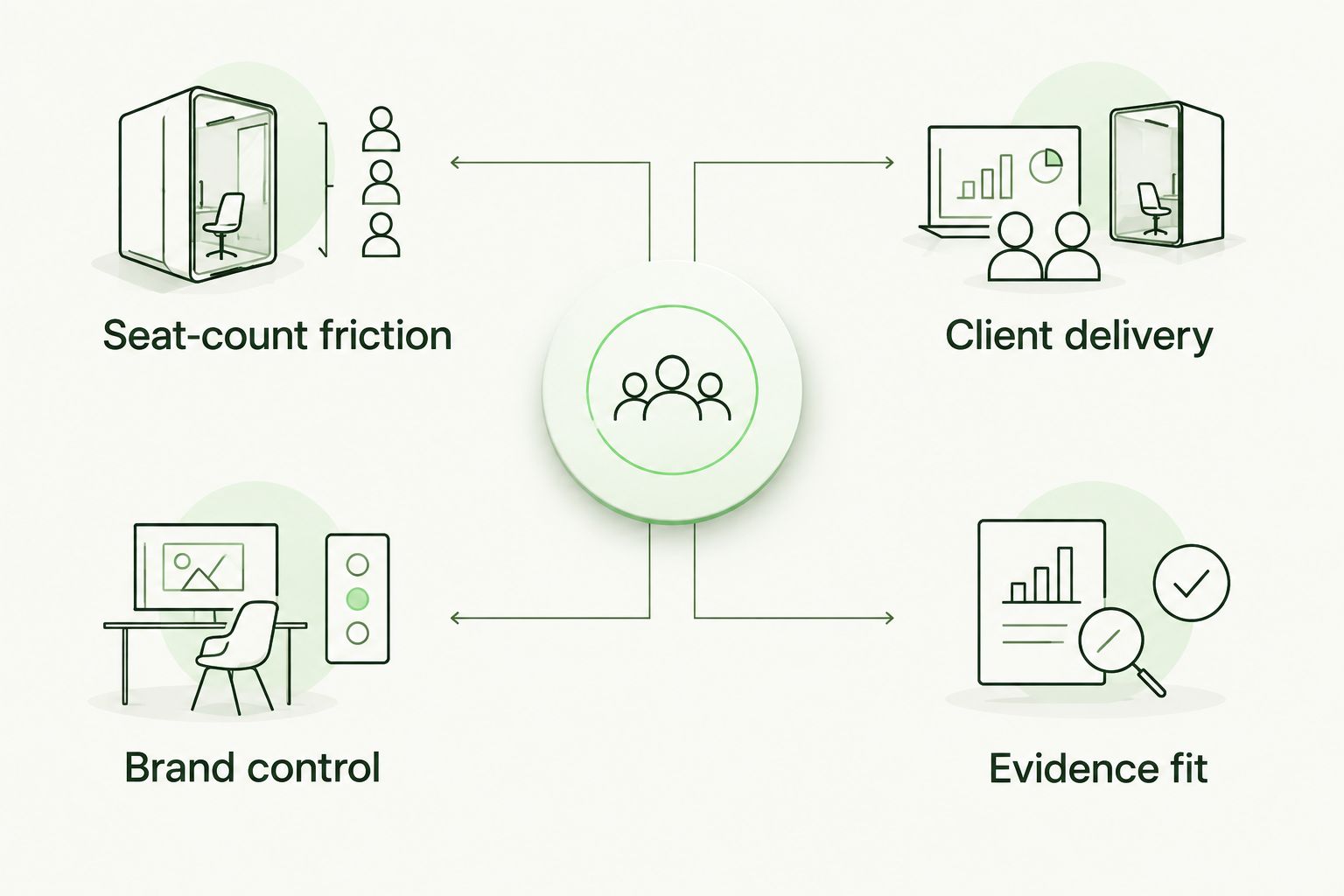
A useful switching reason names a requirement and shows where the current setup fails it. For an MSP evaluating usecure alternatives in 2026, the strongest questions are operational:
- Seat-count friction: Can you expand training across end-client users without repeatedly revisiting how coverage is purchased and administered?
- Brand control: Can you present the service to clients in the way your MSP intends?
- Client delivery: Can your team keep campaigns, assignments, and reporting clear for each end-client organization?
- Evidence fit: Can you give a client the records it actually needs, rather than a report that only shows activity occurred?
- Program emphasis: Is the priority broad training content, phishing behavior, policy workflows, or a combination?
These are selection criteria, not claims that usecure fails them. Write down the gap in your present workflow, then ask each vendor to show that exact task. A feature list cannot tell you how much work remains with your staff.
Evaluate the service work alongside the training features.
A practical 2026 evaluation sequence
Map the scope. List the end-client organizations and users the program must cover. Note who owns assignments and who answers client questions. Use the same scope for every vendor discussion; otherwise, the comparisons measure different services.
Check branding. Decide what must appear under the MSP's identity and what can remain vendor-facing. Ask to see the client experience, not just an administrative screen. If branded delivery is essential, make it a pass-or-fail requirement.
Test evidence. Pick a client request your team actually receives, such as proof of training completion or phishing-simulation activity. Have each vendor show how you would retrieve and present the relevant record. Do not equate a dashboard with evidence that satisfies the request.
Review the operating work. Identify who adds users, adjusts assignments, checks campaign outcomes, and responds when a client asks for a change. The strongest fit is the one your team can run consistently across end clients without rebuilding the process for each account.
Review MSP training fit
Assess white-label delivery and unlimited-seat coverage for your end-client program.
When staying with usecure is right
Stay with usecure when its existing training, phishing simulations, and policy management cover the work you have defined. A familiar workflow has value if your team can deliver it consistently and clients receive the evidence they need. Switching without a documented gap introduces a new setup and another process to learn.
The 2026 decision is not whether a different vendor sounds more modern. It is whether the replacement solves an MSP service problem that your current setup does not solve. If the gap is white-label delivery or seat-count friction, evaluate DefendWise against those requirements. If the gap is content choice, compare the content and the work required to administer it.
FAQ
What are the best usecure alternatives for MSPs in 2026?
DefendWise is the clearest fit for MSPs prioritizing white-label, unlimited-seat training. KnowBe4 suits content-led evaluations, Huntress suits a wider security review, and Hoxhunt suits a phishing-focused program.
Is DefendWise a better fit than usecure for white-label training?
DefendWise is built around white-label security awareness training for MSPs. Compare the client-facing delivery and evidence workflows against your current usecure setup before deciding to switch.
Does usecure offer phishing simulations?
Yes, usecure offers phishing simulations alongside security awareness training. Check whether its campaign workflow meets the needs of each end-client organization.
Does usecure include policy management?
Yes, policy management is part of usecure's offering. If it is central to your service, assess that workflow before replacing usecure with a phishing-focused option.
Which usecure alternative is best for training-content choice?
KnowBe4 is a strong starting point when a broad training catalog is the priority. Assign someone to assess content selection and ongoing administration across clients.
Which usecure alternative is best for phishing-focused training?
Hoxhunt is the phishing-focused option in this shortlist. Check client delivery and evidence separately if you are buying the program for an MSP service.
Should an MSP switch from usecure in 2026?
An MSP should switch only when a replacement solves a defined gap in coverage, branding, delivery, or evidence. Stay with usecure if its current workflows meet those requirements.
One last thing
Ask vendors to demonstrate the client request, not the feature menu. Pick a real end-client question about training or phishing activity and follow it from assignment to the evidence you would send back. In 2026, that single workflow reveals more about MSP fit than a longer list of training topics.