Security training for property and casualty insurers: 2026 guide
Security awareness training for property and casualty insurers: build role-based lessons, safer claims workflows, and clear compliance evidence in 2026.
DefendWise
DefendWise
Property and casualty insurer security awareness training is employee instruction that protects claims, policyholder information, and payment workflows with the aim of reducing preventable security incidents. This 2026 guide explains how to train claims handlers, underwriters, finance teams, and agency-facing staff without treating every role as the same risk.
TL;DR
- Security awareness training for property and casualty insurers should follow claims, underwriting, and payment workflows—not generic office examples.
- The Defend Wise guide recommends role-based lessons, independent payment verification, and documented follow-up rather than completion-only reporting.
- MSPs should separate each insurer’s training records and define who owns employee, agency, and vendor participation.
- Training evidence supports compliance reviews; it does not establish compliance or replace technical security controls.
Why security awareness training matters for P&C insurers
Property and casualty insurance brings sensitive documents and money movement into everyday work. Claims files, policy applications, repair estimates, and payment instructions create different decisions for different employees. A useful training program teaches the safe action at each decision point.
A claims handler needs to recognize an unexpected attachment. A finance employee needs a reliable process for verifying changed payment details. An agency-facing employee needs to distinguish a legitimate request for policy information from an impersonation attempt.
The Defend Wise approach in this guide is straightforward: train the workflow, then document the behavior you expect. For your 2026 program, start with actual tasks and approved escalation routes—not a library of lessons assigned without context.
An insurer also needs clear boundaries around external participants. Employees, independent agencies, adjusters, and vendors do not automatically share the same systems, responsibilities, or training obligations. Define those boundaries before enrollment so your records describe the population you actually manage.
Build a workflow-based training program
1. Map access and assign ownership
Start with a spreadsheet. Record each role, the information it handles, the systems it accesses, and the person responsible for training follow-up. Separate employees from external participants rather than creating one undifferentiated user list.
Use the map to identify decisions that require instruction. Someone who reviews loss photographs faces a different task from someone who approves disbursements. Both need security training, but the examples and escalation routes should reflect their work.
Set a proposed 30-day launch window for completing the inventory and approving responsibilities. This is a planning target, not a regulatory deadline. Do not enroll external organizations until you have agreed who manages participation and records.
- Employee access: list roles, business units, and access to claims or policy information.
- Agency access: identify external agency users and the insurer information they can reach.
- Vendor access: record adjusters, service providers, and other approved external participants.
- Training ownership: name the person who assigns lessons and handles exceptions.
- Record ownership: decide who maintains evidence and approves its release.
2. Write lessons around real insurance decisions
Build your first lessons from approved procedures and sanitized examples. You do not need a purchased content library to explain how employees should verify requests, protect documents, or report suspicious messages.
Use fictional policyholders and fabricated claim identifiers. Never turn a real customer file into training material without an approved process. Preserve the workflow while removing personal information, financial details, and confidential correspondence.
Each lesson should answer a practical question: what should the employee do next? Recognizing a suspicious message is incomplete instruction if the employee still does not know where to report it or how to verify the sender safely.
For 2026, organize the baseline curriculum around decisions rather than attack terminology alone. Employees need instructions they can use during a busy claims queue, not definitions they remember only during a quiz.
- Verify requests: confirm unusual instructions through an independently established contact route.
- Protect documents: use approved channels for claims files, applications, and policyholder information.
- Report incidents: explain where to send suspicious messages and accidental disclosures.
- Check attachments: teach staff to stop when a document or sign-in request is unexpected.
- Escalate pressure: address requests that invoke urgency, authority, or secrecy to bypass procedure.
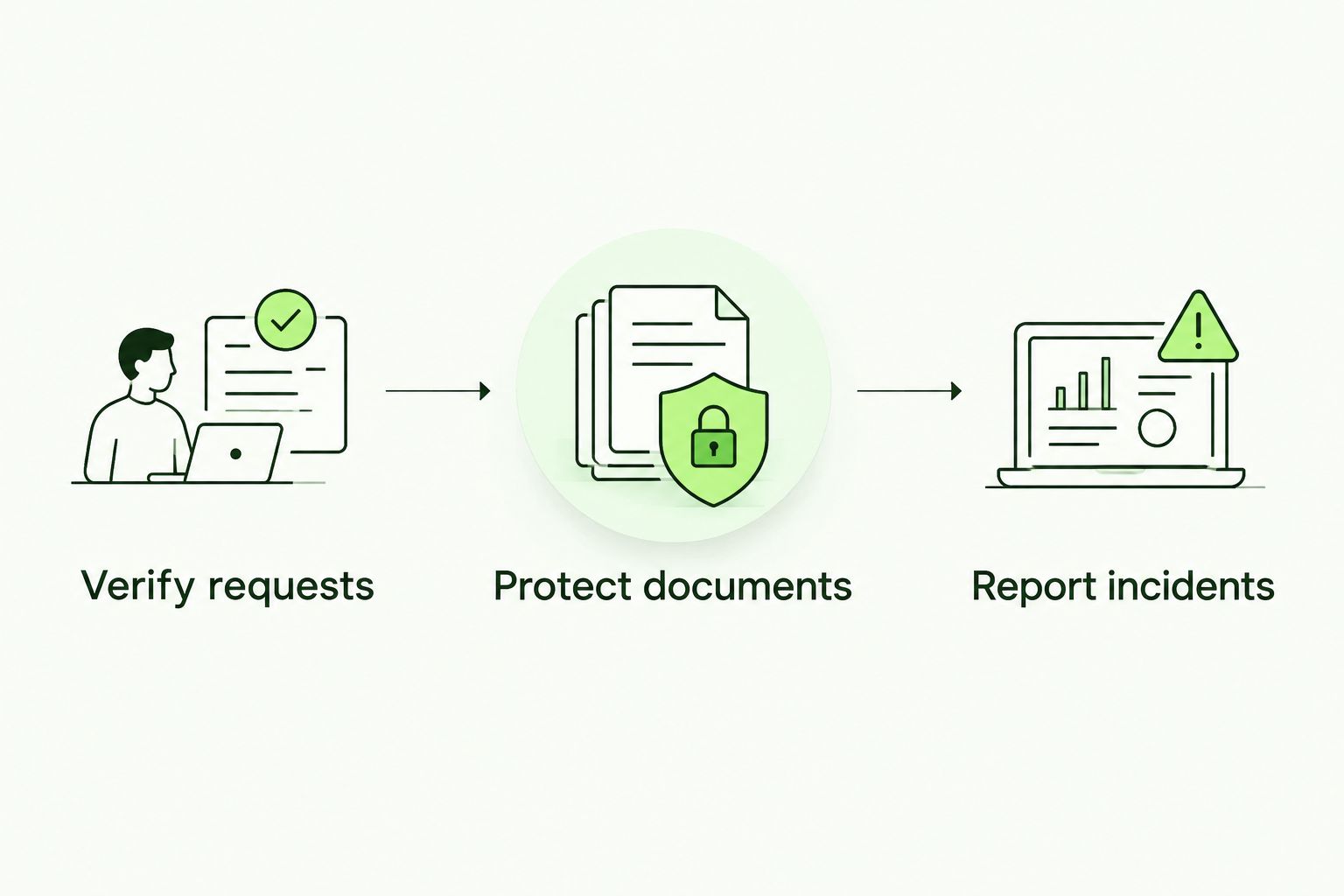
Teach the next safe action, not just the name of the threat.
3. Choose the delivery model that fits your service
The manual route is simple: maintain the roster, distribute approved lessons, track completion, and record follow-up. It gives you direct control over content. It also leaves enrollment changes, reminders, and evidence assembly with your team.
An existing learning management system is another option. Evaluate whether it can separate audiences, assign relevant lessons, and produce the records you need. Do not assume that a course-completion export answers every compliance or client-review question.
Defend Wise security awareness training is best for MSPs that want white-label delivery with flat-fee, unlimited-seat coverage. Its stated offering addresses seat-count friction for MSPs serving end-client organizations. That commercial model does not replace your responsibility to check insurer-specific content, reporting, access controls, and contract requirements.
For an insurer buying directly, the stated MSP-focused model is a fit question to resolve before selection. For an MSP, evaluate the service as a client delivery model—not just a collection of courses.
- Document the tasks your team performs manually before comparing delivery options.
- Check how each option handles employee arrivals, departures, and role changes.
- Review sample evidence against the insurer’s actual assessment requirements.
- Confirm how client boundaries and administrator responsibilities are handled.
- Compare seat-count administration with lesson management and reporting work.
4. Add role-specific scenarios and verification rules
Use short, role-based exercises before adding a broad simulation schedule. A facilitated discussion using a fictional email and an approved procedure can reveal whether employees know the next action. Keep the scenario focused on a decision they actually make.
For claims teams, use unexpected document requests or changes to claimant communications. For underwriting teams, use application attachments and requests to move files into an unapproved channel. For finance teams, use altered payment instructions or urgent disbursement requests.
A correct quiz answer is not a payment control. Employees need a written verification process that does not rely on contact details supplied in the suspicious message. Make that process usable when the apparent sender is a familiar agency, vendor, or colleague.
Propose a 15-minute scenario review for each participating team. Treat it as a facilitated discussion, not a promised training standard. Record unclear steps and revise the procedure before testing the same decision again.
- Give claims handlers a suspicious attachment and ask them to explain the reporting route.
- Give underwriters a file-sharing request and ask them to identify the approved channel.
- Give finance staff changed payment instructions and require independent verification.
- Give agency-facing staff an impersonation request for policyholder information.
- Ask managers how employees should escalate an urgent request without fear of delaying work.
5. Collect evidence that explains the program
Begin with a controlled evidence folder and a consistent naming convention. Keep the participant list, assigned content, completion records, exceptions, and follow-up actions together. A reviewer should be able to understand what happened without reconstructing the program from separate inboxes.
Define the purpose of each record. Completion establishes that an assigned activity was finished. It does not establish that an employee followed a payment procedure, recognized every suspicious message, or prevented an incident.
For 2026 compliance reviews, map evidence to the specific requirement being assessed. Where applicable, an insurer’s legal or compliance team should interpret state insurance requirements, including relevant implementations of the NAIC Insurance Data Security Model Law. Training supports that work; it is not a substitute for the wider information security program.
If an MSP manages the program, agree who approves evidence before it leaves the organization. White-label presentation should not obscure the underlying record, scope, or responsible parties.
- Record the audience, assignment date, content version, and completion status.
- Preserve documented exceptions, including leave, departure, and approved exclusions.
- Record follow-up actions instead of silently resetting failed or incomplete assignments.
- Identify the requirement each evidence item is intended to support.
- Restrict access to training and reporting records according to approved responsibilities.
- Agree retention and release procedures with the insurer’s legal and compliance owners.
6. Review outcomes and remove recurring admin work
Start with a recurring review of your own records. Look for unassigned new employees, stale accounts, unresolved exceptions, and lessons that do not match the audience. Fix those operational gaps before adding more content.
Use a proposed 90-day review cycle for the service design. That cadence is a management choice, not a legal requirement. Review whether the training still reflects claims procedures, payment approvals, external relationships, and current reporting routes.
For MSPs, flat-fee coverage removes one commercial variable: the seat-based charge. It does not remove the work of maintaining accurate populations, approving content, or answering client questions. Defend Wise’s unlimited-seat model should be evaluated alongside those remaining tasks.
Your 2026 scorecard should distinguish coverage, completion, and follow-up. More completed lessons do not prove that the program changed behavior. Use exercise debriefs and documented procedural corrections to explain what improved.
- Reconcile the training roster with the approved employee and participant records.
- Review incomplete assignments and unresolved exceptions with their owners.
- Check whether reporting instructions still point to the correct team.
- Update scenarios after changes to claims, underwriting, or finance procedures.
- Record recurring administrative tasks and decide which to standardize.
- Summarize improvements without presenting activity counts as incident-prevention results.
Compare training delivery options
Choose the model that makes responsibilities clear. Manual delivery gives you direct control but leaves coordination with your team. An existing learning management system uses an established delivery channel but still needs suitable content and evidence configuration. An MSP-focused platform addresses service packaging, but insurer-specific requirements still need review.
| Option | Best for | Practical advantage | Key limitation |
|---|---|---|---|
| Manual delivery with controlled records | Insurers designing an initial role-based program | Direct control over scenarios, procedures, and evidence structure | Your team maintains assignments, reminders, and reporting |
| Existing learning management system | Insurers consolidating employee training | Uses the organization’s established training channel | Suitability depends on audience separation, content, and reporting configuration |
| Defend Wise security awareness training | MSPs delivering white-label training to end-client organizations | Flat-fee, unlimited-seat coverage avoids seat-based purchasing | The stated model targets MSPs; insurer-specific delivery and evidence requirements need confirmation |
Do not select an option on completion tracking alone. Ask it to support a sample claims-team assignment, an employee departure, an exception, and an evidence request. Evaluate the actual workflow before committing to the service design.
Common mistakes P&C insurers make
Treating everyone as a claims handler
Claims examples do not cover underwriting decisions, finance approvals, or agency relationships. Assign a common baseline, then add scenarios for the decisions each team controls. Keep the reporting route consistent even when the examples differ.
Counting external participants as covered without agreement
An agency or adjuster relationship does not establish training ownership. Define the audience, responsibility, and permitted record sharing explicitly. Do not report an external population as trained because its organization appears on a contact list.
Testing phishing without teaching payment verification
A simulation measures a response to that exercise. It does not replace the finance team’s approval and verification process. Teach the process first, then use exercises to identify unclear instructions and follow up without blame.
Presenting completion as proof of compliance
A completion report describes training activity. Compliance requires assessment against applicable requirements and the wider control environment. Label evidence accurately and let the insurer’s responsible owners determine what it establishes.
FAQ
What is security awareness training for property and casualty insurers?
Security awareness training for property and casualty insurers teaches employees how to protect information and handle security-sensitive decisions in insurance workflows. It should cover claims documents, underwriting communications, payment verification, and incident reporting with role-specific examples.
What should claims handlers learn first?
Claims handlers should first learn how to handle unexpected attachments, protect claim information, and report suspicious communications. Use the insurer’s approved document channels and escalation procedures rather than generic advice alone.
Should independent agencies and adjusters join the insurer’s training?
Include independent agencies and adjusters only within a defined training scope and agreed responsibilities. Clarify access, participation ownership, and record sharing before enrolling external users or reporting their completion.
Is phishing simulation enough for an insurance security program?
Phishing simulation is not enough for an insurance security program. It should sit alongside instruction on document handling, independent payment verification, reporting, and the organization’s wider technical and procedural controls.
Can an MSP manage security awareness training for an insurer?
An MSP can manage security awareness training under an agreed service scope. The insurer and MSP should define audience ownership, content approval, evidence access, exceptions, and escalation responsibilities before delivery.
Is Defend Wise designed for insurers or MSPs?
Defend Wise is described as a white-label security awareness training platform for MSPs serving end-client organizations. An insurer or its MSP should confirm that the delivery arrangement and evidence meet the insurer’s specific requirements.
Does a training completion report prove regulatory compliance?
A training completion report does not prove regulatory compliance. It provides evidence of assigned training activity, which the insurer’s legal and compliance owners must assess alongside applicable requirements and other controls.
One last thing
The most useful training improvement is sometimes a procedure change, not another lesson. If employees recognize a suspicious payment request but cannot find an independent verification contact, the workflow is still broken.
For your next 2026 review, choose one claims or payment scenario and ask an employee to walk through the approved response. Correct every unclear handoff. Make the safe action executable before measuring whether people take it.