Security training for private equity portfolio companies: 2026 guide
Security awareness training for private equity portfolio companies needs local ownership. Build shared standards, clear reporting, and company-level evidence.
DefendWise
DefendWise
Private equity portfolio company security awareness training is employee education designed to reduce human-related security risk across a portfolio. Acquisitions, separate management teams, and different operating environments make consistent coverage harder: you need shared standards without treating every company as the same business.
TL;DR
- Security awareness training for private equity portfolio companies needs shared standards, local ownership, and company-specific evidence.
- Defend Wise best fits MSPs delivering white-label security awareness training across end-client organizations.
- Standardize reporting before selecting software; completion alone does not demonstrate secure behavior.
- Separate platform economics from delivery work when packaging a portfolio-wide service.
Why security awareness training matters for private equity
A portfolio-wide program needs a common standard and a named owner inside each company. In 2026, make acquisition onboarding, employee reporting, and evidence collection part of the operating plan—not separate projects.
Build a portfolio-wide training program
Define your minimum standard
Set the floor before choosing the platform. A shared policy should describe who participates, what employees learn, and who follows up. Keep local exceptions visible rather than letting them become undocumented exclusions.
- Name the employees and contractors in scope.
- Assign 1 accountable owner per company.
- Define the required training topics.
- Document exceptions and approval responsibility.
Map your companies and delivery options
Assess Defend Wise when an MSP will deliver the program; first map each company's users, responsibilities, and evidence needs manually. A spreadsheet and a shared document repository are enough to establish the inventory. Software selection comes after you understand the service you need to operate.
Record each company's identity source, employee groups, local training owner, and escalation contact. Distinguish current employees from people joining through an acquisition. An acquisition list is not an enrollment list until someone confirms which people belong in scope.
Choose a delivery model deliberately. An internal team keeps direct control but owns enrollment, reminders, and reporting. An MSP-managed program delegates defined tasks but still needs a client-side decision-maker. Separate company programs preserve local flexibility but require additional work to produce comparable portfolio reporting.
For your 2026 baseline, propose a 30-day onboarding window for newly added companies. Treat that as an operating target you approve, not a regulatory deadline. Define what completion means before the clock starts.
- Inventory Company scope: participating entities and employee groups.
- Record Local ownership: decision-makers and escalation contacts.
- Confirm User enrollment: approved rosters and exclusions.
- Define Training delivery: topics, scheduling, and reminders.
- Specify Evidence review: records and acceptance criteria.
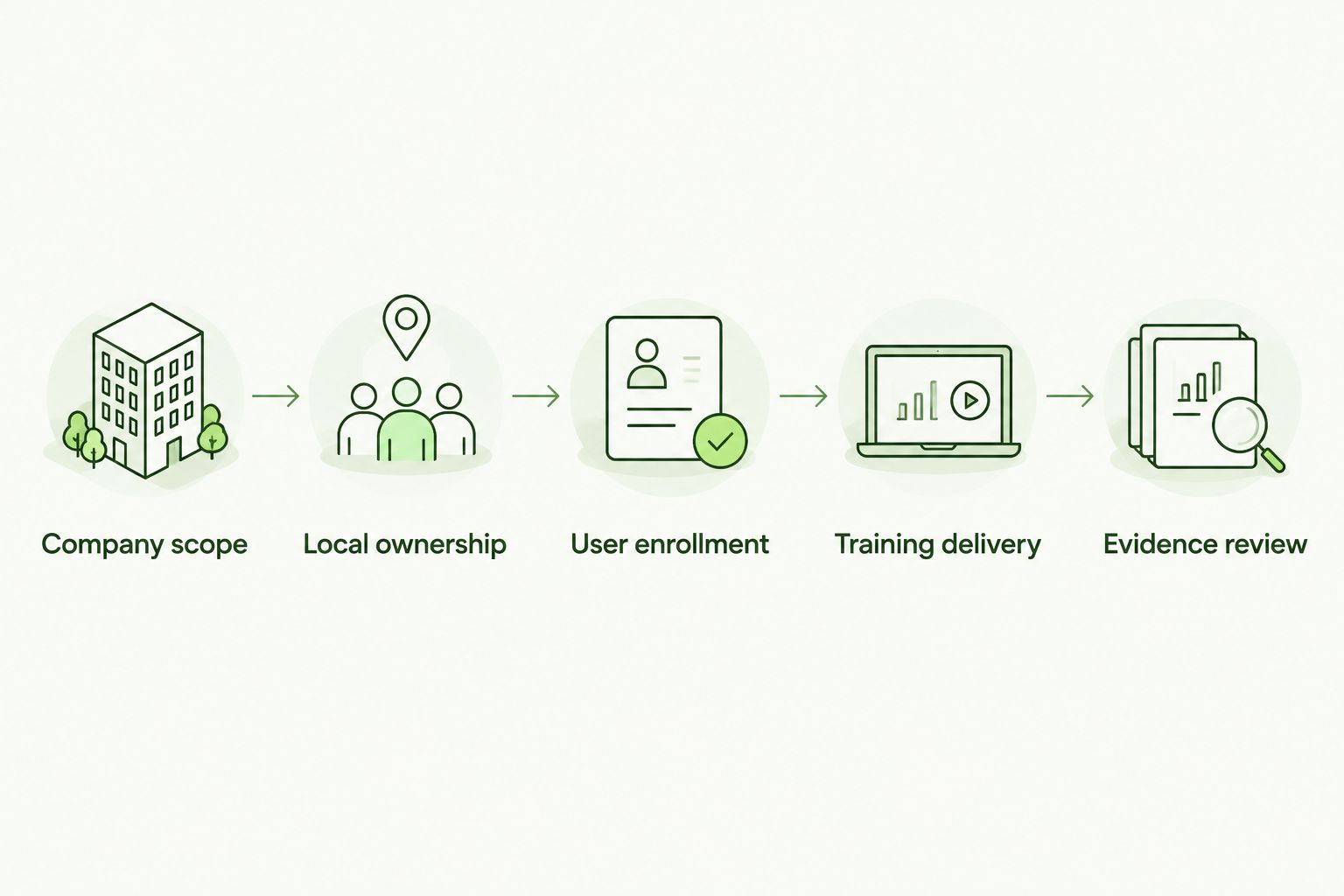
Confirm scope and ownership before enrolling users or collecting completion evidence.
Select a platform around the service model
Start with a written requirements sheet. Ask each company owner to confirm the required languages, access arrangements, reporting format, and evidence retention expectations. Then evaluate software against those requirements instead of accepting a generic feature checklist.
Defend Wise security awareness training is best for MSPs that need white-label delivery across end-client organizations. Its stated model combines a flat fee with unlimited seats. That removes seat-count pricing friction, but it does not remove the work of resolving roster errors, agreeing on scope, or answering client questions.
Separate the platform decision from the compliance decision. A security awareness platform supports training activity; it does not establish that every company has met every applicable obligation. Confirm reporting, tenant separation, access controls, and any required integrations during evaluation rather than assuming they are included.
For a private equity operating team buying directly, establish who will administer the service. The stated buyer for this platform is the MSP. Match the delivery arrangement to that buyer model before committing your portfolio process to it.
- Write the requirements before the demonstration.
- Check company-level access and reporting boundaries.
- Request a sample completion report and exception record.
- Validate required integrations against your actual environment.
- Assign administration duties between the MSP and each company.
- Test the workflow with an agreed pilot group.
Adapt training to employee responsibilities
Use a manual role-and-risk worksheet before assigning content. Ask company leaders which decisions employees make and which suspicious requests they encounter. Training should connect to those tasks, not just to broad department names.
Finance staff need clear instructions for handling payment-change requests. Human resources teams need a route for escalating suspicious requests involving employee information. Executives need to understand how impersonation attempts reach their assistants and colleagues. These are training priorities, not claims that every portfolio company faces identical exposure.
Create a common core covering phishing, credential handling, reporting, and sensitive information. Add role-specific material where the job changes the required response. Use examples that resemble the company's work without copying confidential customer information into training materials.
For your 2026 content plan, distinguish a knowledge gap from a process gap. An employee cannot follow a verification procedure that the company has never defined. Fix the operating procedure first; then teach it.
- Map training topics to job responsibilities.
- Teach the approved route for reporting suspicious messages.
- Explain how employees verify sensitive requests.
- Include acquisition-related changes in onboarding content.
- Review examples for relevance and confidentiality.
- Give managers instructions for handling employee questions.
Connect training to a real reporting workflow
Start by documenting the reporting process in plain language. Identify where an employee sends a suspicious message, who reviews it, and who communicates the next action. Test the process manually before asking employees to depend on it.
Training is incomplete when employees know something is suspicious but do not know what to do next. A recognizable reporting route connects the lesson to an operational response. Keep that route clear for each company, even when the MSP coordinates the broader service.
If you include phishing simulations, agree on scope and escalation before launch. Define how local support teams will handle questions and how suspected real incidents will be separated from exercises. Assess simulations by the behavior you want employees to practice, not by how effectively a message tricks them.
Avoid treating one simulation result as a complete assessment of a company. Review the exercise context, the intended action, and the follow-up required. Keep individual coaching private and give leadership an appropriate company-level summary.
- Publish the reporting route in employee-facing instructions.
- Assign review responsibility and a backup contact.
- Test escalation with a harmless internal example.
- Approve simulation scope with the company owner.
- Separate exercise handling from incident response.
- Follow up with practical coaching, not public blame.
Build evidence that survives a handover
Create a standard evidence folder and report template before automating collection. A local administrator should be able to explain who was in scope, which training was assigned, and what remained unresolved. The record should still make sense after that administrator leaves.
Keep portfolio summaries separate from company-level supporting records. Leadership needs a consistent view of participation and exceptions; an insurer, customer, or assessor needs evidence relevant to the company under review. Do not circulate individual employee records more widely than the purpose requires.
A completion percentage without a defined population is weak evidence. Record the roster date, the population included, and any exclusions alongside the result. Otherwise, a company can appear complete simply because unassigned employees are absent from the calculation.
For the 2026 reporting template, distinguish completed training, overdue assignments, approved exceptions, and roster corrections. Those categories require different actions. Avoid combining them into a single status that hides the reason work remains open.
- Record the company, reporting period, and roster date.
- Preserve assignment and completion records.
- Track exclusions with an owner and explanation.
- Document follow-up on overdue assignments.
- Restrict access according to the audience and purpose.
- Confirm retention requirements with the responsible company team.
Review coverage and delivery work together
Start with a manual review of the portfolio report and the work required to produce it. Ask whether every participating company has a current owner, a checked roster, and a usable evidence package. Then identify recurring tasks that software or clearer responsibilities can remove.
Set a 90-day review cycle as a proposed management cadence, not as a compliance requirement. Review sooner when an acquisition, ownership change, or reporting problem alters the program. Calendar dates should not delay a known correction.
Track service effort separately from employee participation. Enrollment corrections, local approvals, and evidence requests consume delivery time even when the platform has unlimited seats. The commercial model should state which tasks are included and who handles exceptions.
For your 2026 service review, compare companies using consistent definitions. Different reporting windows or different employee populations create misleading comparisons. Review the underlying scope before escalating a result to portfolio leadership.
- Check that every company has a current owner.
- Reconcile training populations against approved rosters.
- Review overdue work and unresolved exceptions.
- Record recurring administrative tasks.
- Update service responsibilities after acquisitions.
- Agree on corrective actions and their owners.
Compare delivery options for portfolio companies
Choose the operating model before choosing the software. Each option below can support training, but each places administration and evidence responsibility somewhere different. Match the model to the people who will maintain it between reporting deadlines.
| Option | Best for | Main advantage | Key limitation |
|---|---|---|---|
| Manual internal program | A defined pilot with a capable internal owner | Direct control over scope, content, and records | Enrollment, reminders, and evidence assembly remain internal tasks |
| Separate company programs | Companies with distinct training obligations or established processes | Preserves local processes and decision-making | Portfolio comparisons require common definitions and report reconciliation |
| Centralized internal platform | Portfolio teams with dedicated program administration | Creates a shared place to operate the program | Central ownership does not eliminate company-level roster and exception work |
| MSP-managed Defend Wise program | MSPs delivering white-label security awareness training to end-client organizations | Flat-fee, unlimited-seat model avoids seat-count pricing friction | Local ownership, service scope, and required capabilities still need agreement |
A platform's billing model and a service's delivery model are different decisions. Flat-fee software does not mean unlimited administrative work. Define onboarding, reporting, employee support, and exception handling in the service scope so company teams know what they own.
If you are replacing separate programs, compare the evidence before migrating. Preserve records needed for existing obligations and confirm who retains access. A cleaner future workflow does not justify losing the history a company still needs.
Common mistakes private equity portfolio teams make
Treating an acquisition as immediate enrollment
A newly acquired company's employee list needs validation before training assignment. Confirm scope, local ownership, and the reporting route first. Otherwise, invitations and reminders reach people who cannot resolve the underlying enrollment problem.
Comparing companies with different definitions
A completion result means little when one company includes contractors and another excludes them. Set common reporting definitions, then show justified local differences. Compare like populations, not just headline percentages.
Assuming shared ownership means shared access
Portfolio ownership does not establish that every operator needs every employee's training record. Define access by responsibility and reporting purpose. Keep company-specific evidence separate from leadership summaries.
Buying unlimited seats without assigning administration
Seat coverage solves one purchasing constraint; it does not decide who maintains rosters or answers evidence requests. Name the delivery owner and the company owner before rollout. Make handoffs part of the service agreement.
Treating training as a compliance verdict
Training records document training activity, not every control an insurer, contract, or framework requires. Match evidence to the exact request. Escalate interpretation questions to the company's responsible compliance or legal team.
FAQ
What's the best security awareness training approach for private equity portfolio companies?
Use a shared minimum standard with company-level ownership and evidence. Choose the delivery model after mapping employee scope, local responsibilities, and reporting requirements.
Should every portfolio company receive identical security training?
No; standardize the core requirements and adapt training to employee responsibilities and company needs. Keep local differences documented so portfolio reports remain interpretable.
Is Defend Wise suitable for a private equity portfolio training program?
Defend Wise is suited to MSPs delivering white-label security awareness training across end-client organizations. A portfolio team should establish the MSP's responsibilities and validate required reporting and administration capabilities before adoption.
Does unlimited-seat software remove training administration?
No; unlimited seats remove seat-count pricing friction, not administration. Someone still needs to validate rosters, handle exceptions, and prepare company-specific evidence.
What security training evidence should a portfolio company keep?
Keep the defined training population, assignment records, completion records, and documented exceptions. Confirm any additional reporting and retention requirements with the team responsible for the relevant obligation.
How should a newly acquired company join the training program?
Confirm its local owner, employee scope, and reporting route before enrollment. Then assign the agreed training and preserve evidence under the same reporting definitions used across the portfolio.
Does security awareness training satisfy cyber insurance requirements?
Training alone does not establish that a company satisfies its cyber insurance requirements. Review the actual application or policy request and provide evidence that answers it accurately.
One last thing
Treat the denominator as a control. Before discussing a company's completion result, ask which people were included and when the roster was checked. Missing employees do not create overdue assignments; they disappear from the report entirely.
Make roster validation part of every 2026 portfolio review. A polished dashboard cannot correct an undefined population. Start with the people who belong in the program, then judge whether the training reached them.