Security training for medical device manufacturers: 2026 guide
Security awareness training for medical device manufacturers needs role-specific scenarios, clear reporting, and usable evidence. Build your 2026 program.
DefendWise
DefendWise
Medical device manufacturers’ security awareness training is workforce education that helps employees recognize, report, and avoid cyber threats affecting device development, production, and business operations. This 2026 guide separates employee awareness from product-security engineering and shows how to build a program with role-specific scenarios, clear reporting routes, and usable evidence.
TL;DR
- Security awareness training for medical device manufacturers must cover engineering, production, suppliers, and incident reporting—not just office phishing.
- Defend Wise security awareness training is best for MSPs seeking white-label delivery with unlimited seats.
- Workforce training supports cybersecurity controls; it does not replace device testing, secure development, or regulatory documentation.
- Measure reporting quality and corrective actions alongside completion, then retain evidence by role and organization.
Why this matters
A manufacturer needs more than a completion report. Employees make decisions about design files, supplier messages, production access, service requests, and software changes. Your training must connect those decisions to the procedures employees actually use.
Separate workforce awareness from product cybersecurity. Awareness teaches people to recognize and escalate suspicious activity. Product cybersecurity addresses the security of the device and its supporting systems. Treating those as interchangeable leaves both programs poorly defined.
For MSPs delivering this service, Defend Wise provides a white-label security awareness training platform with unlimited seats. That delivery model addresses seat-count friction; it does not determine which manufacturer-specific controls or regulatory obligations apply.
Why security awareness training matters for medical device manufacturers
Medical device manufacturers combine functions with different exposure: engineering handles technical information, production follows controlled processes, purchasing works with suppliers, and service teams receive requests from customers. A generic lesson cannot explain the right response for every role.
The practical constraint is consistency. A production employee needs an approved reporting route that works during a shift. An engineer needs to know where to escalate a suspicious dependency or repository message. Finance needs an independent way to verify changed payment instructions.
In 2026, build the program around these decisions rather than a calendar of interchangeable courses. The goal is observable behavior: employees stop, verify, report, and preserve relevant information without improvising changes to controlled systems.
For manufacturers submitting applications for devices that meet the statutory definition of a cyber device, section 524B of the Federal Food, Drug, and Cosmetic Act establishes cybersecurity requirements. Training completion alone does not satisfy those requirements. Use workforce evidence for its actual purpose, not as a substitute for device-specific documentation.
How to build the training program
Map your people, systems, and decisions
Start with a spreadsheet and interviews with the people responsible for engineering, production, IT, quality, and service. Record what each group accesses, which requests it receives, and who owns escalation. This manual inventory establishes the scope before you select a platform.
Do not group everyone under a single employee label. A contractor with repository access and an operator using a shared workstation face different decisions. Your 2026 training plan should distinguish those decisions without collecting unnecessary personal information.
Choose a 30-day baseline period to assemble the inventory and confirm reporting routes. This is a planning recommendation, not a regulatory deadline. Finish with named owners, not an expanding list of possible threats.
- Role inventory: identify employees, contractors, temporary staff, and relevant external users.
- System access: record access to email, repositories, production systems, and service tools.
- Critical decisions: identify approvals, file transfers, access requests, and payment changes.
- Reporting owners: name the team responsible for each escalation route.
- Evidence ownership: assign responsibility for retaining records and correcting gaps.
Write scenarios around actual work
Build the first scenarios yourself using sanitized examples of routine workflows. Remove confidential design details, customer information, credentials, and identifying employee information. A scenario should test a decision, not the employee’s ability to spot an exaggerated spelling mistake.
For engineering, use an unexpected request to share a design file or approve repository access. For purchasing, use a supplier message requesting changed bank details. For service teams, use an unverified request for remote access to a customer environment.
Make the correct response explicit. Employees should know which independent channel to use, what information to preserve, and what action to avoid. Do not teach staff to investigate suspicious files or test unknown software themselves.
- Engineering: verify unexpected access requests through an approved channel.
- Production: report unfamiliar removable media without connecting it.
- Purchasing: confirm payment changes through an established verification process.
- Service: validate requester identity before arranging remote access.
- Quality: escalate suspicious requests to alter or disclose controlled records.
Choose delivery around the service model
You can deliver an initial program through instructor-led sessions, approved materials, and a controlled attendance register. This makes a useful starting point when you need to clarify responsibilities before introducing another system. Its limitation is the administrative work of assigning, following up, and organizing evidence.
For MSP delivery, Defend Wise security awareness training provides a white-label platform with unlimited seats. Defend Wise is best for MSPs that want white-label security awareness training without seat-count friction. The manufacturer's role map and approved procedures still need to shape the program.
Assess the entire workflow, not just course delivery. Ask how the platform handles organizational separation, record retrieval, employee changes, and your required content. Confirm those capabilities before promising them to a client.
- Manual baseline: test approved lessons with a controlled attendance register.
- Delivery ownership: decide whether the manufacturer or its MSP administers training.
- Client separation: verify how organizational boundaries work in the proposed setup.
- Content fit: check whether lessons support your role-specific decisions.
- Evidence retrieval: test whether you can obtain the records your process requires.
Schedule learning around operational constraints
Use an approved calendar and supervisor coordination before relying on automated reminders. Training should not interrupt a controlled production task or encourage employees to use unauthorized devices. Give each group an approved place and time to participate.
For your 2026 pilot, choose a 15-minute scenario exercise and ask employees to explain their response. That duration is a suggested exercise length, not a claim about attention spans or a mandated training interval. Adjust the format when the task needs more explanation.
Include new starters and people changing roles. A course completed before someone received production or repository access does not demonstrate that they understand the new responsibilities. Link assignments to access changes and relevant procedure updates.
- Shift access: provide an approved participation route for each working pattern.
- Onboarding: explain reporting and verification before granting relevant access.
- Role changes: assign instruction for newly introduced responsibilities.
- Accessible materials: check language, readability, and participation needs.
- Procedure changes: update scenarios when the approved workflow changes.
Rehearse reporting without disrupting production
Begin with a tabletop exercise: present a suspicious message, ask what the employee would do, and follow the reporting route together. You can test comprehension without sending simulated messages or touching production systems.
If you introduce phishing simulations, define the scope and get approval from the responsible teams. Avoid collecting real credentials, exposing sensitive information, or prompting unsafe actions. A simulation that creates an operational problem is a failed exercise, regardless of its reporting results.
Make the response supportive and specific. Tell employees whether the report reached the correct team and what information helped. Public embarrassment creates the wrong incentive: concealment instead of early escalation.
- Scenario approval: agree on content, recipients, and exclusions before launch.
- Reporting route: use the same approved channel employees use for real concerns.
- Safe boundaries: exclude credential collection and production-system interaction.
- Response feedback: explain the correct action without naming or shaming employees.
- Follow-up action: correct confusing instructions revealed by the exercise.
Build evidence around actions, not badges
Start with a controlled register that connects the participant, assigned role, training material, completion record, and follow-up action. A certificate without context does not explain what the employee learned or which responsibility the training addressed.
Keep training records separate from regulatory conclusions. Quality, legal, and security owners should decide how workforce evidence supports the organization’s applicable obligations. The training administrator should not label an organization compliant simply because a dashboard is green.
Use this evidence cycle to keep records connected to improvement: Assign, Teach, Report, Review, Correct. Each stage needs an owner and a record appropriate to the task. Retain records according to your approved retention and access-control procedures.
- Assign: record the role, requirement, and responsible owner.
- Teach: identify the material and its approved version.
- Report: capture participation and relevant exercise outcomes.
- Review: distinguish a knowledge gap from a broken procedure.
- Correct: record the action taken and who confirmed completion.
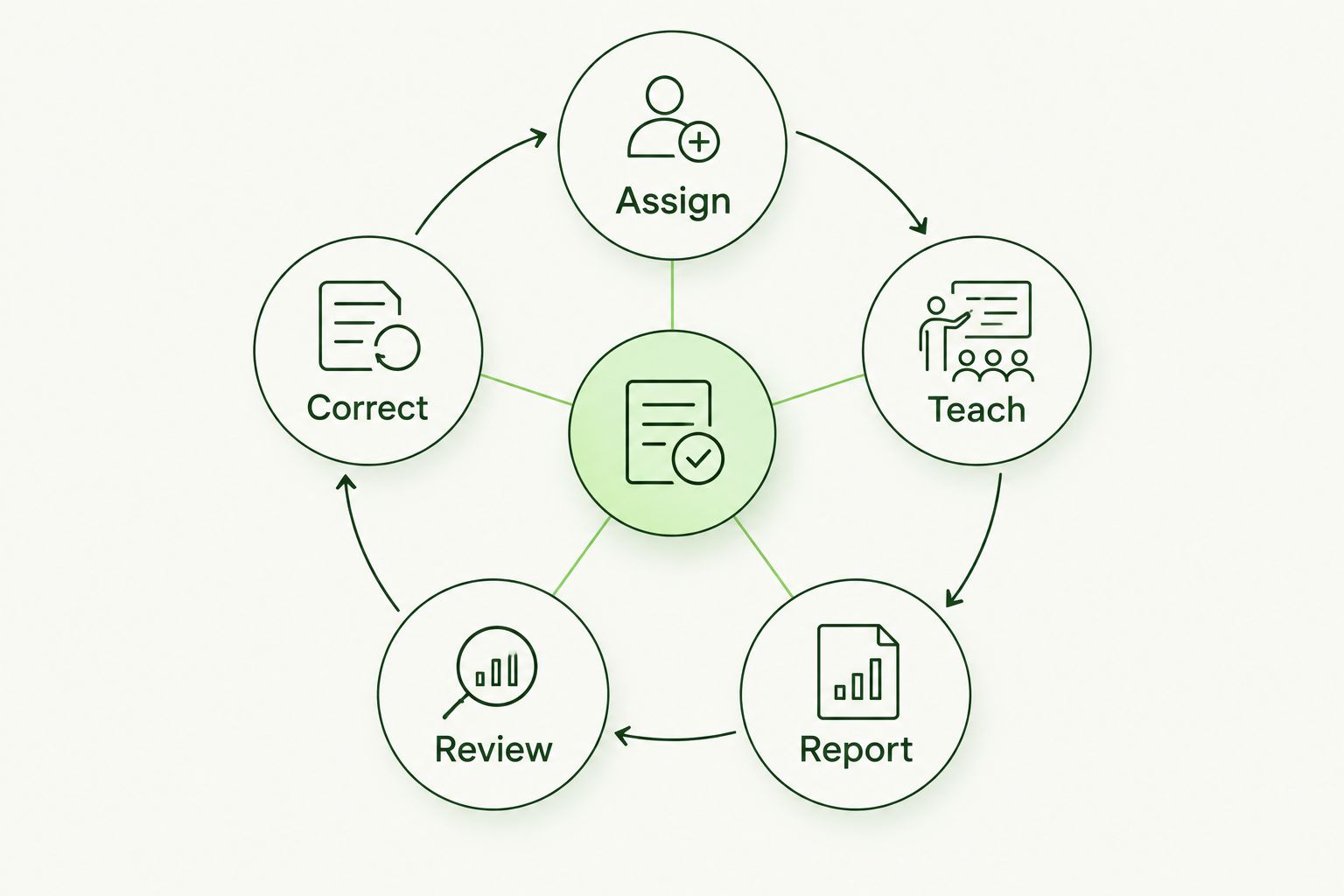
Completion becomes useful evidence when it connects to review and corrective action.
Review results and fix the workflow
Set a 90-day review interval for the initial program, then adjust it to your approved governance process and relevant changes. This is a recommended operating cadence, not a legal minimum. Review sooner when an incident or procedure change exposes a gap.
Your 2026 review should examine more than completion. Check whether employees recognized the request, chose the correct reporting route, and supplied useful information. Separate an employee misunderstanding from a route that nobody could find or a procedure that contradicted the lesson.
Measure administration too. An MSP needs to know whether assignment, reminders, exceptions, and evidence requests consume avoidable work. Unlimited seats remove seat-count constraints; they do not, by themselves, establish how much administration the program requires.
- Coverage: compare assigned roles with completed instruction.
- Reporting quality: assess whether reports contain useful, appropriate information.
- Response routing: check whether the correct team received the concern.
- Repeat gaps: identify decisions that remain unclear after instruction.
- Administrative work: record time spent on assignments, exceptions, and evidence requests.
- Corrective closure: verify that agreed improvements reached the affected teams.
Compare your delivery options
Choose the option that matches the delivery owner and evidence requirements. Do not select a platform before defining the manufacturer’s workflows. A convenient purchasing model cannot compensate for training that omits production, engineering, or supplier decisions.
| Option | Best for | Main advantage | Key limitation |
|---|---|---|---|
| Instructor-led training with controlled records | Manufacturers establishing role-specific procedures | Direct discussion of local decisions and escalation routes | Assignments, follow-up, and evidence organization require manual work |
| General-purpose learning management system | Organizations managing training through an existing learning process | Keeps security instruction within the established training workflow | Verify security-specific exercises, reporting, and organizational separation |
| Per-seat security awareness platform | Buyers choosing a seat-based purchasing model | Provides a purchasing structure tied to licensed users | Seat counts become an additional licensing variable to manage |
| Defend Wise | MSPs delivering white-label security awareness training | White-label delivery and unlimited seats | Manufacturer-specific content and required evidence workflows need validation |
A general-purpose learning system is not automatically unsuitable, and a specialist platform is not automatically sufficient. Test your actual assignment, reporting, and evidence tasks before choosing.
For Defend Wise, the supported advantage is its MSP-focused delivery model. Assess the operational fit separately. Do not assume medical-device-specific content, engineering instruction, integrations, or regulatory coverage from the platform category alone.
Common mistakes medical device manufacturers make
Treating awareness as device-security validation
An employee who identifies phishing has not demonstrated that a device resists attack. Keep awareness records distinct from threat modeling, security testing, vulnerability handling, and device submission documentation. Assign each activity to the appropriate owner.
Training office staff while overlooking production access
Email-based assignments do not establish that every person with relevant access received instruction. Map shift workers, shared-workstation users, contractors, and service personnel explicitly. Provide an approved participation method instead of asking supervisors to improvise one.
Using engineering scenarios that reveal sensitive information
Realism does not require exposing design files, customer records, or credentials. Sanitize examples and approve them before distribution. Test the decision employees need to make, not their familiarity with confidential project details.
Confusing manufacturer status with HIPAA applicability
Manufacturing medical devices does not, by itself, make an organization a HIPAA covered entity or business associate. Determine applicability from the organization’s activities and relationships with qualified owners. Train employees on the obligations that actually apply to their work.
Reporting completion while leaving response routes untested
A completed lesson is not proof that a suspicious request reaches the right team. Rehearse the route and confirm ownership. When employees follow the instruction but the process fails, fix the process rather than assigning the same lesson again.
FAQ
What is security awareness training for medical device manufacturers?
Security awareness training for medical device manufacturers teaches employees to recognize, avoid, and report threats affecting their work. It should cover engineering, production, supplier interactions, service requests, and approved escalation procedures.
Does security awareness training satisfy FDA device cybersecurity requirements?
Security awareness training alone does not satisfy FDA device cybersecurity requirements. For applicable cyber devices, section 524B addresses device-specific cybersecurity obligations that require more than employee training records.
Who needs training at a medical device manufacturer?
Assign training according to access and responsibilities, including relevant employees, contractors, production workers, engineers, and service personnel. Use a role inventory to determine coverage rather than assuming that an email distribution list includes everyone.
Is Defend Wise suitable for MSPs serving medical device manufacturers?
Defend Wise fits MSPs seeking white-label security awareness training with unlimited seats. Confirm manufacturer-specific content, organizational separation, and required evidence workflows before including those capabilities in a client commitment.
Should production workers receive the same training as office staff?
Production workers need instruction matched to their access, equipment, and approved procedures. Shared foundations can remain consistent, but production scenarios and participation methods should reflect the actual working environment.
How often should a manufacturer review its training in 2026?
Use a 90-day review interval as an initial operating recommendation, not a regulatory minimum. Review sooner when an incident, access change, or revised procedure reveals a training gap, and align the cadence with approved governance.
Does every medical device manufacturer need HIPAA training?
Medical-device manufacturing alone does not establish HIPAA applicability. Determine whether the organization is a covered entity or business associate and identify the responsibilities relevant to each role before assigning HIPAA-specific instruction.
What evidence should a manufacturer retain from security training?
Retain records connecting the participant, role, assigned material, completion, relevant exercise outcome, and corrective action. Follow approved retention and access-control procedures, and keep workforce evidence distinct from device-security validation.
One last thing
Test the reporting route before buying more content. Present an approved supplier-message scenario and ask an employee to show where they would report it. Do not ask them to interact with a live suspicious message.
If the employee recognizes the threat but cannot identify the owner, another awareness lesson misses the problem. The missing control is a usable response process.
For your next 2026 planning meeting, bring the role inventory, an approved scenario, and the reporting route. Decide who receives the report, who responds, and what evidence survives. That gives the training program a concrete job—and gives the manufacturer a way to judge whether it works.