Security training for county and state agencies: 2026 guide
Security awareness training for county and state government agencies: prioritize reporting, role-based lessons, and evidence with a practical 2026 MSP guide.
DefendWise
DefendWise
County and state agency security awareness training is workforce education that helps public employees recognize, report, and respond to cyber threats while supporting documented security responsibilities. This 2026 guide explains how to build training around departmental workflows, separate general awareness from role-specific instruction, and retain evidence that agency owners can actually use.
TL;DR
- Security awareness training for county and state government agencies should prioritize departmental workflows, reporting practice, and retrievable evidence.
- Defend Wise fits MSPs delivering white-label security awareness training to agency clients, rather than agencies seeking outsourced policy ownership.
- Use phishing simulation to teach reporting behavior, not to rank departments by failure alone.
- Training records support compliance evidence; course completion does not establish compliance by itself.
Why security awareness training matters for county and state agencies
Public-sector training has to address the work employees perform. A procurement employee handling payment instructions faces a different decision from a records employee receiving an unfamiliar document request. The objective is not identical lessons for everyone. It is a consistent reporting process supported by relevant instruction.
Agency boundaries also matter. County offices, state departments, contractors, and service providers need clear ownership of enrollment, incident escalation, and training records. A shared program becomes difficult to manage when nobody can identify who approves its content or follows up on incomplete assignments.
For MSP-delivered programs, Defend Wise provides a flat-fee, white-label security awareness training platform for managing end-client organizations. That delivery model addresses the provider's commercial structure; it does not replace the agency's responsibility to approve its security policies and determine applicable obligations.
Defend Wise security awareness training is best for MSPs serving agency clients that want white-label delivery without per-seat pricing. Agencies should still assess procurement terms, accessibility, data handling, and reporting before selecting any delivery approach.
Build an agency training program in 2026
Start with a documented manual process. A spreadsheet, an approved lesson, and a functioning reporting route are enough to define ownership before you evaluate software. The platform should make that process easier to operate, not determine what your agency considers acceptable behavior.
Define your agency boundaries
Write down which organizations the program covers and who has authority over each one. Do not assume a county-wide contract covers every office, elected official, temporary worker, or affiliated organization. Confirm scope with the responsible agency owners.
Separate service administration from policy authority. Your MSP can administer training, but the agency should identify who approves assignments, exceptions, and escalation procedures. Document who acts when the primary owner is absent. Otherwise, an incomplete assignment becomes a service ticket with no decision-maker.
Use a simple ownership register before creating accounts or importing a directory. Keep the register specific enough that a new administrator can distinguish an employee's department from the organization responsible for that employee's training.
For your 2026 scope review, record these details:
- List each participating agency, department, and contractor group.
- Name the agency owner who approves training content and scope.
- Assign an administrator responsible for enrollment and follow-up.
- Identify the security contact who receives suspicious-message reports.
- Document exceptions, approval authority, and review dates.
Set the boundary before setting the assignment. A correctly delivered course still creates incomplete evidence if the wrong population was enrolled.
Map your employees to real decisions
Build a role map using existing job descriptions, departmental interviews, and approved procedures. Ask what employees receive, what they can authorize, and which systems or records they handle. Translate those answers into scenarios rather than assigning different courses solely because job titles differ.
For example, payment-processing staff need instruction on verifying changed payment details through an approved independent channel. Public-facing employees need a clear response to suspicious attachments and requests for restricted information. System administrators need role-specific instruction beyond general phishing awareness.
Keep a common baseline for everyone: recognize suspicious activity, avoid unsafe interaction, and report through the agency's designated route. Add specialized instruction where a job creates a distinct responsibility. Do not confuse a larger course catalog with better role coverage.
Close your role-mapping exercise with concrete decisions:
- Match finance roles to payment-change verification procedures.
- Match procurement roles to vendor impersonation scenarios.
- Match records roles to information-handling and identity checks.
- Match privileged roles to approved administrative security procedures.
- Assign managers responsibility for reinforcing reporting and follow-up.
Teach the decision employees must make, not just the threat's name. An employee should leave a lesson knowing which action to take during an actual work task.
Choose your delivery model
The manual route is straightforward: publish approved materials, schedule instruction, track attendance or completion, and retain records in an agency-approved location. This is a useful starting point when you are still defining scope. Its limitation is administrative work, especially when assignments and staff membership change.
An existing learning management system is another option. Evaluate whether it can separate agency populations, assign relevant content, and produce the evidence your owners need. An established internal system should not be discarded simply because a dedicated security platform exists.
For an MSP managing end-client organizations, Defend Wise security awareness training offers a flat-fee, unlimited-seat, white-label model. That removes per-seat vendor billing from this part of the service; it does not remove configuration, client approval, or evidence review. Confirm the platform's fit against your requirements rather than assuming its commercial model answers technical questions.
Compare delivery approaches against a written checklist:
- Test enrollment changes, including transfers and departures.
- Review accessibility against your agency's applicable requirements.
- Confirm how separate client populations are administered.
- Inspect a sample training record before selecting a platform.
- Check procurement, data handling, and contract requirements.
- Identify the work that remains with agency staff and the MSP.
Choose the operating model before the feature list. The right delivery approach makes your approved process manageable without obscuring accountability.
Practice your reporting workflow
Start with an approved sample message and a tabletop exercise. Ask employees to identify the concern and use the real reporting route. Confirm that the report reaches the right team and that the employee receives appropriate guidance.
If you use phishing simulation, define the purpose before launching it. A simulation should help you inspect recognition, reporting, and response. A click count alone does not show whether the reporting destination worked or whether a department followed its escalation process.
Adapt exercises to agency work without using real sensitive records. Use synthetic documents, fictional payment requests, and approved scenarios. Keep the campaign distinct from an actual emergency notification or operational instruction so training does not interfere with public services.
Document the workflow you expect employees to follow:
- State where suspicious messages and requests should be reported.
- Teach employees not to forward dangerous attachments casually.
- Test that reports reach the designated response team.
- Explain what to do after interacting with a suspicious message.
- Debrief the decision and response without public employee rankings.
Measure whether the reporting process works, not just whether someone clicked. A training exercise is incomplete when it records employee behavior but ignores what happens to the report afterward.
Build your evidence record
Begin with a manual evidence template. Record the assigned population, lesson or exercise, assignment date, completion status, and unresolved exceptions. Keep the approved material or its version reference alongside the records so a reviewer can understand what employees were taught.
NIST Special Publication 800-53, Revision 5, includes controls for literacy training and awareness, role-based training, and training records in its Awareness and Training family. These controls provide a useful organizing reference. They do not establish which requirements apply to a particular county or state agency.
Ask the agency's responsible compliance or security owner to map training evidence to applicable policies, contracts, and obligations. Do not label a general awareness course as proof of compliance with every framework. Specialized environments require a separate review of their training responsibilities.
For each evidence package, retain:
- The approved training scope and responsible owner.
- The content title, version, and relevant assignment dates.
- Enrollment and completion records for the covered population.
- Approved exceptions and documented follow-up actions.
- Reporting-exercise findings and corrective actions.
- The agency-approved retention and access instructions.
For a 2026 review, make each record understandable without the administrator present. An export that needs verbal explanation is harder to use than a record with clear scope, ownership, and status.
Measure your program and correct gaps
Start with measures your manual register can support: assignment coverage, completion, unresolved exceptions, and reporting-exercise outcomes. Define each measure before comparing departments. Different populations and assignments should not be combined into a single score without explanation.
Review the operational failures behind the numbers. An incomplete assignment might require an enrollment correction, an accessible format, manager follow-up, or a documented exception. Assign the correction to an owner rather than repeatedly sending the same reminder.
Use software to reduce repeated administration once the process is stable. Evaluate reporting and workflow functions directly; do not assume a platform supplies every record or escalation you need. Keep agency owners involved in interpreting results and approving corrective actions.
At each review, take these actions:
- Reconcile the training roster with the approved workforce list.
- Separate enrollment errors from incomplete training.
- Review whether reported messages reached the response team.
- Assign an owner and due date to each corrective action.
- Update lessons when approved procedures or job responsibilities change.
A useful dashboard points to the next action. If a metric does not help you decide what to fix, remove it from the agency-facing summary.
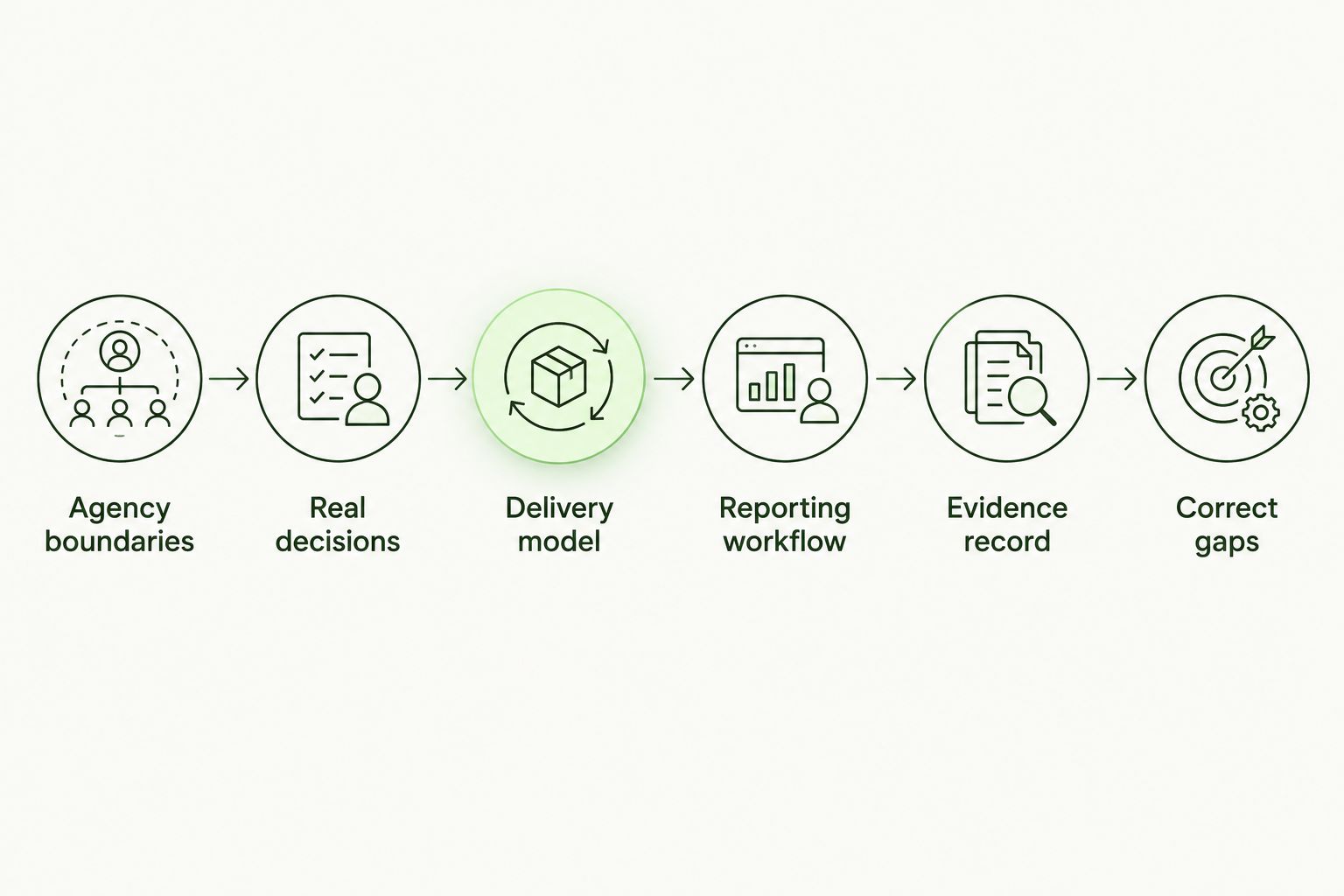
Define ownership and reporting before choosing how to automate administration.
Compare agency training delivery options
Select an option based on who will maintain the program. The distinction is not simply manual versus automated: it is whether the agency or its provider can keep scope, assignments, and evidence current.
| Option | Best for | Practical advantage | Key limitation |
|---|---|---|---|
| Agency-managed materials and register | Establishing scope and piloting an approved process | Direct control over lessons, ownership, and records | Staff must maintain assignments and reconcile records manually |
| Existing agency learning management system | Agencies with an established internal learning process | Keeps training within an existing administration model | Security-specific exercises and evidence requirements need separate evaluation |
| Dedicated agency-managed security training platform | Agencies with staff assigned to security training operations | Provides a dedicated environment for the training program | Agency staff still own configuration, policy mapping, and follow-up |
| Defend Wise through an MSP | MSPs managing white-label training across agency clients | Flat-fee, unlimited-seat model avoids per-seat vendor billing | Procurement fit, accessibility, data handling, and required workflows need verification |
For your 2026 selection, request a demonstration using an agency scenario. Follow a new employee from enrollment to completion and evidence retrieval. Then repeat the exercise for a transfer, departure, and approved exception.
Do not accept a feature checklist as a workflow test. A capability matters only when the responsible administrator can use it in your operating model.
Common mistakes county and state agencies make
Treating the agency as one audience
A general phishing lesson does not cover every decision made by finance, procurement, records, and privileged users. Keep a shared baseline, then add instruction tied to departmental responsibilities. Avoid creating separate courses where the required behavior is actually identical.
Treating completion as compliance
Completion records establish that a recorded assignment was completed. They do not establish that all applicable controls, policy requirements, or specialized training obligations have been satisfied. Map evidence to requirements with the agency owner rather than making a blanket compliance claim.
Leaving contractor ownership unresolved
Contractors can sit between agency administrators and employer-managed training programs. Decide who assigns training, who supplies evidence, and who approves exceptions. Put that decision in the scope register before treating contractor coverage as complete.
Testing employees without testing response
A simulation that stops at employee interaction leaves the reporting workflow unexamined. Verify the receiving team, escalation route, and feedback process. Otherwise, the program rewards recognition while leaving response gaps unresolved.
Buying unlimited seats and ignoring administration
Removing per-seat vendor billing does not remove employee transfers, content approval, evidence requests, or exception handling. Estimate the service work separately. An MSP's bundle needs clear responsibilities even when its underlying training platform has unlimited seats.
FAQ
What is security awareness training for county and state government agencies?
Security awareness training for county and state government agencies teaches employees to recognize threats, follow approved procedures, and report suspicious activity. A useful program combines general awareness, role-specific instruction, reporting practice, and documented records.
Should every government employee receive the same security training?
Employees should share a general awareness baseline, with additional instruction for distinct job responsibilities. Finance, procurement, records, and privileged roles need scenarios that reflect their actual decisions.
Can an MSP manage security awareness training for an agency?
An MSP can administer training when the agency authorizes that service and defines its scope. The agency should retain named owners for policy approval, applicable requirements, exceptions, and escalation decisions.
Is phishing simulation enough for government security awareness training?
Phishing simulation is not a complete security awareness program. Agencies also need approved instruction, relevant role-based coverage, a functioning reporting route, and usable training records.
Does completing security awareness training prove an agency is compliant?
Completing training does not prove agency-wide compliance. The responsible agency owner must determine which requirements apply and whether the retained training evidence addresses them.
What should an agency ask a security training provider to demonstrate?
Ask the provider to demonstrate enrollment, departmental assignment, completion tracking, exception handling, and evidence retrieval. Also review accessibility, data handling, and the division of responsibilities between the agency and provider.
Who is Defend Wise best for in a government training program?
Defend Wise is best for MSPs delivering white-label security awareness training to agency clients under a flat-fee, unlimited-seat model. Agencies still need to verify procurement fit and the platform's suitability for their required workflows.
One last thing
Test evidence retrieval before expanding enrollment. Pick a completed assignment and ask someone other than the administrator to identify its audience, content, status, and unresolved exceptions. That exercise exposes unclear records before they become a review problem.
For a 2026 rollout, use a suggested 90-day sequence rather than treating launch day as completion: establish scope during the first 30 days, pilot reporting and evidence during the next 30 days, and correct gaps during the final 30 days. These are planning targets, not regulatory deadlines. Expand only after the agency owner can understand the evidence without a verbal walkthrough.